Sensory Story Time Lesson Plan Sensory Story Time
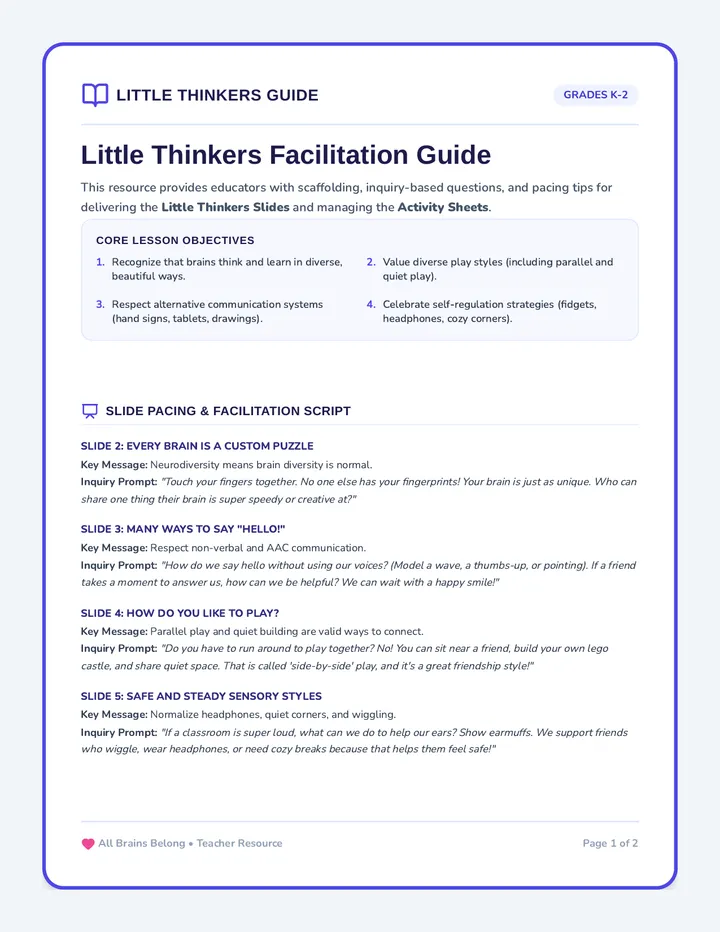
Individualized Tier 3 Support
Duration 15 min
Why This Lesson?
This lesson helps the student develop comprehension, vocabulary, and expressive language by leveraging multiple senses, making learning accessible and engaging for students with vision and auditory needs.
Objective
The student will engage with a short story using auditory and tactile senses, and orally describe key elements.
Prep & Gathering
Time
10 minutes
Review the Sensory Story Script to familiarize yourself with the story and prompts.
Gather small, safe objects (soft cloth, bumpy path texture, smooth stone) that represent story elements.
Prepare Tactile Story Cards with raised textures. Use high contrast colors for residual vision.
Ensure a quiet, well-lit space for the lesson, minimizing distractions.
Materials
• Sensory Objects (stone, twig, etc.)
• Tactile Story Cards
• Sensory Story Script
• Follow-Up Questions Guide
Audience
3rd Grade Student with Vision and Auditory Needs
Approach
Multi-sensory engagement and verbal discussion.
Step-by-Step Delivery
1. Introduction & Sensory Warm-up
3 min
Greet the student. Explain that you will explore a story together using senses other than just eyes and ears.
Have the student gently touch and identify a few of the prepared sensory objects.
Prompts: "What does this feel like?" or "Can you guess what this might represent?"
2. The Sensory Story Experience
8 min
Narrate "The Little Seed's Journey" from the script. Present corresponding objects or Tactile Story Cards at key moments.
Guide the student's hands to touch the objects as you describe them.
Speak clearly and at a moderate pace. Use a slightly amplified voice or assistive device as needed.
Pause frequently to allow the student to process sensory input alongside the narrative.
3. Discussion & Reflection
4 min
Engage the student using the Follow-Up Story Questions .
Ask questions that prompt recall of sensory details (e.g., "Was the root rough or smooth?").
Provide positive reinforcement for all participation and verbal descriptions.
Summarize together, reinforcing the connection between the objects and the story's growth cycle.
Sensory Story Time Presentation Welcome to Sensory Story Time!
Get ready to explore a story with all your senses. We will listen and feel our way through an adventure together.
Teacher Note: Welcome the student and set a calm, focused tone. Explain that today's story will be an adventure for their hands and ears.
Feeling Our Way
What does a soft cloud feel like?
What about a bumpy road?
We'll use special objects to help us understand our story today.
Teacher Note: Introduce the idea of feeling different textures. Guide the student to gently touch a few pre-selected objects. Ask what they feel like.
Today's Selection
"The Little Seed's Journey"
Listen closely to the story of a brave little seed and how it grows!
Teacher Note: Introduce the story title. Explain that you will narrate the story, and they will feel the story elements.
The Adventure Begins!
As I tell the story, you will touch and feel the characters and places.
Listen
Touch
Imagine
Teacher Note: Narrate the story, presenting tactile cards or objects as described in the Sensory Story Time Script. Reinforce sensory vocabulary.
Let's Talk About Our Story
What did you hear?
What did you feel?
What happened in the story?
Teacher Note: After the story, prompt discussion using the Follow-Up Story Questions. Encourage the student to use their own words to describe their experience.
Great Job, Story Explorer!
You did an amazing job exploring the story with your senses. We'll do more sensory stories soon!
Sensory Exploration Complete
Teacher Note: Conclude by praising the student's participation and engagement. Reiterate the fun of sensory exploration.
Sensory Story Time Script Teacher Resource
The Little Seed's Journey Script
Guided Multi-Sensory Narration
Teacher Note: Read slowly and clearly. Pause after each sensory interaction to allow the student to explore the texture or temperature. Use the bolded words to emphasize the sensory quality you are describing.
Introduction
"Hello, my curious friend! Today, we're going on an amazing adventure, not just with our ears, but with our hands too! Are you ready to discover the journey of a tiny seed? Let's begin."
Narration
Action
"Once, there was a tiny, smooth, round seed ."
Present a small, smooth stone or a smooth, round bead for the student to hold and feel.
Narration
"It lay quietly deep in the dark, soft earth ."
Present a handful of soft, slightly damp soil in a bowl, or a piece of very soft, dark fabric .
Narration
"The little seed felt the cool, wet rain patter down, nourishing it."
Gently spritz a few drops of water onto the student's hand, or have them feel a cool, damp cloth .
Narration
"Then, it felt the warm, bright sun shining down, waking it up."
Place a warm (not hot!) heat pack or a piece of warm fabric in the student's hand.
Narration
"Slowly, slowly, the seed began to stretch and grow ! It sent a tiny, rough root down into the earth."
Present a short piece of rough twine or a twig for the student to feel.
Narration
"And then, a small, tender sprout pushed its way up towards the light."
Present a soft, pliable green leaf or a velvety fabric sprout shape .
Narration
"The sprout grew taller and stronger, reaching its smooth stem toward the sky."
Present a smooth, firm stick or a pipe cleaner .
Narration
"Finally, a beautiful, delicate flower bloomed! Its soft petals opened wide to the world."
Present a (if safe/allergy-free) or a .
Tactile Story Cards Guide Preparation Guide
Tactile Story Cards
Building The Little Seed's Journey Experience
Overview
These tactile cards help students with vision needs connect with story elements through touch. They provide a consistent tactile representation for the story, aiding comprehension and memory.
Base Materials
Cardstock or Cardboard (4x6")
High-Contrast Markers
Strong glue or hot glue
Construction Checklist
1
Seed Card
Glue a small, very smooth stone or round bead . Emphasize the round shape.
2
Earth Card
Glue a piece of soft, dark fabric (velvet or felt) to represent soft earth.
3
Rain Card
Use a damp sponge or textured bubble wrap . Can be dampened before use.
4
Sun Card
Glue warm-feeling fabric (flannel) or crinkled metallic paper for subtle texture.
5
Root Card
Glue a short piece of rough twine or a small naturally rough twig .
6
Sprout Card
Cut a simple leaf from soft green felt or velvet and glue to the card.
7
Stem Card
Glue a smooth, thin stick or pipe cleaner vertically on the card.
8
Flower Card
Create a multi-layered flower using soft fabric petals (velvet or silk).
How to Use
1
Present each card as the corresponding item is mentioned in the Sensory Story Script .
2
Guide the student's hand to explore the texture and shape of each card individually.
3
Encourage the student to use descriptive words (rough, smooth, warm, soft) during the experience.
Follow-Up Story Questions Guide Story Explorer Reflection
The Little Seed's Journey: Discussion & Review
Name: __________________________
Date: ___________________________
Teacher Note: These questions are designed to engage the student in recalling and reflecting on the sensory experience. Encourage verbal responses and provide gentle tactile prompts using the story cards or objects as needed. You may scribe the student's responses below.
1
Before the story began, what did the little seed feel like in your hands?
Prompt: Guide to the smooth stone/bead if needed.
2
When the seed was in the earth, what did the earth feel like?
Prompt: Guide to the soft fabric/soil if needed.
3
The story talked about rain and sun. How did the rain feel on your hand? And how about the sun?
Prompt: Guide to cool dampness and warmth if needed.
4
When the root grew, what did that feel like? And the sprout?
Prompt: Guide to the rough twine and soft leaf if needed.
5
What was your favorite part of the little seed's journey? Why?
6
If you could give the little seed some advice, what would you tell it?