A comprehensive system to help students master desk and locker organization through a 'Mission Control' theme, including visual checklists and instructional slides.
A test-preparation strategy lesson focused on helping students differentiate between 'Right There' and 'Thinking' questions using a detective-themed approach.
A dedicated hub for sequence-level evaluations, including the Placement Mission (pre-assessment) and the Final Graduation (post-assessment).
A 5-day handwriting practice program focused on animal kingdom facts and vocabulary, designed to improve fine motor skills through short, daily exercises.
The core framework materials including the enhanced scope and sequence table, instructional slides for WIDA implementation, and a one-page summary chart.
A comprehensive alignment and planning resource that maps WIDA Narrate standards to Unit 1 Part 1 (My Family), providing targeted extensions for proficiency levels 2-4.
A week-long focus on multi-digit subtraction with regrouping, focusing on 'trading' tens for ones and hundreds for tens. Materials utilize base ten block imagery and expanded form to make the abstract process of borrowing more concrete and manageable.
A week-long focus on multi-digit addition with regrouping, emphasizing the connection between base ten blocks and the expanded form method. Students will practice 'making a ten' and 'making a hundred' through guided visualization and structured practice.
A detailed instructional alignment of Grade 1 curriculum units 1-4 to WIDA standards, providing teachers with clear language functions and instructional expectations.
Studies the stages of growth in animals, using WIDA's Narrate (life stories) and Explain (scientific stages) functions.
Analyzes how communities access needs and wants, focusing on the WIDA functions of Argue (persuasive needs) and Explain (the journey of goods).
Investigates the characteristics of living things, utilizing WIDA's Inform function to define life and Explain function to describe biological processes.
Explores family structures, roles, and traditions while focusing on the WIDA functions of Narrate (family stories) and Inform (identifying family members).
Week 5 concludes the series with the consonant-le syllable type. Students learn the rule of counting back three letters from the end of the word to find the syllable break.
Week 4 explores r-controlled syllables (ar, er, ir, or, ur). Students identify how the 'r' changes the vowel sound and practice decoding multi-syllabic words with these patterns.
Week 3 focuses on the Magic E (VCE) syllable type in two-syllable words. Students learn to spot the silent 'e' and apply long vowel sounds across syllable boundaries.
Week 2 introduces open syllables (V/CV pattern). Students practice dividing after the first vowel to create a long vowel sound in the first syllable.
Week 1 focuses on closed syllables (VC/CV and VCC/V patterns). Students learn to identify two consonants between two vowels and divide the word accordingly to maintain short vowel sounds.
A series of hands-on, unplugged activities designed to teach Python data types and variables through tactile sorting, logic puzzles, and matching games. Focused on accessibility and clarity for students with diverse learning needs.
Introduces consonant blends, digraphs, and the CVCe (silent e) pattern using professional and household management themes to maintain adult engagement.
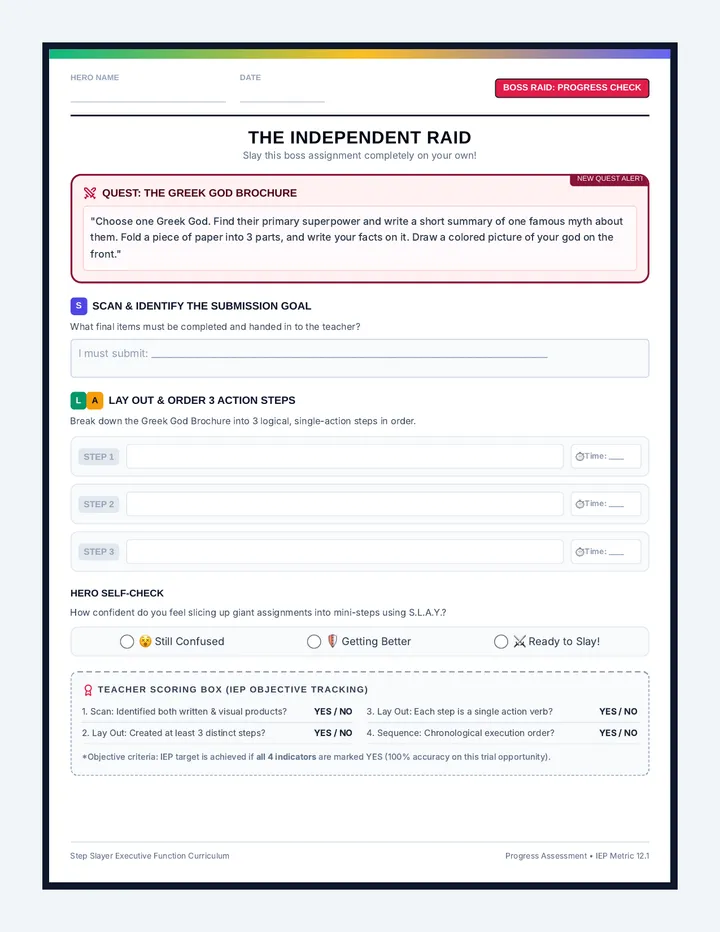
A comprehensive set of tools and strategies designed for a 7th-grade student to improve organizational skills, sustain attention, and boost reading comprehension.
A comprehensive lesson on the events of Holy Week designed for early elementary students with dyslexia, focusing on sequencing and retelling skills through visual aids and hands-on activities.
A reading companion for Roald Dahl's Matilda, designed for 5th-grade resource room students to track plot, character traits, and vocabulary in two-chapter increments.
A lesson focused on teaching inclusive strategies and providing visual/tactile tools for ordering numbers 1-10 in a preschool setting.
The mystery concludes as students use cause-and-effect inferences to understand the final vocabulary words and solve the clock's puzzle.