Function Foundations Review Worksheet
Algebra 1 • Unit 3 Review
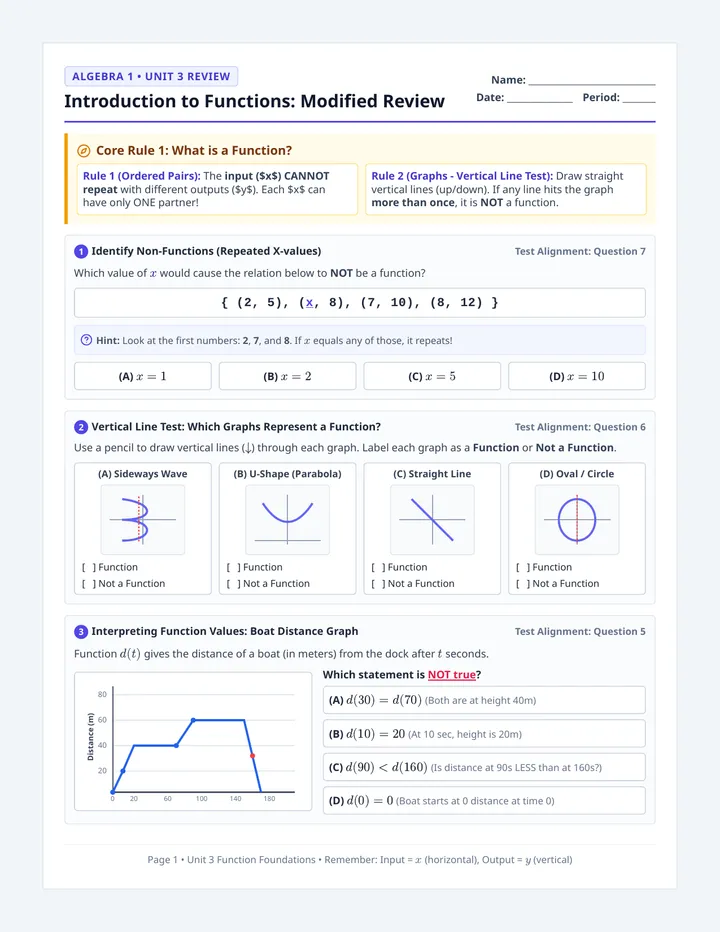
Introduction to Functions: Modified Review
Name: ___________________________
Date: ______________ Period: _______
Core Rule 1: What is a Function?
Rule 1 (Ordered Pairs): The input ($x$) CANNOT repeat with different outputs ($y$). Each $x$ can have only ONE partner!
Rule 2 (Graphs - Vertical Line Test): Draw straight vertical lines (up/down). If any line hits the graph more than once, it is NOT a function.
1 Identify Non-Functions (Repeated X-values) Test Alignment: Question 7
Which value of \(x\) would cause the relation below to NOT be a function?
{ (2, 5), (x, 8), (7, 10), (8, 12) }
Hint: Look at the first numbers: 2, 7, and 8. If \(x\) equals any of those, it repeats!
(A) \(x = 1\)
(B) \(x = 2\)
(C) \(x = 5\)
(D) \(x = 10\)
2 Vertical Line Test: Which Graphs Represent a Function? Test Alignment: Question 6
Use a pencil to draw vertical lines (\(\downarrow\)) through each graph. Label each graph as a Function or Not a Function.
(A) Sideways Wave
[ ] Function
[ ] Not a Function
(B) U-Shape (Parabola)
[ ] Function
[ ] Not a Function
(C) Straight Line
[ ] Function
[ ] Not a Function
(D) Oval / Circle
[ ] Function
[ ] Not a Function
3 Interpreting Function Values: Boat Distance Graph Test Alignment: Question 5
Function \(d(t)\) gives the distance of a boat (in meters) from the dock after \(t\) seconds.
20 40 60 80 Distance (m) 0 20 60 100 140 180 Time (seconds)
Which statement is NOT true?
(A) \(d(30) = d(70)\) (Both are at height 40m)
(B) \(d(10) = 20\) (At 10 sec, height is 20m)
(C) \(d(90) < d(160)\) (Is distance at 90s LESS than at 160s?)
(D) \(d(0) = 0\) (Boat starts at 0 distance at time 0)
Page 1 • Unit 3 Function Foundations • Remember: Input = \(x\) (horizontal), Output = \(y\) (vertical)
Part 2 • Word Problems & Equations
Real-Life Situations & Solving for \(x\)
Name: ___________________________
Notation Rule: If the number is inside: \(f(\mathbf{4})\) \(\rightarrow\) plug in 4 for \(x\). If the equation says \(f(x) = \mathbf{10}\) \(\rightarrow\) set the whole formula equal to 10 and solve for \(x\)!
4 Solve for \(x\) When Output is Given Test Alignment: Question 11
Given \(f(x) = 2x - 20\), find \(x\) when \(f(x) = 10\).
Step 1: Set equation equal to 10
\(2x - 20 = 10\)
Add 20 to both sides:
Step 2: Divide by 2 to isolate \(x\)
\(2x = \text{______}\)
Divide by 2:
(A) \(x = 0\)
(B) \(x = 15\)
(C) \(x = -5\)
(D) No solution
5 Real-Life Math: What Do the Numbers in the Formula Mean? Test Alignment: Question 8
A mechanic calculates the total repair bill using this formula:
\(f(h)\)
Total Bill ($)
=
125
Starting Flat Fee (0 hours)
20\(h\)
$20 for each hour (\(h\))
Based on the formula, what does the number 125 mean?
(A) A starting flat fee of $125 for 0 hours worked (the base charge).
(B) A charge of $125 for each individual tire change.
(C) The total final price no matter how many hours she works.
(D) An hourly rate of $125 per hour worked.
6 Real-Life Domain: What Kinds of Numbers Make Sense? Test Alignment: Question 10
A grocery store sells boxes of bananas. The cost \(c(b)\) depends on \(b\) (the number of bananas).
Plain English: "Domain" means: What type of numbers can you actually count bananas with?
(A) Integers
(includes negatives like \(-4\))
(B) Real numbers
(includes decimals like \(2.71\dots\))
(C) Whole numbers
(\(0, 1, 2, 3\dots\) whole items)
(D) Fractions
(like \(\frac{1}{3}\) or \(\frac{7}{8}\))
7 Open Ended Practice: Function Sentences (Rain Gauge) Test Alignment: Question 13
Function \(R(t)\) gives rain (in millimeters) after \(t\) hours: \(R(\text{hours}) = \text{rain in mm}\)
Part A: What does \(R(0.5) = 14\) mean in words?
"After hours, the rain measured mm."
Part B: Write in function notation:
"Six hours after it started, the rain was 37 mm."
\(R(\) _____ \() =\) _____
Page 2 • Unit 3 Function Foundations • Tip: In formulas, the number alone = starting amount, number with variable = rate
Part 3 • Key Graph Features
Intervals, Domain & Range
Name: ___________________________
Increasing / Decreasing
Read from LEFT to RIGHT:
• Uphill (\(\nearrow\)) = Increasing
• Downhill (\(\searrow\)) = Decreasing
Positive / Negative
Think of x-axis as Sea Level (0):
• Above x-axis = Positive (\(y > 0\))
• Below x-axis = Negative (\(y < 0\))
Domain & Range
• Domain (\(x\)): Far LEFT to far RIGHT
• Range (\(y\)): Lowest BOTTOM to highest TOP
8 Test Questions 1, 2, 3, and 4 (Refer to Graph Below) Core Exam Skill
-1 0 1 2 3 -2 Sea Level (0)
Quick Graph Map:
• Start point: solid dot at \(x = -1\)
• Hill peak: at \((0, 0)\)
• Valley bottom: at \(y = -2\)
• Crosses above zero at: \(x = 3\)
Q1: Where is \(f(x)\) POSITIVE? (Above 0)
(A) \((0, \infty)\)
(B) \([1, \infty)\)
(C) \((-1, 3)\)
(D) \((3, \infty)\)
Q2: Where is \(f(x)\) INCREASING? (Uphill \(\nearrow\))
(A) \((-1, 0) \cup (2, \infty)\)
(B) \((-1, 1) \cup (1, \infty)\)
(C) \((3, \infty)\)
(D) \((1, \infty)\)
Q3: What is the DOMAIN? (Left to Right \(x\))
(A) \((-\infty, \infty)\)
(B) \([-1, 3]\)
(C) \([-1, \infty)\)
(D) \([-2, \infty)\)
Q4: What is the RANGE? (Bottom to Top \(y\))
(A) \((-\infty, \infty)\)
(B) \([-1, 3]\)
(C) \([-1, \infty)\)
(D) \([-2, \infty)\)
9 Test Question 14: Use the Graph Below to Find the Intervals Exact Visual Test Match
-10 -5 5 10 10 5 -5 -10 Peak: (-2, 4) Valley: (2, -4)
Part A: Increasing (\(\nearrow\) uphill):
Rises before \(x=-2\) and after \(x=2\):
\((\text{____}, -2) \cup (2, \text{____})\)
Part B: Decreasing (\(\searrow\) downhill):
Falls between peak and valley:
\((\text{____}, \text{____})\)
Part C: Positive (above x-axis):
Above zero line:
\((-4, 0) \cup (5, \text{____})\)
Part D: Negative (below x-axis):
Below zero line:
\((-\infty, -4) \cup (\text{____}, 5)\)
Page 3 • Unit 3 Function Foundations • Great work completing your test review!
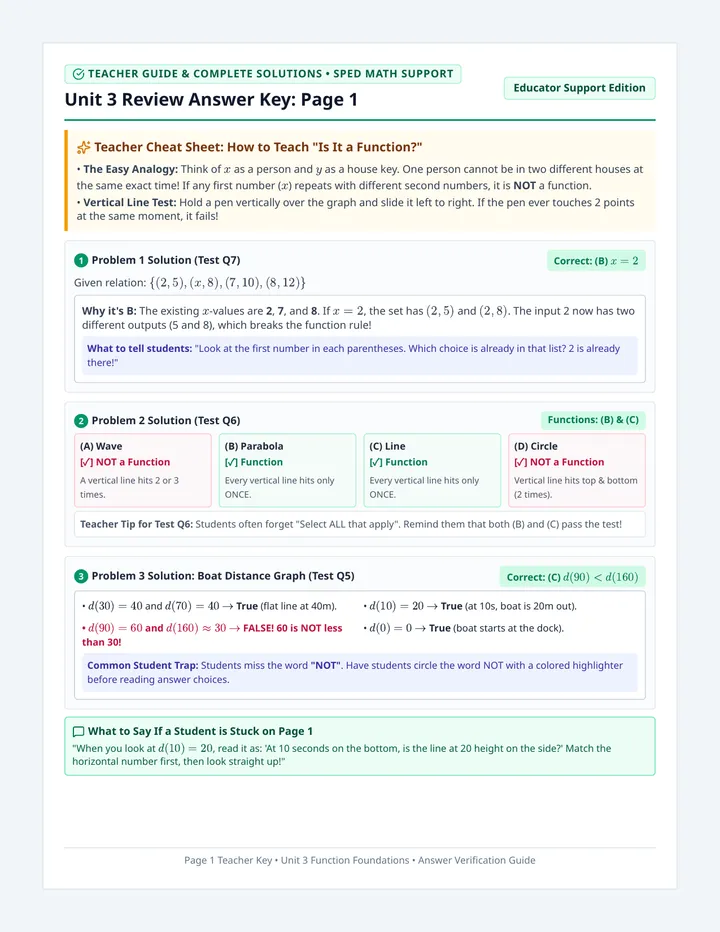
Function Foundations Teacher Key
Teacher Guide & Complete Solutions • SPED Math Support
Unit 3 Review Answer Key: Page 1
Educator Support Edition
Teacher Cheat Sheet: How to Teach "Is It a Function?"
• The Easy Analogy: Think of \(x\) as a person and \(y\) as a house key. One person cannot be in two different houses at the same exact time! If any first number (\(x\)) repeats with different second numbers, it is NOT a function.
• Vertical Line Test: Hold a pen vertically over the graph and slide it left to right. If the pen ever touches 2 points at the same moment, it fails!
1 Problem 1 Solution (Test Q7) Correct: (B) \(x = 2\)
Given relation: \(\{ (2, 5), (x, 8), (7, 10), (8, 12) \}\)
Why it's B: The existing \(x\)-values are 2, 7, and 8. If \(x = 2\), the set has \((2, 5)\) and \((2, 8)\). The input 2 now has two different outputs (5 and 8), which breaks the function rule!
What to tell students: "Look at the first number in each parentheses. Which choice is already in that list? 2 is already there!"
2 Problem 2 Solution (Test Q6) Functions: (B) & (C)
(A) Wave
[✓] NOT a Function
A vertical line hits 2 or 3 times.
(B) Parabola
[✓] Function
Every vertical line hits only ONCE.
(C) Line
[✓] Function
Every vertical line hits only ONCE.
(D) Circle
[✓] NOT a Function
Vertical line hits top & bottom (2 times).
Teacher Tip for Test Q6: Students often forget "Select ALL that apply". Remind them that both (B) and (C) pass the test!
3 Problem 3 Solution: Boat Distance Graph (Test Q5) Correct: (C) \(d(90) < d(160)\)
• \(d(30) = 40\) and \(d(70) = 40\) \(\rightarrow\) True (flat line at 40m).
• \(d(10) = 20\) \(\rightarrow\) True (at 10s, boat is 20m out).
• \(d(90) = 60\) and \(d(160) \approx 30\) \(\rightarrow\) FALSE! 60 is NOT less than 30!
• \(d(0) = 0\) \(\rightarrow\) True (boat starts at the dock).
Common Student Trap: Students miss the word "NOT". Have students circle the word NOT with a colored highlighter before reading answer choices.
What to Say If a Student is Stuck on Page 1
"When you look at \(d(10) = 20\), read it as: 'At 10 seconds on the bottom, is the line at 20 height on the side?' Match the horizontal number first, then look straight up!"
Page 1 Teacher Key • Unit 3 Function Foundations • Answer Verification Guide
Teacher Guide & Complete Solutions
Unit 3 Review Answer Key: Page 2
Educator Support Edition
4 Problem 4 Solution: Solving for \(x\) (Test Q11) Correct: (B) \(x = 15\)
Given \(f(x) = 2x - 20\), find \(x\) when \(f(x) = 10\).
Step 1: Set equation: \(2x - 20 = 10\)
Step 2: Add 20 to both sides: \(2x = 10 + 20 \implies 2x = 30\)
Step 3: Divide by 2: \(x = \frac{30}{2} = 15\)
Math Trap Alert: Weak students often plug 10 in for \(x\) (giving \(2(10) - 20 = 0\), which is choice A!). Explain: "\(f(x) = 10\) means the total answer is 10, so replace the whole \(f(x)\) box with 10!"
5 Problem 5 Solution: Meaning of Numbers in \(f(h) = 125 + 20h\) (Test Q8) Correct: (A)
In \(f(h) = 125 + 20h\), what is 125?
Correct Answer: (A) She charges a starting fee of $125 for 0 hours worked.
• Plain English Explanation: The number standing completely by itself without a letter (125) is always the starting flat fee (the base price before any work begins, when hours = 0).
• What is 20? The number touching the letter (\(20h\)) is the hourly rate ($20 for each hour worked).
• Why tire choices are wrong: The test question mentions "tires" to distract students, but the problem never mentions tires at all!
6 Problem 6 Solution: Banana Domain (Test Q10) Correct: (C) Whole Numbers
Why it's Whole Numbers: You count individual bananas using whole numbers: \(0, 1, 2, 3, \dots\) You cannot buy \(-4\) bananas (eliminates Integers), and you don't buy \(\sqrt{2}\) or \(3.14\) bananas (eliminates Real numbers).
Memory Anchor: "Whole numbers are counting numbers plus zero (like whole bananas, no broken pieces or negative bananas!)."
7 Problem 7 Solution: Rain Gauge Notation (Test Q13) Full Points Guide
Part A (\(R(0.5) = 14\)): "After 0.5 hours (or 30 minutes), the amount of rain was 14 mm."
Part B (Function form): \(R(6) = 37\) (The input 6 goes inside parentheses; the output 37 goes on the right).
Quick Teacher Notes for Remaining Test Questions (Q9 & Q12):
• Test Q9: \(g(x) = 2x + c\). If \(g(4) = 5\), then \(2(4) + c = 5 \implies 8 + c = 5 \implies c = -3\). Then \(g(-2) = 2(-2) - 3 = -4 - 3 = \mathbf{-7}\) (Choice A).
• Test Q12: Solve \(3pn - 12 = m\) for \(n\). Step 1: Add 12 \(\implies 3pn = m + 12\). Step 2: Divide by \(3p \implies n = \mathbf{\frac{m+12}{3p}}\) (Choice B).
Page 2 Teacher Key • Unit 3 Function Foundations • Answer Verification Guide
Teacher Guide & Complete Solutions
Unit 3 Review Answer Key: Page 3
Educator Support Edition
Teacher Cheat Sheet: Parentheses vs. Square Brackets
• Parentheses \(( \dots )\) = DOES NOT INCLUDE (open circle, infinity \(\infty\), or when asking positive/negative because zero is neither positive nor negative!).
• Brackets \([ \dots ]\) = INCLUDES the point (solid filled dot). Used for Domain and Range endpoints!
8 Solutions for Test Questions 1, 2, 3, and 4 Core Graph Questions
Q1: Positive Interval Answer: (D) \((3, \infty)\)
Why: "Positive" means strictly ABOVE the x-axis (\(y > 0\)). Between \(-1\) and \(3\), the graph is touching or below zero. Only after \(x = 3\) does it stay above the axis forever!
Q2: Increasing Interval Answer: (A)
Answer: (A) \((-1, 0) \cup (2, \infty)\)
Why: Walking left-to-right, you go UPHILL from \(x = -1\) to \(0\), then downhill from \(0\) to \(2\), then UPHILL again from \(x = 2\) to \(\infty\).
Q3: Domain (\(x\)-values) Answer: (C) \([-1, \infty)\)
Why: The furthest left point has a solid dot at \(x = -1\) (bracket \([-1\)). The right side has an arrow going right forever (\(\infty\)).
Q4: Range (\(y\)-values) Answer: (D) \([-2, \infty)\)
Why: The LOWEST bottom point dips down to \(y = -2\) (bracket \([-2\)). The top goes up forever to \(+\infty\).
9 Test Question 14 Open Response Solutions (Visual Graph Match) Exact Test Match
Part A: Increasing Interval (\(\nearrow\))
Answer: \((-\infty, -2) \cup (2, \infty)\)
Uphill before peak \(x=-2\) and uphill after valley \(x=2\).
Part B: Decreasing Interval (\(\searrow\))
Answer: \((-2, 2)\)
Downhill between peak \(x=-2\) and valley \(x=2\).
Part C: Positive Interval (Above 0)
Answer: \((-4, 0) \cup (5, \infty)\)
Above x-axis between \(-4\) and \(0\), and again after \(5\).
Part D: Negative Interval (Below 0)
Answer: \((-\infty, -4) \cup (0, 5)\)
Below x-axis before \(-4\), and between \(0\) and \(5\).
The #1 Mistake SPED Students Make on Graphs (And How to Fix It)
Students often write the \(y\)-values when asked for intervals (e.g., writing \((-4, 4)\) because the graph goes from height \(-4\) to height \(4\)).
Teacher Script: "Intervals ALWAYS describe WHERE on the horizontal sidewalk (\(x\)-axis) things happen. Cover the vertical axis with a sticky note or ruler so students only look at the numbers on the bottom line!"
Test Day Encouragement
You've got this! By breaking the test into 3 chunked pages and using visual analogies (person & key, roller coaster, sea level), your students can access every single standard tested on this exam without feeling overwhelmed.
Page 3 Teacher Key • Unit 3 Function Foundations • Complete Educational Guide