Personal Toolkit Guide Plan Personal Toolkit Guide
Executive Function Intervention: Task Initiation
Duration 60 MIN
Audience
10th Grade Student
Tier Level
Tier 3 (Individual)
Format
Interactive Coaching
The "Why"
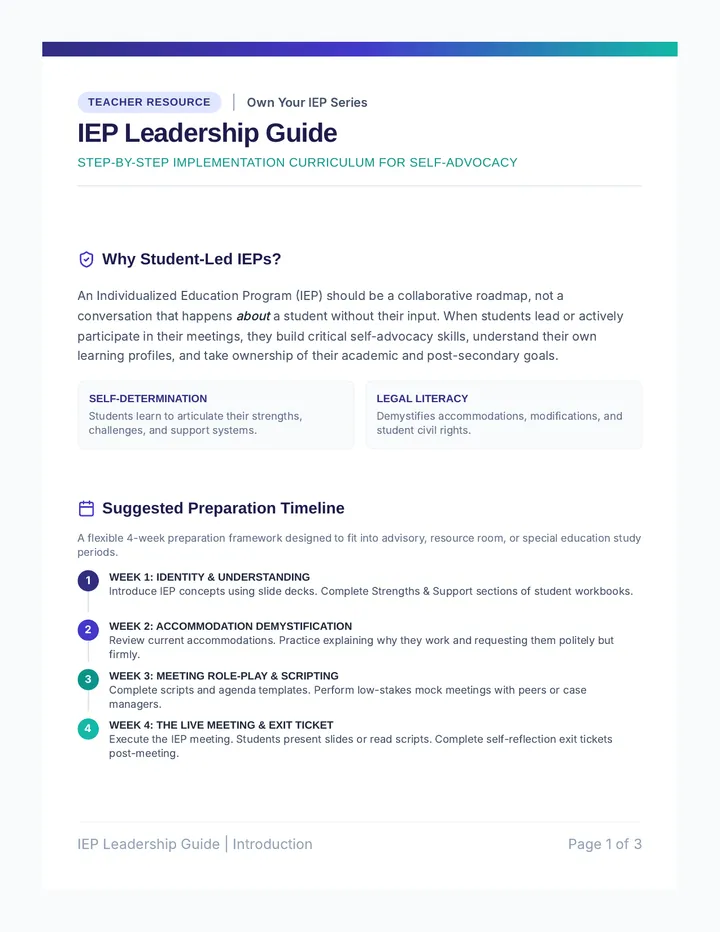
Understanding and addressing task initiation is crucial for academic success and life skills. By the 10th grade, academic demands increase significantly, and the "starting block" often becomes the primary hurdle. This lesson empowers students to take control of their learning by building a custom toolkit of effective strategies, fostering independence and reducing the anxiety associated with procrastination.
Preparation
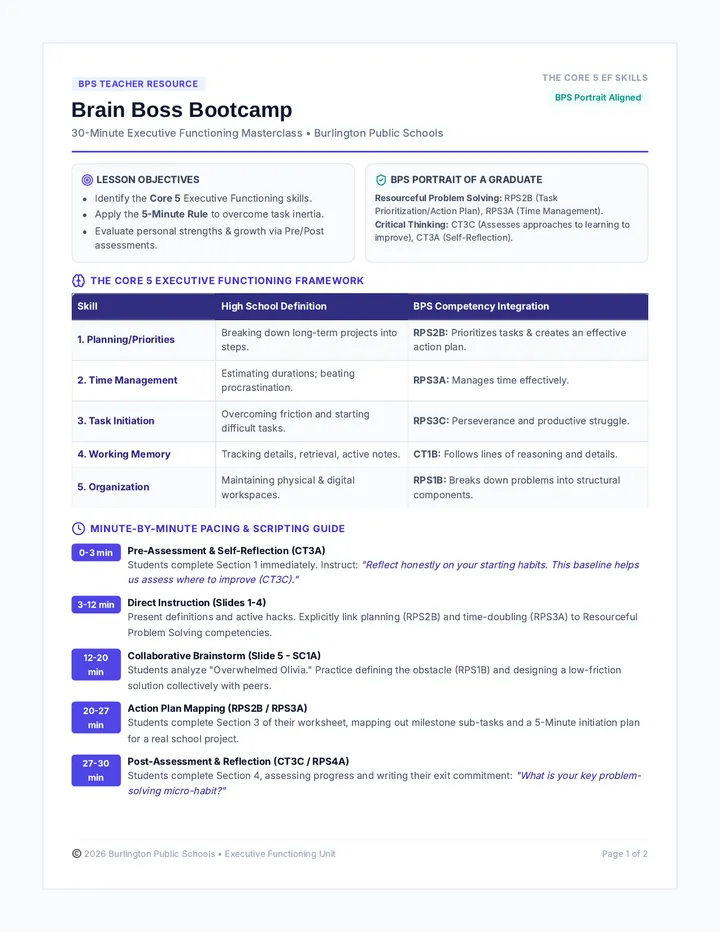
Review the Building Brain Strengths Slides to familiarize yourself with the technical terms.
Read through the Initiation Reflection Log and Task Start-Up Menu .
Ensure digital materials are accessible and print student worksheets.
Materials Needed
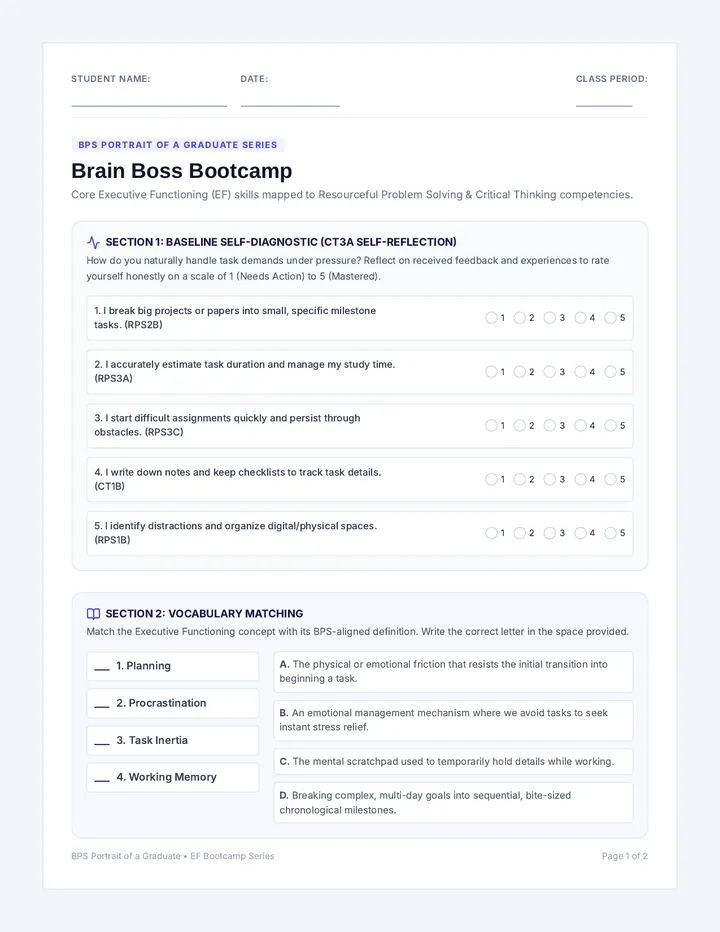
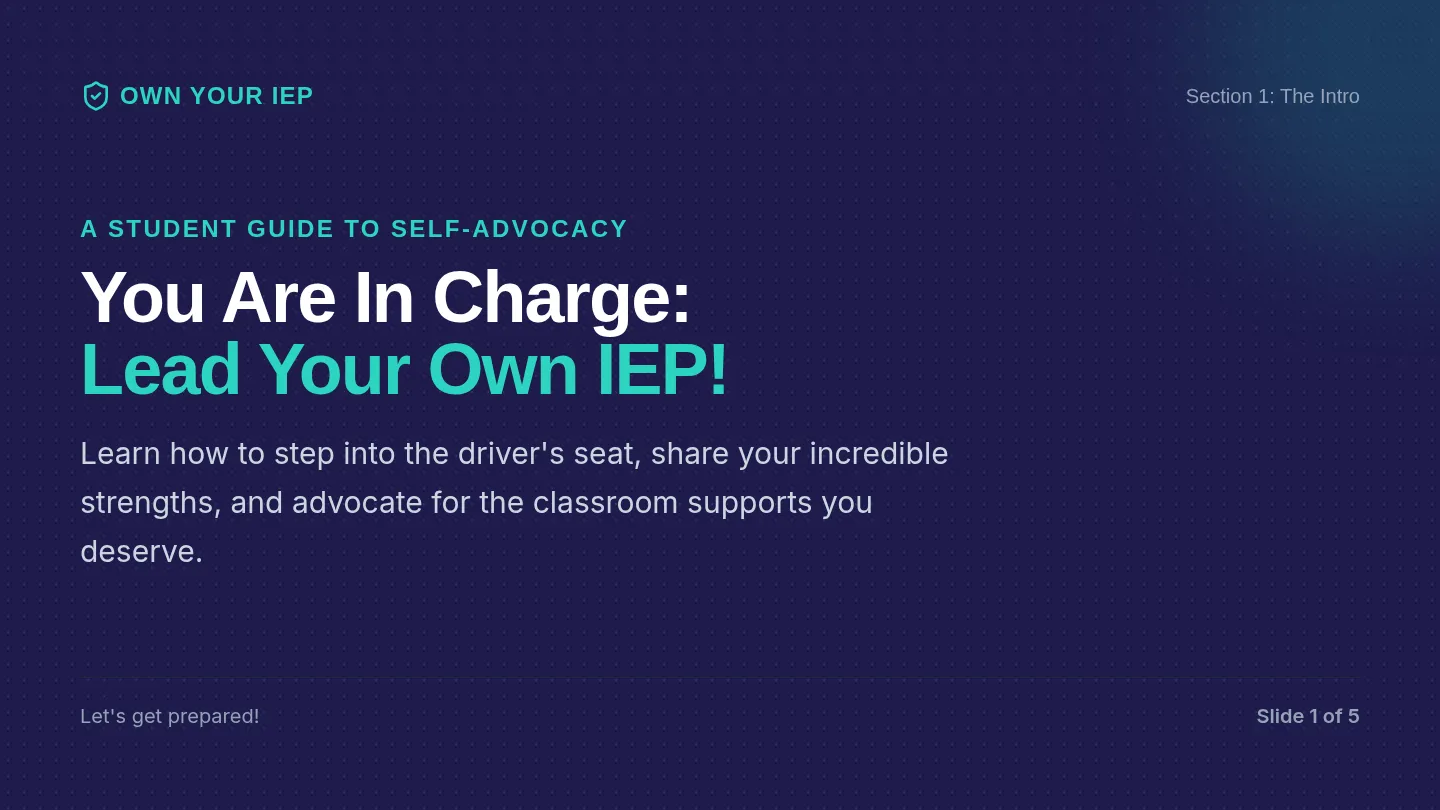
Building Brain Strengths Slides
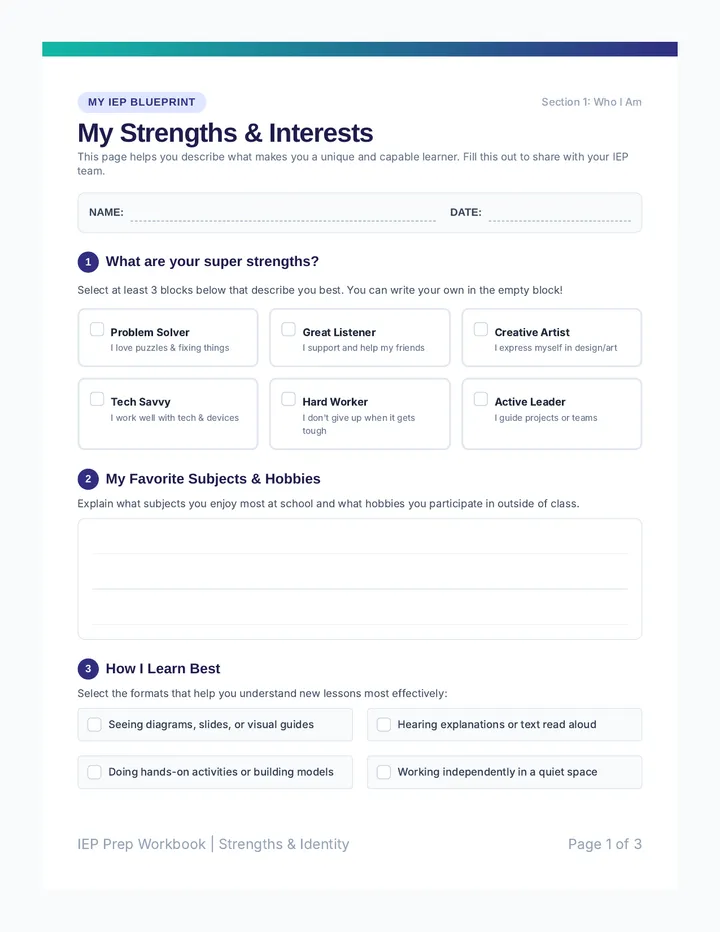
Initiation Reflection Log (Journal)
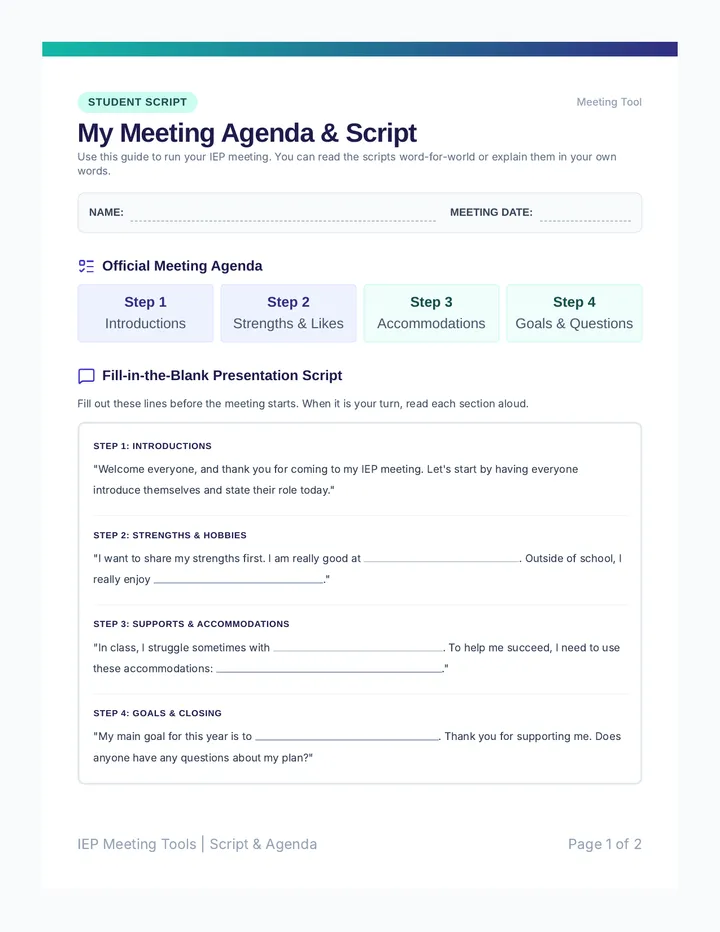
Task Start-Up Menu (Project)
Digital Timer (optional)
Learning Objective
"The student will identify personal task initiation challenges and develop a personalized set of strategies to overcome them, fostering greater independence and self-management."
Instructional Flow
Stage & Time Teacher Actions & Student Engagement Warm-Up
10 Minutes
|
Intro: Open with an engaging hook: "What's one task you've put off recently, and what was the 'feeling' that made you wait?"
Slide Focus: Use the first few slides to introduce Executive Function as the brain's "Command Center." Explain that today is about personal troubleshooting, not criticizing procrastination.
|
|
Exploration
15 Minutes
|
Deep Dive: Move through the slides detailing Barriers (Overwhelm, Clarity, Perfectionism). Ask which "barrier profile" fits them best.
Reflection: Introduce the Reflection Log . Guide the student through Reflection 1, helping them put words to their specific struggles.
|
|
Strategy Design
15 Minutes
|
Brainstorm: Discuss the 4 strategies from the slides (5-Minute Rule, Breaking Down, etc.). Prompt: "Which of these feels 'doable' even when you're at zero energy?"
Logging: Have the student record initial ideas in Reflection 2 of their journal.
|
|
Toolkit Build
15 Minutes
|
Construction: Transition to the Task Start-Up Menu . This is their permanent reference. Guide them to select 3-5 "Heavy Hitters"—strategies they commit to trying first.
Personalization: Encourage them to rename strategies in their own voice (e.g., "The 5-Min Sprint").
|
|
Closing
5 Minutes
|
Commitment: Discuss how they will use the toolkit in the next 48 hours. Reiterate that this is a living document —if a strategy fails, it's just data, not a failure.
|
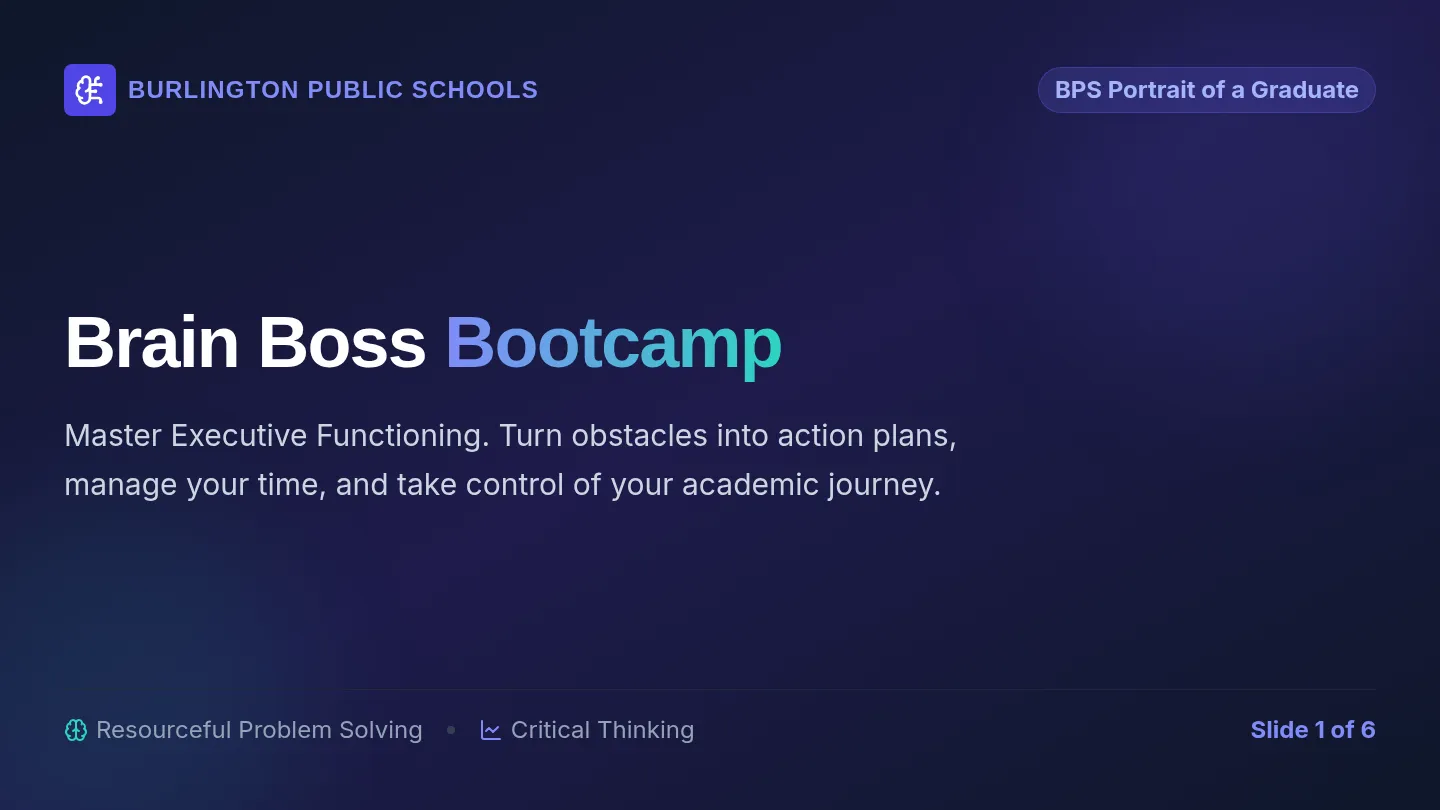
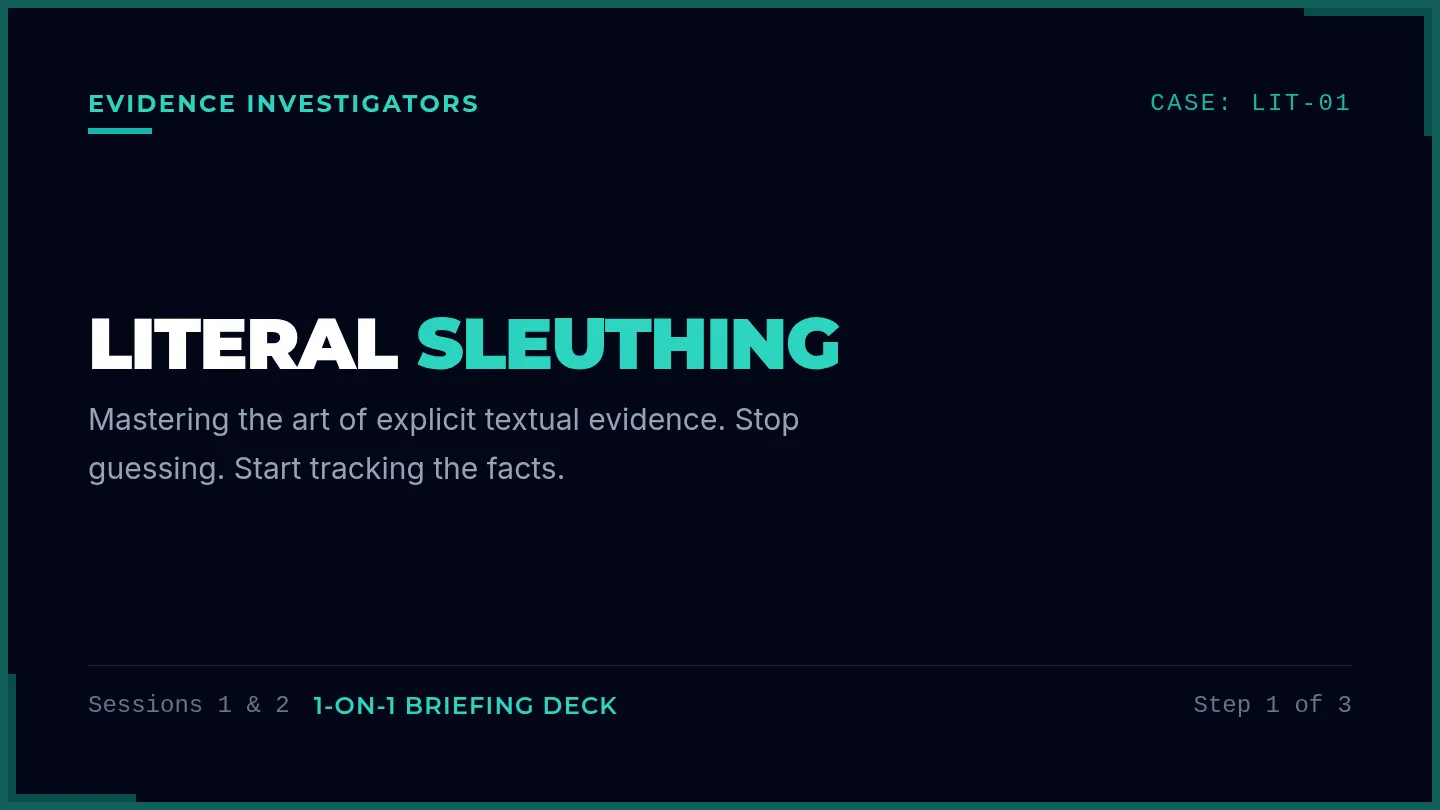
Brain Strengths Slides Tier 3 Intervention
Building Your
Brain's Strengths
Let's build your personal toolkit for
getting started on tasks.
Teacher Note
Welcome the student. Warm-up question: "What's one task you've put off recently, and why?" Transition into Brain Managers (EF).
What are Executive Functions?
Think of your brain like a Control Center or a high-stakes flight deck.
Executive Functions are the "Manager Skills" your brain uses to navigate daily life.
Plan & Organize
Stay Focused
Manage Time
START TASKS!
Teacher Note: Emphasize that these are skills we can improve with the right tools—just like an athlete trains specific muscles.
The Starting Line
Task Initiation is the ability to begin a task without procrastination. It's the hardest part!
Common Barriers
It feels too big (Overwhelm)
Where do I start? (No Clarity)
Fear of failure (Perfectionism)
It's boring! (Lack of Interest)
"Procrastination isn't about being lazy. It's often about managing feelings like stress or boredom."
Action: Ask the student which of these barriers they recognize most.
Strategy 1: Break It Down
Modular Approach
When a task feels like a mountain, build stairs.
The Rule:
"A task is only 'too big' because you're looking at the whole mountain. Look only at the next 2 feet."
Example: The Essay
?
Write 5-page Essay
Open blank document
2
Type the title
3
Write ONE sentence
Strategy 2: The 5-Minute Rule
BOOST
The brain loves low stakes.
Tell yourself: "I will work on this for exactly 5 minutes. If I want to stop after that, I can."
Why it works:
It lowers the "Activation Energy" needed to move.
Once you start, momentum takes over.
The "Oh, this isn't so bad" realization happens.
Strategy 3: The Launchpad
Distraction Lockdown
Initiation Reflection Log Journal Initiation Reflection Log
Personal Executive Function Journal • Grade 10
Student: _______________________
Date: __________________________
This journal is your space to think about tasks, what makes them hard to start, and what helps you get going. Be honest with yourself—this is your toolkit for success.
1 My Starting Struggles
Think about a task you've had trouble starting recently. It could be homework, a project, a chore, or even something you wanted to do but didn't.
What was the task?
Why was it hard to start? (Check and explain)
It felt too big/overwhelming.
Explain why:
I didn't know where to begin (Lack of clarity).
Explain why:
I was worried it wouldn't be perfect.
Explain why:
It seemed boring or uninteresting.
Explain why:
2 Brainstormed Strategies
From the strategies we discussed (Break it Down, 5-Minute Rule, Eliminate Distractions, Rewards), or your own ideas, which ones might help with the task above?
Strategy Name
How would you use it specifically for your task?
Strategy Name
How would you use it specifically for your task?
Strategy Name
How would you use it specifically for your task?
3 What's Next?
What is one small step you can take right now or today to practice task initiation?
Task Start-Up Menu Project Task Start-Up Menu
Personalized Executive Toolkit
System Design
This is your go-to menu of strategies for when you feel stuck. It’s a living document—add, change, or remove items as you find what works for your unique brain.
STEP 01: SELECTION
Select 3-5 strategies from the toolkit that you find most effective. Explain your choices below.
Strategy 01
Selected Tool:
Why I chose it:
Strategy 02
Selected Tool:
Why I chose it:
Strategy 03
Selected Tool:
Why I chose it:
Step 02: The Menu
Translate your strategies into specific actions for different "stuck" scenarios.
01. When I feel overwhelmed, I will...
02. When I don't know where to begin, I will...
03. When I'm easily distracted, I will...
04. When I lack motivation, I will...
Step 03: Field Test
After your next challenging task, record the data below.
Task description:
Strategy utilized:
How it helped (or didn't):
Adjustment for next time:
End of Toolkit Blueprint • Version 1.0