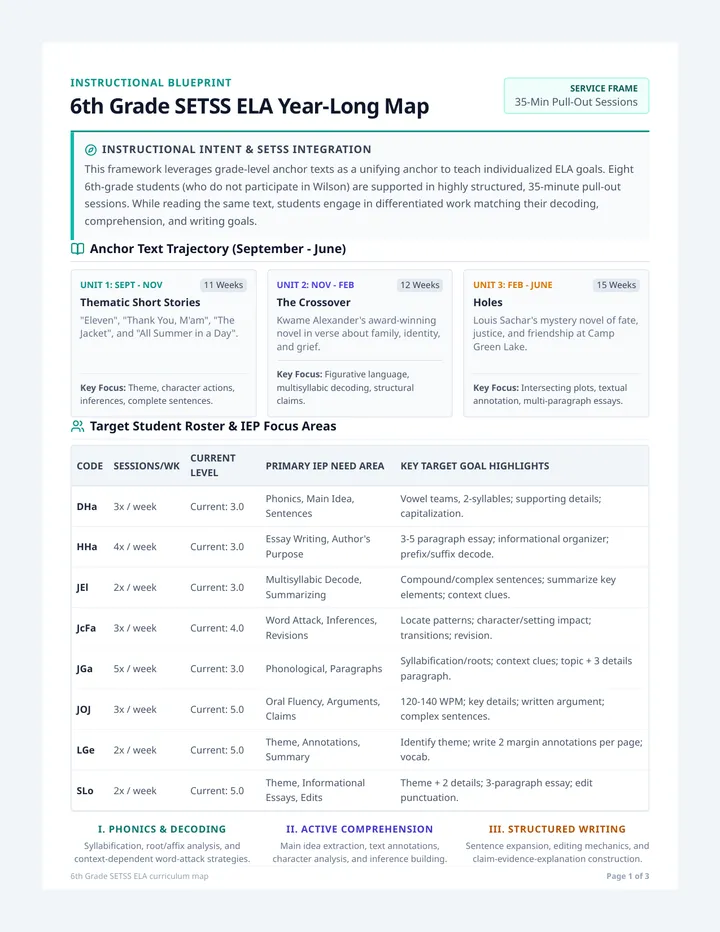
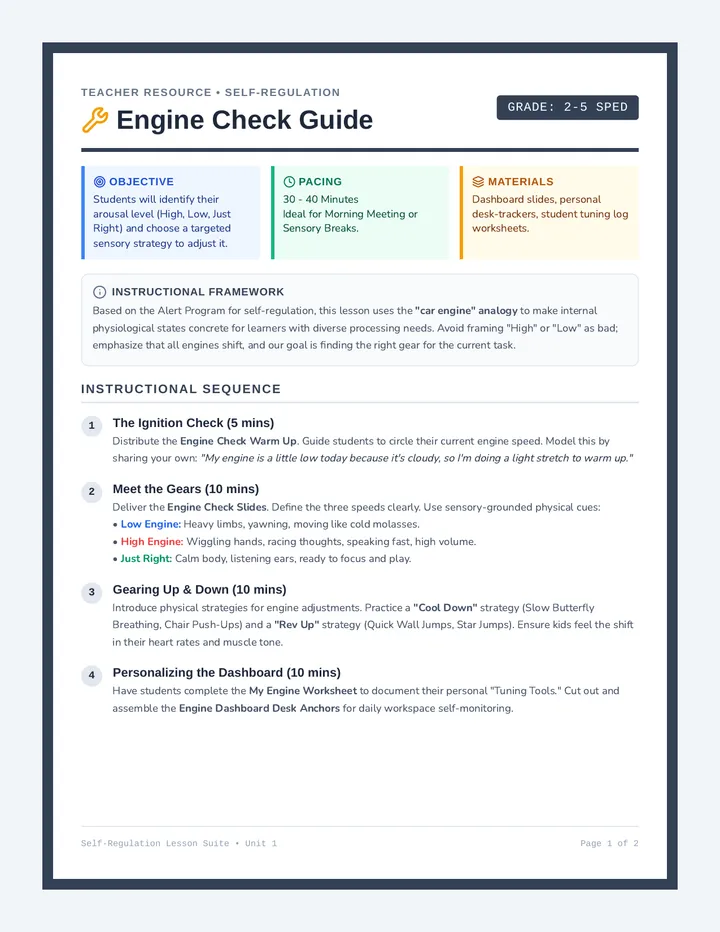
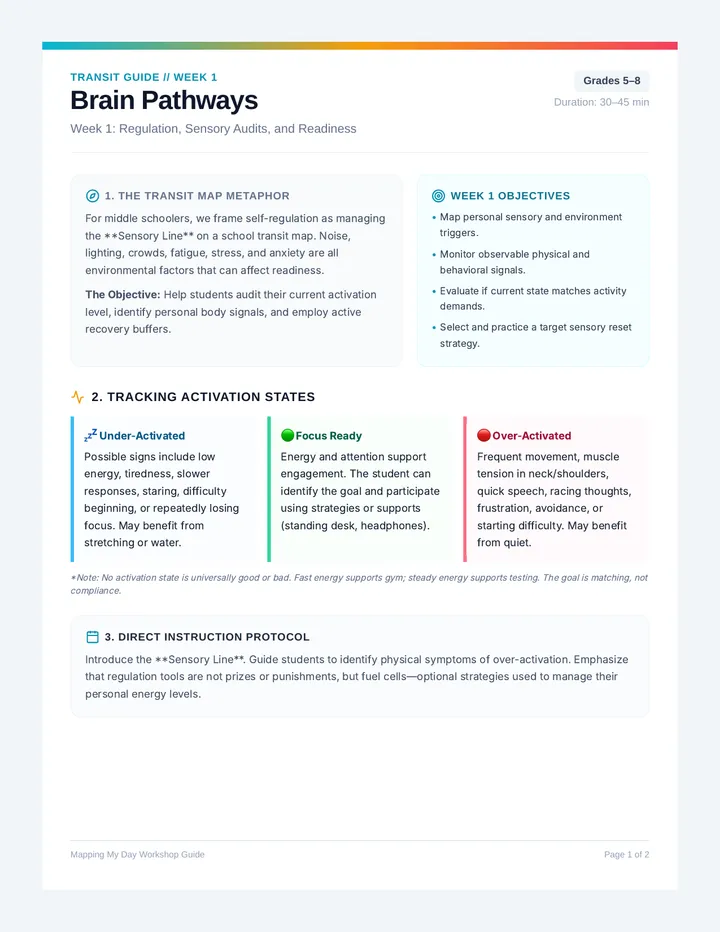
Campus Compass Coach Guide Transition Intervention Protocol
Campus Compass Coach Guide
FACILITATOR RESOURCE
Clinical Focus
For a 10-year-old starting a new school, the combination of ADHD and anxiety creates dual hurdles: executive dysfunction makes new routines feel chaotic, while somatic anxiety triggers avoidance behaviors. This guide coordinates a 3-part toolkit designed to build predictability, reduce fear of the unknown, and foster self-advocacy.
Understanding the Profile (Age 10)
ADHD Impact
Transitioning between classes, locating lockers, and tracking multiple materials taxes weak executive skills. Leads to rushing, physical clutter, and task abandonment.
Anxiety & Somatics
Anxiety often manifests somatically (headaches, stomach aches, elevated heart rate) especially during non-academic times like lunch, recess, or morning arrival.
The 3-Part Intervention Framework
1. Social Narrative & Scripting
Uses customized storytelling to neutralize uncertainty and model adaptive problem-solving. Scripting prepares concrete, verbally accessible responses for social and emotional crises.
2. Interactive Transition Worksheets
Enables active cognitive processing of somatic responses, allows physical routine mapping, and creates a customized self-advocacy plan for classroom adjustments.
3. Calm & Clear Visual Pack
Translates abstract instructions into immediate spatial and environmental visual cues. Includes desktop reminders, an anxiety thermometer, and visual checklists.
CAMPUS COMPASS • TRANSITION SYSTEM PAGE 1 OF 2
Implementation Guide & Lesson Plan
STAGE 1 & 2 PROTOCOLS
1
Session 1: Narrative & Scripting (45 min)
Objective: Reframe transition anxiety from a threat to an actionable quest. Build social scripts.
Coach Actions: Read the School Scene Social Narrative together. Emphasize that "Alex" is in 5th grade, just like them, and normalizes feeling somatic sensations.
Key Dialogue Prompt: "When you feel nervous, where in your body does that feeling show up first? Let's check how Alex figured that out."
2
Session 2: Somatic Mapping & Routine Anchors (45 min)
Objective: Externalize anxiety and build concrete executive visual schedules.
Coach Actions: Complete the Mission New School Worksheets (Pages 1 & 2). Work on identifying somatic signals, and color-code the "Routine Map". Emphasize sequential anchor points.
Key Dialogue Prompt: "We can't control everything, but we can plan our transitions. Let's make a clear game plan for your morning routine so it runs on autopilot."
3
Session 3: Self-Advocacy & Visual Rigging (45 min)
Objective: Establish school communication cards and customize desk/locker visual reminders.
Coach Actions: Fill out the self-advocacy prompts. Cut out and laminate the cards from the Calm & Clear Visual Pack. Run practice rehearsals where the student hands a script card to you (acting as the teacher).
Key Dialogue Prompt: "Teachers are here to support your mission. Let's practice handing them this card so you don't even have to find the words when your brain feels full."
Troubleshooting & Accommodation Tips
Somatic Avoidance (refusal to enter): Do not force immediate entry. Refer to the anxiety scale thermometer, identify physical tension, and spend 5 minutes using the "Box Breathing" model in the script.Visual Overwhelm: Keep visual aids minimal. Tape the "Desk Reminders" inside a locker door or on the desk corner, rather than cluttering their central workspace.Memory/Attention Glitches: Ensure the visual schedule uses high-contrast borders and simple icons. Laminate and use dry-erase markers so they can physically cross off completed transitions.
CAMPUS COMPASS • TRANSITION SYSTEM PAGE 2 OF 2
School Scene Social Narrative The Navigator’s Chronicle
Section A • Social Narrative
Mission: The New Territory
My name is Alex, and I am a 10-year-old explorer. I have a brain that runs at 100 miles per hour. It’s excellent for finding creative solutions, drawing detailed maps, and learning things quickly. But starting a new school can make my brain spin even faster.
When my brain gets overloaded, my body's internal radar goes off. Sometimes, I feel a squeeze in my stomach, or my breathing feels quick, like a steam engine. My coach told me these are called somatic signals . They aren't dangerous; they are just my nervous system sounding a fire drill because everything around me is new.
When we arrived at Oak Creek Academy, the hallway looked huge, noisy, and full of strangers. My radar started buzzing. My stomach tightened.
Instead of running away or staying silent, I decided to use my Navigator Tactics . First, I stopped and took three deep "balloon breaths," puffing my belly out like a balloon, then letting the air escape slowly. I looked down at my desk reminder card. My first anchor point was simple: Find Room 112 and put my backpack in locker 42.
My new teacher, Mr. Garrison, had a loud voice, which made my radar hum. But I remembered my script. I walked up to him during the quiet reading block and handed him my cue card. He smiled, read it, and said, "Thanks for letting me know, Alex. You can sit by the window and use your sensory tool whenever you need." The somatic alarm in my stomach slowly quieted down. The mission was underway.
Your Explorer Log: Making Connections
1. What somatic "radar signals" (like stomach squeezes or rapid breathing) do you feel when you enter a noisy room?
2. Who is one adult at your new school you can share your "Navigator tactics" with?
CAMPUS COMPASS • TRANSITION SYSTEM PAGE 1 OF 2
The Navigator’s Scriptbook
Section B • Communication Scripts
When your brain is busy processing a new school environment, finding the right words to say can feel almost impossible. These Comm Scripts are like pre-programmed radio codes. Read them, practice them with your coach, and write down your own personalized versions.
Situation A: Hallway or Classroom Is Too Loud
SOS CARD
"Excuse me, Mr./Ms. [Teacher Name], my sensor system is feeling overloaded right now. May I step out to my designated quiet spot for 3 minutes to reset my compass?"
Situation B: You Missed the Teacher's Instructions
INFO CARD
"Hi Mr./Ms. [Teacher Name], my ADHD brain took a detour during the instructions. Could you show or tell me what step 1 of the task is so I can map out my progress?"
Mission New School Worksheets Mission: New School Workbook
Page 1 • My Somatic Radar
Explorer:
Launch Date:
Step 1: Locate the Somatic Radar Signals
When your brain senses a big transition, it sends alerts down into your body. This is called somatic anxiety. Look at the options below and check off where you feel tension or worry in your body.
Mind Racing Thoughts spin fast or freeze up
Hot Flushes Face and ears feel warm or red
Fluttering Heart Heart beats like a tiny drum
Shallow Breathing Short, quick chest breaths
Stomach Squeeze "Butterflies" or actual ache
Fidgety Hands Shaky fingers or bouncing legs
Step 2: Apply the "Box Breathing" Anchoring Tool
1. Inhale (4s) 2. Hold (4s)
RESET CODE
4. Hold (4s) 3. Exhale (4s)
When your somatic radar goes crazy, Box Breathing forces your heart rate down and stops the alarm.
Try it now with your coach. Trace the box outline above with your finger while counting. Repeat this cycle 3 times in a row.
My calm rating after trying:
1 2 3 4 5
CAMPUS COMPASS • TRANSITION SYSTEM PAGE 1 OF 2
My Routine Map & Anchor Points
Page 2 • Anchor Routines
Transitions can feel chaotic because your brain doesn't know what is coming next. When we build a Routine Map , we lock in physical anchors. Fill out your game plans below for these key moments.
1
Morning Arrival: Getting to Class
My Launch Actions
1. Go to locker #_____
2. Hang up coat and put away backpack
3. Take folder, laptop, and pencil bag
My Extra Morning Action:
Example: Grab morning visual schedule sheet
2
Class Transitions: Shifting Rooms
My Switching Checklist
1. Check classroom whiteboard for next room #
2. Put away active books in desk/locker
3. Hold sensory fidget in my pocket
My Shift Anchor Action:
Example: Walk on left side of hallway to avoid crowds
3
Dismissal Pack-Up: Ending the Day
My Pack-Up Checklist
1. Put planner and homework folder in bag
2. Collect water bottle and lunch box
3. Lock up locker and go to transit point
My Dismissal Checklist Item:
Example: Double check desk top is completely clear
CAMPUS COMPASS • TRANSITION SYSTEM PAGE 2 OF 2
Calm and Clear Visual Pack Calm & Clear Visual Pack
Section C • Desktop Tools
Facilitator Tip: Cut out these cards, laminate them, and tape them to the student's desk corner or inside their daily binder. They provide silent, low-stress guidance during high-anxiety moments.
Focus Launch Sequence
Check these off with a dry-erase marker:
1 Is my desk clear?
2 Do I have my pencil?
3 Is my workbook open to the page?
4 Is my sensory fidget in hand?
Cut & Laminate • Desktop Aid
Fidget Tool Rules
To keep my sensory tools helpful:
Look: My eyes are still looking at the teacher or the task.
Low Key: Fidget stays on lap or inside desk, out of sight.
No Noise: Squeeze quietly. If it makes noise, trade it out.
Cut & Laminate • Desktop Aid
Somatic Fast Check-In
10-SECOND RESET
Run this scan silently whenever you feel your somatic alarm ringing:
1. Relax Face Unclench jaw
2. Drop Shoulders Let them slide down
3. Belly Breath 4-second slow exhale
4. Release Hands Open fingers flat
Cut & Laminate • Desk Strap Strip
CAMPUS COMPASS • TRANSITION SYSTEM PAGE 1 OF 2
The Somatic Alarm Scale
Section D • Thermometer
Our somatic alarm goes off in levels. We can't always stop our alarm from humming, but we can match our alarm level to an immediate action to prevent a breakdown or freeze. Locate your level below and run the action code:
Level 5
RED ALARM • Overloaded / Exploding
Body Signal: Heart hammering, crying, stomach is in a knot, or completely frozen.
ACTION CODE: Hand teacher the SOS Card • Go to Calm Zone for 5 min • Deep breathing
Level 4
ORANGE ALARM • Buzzing / Fidgety
Body Signal: Bouncing leg constantly, heavy chest, face feels hot, mind racing.
ACTION CODE: Hold fidget tool • Hand teacher help card • Take three slow balloon breaths
Level 3
YELLOW ALARM • Humming / Nervous
Body Signal: Butterflies in stomach, clenching pencil too hard, looking around class.
ACTION CODE: Silent Somatic Fast Check-In (relax face, drop shoulders) • Draw a map star
Level 2
GREEN LIGHT • Focused & Ready