Master Facilitation Guide Tier 3 Intensive Behavior Intervention
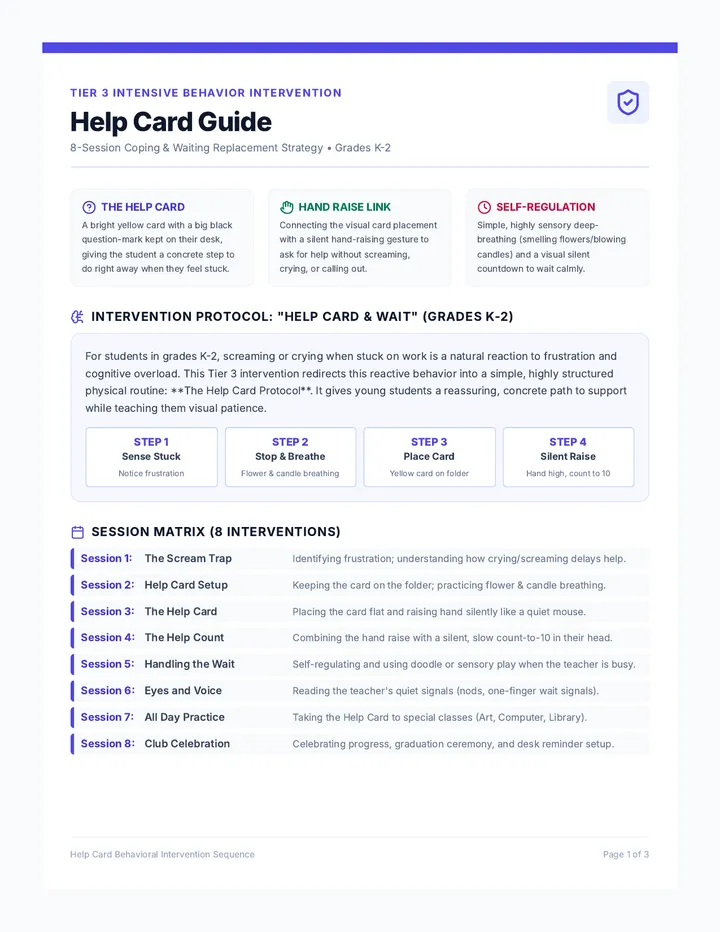
The Silent Anchor Guide
8-Session Interruption & Attention-Seeking Intervention • Grades K-2
1. SILENT TOUCH
Slowing down and walking up quietly. Placing a flat hand on the teacher's forearm or hip instead of shouting or tugging clothes.
2. HAND CONNECTION
The teacher places their hand over the student's hand to say, "I feel you, give me one moment" without interrupting instruction.
3. STEADY WAITING
The student anchors their body, counts silently inside, and maintains contact until the teacher is ready to listen.
Grades K-2 Intervention Protocol: "The Anchor Routine"
For students in grades K-2, shouting out and tugging are automatic impulses to grab adult focus immediately. **The Silent Anchor Club** uses highly tactile, child-friendly steps to replace these loud or physical behaviors with a quiet, reliable touch cue. This routine honors the child's need for connection while preserving instruction.
STEP 1 Quiet Approach Walk up quietly, zero voice
STEP 2 Flat Hand Anchor Place flat hand on forearm or hip
STEP 3 Double Hand Wait Feel teacher's hand cover yours and count
Session Matrix (8 Interventions)
Session 1: The Attention Volcano Meeting Buster the Shouting Volcano; learning what interrupting feels like.
Session 2: The Silent Touch Teaching physical placement of flat hand on adult's arm or hip quietly.
Session 3: The Silent Connection Introducing teacher hand-over-hand physical acknowledgment ("I feel you").
Session 4: Step Three Ask Using polite scripts ("Excuse me...") after waiting counting to 10.
Session 5: Handling the Not Yet Coping calmly when teacher squeezes twice (meaning "not yet, keep holding").
Session 6: Eyes and Voice Reading teacher cues to see if they are talking, writing, or ready to listen.
Session 7: All Day Practice Generalizing flat hand anchors to small group work, circle, and independent work.
Session 8: Club Celebration Earning Anchor Master badges and homeroom teacher graduation ceremony.
The Silent Anchor Club Behavioral Intervention Sequence (Grades K-2) Page 1 of 3
Tier 3 Intensive Behavior Intervention
Lesson Plans: Sessions 1 to 4
Part 1
1 Session 1: Buster the Shouting Volcano
Duration: 15 Min
Learning Target: I can tell when a voice "erupts" and interrupts our classroom.
Success Criteria: I can name why shouting makes it hard for teachers to teach and hear others.
Step 1: Meet Buster: Read the story about Buster, a cute little volcano who gets a bubbling feeling in his throat when he wants to tell the teacher something, then erupts: "LOOK AT ME!" Ask: "What happens to the class when Buster erupts?"
Step 2: Interactive Sort: Show visual cards or model behaviors. Have student label "Erupting" (yelling out, clothing tugs) or "Quiet Waiting". Introduce the "Anchor Club Binder".
Practice: Help Buster calm his bubbling red lava on the story worksheet. Put on first sticker!
2 Session 2: The Silent Touch
Duration: 15 Min
Learning Target: I can walk up quietly and place a flat hand anchor on my teacher.
Success Criteria: I can walk with zero voice and place a flat palm gently on the teacher's forearm or hip.
Step 1: Flat Hand Trick: Model walking up silently. Place a flat, warm palm on the child's shoulder (or vice versa on your forearm). Explain: "An anchor is heavy and quiet. No tapping, no grabbing, no squeezing. Just a flat hand that stays completely still."
Step 2: Physical Practice: Practice the quiet approach. Have the child walk from their seat, place their flat palm on your forearm, and keep their eyes on you with a quiet, calm body.
Rehearsal: Practice stepping up while the teacher is writing on the whiteboard.
3 Session 3: The Silent Connection
Duration: 15 Min
Learning Target: I can wait for my teacher's double hand cover acknowledgment.
Success Criteria: I can keep my hand on my teacher's arm and wait calmly when they cover it with theirs.
Step 1: The Magic Cover: Explain: "When you anchor your hand on me, I will place my hand over yours. This means: 'I feel you, I know you are here, give me one moment.' It is our secret silent bridge!"
Step 2: Playful Practice: Play "Connect the Bridge". Student walks up, places a flat hand, and the teacher immediately covers it. Student holds their hand still, breathes in, and waits without speaking.
Roleplay: Rehearse while the teacher is reading a book to a puppet. Student waits for the cover.
4 Session 4: Step Three Ask
Duration: 15 Min
Learning Target: I can count to 10 and then use my polite verbal script.
Success Criteria: I can wait for 10 quiet counts, then use a low, gentle voice when the teacher turns to me.
Step 1: Anchor & Wait: Explain that after the touch and hand cover, we must count to 10 in our heads. Once the teacher turns, we use a friendly voice to ask: "Excuse me, can you help me?" or "Excuse me, can I share?"
Step 2: Ask & Count Game: Play the board game where student practices placing their hand on a target, counting to 10, and saying their quiet script to advance.
Simulation: Rehearse asking for a pencil or permission to use the restroom during instruction.
The Silent Anchor Club Behavioral Intervention Sequence (Grades K-2) Page 2 of 3
Tier 3 Intensive Behavior Intervention
Lesson Plans: Sessions 5 to 8
Part 2
5 Session 5: Handling the Not Yet
Duration: 15 Min
Learning Target: I can stay calmly anchored when my teacher squeezes my hand twice.
Success Criteria: I can take a deep breath, keep my hand anchored, and say "Okay" inside when given a "not yet" cue.
Step 1: The "Not Yet" Squeeze: Sometimes teachers are in the middle of a very important sentence. Teach the "Not Yet" double-squeeze on the student's hand. Explain: "This means 'I feel you, but I need you to stay anchored and wait a little longer. You are safe.'"
Step 2: Calm-Down Steps: Practice K-2 coping steps: "1. Feel the double squeeze. 2. Take a slow, quiet belly breath. 3. Smile and stay anchored. 4. Think: I am a super star waiter!"
Roleplay: Teacher gives double squeeze. Student practices breathing and waiting with a smile.
6 Session 6: Eyes and Focus
Duration: 15 Min
Learning Target: I can read adult body language to find a good time to anchor.
Success Criteria: I can look at classroom images and determine if the teacher is busy/talking or ready to be anchored.
Step 1: Teacher Cue Detectives: Explain that teachers show with their bodies when they are in "teaching flow". If teacher is talking to a visitor, typing on the computer, or teaching the whole group, they are "busy". We can still walk up and anchor, but we must use our extra steady anchor waiting!
Step 2: Picture Card Game: Use the Eyes and Focus Cards. Ask: "Is this teacher writing on the board? Yes, so she is busy. What should we do? Walk up quietly and place our flat hand anchor!"
Rehearsal: Practice checking teacher posture before walking up to anchor.
7 Session 7: All Day Practice
Duration: 15 Min
Learning Target: I can use my Silent Anchor during independent work, circle, and centers.
Success Criteria: Earn 3 friendly anchor stamps on my daily tracker from teachers or paraprofessionals.
Step 1: All-Day Map: Review high-risk areas: independent table work, small group centers (temptation to shout "Teacher!"), and carpet circle instruction.
Step 2: Visual Reminders: Introduce the "Mini Anchor Desk Cue" (a small sticker or visual card on the desk to remind them of the Silent Anchor touch).
Practice Tracker: Introduce the printable daily tracker sheet to collect anchor stamps.
8 Session 8: Club Celebration
Duration: 15 Min
Learning Target: I can celebrate graduating as a certified Silent Anchor Master!
Success Criteria: Pass 3 final fun anchor tests (anchoring during small group, circle, and independent reading).
Step 1: The Anchor Tests: Execute playful tests in real time. Can the student approach the teacher during a reading group, apply a quiet flat hand, and wait calmly for 10 counts?
Step 2: Award Ceremony: Present the "Silent Anchor Master Certificate" with official golden anchor stickers. Invite the principal or school counselor to celebrate.
Hand-off: Give the homeroom teacher the follow-up transition tracking sheet to keep the behavior going.
The Silent Anchor Club Behavioral Intervention Sequence (Grades K-2) Page 3 of 3
Attention Volcano Story Worksheet The Silent Anchor Club • Session 1
Buster the Shouting Volcano!
Name:
Date:
Buster's Volcano Story
PANEL 1: THE BUBBLY FEELING
Meet Buster! He is a friendly volcano who loves sharing. But when he wants to tell the teacher something, his throat gets a hot, bubbling feeling and he erup-erup-erupts with a loud shout: "TEACHER, LOOK!"
Buster shouts: "I want to share right now!"
PANEL 2: VOLCANO BLOWOUT!
Buster erupts during reading time! It makes his teacher stop talking. His classmates jump and forget what they were learning. Oh no, shouting out makes everyone feel distracted!
Shouting out interrupts our reading flow.
PANEL 3: THE FLAT HAND ANCHOR
Buster learns a cool silent trick! Instead of shouting, he walks up quietly and places his flat hand gently on the teacher's forearm. His mouth stays closed. He is anchored!
Walk up quietly and place your flat hand.
PANEL 4: THE SILENT BRIDGE
The teacher places her hand over Buster's hand to say, "I feel you, wait one second." Buster waits silently. When the teacher finishes her sentence, she turns and says, "Thank you for waiting, Buster!"
Flat hand waiting keeps our classroom calm!
Anchor Cadet Practice
Help Buster practice his Silent Anchor rules!
1. How does the teacher feel when we shout and interrupt?
😊 Happy
😯 Distracted
😟 Surprised
Circle the matching feelings!
2. Trace our silent anchor word:
A N C H O R
Use your pencil to trace the lines!
My Silent Anchor Sketch:
Draw your flat hand resting gently on your teacher's forearm or hip.
Club Rule: "Walk up quietly, place a flat hand, wait silently!"
Session 1 Workpage • Grades K-2
Attention Volcano Lesson Plan Tier 3 Intensive Behavior Intervention
Lesson Plan: Session 1
Introduces: Buster the Shouting Volcano & Interrupting
Session Duration 15 Minutes
Grade Level Grades K-2
Setting Individual / Small Group
Metaphor Vocal Shouting = Volcano
Objectives
Students will define "interrupting" and identify how vocal attention-seeking impacts teacher instruction and peer learning, preparing them for physical touch replacement cues.
Materials
Attention Volcano Story Worksheet
Red/Orange crayons for activity
Sticker chart or Anchor binder
Target Behaviors
Shouting out name repetitively
Tugging teacher clothes/arms
Stepping directly into workspace
PART 1: STORYTIME & INTRODUCTION (5 MINUTES)
Meet Buster the Shouting Volcano
Read the story of Buster from the worksheet. Emphasize the hot, bubbling feeling in his throat when he wants to say something immediately. Ask: "Have you ever felt a bubbly volcano feeling in your throat when you wanted to speak?" Talk about how shouting out interrupts others.
PART 2: INTERACTIVE BEHAVIOR SORT (4 MINUTES)
Volcano vs. Anchor Touch
Describe two actions. Have the child yell "Erupt!" if it is a shouting volcano behavior (e.g., pulling on clothes, shouting "Teacher! Look!"), or "Anchor!" if it is quiet waiting (e.g., walking up with a quiet mouth). Explain that in the next session, they will learn the exact Anchor Touch.
PART 3: GUIDED WORKSHEET PRACTICE (4 MINUTES)
Volcano Reflection & Sketch
Guide the student in completing the Attention Volcano Story Worksheet. Read the questions aloud. Have them circle the distracted teacher feeling face, trace the word "ANCHOR", and sketch their silent hands in the drawing frame.
PART 4: DEBRIEF & TRANSITION (2 MINUTES)
Setting our Club Goal
Say: "You did an amazing job today! You are now an official Anchor Cadet. Next time, we are going to practice the physical touch of the anchor so you can communicate without shouting!"
Facilitator Pro Tip
Keep a friendly, non-punitive tone throughout. Remind the student that wanting to talk to the teacher is wonderful! We are simply learning a secret, quiet superhero trick so they can get the teacher's attention without interrupting the whole class.
The Silent Anchor Club Behavioral Intervention Sequence (Grades K-2) Session 1 Lesson Plan
Silent Anchor Poster The Silent Anchor Club
How to Be a Silent Anchor
Four simple steps to connect quietly with your teacher!
STEP 1
Quiet Approach
Walk up to your teacher on soft, quiet feet. Your mouth is closed. Your voice is at Level 0 .
STEP 2
Flat Hand Anchor
Gently place your flat palm on your teacher's forearm or hip. Keep it still like an anchor.
STEP 3
Quiet Mouth
Keep your voice completely silent. Do not squeeze, grab, or tug clothing. Just let your hand rest.
STEP 4
Steady Waiting
Wait for your teacher's hand to cover yours. Count to 10 in your head. When the teacher is ready, they will listen!
"My Hand on Your Arm Says: I am Waiting Quietly!"
The Silent Anchor Club Classroom Chart • Keep Posted on Whiteboard! • Grades K-2
Silent Touch Lesson Plan Tier 3 Intensive Behavior Intervention
Lesson Plan: Session 2
The Silent Touch: Muscle Control & Hand Placement
Session Duration 15 Minutes
Grade Level Grades K-2
Focus Behavior Physical Touch Control
Skill Quiet Hand Resting
Objectives
Students will practice and execute placing a completely flat hand on the teacher's forearm or hip with "calm muscles" (no squeezing, tapping, or tugging) on command.
Materials
Silent Anchor Poster (for visual reference)
Anchor Stance Poster (muscle control)
Hand sanitizer (to practice tactile safety)
Success Criteria
Walking with zero voice
Placing hand flat (palm down)
Holding hand perfectly still
PART 1: WARM UP (3 MINUTES)
Squeezing vs. Calm Muscles
"Today we are learning about our anchor muscles! Clench your hand super tight like a claw. Now relax it completely flat on the table. Feel how soft and quiet it is? That is an anchor hand! It is peaceful and flat."
PART 2: MODELING (4 MINUTES)
The Forearm and Hip Targets
Explain that when we want to talk, we walk up quietly and place this flat anchor hand in one of two targets:
1. Forearm: If the teacher is sitting or standing nearby.
2. Hip: If the teacher is standing up and writing on the board.
Model both. Emphasize that there is no poking or scratching. Just a gentle, heavy hand resting.
PART 3: INDEPENDENT PRACTICE (5 MINUTES)
Anchor Practice Rounds
Have the student sit at their seat. Give the command: "Go!"
1. Student stands up quietly (zero voice).
2. Walks up to the teacher.
3. Places flat hand on forearm.
4. Freezes their body for 5 counts.
Do 3 rounds, practicing different target sites (forearm vs hip).
PART 4: DEBRIEF & STICKER (3 MINUTES)
Self-Reflection
Ask: "Were your muscles tight like a claw, or relaxed like a heavy boat anchor? Yes, heavy and quiet! You did spectacular." Put a sticker on the student's chart!
Physical Boundaries Guide
If the student has history of aggressive physical grabbing, establish a very firm guideline: ONLY place the flat hand on the forearm or hip. Practice on a stuffed animal first if they struggle with pressure boundaries.
The Silent Anchor Club Behavioral Intervention Sequence (Grades K-2) Session 2 Lesson Plan
Anchor Stance Poster Silent Anchor Muscle Control
How Does Your Anchor Feel?
Keep your anchor steady so the teacher's boat doesn't shake!
Shaking the Boat
These movements shake the teacher's brain and make it hard for them to teach!
Poking or pinching arms
Tugging on shirts or sleeves
Waving hands in teacher's face
Squeezing the teacher's arm
Holding the Boat Steady
These quiet choices show the teacher you are ready and waiting politely!
Palm is completely flat and open
Hand rests gently on forearm or hip
Fingers stay relaxed and still
Take deep, slow belly breaths
"A flat hand is a quiet friend!"
The Silent Anchor Club Classroom Chart • Keep Posted on Whiteboard! • Grades K-2
Silent Connection Slides The Silent Anchor Club • Lesson 3
The Silent Connection
How we connect with our teacher using a secret hand cover—without saying a single word!
Get ready to learn the secret bridge! Slide 1 of 5
Our Secret Trick
What is the Silent Touch?
When we need help or want to share, we don't shout Buster's volcano voice. Instead, we do this:
1 Flat Palm Touch
Walk up silently and rest your flat palm gently on the teacher's forearm or hip target.
2 Heavy and Still
Hold your hand perfectly still like a heavy ship's anchor. No squeezing, no tugging, no poking.
Zero voice, 100% quiet muscles! Slide 2 of 5
The Secret Bridge
The Teacher's Hand Cover
Once you place your flat hand, the teacher will place their hand over yours.
What does the cover mean?
"I feel you, I know you are here waiting, and I will help you in just one moment!"
It is a silent bridge of friendship between you and your teacher!
Keep holding still when you feel the cover! Slide 3 of 5
Classroom Roleplay
Let's Try It Together!
Let's practice our anchor moves while the teacher is busy teaching!
STEP 1 Walk up quietly with Zero Voice
STEP 2 Place flat palm on forearm or hip
STEP 3 Wait for the secret hand cover
Who wants to be the first Anchor Cadet? Slide 4 of 5
Anchor Master Check
The Anchor Master Oath
Let's say our Anchor Club pledge together so we can earn our master stamps:
"I walk up quiet, I place my flat hand,"
"I wait for the cover, like anchors in sand."
"No shouting, no tugging, my body stays still,"
"I am an Anchor Master with waiting skill!"
Congratulations, Anchor Cadets! Slide 5 of 5
Silent Connection Lesson Plan Tier 3 Intensive Behavior Intervention
Lesson Plan: Session 3
The Silent Connection: Hand-over-Hand Cover
Session Duration 15 Minutes
Grade Level Grades K-2
Focus Behavior Quiet Waiting Response
Touch Cue Double Hand Cover
Objectives
Students will demonstrate waiting silently for up to 10 seconds while the teacher places their hand over the student's anchored hand, acknowledging their bid for attention.
Materials
Silent Connection Slides (Lesson 3)
Teacher's desk or carpet chair
Golden Anchor sticker sheets
Double Hand Cover
This physical contact is highly reinforcing for Grades K-2. It immediately releases the chemical "need to touch" and provides a secure sensory connection while they wait.
PART 1: INTRODUCE THE BRIDGE (4 MINUTES)
The Secret Hand Cover
Project Slide 3 of the Silent Connection Slides. Explain: "When you anchor your flat hand on my arm, I am going to gently place my hand over yours. This is our secret silent bridge! It tells you: 'I feel your hand, I know you are here waiting, and I will help you very soon!'"
PART 2: TEACHER MODELING (3 MINUTES)
Model the Cover and Feel
Model placing your flat hand on the table, then covering it with your other hand. Let the child try placing their hand on yours, and you cover it. Ask: "How did that feel? Cozy and safe, right? It means you don't have to shout out!"
PART 3: SLIDE-SUPPORTED PRACTICE (5 MINUTES)
Choral Practice Rounds
Run simulated rounds using Slide 4:
1. Pretend you are teaching a reading lesson.
2. Have the student approach quietly and place their flat anchor hand.
3. Cover their hand.
4. Count together: "1, 2, 3, 4, 5."
5. Release and say: "Thank you for connecting quietly, how can I help you?"
Practice 3 times, extending the count from 3 to 10 seconds.
PART 4: DEBRIEF & TRANSITION (3 MINUTES)
Anchor Cadet Oath
Read the Anchor Master Oath on Slide 5 together. Celebrate their ability to stand with still muscles. Put an anchor sticker on their daily tracking chart!
Sensory Co-Regulation Guide
For students with sensory processing needs, the pressure of the hand cover can act as a deep-pressure co-regulation strategy. Ensure your cover is firm and warm, not a light tickle, to provide high sensory satisfaction and grounding.
The Silent Anchor Club Behavioral Intervention Sequence (Grades K-2) Session 3 Lesson Plan
Anchor and Count Game The Silent Anchor Club • Session 4
Anchor & Count Game!
Practice silent waiting & polite asking to reach the Harbor!
Name:
Date:
Game Rules:
Roll a die or flip a coin. Move your marker. When you land on a wave, you must:
1. Place your flat hand on the anchor target below.
2. Count to 10 silently while your partner covers your hand.
3. Say your polite script: "Excuse me, can I share?" or "Excuse me, can you help me?"
START Volcano Bay
Wave 1 Safe Spot
Writing Table Anchor!
Wave 3 Safe Spot
Reading Group Anchor!
Computer Zone Anchor!
Wave 6 Safe Spot
Tying Shoes Anchor!
Wave 8 Safe Spot
FINISH Anchor Harbor
Tactile Practice Target
Play Touch Target:
When you land on an "Anchor!" space, place your flat palm inside the dotted frame on the right and count to 10 out loud!
Place Flat Hand Here
Pledge: "Touch the anchor target, count to 10, then use a low, gentle voice!"
Session 4 Game • Grades K-2
Ask and Count Lesson Plan Tier 3 Intensive Behavior Intervention
Lesson Plan: Session 4
The 10-Second Wait & Verbal Script Connection
Session Duration 15 Minutes
Grade Level Grades K-2
Focus Behavior Quiet Vocal Entry
Strategy Count-to-10 Strategy
Objectives
Students will coordinate physical flat-hand contact with a mental count of 10 seconds, then utilize a polite, quiet whispering script when the teacher turns to listen.
Materials
Anchor and Count Game board
A die and game markers
Golden Anchor sticker sheets
Low Voice Scripts
"Excuse me, can you help me?"
"Excuse me, I have a question."
"Excuse me, can I share?"
PART 1: INTRODUCE THE COUNT (3 MINUTES)
The Silent Timer Inside
"Once our teacher covers our hand, we must give them time to finish their sentence! We count to 10 in our heads. Let's practice taking 10 deep, slow breaths together while looking at our hands. Ready? 1... 2... 3... up to 10."
PART 2: MODELING COOPERATIVE PLAY (3 MINUTES)
The Game Walkthrough
Show the Anchor and Count Game. "We are going to play this game to practice our skills! When we land on an 'Anchor!' space, we must place our flat hand on the target page, wait for our partner's hand-cover, count silently to 10, then whisper our polite script!"
PART 3: GUIDED GAMEPLAY (6 MINUTES)
Anchor and Count Trials
Play the board game with the student. Take turns rolling the die and moving.
• Act as the student's partner, applying the warm hand-cover whenever they place their hand on the tactile target box.
• Count with them silently, tapping your finger on the table to guide their K-2 pacing.
• Encourage them to whisper their script clearly when the count completes.
PART 4: DEBRIEF & TRANSITION (3 MINUTES)
Whisper Power
Say: "Your whisper voice was perfect today! You didn't erupt like Buster the Volcano at all. You are a true Anchor Master!" Give the student an anchor stamp on their daily tracker.
Instructional Adaptations
If the student cannot count silently in their head, provide a physical sand-timer or a visual strip of 10 circles they can slide their thumb across while waiting. Keep the script short (e.g., just "Help, please") if they struggle with verbal processing.
The Silent Anchor Club Behavioral Intervention Sequence (Grades K-2) Session 4 Lesson Plan
Handling Not Yet Comic The Silent Anchor Club • Session 5
Handling "Not Yet"!
Name:
Date:
Buster's "Not Yet" Comic
PANEL 1: THE IMPULSE
Buster is building with blocks. He wants to show his teacher his tall tower. He feels his bubbling volcano voice coming! He wants to shout "TEACHER, NOW!"
Bubbles are rising: "Look at me!"
PANEL 2: SILENT TOUCH
But Buster remembers his training! He uses quiet feet, walks over silently, and places his flat hand anchor gently on his teacher's arm. Mouth stays shut.
Quiet approach. Hand is flat and still.
PANEL 3: THE SQUEEZE
The teacher is talking to a visitor. She covers Buster's hand and gives it a gentle squeeze, squeeze! This cue means: "I feel you, but not yet. Keep waiting."
Double squeeze: "Not yet, hold still."
PANEL 4: THE CALM WAIT
Buster takes a slow belly breath. He smiles and keeps his anchor steady. When the teacher is ready, she turns to him and says: "Thanks for waiting, Buster! How can I help?"
Waiting is a superpower!
Wait Master Practice
How do you keep your anchor safe during a "Not Yet" squeeze?
1. What do we do when teacher says "not yet"?
😡 Shout
😊 Breathe
⚓ Hold Still
Circle the correct coping choices!
2. Trace our waiting word:
W A I T
Use your pencil to trace the lines!
My Waiting Sketch:
Draw a happy, slow breath bubble blowing out of your mouth while waiting!
Club Rule: "Double squeeze means keep holding, breathe in, and smile!"
Session 5 Workpage • Grades K-2
Handling Not Yet Lesson Plan Tier 3 Intensive Behavior Intervention
Lesson Plan: Session 5
Coping with the Double Squeeze ("Not Yet")
Session Duration 15 Minutes
Grade Level Grades K-2
Focus Skill Frustration Tolerance
Target State Emotional Regulation
Objectives
Students will maintain a steady, silent anchor placement when the teacher executes the double squeeze ("not yet") tactile cue, utilizing a deep belly breath to self-soothe.
Materials
Handling Not Yet Comic sheet
Golden Anchor sticker sheets
A bubble wand (optional, for breathing)
The Coping Formula
Feel the double squeeze
Take a deep belly breath
Think: "I am safe and waiting"
Stay anchored
PART 1: EMOTION TALK (3 MINUTES)
When Teachers Say "Not Yet"
"Sometimes, we walk up and anchor, but the teacher is in the middle of a very important conversation. If they give us a gentle double squeeze, squeeze, it is their way of saying, 'Not yet, wait a little more.' How does that feel inside? A little frustrating? That is normal! Let's learn how to stay super steady!"
PART 2: TEACHING BREATHING (3 MINUTES)
Blowing out the Lava
Teach the student to take a slow belly breath. "When you feel that hot volcano lava bubbling up because you have to wait, take a deep nose breath, and slowly blow it out like blowing a quiet bubble. Let's do 3 bubble breaths!"
PART 3: COMIC ANALYSIS & ROLEPLAY (6 MINUTES)
"Not Yet" Simulation Rounds
Review Buster's Comic sheet. Point to Panel 3. "Look, Buster gets the double squeeze! What does he do in Panel 4? He breathes and waits! Let's do it!"
• Have the student approach and anchor.
• Cover their hand and give a double squeeze.
• Encourage them to immediately take a slow bubble breath and freeze their hand.
• Count to 10 silently, then release: "I am ready now, Buster! Thanks for waiting!"
PART 4: DEBRIEF & PROGRESS STICKER (3 MINUTES)
Quiet Pride
Ask: "How did your chest feel when you took that slow breath? It cooled the volcano right down! I am so proud of your strong waiting muscles!" Apply an anchor stamp to their tracker.
Emotional Support Guide
Some students with behavioral challenges may find physical touch or double squeezes disorienting if they are highly agitated. Ensure that the double squeeze is modeled and practiced in a calm state first so they associate the physical contact with safety and co-regulation, rather than restriction.
Eyes and Focus Cards The Silent Anchor Club • Session 6
Eyes and Focus Cards
Read the teacher's cues & practice your Silent Anchor!
Teachers: Cut along the dotted lines to create 4 classroom roleplay practice cards!
Card 1
The Talking Teacher
The teacher is talking to a parent or another adult at the classroom door. She is smiling and nodding.
Is the teacher ready?
She is talking, but you can walk up with ZERO voice and place your flat hand anchor. Wait silently!
Routine: Approach quietly • Anchor hand • Wait
Card 2
The Typing Teacher
The teacher is typing an email at her desk. She is staring at the computer screen with a focused face.
Is the teacher ready?
She is typing! Walk up with a calm body, place your flat hand on her shoulder or desk, and close your mouth.
Routine: Approach quietly • Anchor hand • Wait
Card 3
The Reading Teacher
The teacher is reading a story to a small group of children at the carpet. She is holding the book up.
Is the teacher ready?
She is reading! Do not call out. Walk up, place your hand on her forearm. Wait for her hand to cover yours.
Routine: Approach quietly • Anchor hand • Wait
Card 4
The Busy Hand Teacher
The teacher is helping a classmate write a word. Her hands are busy guiding the classmate's pencil.
Is the teacher ready?
She is busy guiding! Do not pull her arm. Simply rest your flat palm on her hip and count to 10.
Routine: Approach quietly • Anchor hand • Wait
Our Golden Rule: "Even when the teacher is busy, my Silent Anchor says I am here without a single word!"
The Silent Anchor Club • Grades K-2 Session 6 Activity Page
Eyes and Focus Lesson Plan Tier 3 Intensive Behavior Intervention
Lesson Plan: Session 6
Eyes and Focus: Reading Teacher Body Language
Session Duration 15 Minutes
Grade Level Grades K-2
Setting Individual / Small Group
Intervention Step Tactile Reading of Cues
Objectives
Students will identify whether an adult is "busy" or "ready" using physical and visual body cues, then demonstrate the correct Silent Anchor routine for each scenario.
Materials
Eyes and Focus Cards (4 cut-out scenarios)
Sticker chart or Anchor binder
Teacher's laptop / notebook for roleplay
Key Vocabulary
Teacher Cue: What an adult's body is showing us.
Teaching Flow: When the teacher is in the middle of a very important task.
PART 1: WARM UP (3 MINUTES)
The Detective Look
Start by saying: "We are body-language detectives! Today we are looking at our teachers to see when they are in their 'Teaching Flow'. If a teacher is busy writing, typing, or speaking, do we shout? No, we use our quiet flat-hand anchor!"
PART 2: MODELING (4 MINUTES)
The "Busy" and "Ready" Roleplay
**The "Busy" Scene:** Act out typing intensely on your laptop. Have the student approach. If they shout, dramatically pause and say: "Oh, my brain was in the middle of typing! What was our quiet trick instead?" Model having them approach, placing a quiet flat hand on your forearm, and waiting. Cover their hand to acknowledge.
PART 3: GUIDED PRACTICE (5 MINUTES)
Using the Eyes and Focus Cards
Show the 4 Eyes and Focus Cards one by one. Have the student tell you:
1. What is the teacher doing in this picture?
2. Is she busy or is she ready?
3. Show me how you walk up quietly, anchor your flat hand, and wait!
Provide warm, positive reinforcement immediately when the student completes the touch quietly.
PART 4: DEBRIEF & TRANSITION (3 MINUTES)
Anchoring in the Classroom
Ask: "If I am helping a friend tie their shoe, what is your body-language clue? Yes, my hands are busy! How do you anchor?" Congratulate the student on completing another session. Put a sparkling anchor sticker in their binder!
Teacher Adaptation & Accommodation Notes
For students with visual or attention difficulties, physically tap on their desk during classroom work to remind them to check your body posture before approaching. Always pair the hand-over-hand physical cover with a quiet smile or head nod to visually reinforce their successful silent connection.
All Day Practice Tracker The Bubble Club • Lesson 7 Tracker
My All-Day Bubble Tracker
Name:
Date:
My Magic Bubble Goals: Carry this card to lines, carpet circles, and recess play! Keep your invisible hula hoop bubble safe. If a teacher catches you using your Reach & Step check or keeping Ready Hands , you earn a friendly star stamp!
1. Lining Up & Transitions
Practice lining up at the classroom door, in the hallway, or in the lunch line. Tweak your spacing with the Reach & Step rule. Keep your hands in Ready posture!
M
⭐
T
⭐
W
⭐
Th
⭐
F
⭐
2. Circle Time & Rug Seating
Sit calmly on the rug. Keep your legs crossed ("criss-cross apple sauce") and hands in your lap. Give your classmates a happy, safe bubble space!
M
⭐
T
⭐
W
⭐
Th
⭐
F
⭐
3. Playground & Recess
Practice asking to play politely at the sandbox, slides, blocks, or free play zones. Look at your friend's face, smile, and ask: "Can I play?"
M
⭐
T
⭐
W
⭐
Th
⭐
F
⭐
My Bubble Map
Draw a picture of yourself sitting calmly on the carpet with a beautiful round Body Bubble around you!
The Bubble Club Generalization Tracker
Lesson 7 Workpage • Grades K-2
All Day Practice Lesson Plan The Bubble Club • Session 7 Plan
Session 7: All Day Practice
Focus: Generalization across school-wide environments in grades K-2
Plan 7 of 8
Learning Target
I can use my "Reach & Step" check and "Ready Hands" throughout the school day.
Success Criteria
I can earn 3 friendly bubble star stamps on my daily tracker card from lining up, carpet, or recess.
Materials Needed
All Day Practice Tracker, crayons, clipboard, homeroom teacher star stamps.
Explicit Lesson Steps (15 mins)
3m
1. The Hook (The Bubble Club Challenge)
Explain: "We have proven our bubble-checking skills in our small-group sessions, but our real reputation as Bubble Club Space Explorers is built out in the whole school! A true master keeps their bubble round and safe at lining up, on the rug, and on the playground. Today we launch your school-wide deployment mission."
4m
2. Preparing the Tracker Protocol
Review the **All Day Practice Tracker** sheet. Break down the three settings: 1. Lining Up & Transitions (using Reach & Step silently), 2. Circle Time & Rug Seating (keeping cross legs and hands in lap), 3. Playground & Recess (looking, smiling, and asking to join). Discuss how keeping space makes classmates super happy to play with us.
5m
3. High-Risk Environment Simulation
Set up simulated school zones. Mock a busy transition line where a peer group is waiting. Direct the student to approach, stop, use silent Reach & Step check, and take one big dinosaur step back. Next, simulate a crowded circle time carpet seating scenario. Student must walk calmly, sit down without bumping, cross legs, and keep hands in lap.
3m
4. Teacher Stamp Coordination
Provide the student with their clipboard tracker. Coordinate with homeroom teachers, recess monitors, and lunch staff. Explain that they will stamp a friendly star on the tracker when they observe independent bubble-awareness or Ready Hands. Set a goal of 3 star stamps today.
Self-Advocacy Focus
If teachers are busy, encourage the student to self-advocate at the end of class by showing their tracker: "Mrs. Smith, did you catch me keeping my hands ready and taking a big step back at circle time today?"
Points Reinforcement
Connect tracking success with exciting classroom rewards. Provide a tier-1 reward (e.g. playground ball helper or being the class line leader) once 3 validated stars are collected during the day.
The Bubble Club Behavioral Intervention Sequence Session 7 Lesson Plan • Grades K-2
Silent Anchor Tracker The Silent Anchor Club • Session 7
Silent Anchor Tracker
Collect golden anchors during the school day!
Name:
Date:
How to Earn Anchors:
When you need the teacher's help, walk up silently, place your flat hand gently, wait for the hand cover, and count to 10 in your head! The teacher will stamp your anchor!
My Weekly Anchor Chart
MONDAY
Morning Circle
Math Center
Reading Table
Afternoon Wrap
TUESDAY
Morning Circle
Math Center
Reading Table
Afternoon Wrap
WEDNESDAY
Morning Circle
Math Center
Reading Table
Afternoon Wrap
THURSDAY
Morning Circle
Math Center
Reading Table
Afternoon Wrap
FRIDAY
Morning Circle
Math Center
Reading Table
Afternoon Wrap
My Weekly Goal: Anchor quietly 10 times to earn a gold badge!
Session 7 Practice • Grades K-2
All Day Practice Lesson Plan Tier 3 Intensive Behavior Intervention
Lesson Plan: Session 7
All Day Practice: Generalization and Tracking
Session Duration 15 Minutes
Grade Level Grades K-2
Setting School-wide / Transitions
Goal Generalize replacement routine
Objectives
Students will apply the Silent Anchor routine across multiple high-risk school environments (small groups, transitions, independent work) and take ownership of tracking their stars on the daily tracker.
Materials
Silent Anchor Tracker sheets
A cute stamp or stickers
Mini anchor stickers for student desk
Visual Reminders
Place a tiny paper anchor on the corner of the student's desk as a non-verbal cue to anchor their hand when they feel the impulse to shout out or wave.
PART 1: REVIEW AND INTRODUCE (4 MINUTES)
Mapping the School Day
"We have learned our flat-hand anchor and our silent wait countdown. Today, we are going to look at our school day map and practice keeping our anchors safe all day long—during morning circle, math center, reading table, and when packing up!"
PART 2: MODELING TRACKING (3 MINUTES)
The Golden Stamp Rule
Show the Silent Anchor Tracker. "Every time you need my help during these parts of the day, and you walk up silently, place your flat hand, and wait for my cover, you get a beautiful anchor stamp on your chart! Let's practice how we can ask for a stamp after class."
PART 3: GUIDED REHEARSAL (5 MINUTES)
Transition Simulation
Simulate a busy transition: "Imagine we are cleaning up our math toys and lining up. You need to ask me where to put your notebook. Instead of yelling 'TEACHER!', show me what you do!" Have the student walk over, place a flat palm on your hip, hold still with zero voice, wait for the hand cover, count to 10, then whisper: "Excuse me, where does this go?"
PART 4: DEBRIEF (3 MINUTES)
Tracker Hand-Off
Confirm that the student understands how to show their tracker to other classroom specialists (like their paraprofessional or art teacher) so they can earn stamps in all environments. Give them their first warm stamp of the day!
Specialist & Paraprofessional Coordination Notes
Provide a copy of the Silent Anchor protocol to any special education teachers, speech therapists, or specials teachers who work with this student. Consistency is critical for establishing the automaticity of tactile attention cues over verbal calling out.
The Silent Anchor Club Behavioral Intervention Sequence (Grades K-2) Session 7 Lesson Plan
Silent Anchor Master Certificate The Silent Anchor Club
Certificate of Mastery
Awarded for outstanding physical impulse control & silent communication skills
This certifies that
Name Goes Here
has successfully completed the 8-session intensive behavioral intervention, mastered the Silent Anchor Routine , and is officially declared a certified
Silent Anchor Master
"I walk up quietly, place my flat hand anchor, breathe in, and wait silently for connection."
Date
Teacher Signature
Counselor Signature
Club Celebration Lesson Plan Tier 3 Intensive Behavior Intervention
Lesson Plan: Session 8
Silent Anchor Graduation & Reintegration
Session Duration 15 Minutes
Grade Level Grades K-2
Focus Skill Skill Maintenance
Celebration Official Graduation
Objectives
Students will demonstrate 100% mastery of the Silent Anchor sequence (approach, touch, silent wait, polite script) in 3 blind simulation trials to earn their Master Certificate.
Materials
Graduation Certificate
Golden Anchor sticker badge
Homeroom teacher invitation
Graduation Checklist
No voice on approach
Flat hand resting gently
Wait patiently during cover
Count to 10 silently
Whisper polite script
PART 1: THE FINAL CHALLENGE (5 MINUTES)
The Anchor Master Trials
"Today is the big day! To earn your Silent Anchor Master Certificate, you must pass 3 final secret waiting tests! I am going to pretend to be super busy. You must get my attention using only your silent anchor moves!"
• Trial 1: Teacher typing intensely. (Student anchors forearm, waits for cover, counts to 10, whispers script).
• Trial 2: Teacher speaking to a visitor puppet. (Student anchors hip, holds through double squeeze, waits for release).
PART 2: HOMEROOM CONNECTION (3 MINUTES)
Inviting the Homeroom Teacher
Invite the student's homeroom teacher (or another special adult) to step into the room. Have the student demonstrate one final perfect Silent Anchor trial in front of their teacher to showcase their amazing self-control.
PART 3: AWARD CEREMONY (5 MINUTES)
Presenting the Certificate
Play a quiet royal trumpet march sound (or clap enthusiastically).
• Present the "Silent Anchor Master Certificate" with their name beautifully written.
• Place the golden anchor sticker directly on the center seal.
• Have the homeroom teacher sign the certificate in real time to show shared pride and commitment!
PART 4: TRANSITION & MAINTENANCE (2 MINUTES)
Keeping the Anchor Strong
Say: "You are no longer a cadet—you are a certified Master! Whenever you need help in class, what is your superhero move? Yes! The Silent Anchor!"
Classroom Reintegration & Maintenance Guide
Ensure the homeroom teacher understands that once the program concludes, the student will still need active visual reinforcement. Have the teacher wear a small wristband or keep a blue/indigo token in their pocket as a shared secret reminder to execute the hand-over-hand cover whenever the student approaches.