Calm Steps Slides TK Behavior Support Toolkit
Calm Steps
Proactive strategies, safe redirection, and crisis protocols for managing hitting, biting, and elopement in Early Childhood.
Professional Staff Training Guide
1 / 6
Understanding the "Why"
Functions of Behavior
In TK, severe behavior is communication. Before intervening, identify which of these four core functions is driving the action:
The Golden Rule
If we block the behavior without teaching an alternative way to meet the function, a new behavior will emerge.
Escape / Avoid
Wants to get out of an activity, routine, or peer interaction.
Access Tangible
Wants a specific toy, preferred food, item, or activity.
Attention
Wants connection or reaction from peers or adults.
Sensory Needs
Wants relief from overstimulation or seeks physical input.
Safe Steps Toolkit • Staff Professional Learning
2 / 6
Spotting & Redirecting Early
Proactive Redirection
Safe Body Positioning
When a student shows signs of escalation (fists clenching, heavy breathing, backing away):
Maintain a supportive stance: Stand at a 45-degree angle, 1.5–2 arms' length away. Never stand square or block paths.Adopt a low-profile posture: Crouch down to their eye level at a safe distance to appear non-threatening.Keep hands open and visible: Avoid crossing arms, pointing fingers, or putting hands behind your back.
Redirection Scripts
Use low-demand, direct, and visual-first phrases to guide behaviors early:
To Prevent Hitting/Biting:
"Hands down. Show me 'calm hand' or point to break."
To Prevent Elopement:
"Walk with me. We need to check our visual board."
Instead of "No/Stop":
"Hands in pockets" or "Bite your chewy star."
Safe Steps Toolkit • Staff Professional Learning
3 / 6
Functional Communication Training
FCT Strategies
What is FCT?
An evidence-based practice where we identify the function of aggression and teach a safer, functionally equivalent replacement behavior.
Immediate Success Rule
When the student uses their replacement skill (pointing to a picture, using a word), they must immediately receive the reinforcer or escape.
Teaching Replacement Skills
Alternative to Hitting / Biting
Prompt student to use physical communication cards ("STOP", "HELP", "MY TURN"). Hand them the card immediately as escalation begins.
Alternative to Elopement
Teach "Go to break" using a card or visual icon. Give access to a designated safety mat or safe corner immediately upon request.
Safe Steps Toolkit • Staff Professional Learning
4 / 6
Crisis Safety Protocols
Emergency Response
If Hitting Begins
• Block: Use soft visual shields/clipboards to block blows.
• Move: Put physical space (at least 3 feet) between peers and student.
Keep verbal commands to 3 words or less: "Hands down. Safe."
If Biting Occurs
• Do Not Pull Away: If latched, gently push into the bite to release.
• Chewy: Place chewy tubes/stars in field of vision or mouth level.
Offer replacement: "Bite your chewy. Keep mouth safe."
If Elopement Starts
• Staff Roles: 1 staff tracks/stays beside, 1 coordinates security/doors.
• Shadowing: Stand slightly behind and to the side, redirecting gently.
Avoid chasing (which increases elopement). Walk, shadow, block pathways.
Safe Steps Toolkit • Staff Professional Learning
5 / 6
Daily Toolkit Procedures
Implementation
Printable Support Tools
Your TK physical resources work in unison to reinforce stable, predictable learning loops:
Visual Support Cards: Break cards and daily schedule grids to lower escape-based urges.Token Boards: Quick reward loops (3-token or 5-token boards) to reward non-aggressive behaviors.Behavior Trackers: Daily frequency/ABC charts to spot specific triggers and track progress.
Tracking Instructions
Consistent data is how we secure district and therapy support:
1
ABC Chart: Log the immediate antecedent, behavior, and consequence.
2
Frequency logs: Tally every instance of hitting, biting, or elopement.
3
Be objective: Write what you observe (not "He was angry", but "Student clenched fists").
Safe Steps Toolkit • Staff Professional Learning
6 / 6
Crisis Response Guide TK Crisis Protocol & Safety
Crisis Response Guide
Classroom Intervention Plan for Biting, Hitting, and Elopement
STAFF ONLY REFERENCE
Target Student: TK Intervention Plan
Target Behaviors: Hitting, Biting, Elopement
Environment: Classroom & Play Area
Version Date: August 2026
Emergency Staff Roles
Staff 1: Lead Intervener
Maintains 1-on-1 contact, implements blocking, and delivers low-demand FCT scripts.
Staff 2: Peer Coordinator
Immediately moves peers away, seals off exits/doors, and manages environmental safety.
Staff 3: Office Liaison / Timer
Contacts administration, grabs the visual kit/safety binder, and tracks behavior duration.
Escalation Warning Signs
Catch the behavior at the warning phase to prevent aggression.
Warning Sign Immediate Staff Action Fists/Jaw clenching Model "calm open hands", lower voice. Pacing / Glancing at exits Position near door; offer break card. Heavy breathing / growls Introduce chew toy or a visual choice.
Safe Supportive Stance
Stand 45-degrees to the side, 1.5–2 arms' length away. Avoid standing directly in front of or behind the student. Keep your hands visible, open, and at waist-height. Crouching is acceptable only if safe distance is kept.
Protocol: If Hitting Begins
Use Shield Blocks: Place a thick binder, clipboard, or large cushion between your body and the student. Do not grab their hands.
Isolate Safely: Guide other students to safety instantly. Keep the surrounding floor clear of items that could be thrown.
Direct Command Script: Speak with flat tone, low volume, using exactly 3 words: "Hands down. Safe."
Protocol: If Biting Occurs
Push Into Biting: If latched, gently push into their mouth rather than pulling away. This triggers their jaw reflex to open.
Behavior Tracker Sheets TK Data Collection System
ABC Data Chart
Record patterns immediately following behavior events to identify triggers and functions.
PAGE 1 OF 2
Print & attach to clipboard
Student Name
Date / Week
Target Behaviors Hitting, Biting, Elopement
Staff Observer
Antecedent (A)
What happened *immediately* before? (e.g., transition, peer took toy, adult demand, overstimulation)
Behavior (B)
What did the student do? Describe objectively. (e.g., bit peer's arm, hit staff, ran toward hallway exit)
Consequence (C)
What happened *immediately* after? (e.g., peer cried, verbal redirection, student escaped activity, given chew item)
Date / Time Antecedent (A) Behavior (B) Consequence (C)
|
|
|
|
|
|
|
|
|
|
|
|
|
|
|
|
|
|
Data Integrity Tip: Ensure all tracking is strictly objective. Refrain from words like "aggressive", "mad", or "defiant". Describe physical actions strictly (e.g., "Student raised open hand, connected with peer's arm. Peer dropped toy and cried.")
TK Data Collection System
Daily Frequency Log
Track and tally daily occurrences and intensity to identify weekly behavioral patterns.
PAGE 2 OF 2
Tally as occurrences occur
Student Name
Date / Week
Behaviors Logged Hitting, Biting, Elopement
Daily Baseline Target Zero physical aggression
1. Hitting Occurrences
Tally box below
Mon
Total: ____
Tue
Total: ____
Wed
Total: ____
Thu
Total: ____
Fri
Total: ____
2. Biting Occurrences
Tally box below
Mon
Total: ____
Tue
Total: ____
Wed
Total: ____
Thu
Total: ____
Visual Success Cards TK Visual Intervention Kit
Visual Communication Cards
Print, laminate, cut out, and apply Velcro backing. Place on ring or desk for immediate redirection.
PAGE 1: CLASSROOM CARDS
Step 1: Emergency Communication Cards (Size: 3" x 4")
CUT OUT
I Need Break
Hand to staff to walk to safe space.
CUT OUT
I Need Help
Hand to staff when stuck or upset.
CUT OUT
Stop Please
Express boundary to peers or staff.
Step 2: Interactive First-Then Board (Desktop Use)
Place target task on "FIRST", and rewards or breaks on "THEN" to manage escape behaviors.
First
Velcro Dot
Place activity card here
Then
Velcro Dot
Place reward/break card here
Cutout Mini Choice Items
Table Work
Circle Time
Play Area
Snack Time
Toy Choice
Proactive Usage Tip: When transitions occur, direct the student to their first-then board and prompt physical interaction (e.g. "Take 'Table Work' off, put 'Play Area' on"). Transition pacing decreases elopement attempts.
TK Visual Intervention Kit
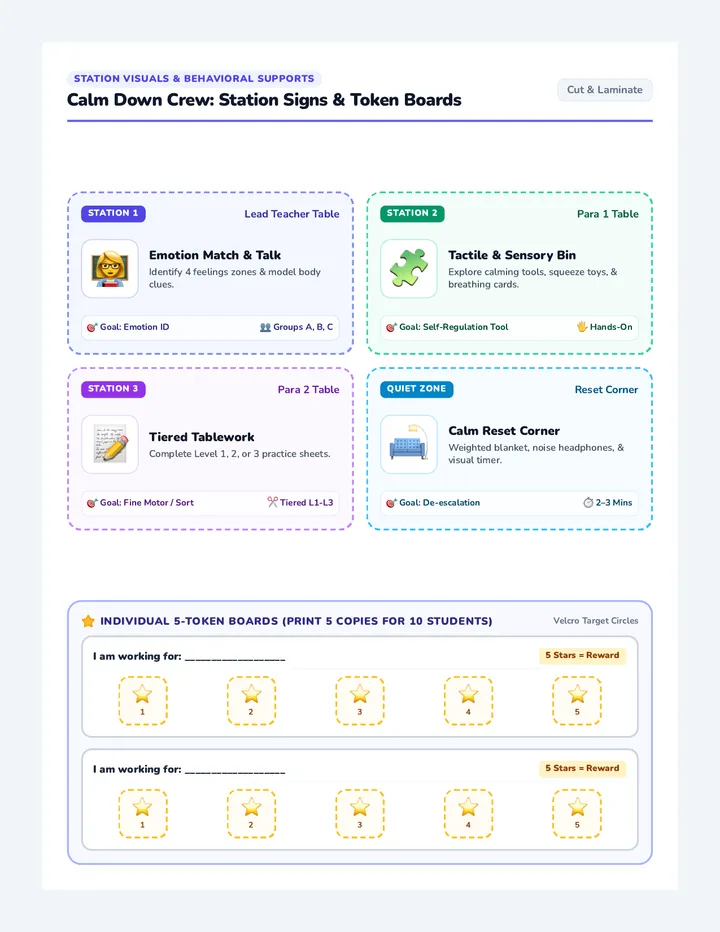
Visual Token System
Designed for positive reinforcement. Deliver tokens instantly following targeted baseline behaviors.
PAGE 2: TOKEN SYSTEM
Option A: 3-Token Visual Board
Use this for rapid reinforcement loops (every 3–5 minutes) to build trust and compliance.
Laminate Board
Working For:
Velcro
Velcro
Velcro
Velcro
Option B: 5-Token Visual Board
Standard classroom system. Use when baseline behavior extends safely beyond 10-minute blocks.
Laminate Board
Working For:
Velcro
Velcro
Velcro
Velcro
Velcro
Velcro
Step 3: Cutout Token Stars (Laminate and add velcro)
PRINT & CUT
Token Economy Rule: Praise must be verbal and immediate (e.g. "I love how you kept your feet quiet, here is a star!"). Do NOT threaten to remove already earned stars as a punishment; doing so breaks the integrity of the board.