Detective Training Slides Training Module 01
Evidence Detectives
Day 1: Cracking the Code
VS
The Mission
Today, you are joining the Evidence Detective Agency.
Our Goal
Use text facts to explain what happened and make smart guesses (inferences).
Key Question
"How do you know that? What is your proof?"
Two Types of Clues
Explicit
"Right There!"
The author says it directly. You can point to it.
Implicit
"In Your Brain!"
The author hints at it. Clues + what you know.
Let's Practice
"Marcus walked into the house, closed his soaking wet umbrella, and shook the water off his boots."
Explicit Fact:
Marcus has an umbrella.
Implicit Inference:
It is raining outside.
How did we know? The "soaking wet" clue!
The Detective's Formula
Text Evidence
(What I see)
My Brain
(What I know)
Inference
Mission Solved!
Ready to Hunt?
Grab your Case File Worksheet. We are going to sort clues to see if they are explicit or implicit!
Explicit Implicit Sort Worksheet Case File: The Sorting Room
Subject: RI.8.1 Evidence
Agent Name: ____________________
Mission: Read each short clue below. Determine if the statement is Explicit (written directly in the text) or an Inference (a smart guess based on clues). Check the correct box.
"The sun beat down on the dry, cracked earth. The farmer wiped sweat from his forehead and looked up at the cloudless blue sky, sighing as he held his empty water jug."
1. The farmer is thirsty.
Explicit (stated directly)
Inference (smart guess)
2. The sky is blue.
Explicit (stated directly)
Inference (smart guess)
"Unlike most big cats, tigers actually enjoy swimming. They often lounge in pools or streams to cool off during the heat of the day."
3. Tigers like water.
Explicit (stated directly)
Inference (smart guess)
4. Tigers live in hot places.
Explicit (stated directly)
Inference (smart guess)
"The lightbulb was invented by Thomas Edison in 1879. Before this, most people used gas lamps or candles to see at night."
5. Candles were common in 1870.
Explicit (stated directly)
Inference (smart guess)
6. Thomas Edison was an inventor.
Explicit (stated directly)
Inference (smart guess)
Detective's Log:
How can you tell the difference between a direct fact (explicit) and a smart guess (inference)?
Day 1 Teacher Guide Teacher Guide: Day 1
Cracking the Code (Explicit vs. Implicit Information)
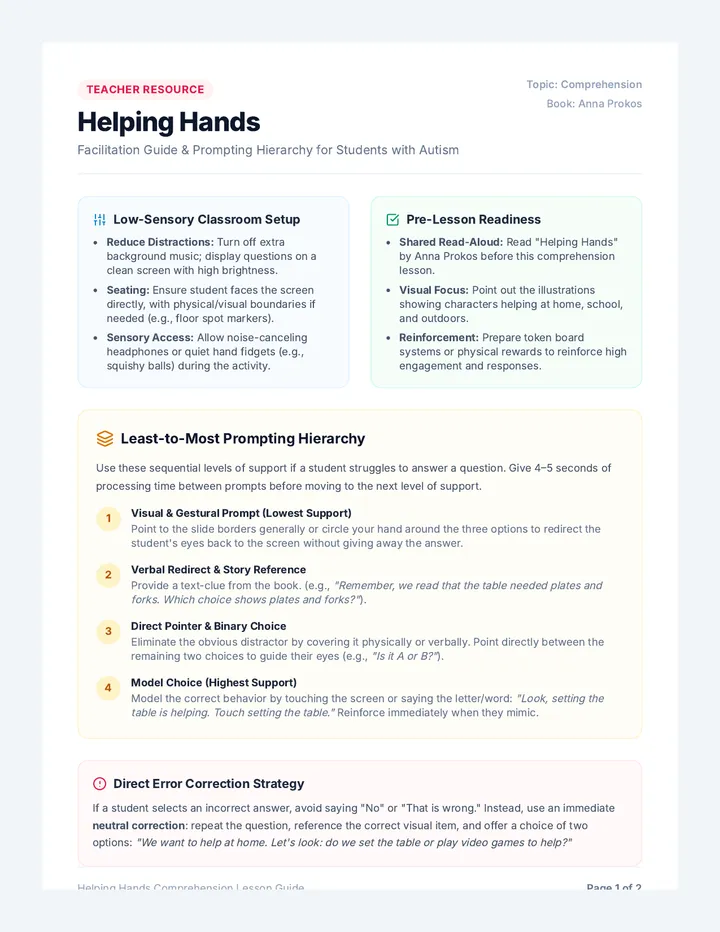
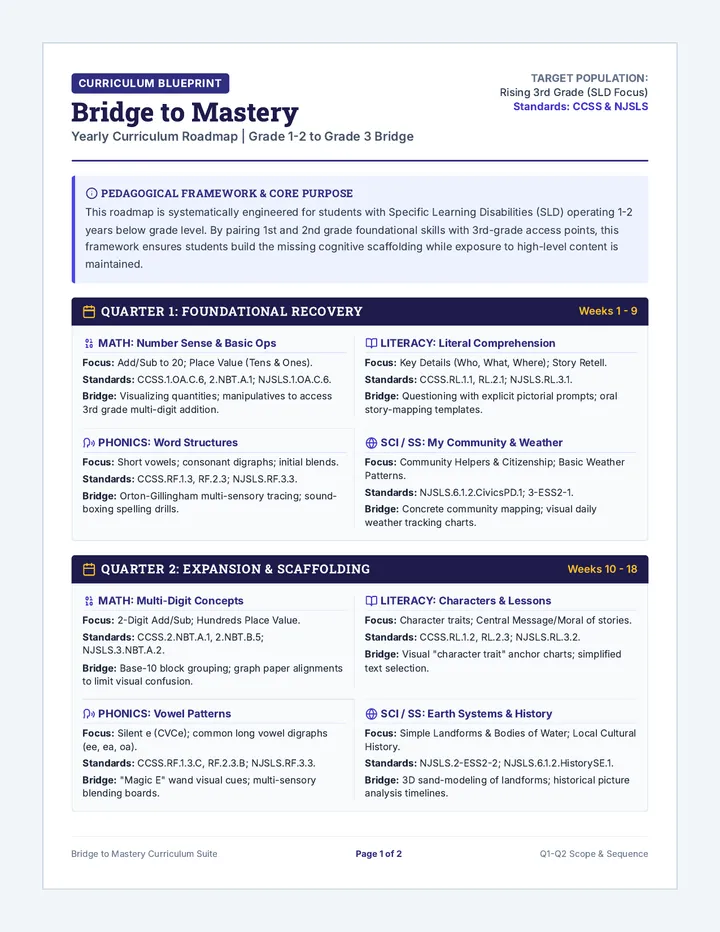
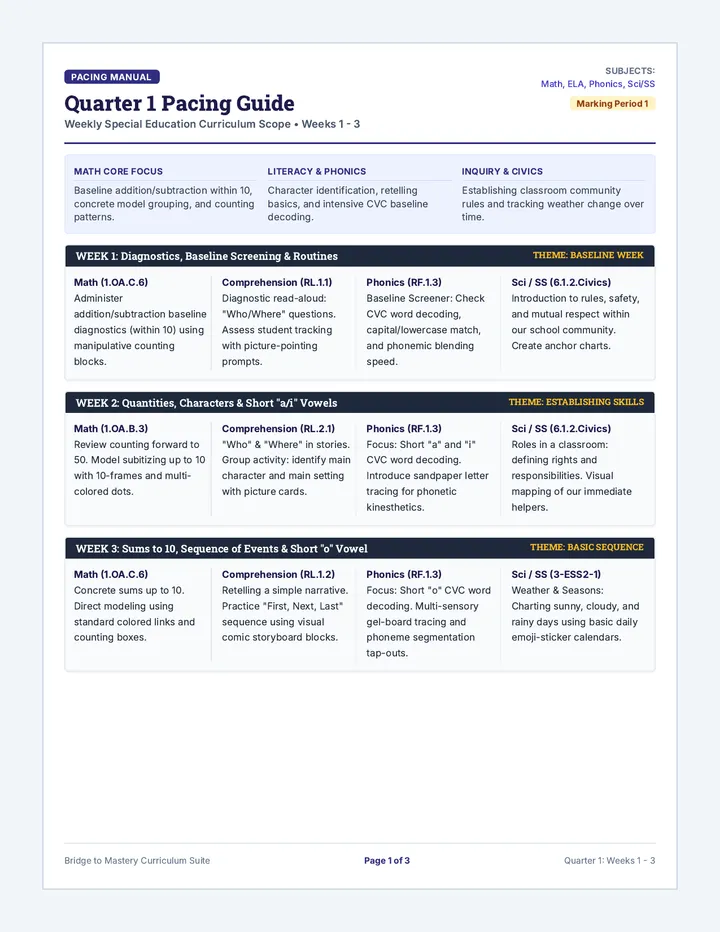
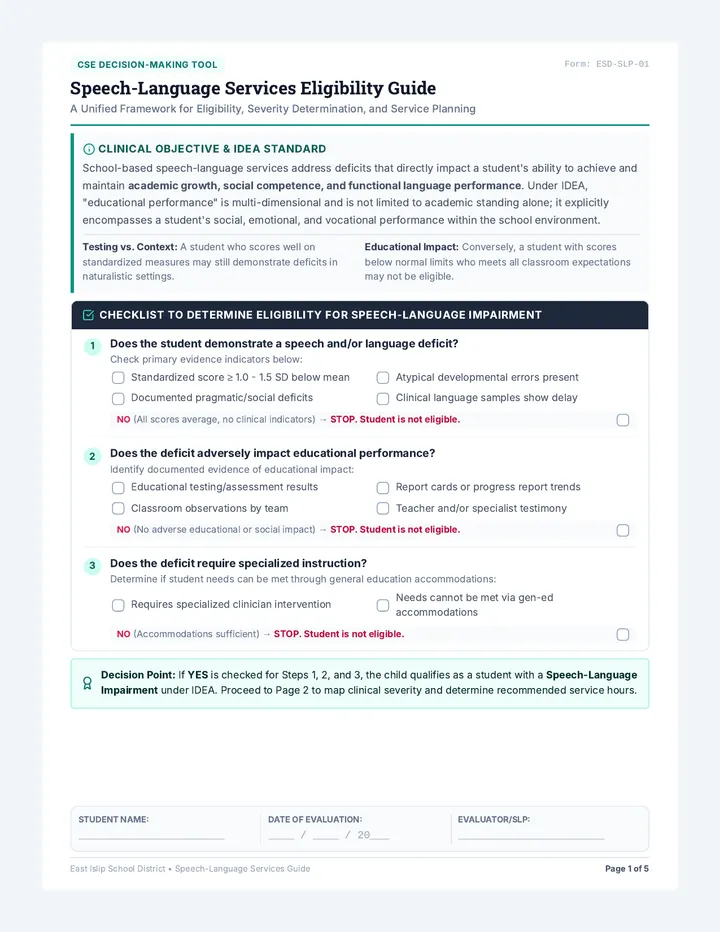
Lesson Objective
Students will distinguish between information stated explicitly in a text and inferences that require background knowledge, setting the foundation for citing textual evidence (RI.8.1).
IEP Accommodations
Visual Metaphors: Use the "Detective Training Slides" to visualize the "Eye" vs. "Brain" difference.
Read Aloud: For students with decoding difficulties, read the sort scenarios aloud. The goal is conceptual understanding.
Highlighter Usage: Have students highlight explicit facts in yellow and circle clues for inferences in blue.
Instructional Flow
Hook (10 min)
Use slides to introduce the "Evidence Detective" persona. Discuss the wet umbrella example to see who already makes inferences naturally.
Instruction (15 min)
Model the Detective's Formula. Show how "Text Evidence + My Brain = Inference".
Practice (20 min)
Guided completion of the Case File: The Sorting Room worksheet. Monitor for "Finger-to-Text" checking.
Sort Worksheet Answer Key
1. Inference: Empty jug & sweat.
2. Explicit: Says "blue sky".
3. Explicit: Says "enjoy swimming".
4. Inference: "Heat of the day".
5. Inference: Used "before" 1879.
6. Explicit: Says "invented by".
Strongest Evidence Slides Training Module 02
The Strongest Clue
Day 2: Picking the Best Evidence
Weak vs. Strong
Weak Evidence
A "sort of" clue. It's related, but doesn't prove it all the way.
Strong Evidence
The "Slam Dunk" clue. It directly proves the claim 100%.
Practice: The Missing Cookies
The Analysis (Claim):
"Someone ate the chocolate chip cookies."
A
Clue #1
"The cookie jar lid was found sitting on the counter."
B
Clue #2
"The dog has chocolate crumbs all over his chin and paws."
Which is the STRONGEST evidence?
Today's Mystery
Investigation Topic:
The Antikythera Mechanism.
An ancient Greek machine found in a shipwreck. It is 2,000 years old and incredibly complex!
Your Task:
Ancient Machine Passage Case File: The Ancient Machine
Subject: RI.8.1 Mastery
Agent Name: ____________________
The Computer of Ancient Greece
1 In the year 1901, divers exploring a Roman shipwreck near the Greek island of Antikythera found something shocking. Among the statues and coins was a lump of green, rusted bronze. It didn't look like much at first, but it would become one of the most famous scientific finds in history.
2 Scientists spent decades studying the object, now called the Antikythera Mechanism . Using modern X-rays, they discovered that inside the rusted shell were dozens of tiny, interlocking bronze gears. This machine was created over 2,000 years ago. Before this find, historians believed that such complex technology didn't exist until the 1300s.
3 What did this ancient machine do? It was a solar system calculator. By turning a small handle, a person could predict when eclipses would happen. It also tracked the movements of the sun, moon, and five planets. It even had a calendar that showed when the Olympic Games would take place!
4 This "ancient computer" was far ahead of its time. The precision needed to build those gears is incredible. It shows that the ancient Greeks had a deep understanding of math and astronomy that was lost for over a thousand years.
Mechanism
A piece of machinery or a tool that does a specific task.
Precision
The quality of being very accurate and exact.
Astronomy
The study of stars, planets, and space.
"Now that you have read the report, use your Evidence Detective Organizer to solve the case!"
Evidence Detective Organizer Evidence Detective Organizer
Subject: RI.8.1 Evidence Mapping
Agent Name: ____________________
Mission Briefing:
For each claim, find the STRONGEST sentence from the report. Write the exact words and the Paragraph # .
Case Claim #1
The machine was more advanced than people expected.
The Strongest Evidence:
Paragraph # _______
Case Claim #2
The machine helped the Greeks track space and time.
The Strongest Evidence:
Paragraph # _______
Case Inference #3
The ancient Greeks were very good at math.
The Strongest Evidence:
Paragraph # _______
Day 2 Teacher Guide Teacher Guide: Day 2
The Strongest Clue (Selecting Strong Evidence)
Lesson Objective
Students will distinguish between weak and strong textual evidence to support specific claims based on the Antikythera Mechanism passage.
IEP Scaffolding
Chunking: Read Paragraph-by-Paragraph.
Visual Support: Use the "Slam Dunk" metaphor for strong evidence.
Wait Time: Provide 30s before revealing the "Missing Cookies" answer.
Organizer Answer Key
Claim 1: Advanced for its time.
"Before this find, historians believed that such complex technology didn't exist until the 1300s." (P2)
Claim 2: Tracked space and time.
"It was a solar system calculator... It also tracked the movements of the sun, moon, and five planets." (P3)
Claim 3: Greeks were good at math.
"It shows that the ancient Greeks had a deep understanding of math and astronomy..." (P4)
Teacher Notes: Ensure students are copying the exact text to practice quoting skills.
Test Strategy Slides Training Module 03
Closing the Case
Day 3: Mastering the Test
Spotting the Trick
On a test, look for this wording:
"Which sentence MOST STRONGLY supports...?"
The Trick:
ALL the answers might be true facts! They want to distract you.
The Secret:
Find the "Perfect Match" for the claim. Skip the "extra" facts.
Strategy: Key Word Match
The Claim (Question):
"The chef was in a hurry."
X
Choice A:
"The chef wore a white hat and an apron."
TRUE, but doesn't prove "Hurry".
Choice B:
"He ran to the stove, dropping his spoon as he rushed."
MATCH! "Ran" and "Rushed" = Hurry.
The 1-2-3 Check
1
Underline the Claim in the question.
2
Circle Key Words in that claim.
3
Pick the answer that Matches those words.
The Great Barrier Reef
Apply your Key Word Match strategy to solve the case!
Exam Mode: Activated
Evidence Mastery Guide 1-2-3 Evidence Check
Day 3: Great Barrier Reef Assessment Analysis
Standard Focus
NC.RI.8.1 Mastery
Assessment Protocol: "The Final Case"
1 Set the Stage
Present the passage as a "Final Case File." Remind students to prove findings using the text.
2 Active Reading
Allow underlining. Provide highlighters for paragraph numbers (P1, P2) for IEP support.
3 The 123 Scoring
Grade MCQ items, then use "Detective's Log" to evaluate reasoning and depth.
The 1-2-3 Diagnostic
Check 1: The Fact Finder (Explicit)
Can the student identify that the reef is made of polyps ?
Target: Q1
Check 2: The Clue Connector (Implicit)
Can the student infer that animal health depends on coral health ?
Target: Q3
Check 3: The Evidence Master (Strongest)
Can the student select the quote about "outer space" and "tourists" ?
Target: Q2 & Q4
Instructional Next Steps
Mistake Analysis Teach Next Missed Q1 Struggles with basic text search/literal comprehension. Focus on scanning and "keyword matching." Missed Q2/Q4 Picks "true" facts that don't prove the claim. Use "Evidence Weight" activity: Sort quotes as Weak or Strong. Mastered All Ready for more abstract informational texts. Independent Study: Write their own "Case Files."
Quick Answer Key
1: Polyps | 2: Outer Space | 3: Health Depends | 4: Tourists
Great Barrier Reef Assessment Final Case: The Living Reef
Evidence Detective Unit Assessment
Subject: RI.8.1
Agent Name: ____________________
The Great Barrier Reef
P1 The Great Barrier Reef is the largest coral reef system in the world. It is so big that it can be seen from outer space! Located off the coast of Australia, it stretches over 1,400 miles long. It is made of billions of tiny coral polyps.
P2 This reef is like an underwater city. It is home to thousands of species, including sea turtles, sharks, and over 1,500 types of fish. It is a "biodiversity hotspot."
P3 However, the reef is in danger. In recent years, the ocean water has become warmer. When it gets too hot, coral polyps turn white ("bleaching") and can die. Without coral, thousands of animals lose their homes.
P4 Protecting the reef is important for the animals and the millions of tourists who visit Australia to see its beauty each year.
1. According to the text, what are coral reefs made of?
Giant underwater rocks found in the deep ocean
Billions of tiny living organisms called coral polyps
Sand and seashells from ancient sea animals
2. Which sentence MOST STRONGLY supports the idea that the Great Barrier Reef is enormous?
"It is located off the coast of Australia."
"It is so big that it can be seen from outer space!"
"The reef is home to thousands of different species."
Detective's Log: Explain your choice
3. Based on Paragraph 3, what can you infer about the reef animals?
The animals prefer to live in white coral.
The animals will find a new home in the deep ocean.
The health of animals depends on the health of the coral.
4. Which evidence BEST explains why the reef is important to Australia's economy (money)?
"Groups are trying to reduce pollution and keep the ocean cool."
"Millions of people visit Australia to see its beauty every year."
"Scientists call the reef a 'biodiversity hotspot' for many types of life."