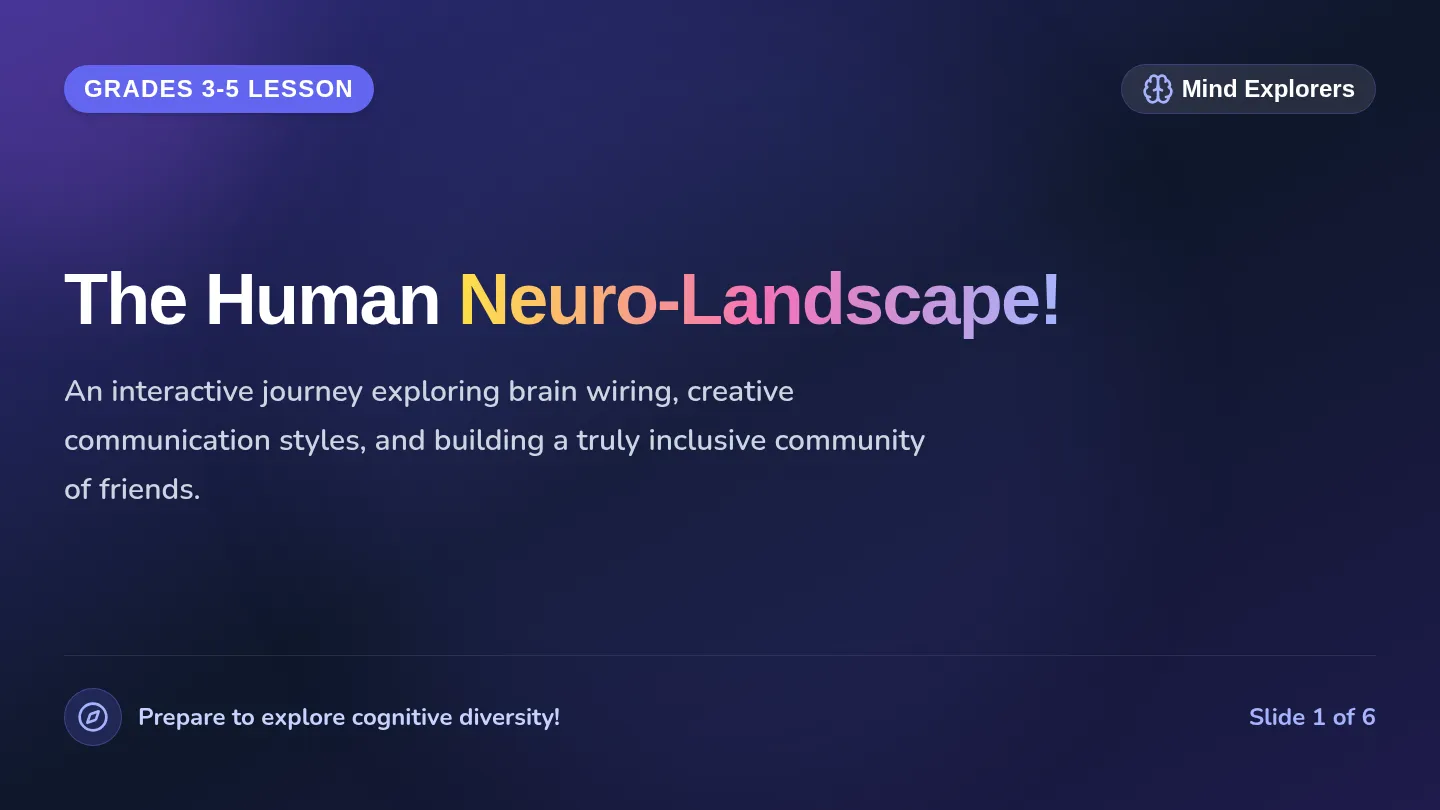
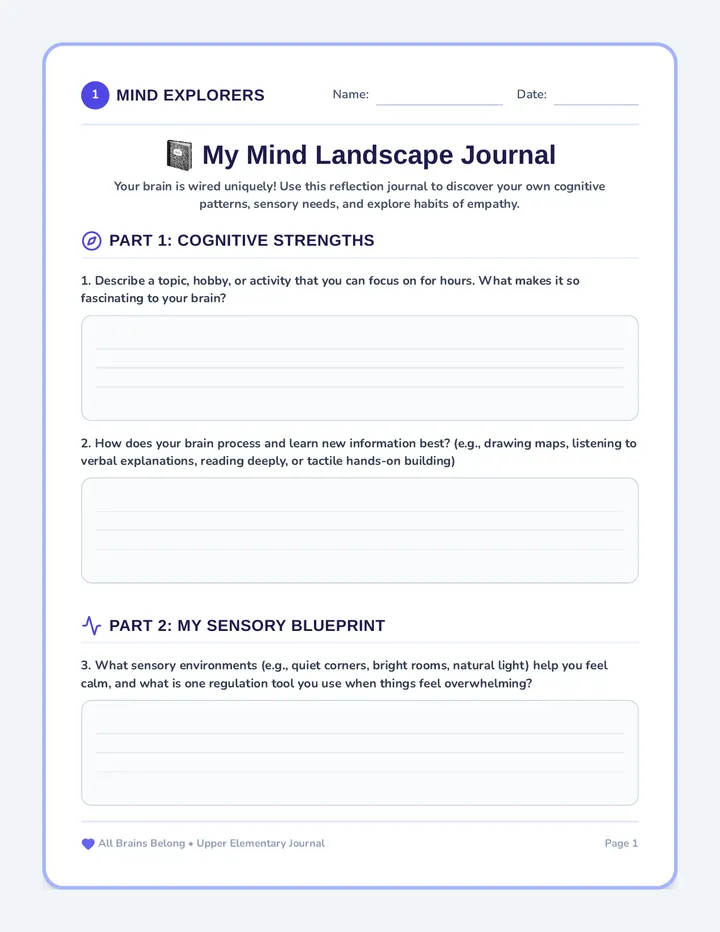
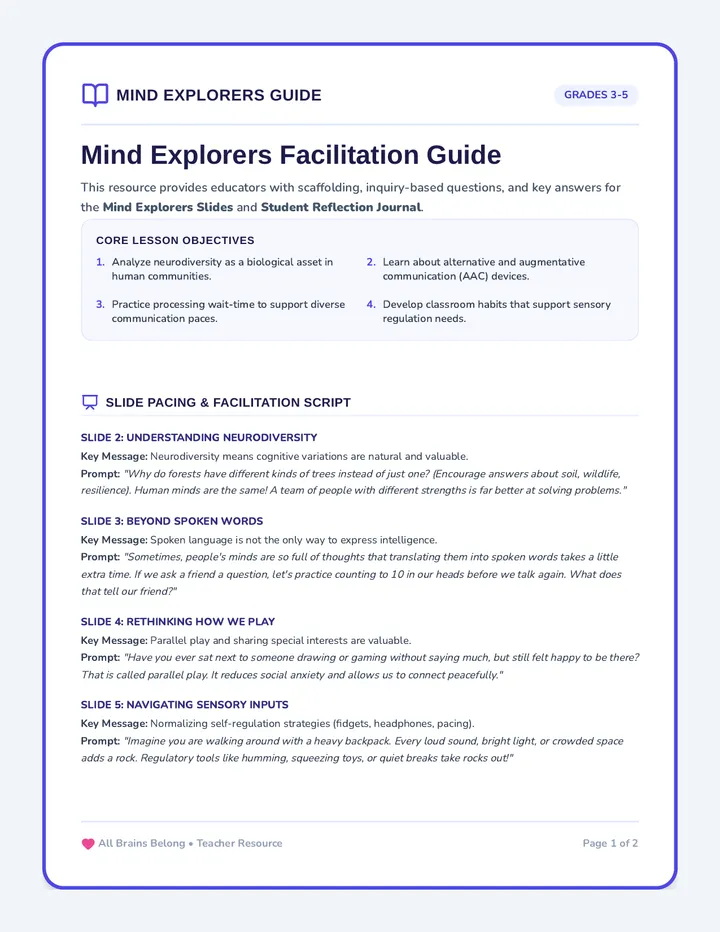
A comprehensive educational unit celebrating neurodiversity, acceptance, and inclusive communication across elementary grades. It equips educators with slide presentations and reflection tools tailored for K-2 and 3-5 students to cultivate empathetic classrooms.

"In the big frame, draw what makes your brain shine! You can draw yourself building with blocks, reading a favorite book, wiggling, or drawing. There are no wrong answers!"
Accommodations:
2 Page 2: The All-Belong Playground Matching
Objective: Demystify and build empathy for sensory tools and support devices. Teacher Script:"Look at Leo, Maya, and Sam. They all play and feel comfortable in different ways! Let's help them find their perfect helper." Matching Key:
• Leo (sensitive ears) ➔ 🎧 Calm Headphones (blocks out loud noises).
• Maya (needs to wiggle/spin) ➔ 🤸♀️ Active Trampoline (bounces and spins safely).
• Sam (needs quiet space) ➔ ⛺ Cozy Corner (quiet mini-tent for calm breaks).
🛠️ Continuous Classroom Integration Tips
✦ Incorporate Wait-Time: Introduce the "5-second rule" before anyone raises a hand to answer. This supports processing delays.
✦ Establish a Safe Cozy Corner: Create a physical classroom tent with noise-canceling headphones, dim lighting, and fidgets. Ensure it is seen as a tool, not a punishment.
✦ Validate Play Styles: Explicitly praise students engaging in parallel play during free time: "I love how beautifully you two are building lego structures near each other!"
All Brains Belong • Teacher Resource
Page 2 of 2
How to invite a classmate:
"Hey, I'm drawing some comics over here. You are totally welcome to draw yours right next to me if you'd like!"
This reduces pressure and builds a shared, low-sensory safe space.
Inclusivity means building pathways for everyone to participate on their own terms!
Slide 4 of 6
4. Sensory Systems
Mind Explorers
🔊
Sensory Load
Noises, fluorescent lights, and crowd chatter pile up inside the brain like a heavy backpack.
🎛️
Self-Regulation
Actions like hand-flapping, humming, pacing, or utilizing stress balls help unload the sensory backpack.
🎧
Sensory Supports
Noise-canceling headphones, tinted sunglasses, or sitting in calm, designated spaces.
🌱
Respecting Breaks
Allowing peers to step away into quiet zones during group work without asking intrusive questions.
Navigating Sensory Inputs
Some minds feel sensory environments much more intensely. What feels like quiet background noise to you might feel like a roaring stadium to a classmate.
Providing access to fidget tools and quiet zones protects everyone's ability to focus and feel comfortable!
Normalizing self-regulation makes the entire classroom feel safe for everyone.
Slide 5 of 6
Inclusion Plan
Mind Explorers
Empathy In Action!
Being an inclusive classmate means turning understanding into daily, positive habits. How can you help?
"I will speak clearly, listen patiently, respect sensory tools, and welcome many ways to play."
Daily Inclusion Checklist:
👥
Invite classmates to hang out near you, even if it's quiet play.
🗣️
Respect all ways of talking (verbal, signs, iPads, picture cards).
🤫
Keep classroom spaces calm and respect someone's need for quiet breaks.
Our promise: In this classroom, all minds are valued, respected, and heard!
Slide 6 of 6
1 Part 1 & 2: Strengths & Sensory Blueprints
Focus: Self-discovery and normalizing individual processing and sensory profiles. Discussion Guidance: Allow students to share their special interests. Normalize that some students seek sensory stimulation (e.g., squishing fidgets, moving around) while others avoid sensory stimulation (e.g., wearing headphones, sitting in dim areas). Both styles are helpful!
2 Part 3: Scenario Analysis (Julian & AAC Device)
Focus: Converting intellectual empathy into concrete communication habits. Exceptional Student Answers should include:
• Waiting patiently (10-15 seconds) without finishing Julian's sentences.
• Maintaining open, relaxed body language and welcoming facial expressions.
• Actively looking at Julian's screen if invited, or pointing to shared paper mockups.
• Never mocking, rushing, or excluding Julian from speaking or decision-making.
🏫 Continuous Classroom Inclusion Practices
✦ Incorporate Wait-Time (Grades 3-5): Model slow transitions and wait-time during all academic lessons. Count to 10 silently when asking questions before selecting a responder.
✦ Destigmatize Regulation Tools: Ensure squishy toys, wobbling stools, and headphones are accessible to any student who needs them, rather than strictly as a special accommodation.
✦ Introduce the "No-Pressure" Invite: Teach students to use invitations that have a high comfort level (e.g., "Would you like to join, or do you want to play quietly near us?").