Master Facilitation Guide Tier 3 Intensive Behavior Intervention
"I Need" Script Guide
8-Session Coping & Request Replacement Strategy • Grades K-2
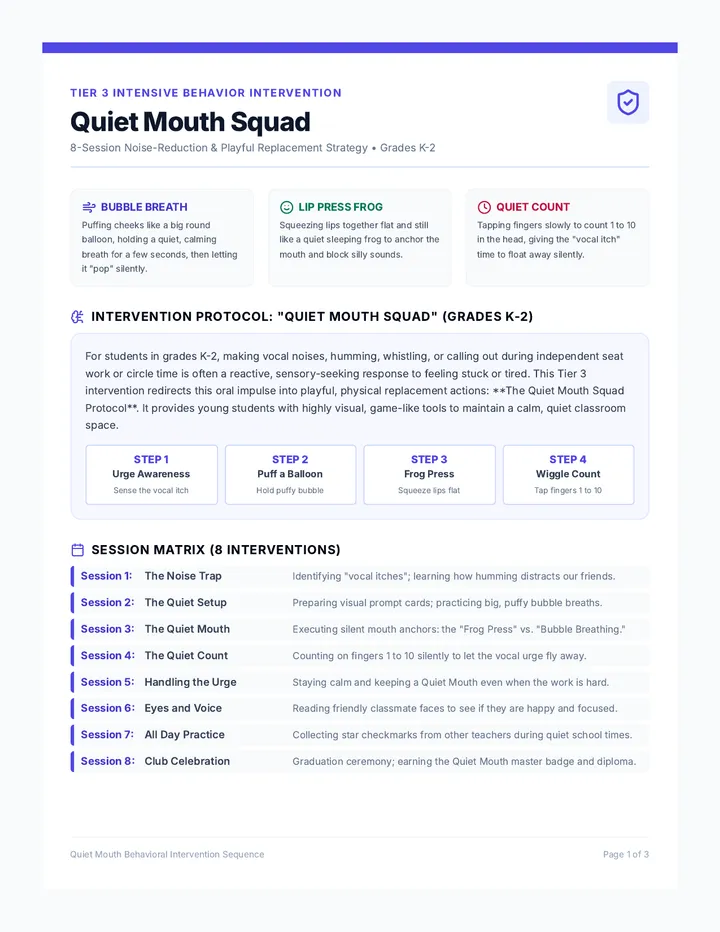
HELP & BREAK ICONS
A visual card on their desk with clear, simple picture icons, giving young students a concrete non-verbal point-to option to execute when stuck.
"HELP/BREAK, PLEASE"
Teaching students to say "Help, please" or "Break, please" in a calm voice, replacing vocal protests (screaming, whining, saying "No!").
SELF-REGULATION
Simple self-calming (3 deep breathing bubbles) and waiting strategies tailored to young minds while teachers finish teaching.
Intervention Protocol: "I Need" Script (Grades K-2)
For students in grades K-2, vocal protesting (screaming, whining, or saying "No!") when stuck on academic tasks is a highly reactive response to frustration or communication blocks. This Tier 3 intervention redirects this frustration into a structured, very simple physical and verbal routine: **The Point & Ask Protocol**. It provides young learners with a clear, stress-free path to support while maintaining a quiet, positive classroom environment.
STEP 1 Frustration Alert "My brain feels stuck!"
STEP 2 Stop & Breathe 3 calm belly breaths
STEP 3 Point & Script Point & say script
STEP 4 The Calm Wait Quietly waiting
Session Matrix (8 Interventions)
Session 1: The Scream Trap Whining/Screaming vs Calm waiting; how outbursts delay help.
Session 2: The Script Setup Desk cards setup; practicing the 3-breath "bubble" breathing.
Session 3: The I Need Script Pointing to visual icons and stating "Help, please" or "Break, please".
Session 4: The Help Count Counting slowly to 10 in our head or on our fingers after asking.
Session 5: Handling the Wait Staying calm and waiting quietly when the teacher is busy with friends.
Session 6: Reading the Signal Recognizing the teacher's quiet signals (nod, thumbs up, hold on).
Session 7: All Day Practice Generalizing "Help, please" across specialists (Art, Music, PE, STEM).
Session 8: Club Celebration Graduation ceremony trials; transitioning to classroom maintenance.
I Need Script Behavioral Intervention Sequence Page 1 of 3
Tier 3 Intensive Behavior Intervention
Lesson Plans: Sessions 1 to 4
Part 1
1 Session 1: The Scream Trap
Duration: 15-20 Min
Learning Target: I can recognize when screaming, whining, or saying "No!" hurts my learning and makes help take longer.
Success Criteria: I can identify 3 reasons why whining is a trap, and choose the calm wait route.
Step 1: Simple Story: Read a very simple visual scenario showing how whining or screaming stops the class. Introduce the "Scream Trap" (making noise forces the teacher to calm us down first, delaying actual help with work).
Step 2: Interactive Roleplay: Teacher models a whiny child vs a calm child. Discuss which child gets their math paper solved faster.
2 Session 2: The Script Setup
Duration: 15-20 Min
Learning Target: I can keep my Help & Break desk card ready and take 3 deep quiet breaths when stuck.
Success Criteria: I can point to my card, and take 3 deep "bubble blowing" breaths when stuck.
Step 1: Desk Cards: Mount the simple Help & Break card to the desk. Practice keeping hands ready.
Step 2: Bubble Breathing: Model feeling stuck on a tough puzzle, taking 3 deep, quiet breaths immediately instead of whiny crying. Trace the circles on the worksheet to count.
3 Session 3: The I Need Script
Duration: 15-20 Min
Learning Target: I can point to my desk icon and ask calmly: "Help, please" or "Break, please".
Success Criteria: I can point to either the Help or Break picture, and state the calm phrase level-1.
Step 1: Core Replacement: Teach that pointing to the desk card and speaking in a calm voice is our magic key. It tells the teacher exactly what we need without making a scene.
Step 2: Guided Rehearsal: Practice pointing and saying "Help, please" or "Break, please" in a calm, sweet voice. Praise quiet motor control.
4 Session 4: The Help Count
Duration: 15-20 Min
Learning Target: I can count slowly to 10 on my fingers or in my head to wait calmly.
Success Criteria: I can point, ask calmly, and count slowly from 1 to 10 in my head or with calm toe taps.
Step 1: The Wait Buffer: Explain that teachers need up to 10 seconds to finish helping other classmates.
Step 2: Dual Action: Rehearse pointing, saying the script, and executing a slow internal count. Play the board game to practice.
I Need Script Behavioral Intervention Sequence Page 2 of 3
Tier 3 Intensive Behavior Intervention
Lesson Plans: Sessions 5 to 8
Part 2
5 Session 5: Handling the Wait
Duration: 15-20 Min
Learning Target: I can stay calm and wait quietly if my teacher is busy helping a classmate.
Success Criteria: I can wait calmly for up to 20 seconds after pointing or asking without screaming or whining.
Step 1: Busy Classrooms: Discuss times when the teacher is explaining directions or helping a peer. The wait is longer, but the calm point-to card holds your spot.
Step 2: Self-Talk: Teach students to think: "My teacher knows I need a break or help. I pointed to my card. I am safe to wait." Rehearse.
6 Session 6: Reading the Signal
Duration: 15-20 Min
Learning Target: I can read my teacher's quiet signals to know they see my pointed icon.
Success Criteria: I can identify "I see you, one minute" nods, open hand signals, and available focus cues.
Step 1: Reading Cues: Teach visual and physical signals. A teacher giving a thumbs-up or a small nod means they see the request. They will arrive soon.
Step 2: Evaluation: Analyze scenario cards. Rehearse holding a calm body when the teacher nods.
7 Session 7: All Day Practice
Duration: 15-20 Min
Learning Target: I can use my "I Need" Script and icon pointing in other classrooms (art class, music room, gym).
Success Criteria: I can collect self-monitoring and teacher signatures across three distinct classrooms.
Step 1: Generalizing the Script: Inform other specialists about the pointing and calm "Help/Break, please" protocol. Rehearse with the student before specials.
Step 2: Self-Monitoring: Use the tracker to record daily checkmarks.
8 Session 8: Club Celebration
Duration: 15-20 Min
Learning Target: I can celebrate my growth as a master of the "I Need" Script and calm waiting technique.
Success Criteria: I can pass the graduation roleplay assessment independently under high-distraction conditions.
Step 1: Reflection & Review: Review progress charts, noting the drop in vocal protesting (screaming, whining, saying "No!").
Step 2: Ceremony & Maintenance: Run a graduation roleplay in front of support staff. Present the "I Need Script Master Certificate." Set up the maintenance cue card for the student's general classroom desk.
I Need Script Behavioral Intervention Sequence Page 3 of 3
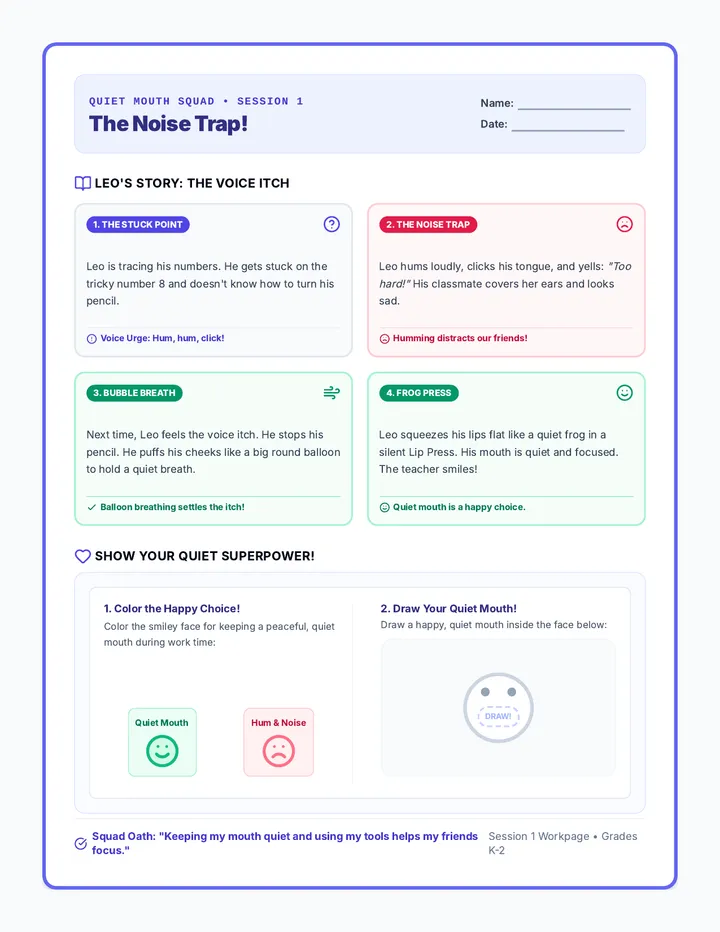
Scream Trap Story Worksheet I Need Script Club • Session 1
The Scream Trap!
Name:
Date:
Leo's Story: Getting Stuck on Work!
PANEL 1: OH NO!
Leo is working on a tough coloring worksheet. He gets stuck and doesn't know what to do next. He feels frustration starting inside.
Frustration: "This is too hard!"
PANEL 2: THE WHINE TRAP
Leo screams, whines, and says "No, I won't do it!" . The teacher has to stop teaching. Now Leo has to wait a long time for help.
Screaming and whining delay help!
PANEL 3: STOP & BREATHE
Next time, Leo gets stuck. He stops, drops his pencil, and takes 3 slow, deep "bubble" breaths. His body engine calms down!
Breaths quiet down the panic.
PANEL 4: THE CALM SCRIPT
Leo points to his desk's **Help** picture and says calmly: "Help, please!" The teacher smiles and helps him right away!
Calm scripting gets you help fast!
What is the Best Choice?
Color or Circle the Best Answer:
Does whining or screaming get help faster?
NO YES
Does a calm voice get help faster?
NO YES
Trace this word: C A L M
My Happy, Calm Face:
Draw your face when you point to your icon and say "Help, please" calmly.
Club Oath: "I point and ask calmly, 'Help, please!'"
Session 1 Workpage • Grades K-2
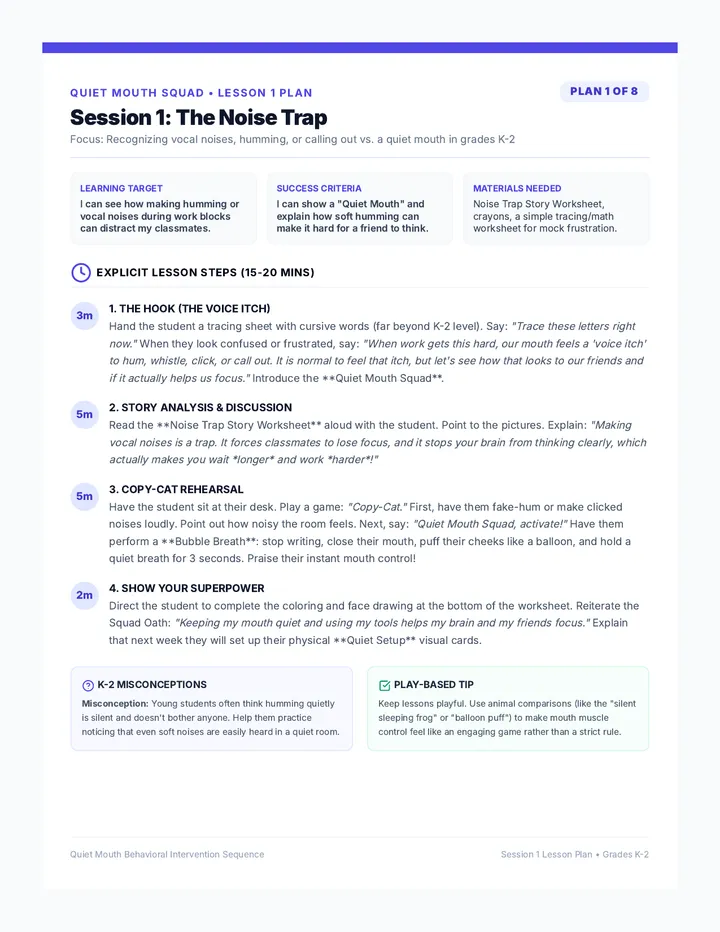
Scream Trap Lesson Plan I Need Script Club • Lesson 1 Plan
Session 1: The Scream Trap
Focus: Recognizing frustration triggers and vocal protesting vs. calm requests in grades K-2
Plan 1 of 8
Learning Target
I can understand that screaming, whining, or saying "No!" makes getting help take longer.
Success Criteria
I can identify the "whine trap" and point to the calm face as the best way to get help.
Materials Needed
Scream Trap Story Worksheet, crayons/pencils, a difficult coloring worksheet for mock frustration.
Explicit Lesson Steps (15-20 mins)
3m
1. The Hook (The Tough Puzzle)
Hand the student a coloring page with complex teeny-tiny shapes, or double-digit math. Say: "Color all of this perfectly right now." When they look stuck, pretend to be busy. Then say: "When work gets hard, our body engine gets hot! The urge to scream, whine, or say 'No!' is very big, but let's see why that is a trap!" Introduce the **I Need Script Club**.
5m
2. Story Analysis & Discussion
Read the **Scream Trap Story Worksheet** aloud. Highlight Leo's frustration in Panel 2. Explain: "Whining, crying, or shouting 'No!' is a trap. It forces the teacher to pause and focus on calming you down, which actually makes you wait *longer* before you get help with your work!"
5m
3. Calm Body vs. Whiny Body
Have the student sit at their desk with the tough paper. Rehearse the contrast. First, have them pretend to whine loudly: "I can't do this!" Pause and point out how noisy and tight their shoulders feel. Next, have them perform a **Calm Reflex**: stop writing, lay their hands flat, and take 3 deep "bubble blowing" breaths. Praise their instant body control!
2m
4. Simple Choices
Have the student complete the bottom section of the worksheet: circle YES or NO, trace the word "CALM", and draw a simple happy smile in the box. Reiterate the Club Oath: "I point and ask calmly, 'Help, please!'"
Common Misconceptions
Misconception: Young kids often think loud noises get teachers to run over faster. Teach them that teachers must wait until they are calm and quiet before helping.
Teacher Tips
Use concrete terms. Tell them screaming "breaks" the teacher's ears. A calm, quiet body is "strong and ready" for faster support.
I Need Script Behavioral Intervention Sequence Session 1 Lesson Plan • Grades K-2
Help Card Poster I Need Script Club Protocol
The "I Need" Signal
The calm, clear way to let your teacher know what you need when stuck!
1
Feeling Stuck?
Notice when your face feels hot, or you want to whine, scream, or say "No!". Stop writing.
2
Stop & Breathe
Put down your pencil. Clasp your hands together and take 3 deep "bubble blowing" breaths.
3
Point to the Picture
Point your finger at either the **Help** (question mark) or **Break** (calm cloud) picture on your desk card.
4
Ask with Calm Script
Say in a soft, quiet, whispering voice: "Help, please!" or "Break, please!" and wait patiently.
The "Stop & Breathe" Training Challenge
Let's practice! When you feel stuck on a tough puzzle, can you immediately stop, drop your pencil, and take 3 deep, silent belly breaths? Color in your happy clouds:
Breath 1
Breath 2
Breath 3
Breath 4
Breath 5
Pointing to your icon and using a calm voice shows excellent self-control. Post in Classroom • Grades K-2
Help Card Setup Lesson Plan I Need Script Club • Lesson 2 Plan
Session 2: The Script Setup
Focus: Body-breathing regulation and organizing desk-mounted Help & Break tools for K-2
Plan 2 of 8
Learning Target
I can organize my desk to keep my Help & Break card ready and use deep breathing when I feel stuck.
Success Criteria
I can show exactly where my desk card sits and take 3 deep, quiet "bubble" breaths when stuck.
Materials Needed
Help Card Poster, Help & Break desk card, tape/velcro, a bubble-blower (optional, for concrete modeling).
Explicit Lesson Steps (15-20 mins)
3m
1. The Hook (The Bubble Engine)
Explain: "When we get stuck on tough work, our body's motor gets hot and wants to whine or scream! Today we learn how to cool down our motor by blowing imaginary giant bubbles. This slow, quiet breathing helps our brains think clearly so we can point to our desk card."
5m
2. Poster Breakdown & Teacher Modeling
Review the **Help Card Poster** (Focus on Step 1: Feeling Stuck and Step 2: Stop & Breathe). Teacher models looking at a worksheet, wiggling shoulders (sensing tension), putting down the pencil immediately, clasping hands, and taking 3 slow, deep breaths, pretending to blow giant bubbles. Show how this stops the whine monster.
5m
3. The "Bubble Breath" Challenge
Give the student a coloring page. Tell them: "Begin coloring. When I tap the desk, that means you are stuck." Student begins. Tap the desk. The student must immediately drop their crayon, clasp their hands, and execute 3 slow, deep "bubble" breaths. Repeat 3 times, praising their physical self-control.
2m
4. Tracker Setup & Calibration
Show the student how to check off their 5 practice clouds on their poster. Mount the Help & Break icon card securely to the corner of their desk. Emphasize that calming their physical body engine is a major strength, showing teachers that they are responsible and ready for harder work.
Silent Prompt Rule
If the student begins to whimper or freeze, use a silent hand cue (clasping your own hands together and breathing deeply) to remind them of the breathing steps instead of a verbal correction. This builds independent self-monitoring.
Cognitive Connection
Treat the desk setup as "executive task control." K-2 students respond very well to being treated as responsible "grown-up" school helpers when practicing these physical self-regulation techniques.
I Need Script Behavioral Intervention Sequence Session 2 Lesson Plan • Grades K-2
Silent Anchor Slides I Need Script Club • Session 3
"I Need" Script
The "I Need" Script
Let's learn how to ask for help or a break calmly! Just point to your card and say: "Help, please" or "Break, please".
Point to Icon
Calm Spoken Words
Academic Frustration & Self-Regulation (Grades K-2) Slide 1 of 5
I Need Script Club • Step 1 Pointing to Icons
Point to the Picture
Point your finger directly to the **Help** or **Break** picture on your desk card. This gives your hands a quiet, safe task to do right away when you feel frustrated.
Why it works:
It stops the whiny feeling immediately and shows your teacher exactly what you need without shouting!
1
Rehearse:
Keep your finger still and flat on the picture icon!
Keep other hand still!
Choral Practice: Pointing cleanly while maintaining a quiet mouth Slide 2 of 5
I Need Script Club • Step 2 Speaking Calmly
Use Your Soft Whispering Voice
While pointing to the picture, say your calm "I Need" Script in a soft, quiet voice:
Our Calm Scripts:
"Help, please!"
"Break, please!"
2
Rehearse:
Say your script at level-1. Whisper slowly and clearly!
No whiny or crying voices!
Speak in a calm voice. Point, ask, and wait silently. Slide 3 of 5
I Need Script Club • Scenario Active Analysis
Leo Gets Stuck on a Puzzle
Leo is coloring a worksheet. He gets stuck and doesn't know what to do next. Let's look at his choices:
The Whining Trap
Leo whines, screams "No, I can't do this!" and throws his crayon. The teacher stops teaching. Now Leo has to wait a long time.
Stop & Breathe
Leo puts down his crayon immediately, clasps hands, and takes 3 slow bubble-breaths to calm down his body engine.
Point & Ask
He points to his Help picture and says calmly: "Help, please!" in a quiet voice. He waits calmly and gets help fast!
Who can demonstrate Leo's successful "I Need" Script approach? Slide 4 of 5
I Need Script Club • Commitment Pledge
The "I Need" Agreement
"When I feel stuck, I will stay calm,
point to my Help or Break picture,
and say in a quiet, whispering voice:
'Help, please!' or 'Break, please!'
and wait calmly for my teacher to arrive!"
You are equipped with a powerful, calm tool to get support in your classroom.
Help Card Lesson Plan I Need Script Club • Lesson 3 Plan
Session 3: The "I Need" Script
Focus: Pointing to Help/Break icons and using calm "Help/Break, please" requests for K-2
Plan 3 of 8
Learning Target
I can point to my desk card and say: "Help, please" or "Break, please" in a calm whispering voice.
Success Criteria
I can point to my desk picture and speak my simple calm verbal script calmly.
Materials Needed
Silent Anchor Slides, display screen, desk Help/Break card, crayons, stopwatch.
Explicit Lesson Steps (15-20 mins)
3m
1. The Hook (Our Magic Words)
Explain: "We have learned to calm down our body's hot engine. Now we need our magic verbal keys! When we get stuck on hard work, pointing to our Help or Break picture and whispering 'Help, please' or 'Break, please' is like sending a quiet rocket straight to the teacher! This brings us help so much faster than whiny noises."
5m
2. Slide Presentation & Script Training
Open the **Silent Anchor Slides**. Present Slide 2 (Pointing to Icons) and Slide 3 (Speaking Calmly). Show the dual action: point with one finger flat, then speak in a soft level-1 whispering voice. Contrast this with loud, whiny crying or shouting "No!". Run choral repetition of the two scripts.
5m
3. Guided Point-and-Ask Rehearsal
Pretend to grade papers. Give the student a simple coloring assignment. Tap their desk to signal "stuck." The student must immediately drop their pencil, take a slow belly breath, point their finger on the "Help" picture, and say calmly: "Help, please!" Walk over immediately, tap their desk, and say: "Thank you for asking with your calm voice. I will help you now!" Repeat 3 times (and alternate with "Break, please!").
2m
4. Help Card Commitment
Display Slide 5. Read **The "I Need" Agreement** together in a fun call-and-response chant. Have the student repeat the pledge: "I will stay calm, point to my card, and ask calmly!"
Level-1 Whisper Rule
For K-2, keep the voice level strictly at a whisper. High-pitched whine triggers can be avoided by having students physically touch their index finger to the desk icon, anchoring their physical attention.
Immediate Reward
Praise immediately with tangible social reinforcement: "You pointed so beautifully and asked quietly! That makes my teacher ears happy!"
I Need Script Behavioral Intervention Sequence Session 3 Lesson Plan • Grades K-2
Ask and Count Game I Need Script Club • Session 4 Game
The "Point and Ask" Board Game
Name:
Date:
How to Play: Flip a coin (Heads = move 1 box, Tails = move 2). When you land on an "Academic Challenge" box, look at the picture. Stand up, take a slow breath, point to your Help or Break picture on your desk card, and say in a calm whispering voice: "Help, please!" or "Break, please!" . Count to 10 slowly on your fingers before your turn ends!
Start
Go!
Box 1
Math Puzzle
Box 2
Science Fun
Box 3
Coloring Page
Box 6
Tablet Game
COUNT TO 10!
Take a breath, point to your card, ask calmly, and count:
1, 2, 3, 4, 5, 6, 7, 8, 9, 10!
Box 4
Spelling Words
Box 7
Cut & Paste
Box 8
Map Work
Box 9
Singing ABCs
Box 10
Art Craft
My Game Stars
Box 11
Traced Letters
Finish
Win!
Color My Waiting Heart
When I wait calmly for my teacher, my heart feels happy and proud!
Calm Body
Whisper Voice
Smiling Mind
"I Need" Script Strategy Training
Lesson 4 Workpage • Grades K-2
Ask and Count Lesson Plan I Need Script Club • Lesson 4 Plan
Session 4: The Help Count
Focus: Integrating the 10-second wait buffer for K-2 students
Plan 4 of 8
Learning Target
I can use a 10-second slow wait buffer to keep my body calm after asking for help.
Success Criteria
I can point, ask calmly, and execute a slow 10-second count on my fingers.
Materials Needed
Point and Ask Game Board, coin for flipping, crayons, pencils.
Explicit Lesson Steps (15-20 mins)
3m
1. The Hook (The Finger Train)
Explain: "In grades K-2, pointing and asking calmly 'Help, please' is step one. Step two is waiting. Sometimes teachers are finishing a sentence and cannot come over instantly. We need to learn how to keep our bodies calm during this wait. We call this the '10-Second Wait Count'—we count slowly to 10 on our fingers, like a slow train rolling down the track!"
5m
2. Direct Modeling (10-Second Finger Count)
Model sitting down, feeling stuck on a coloring block, dropping your pencil, pointing to the Help picture, and whispering: "Help, please!" Take a slow, quiet breath, and lift your fingers one by one: 1, 2, 3, 4, 5, 6, 7, 8, 9, 10. Show how still and quiet your body remains during this count.
5m
3. Board Game Play
Introduce the **Point and Ask Board Game**. Flip coins to move. When landing on a challenge, the student must point to their card's picture, say: "Help, please!" or "Break, please!" , and execute a slow 10-second count on their fingers or by toe tapping. Helper checks off their scorecard.
2m
4. Strategy Reflection Work
Direct the student to complete their "Waiting Hearts" coloring activity at the bottom of the game sheet, coloring in the hearts as they promise to keep a calm body, use a whisper voice, and smile while waiting.
Speed Warning
K-2 students often speed-count (e.g. 1-to-10 in 1 second). Practice deep, slow belly breaths on every third number to pace their counting safely.
Working Memory Focus
Counting on fingers occupied motor channels, which dampens the physiological drive to whine or shout "No!" when frustrated.
I Need Script Behavioral Intervention Sequence Session 4 Lesson Plan • Grades K-2
Handling No Comic I Need Script Club • Session 5
Handling the Wait
Name:
Date:
Coping Routine: Responding When the Teacher is Busy
1
Keep Pointing
Keep your finger on the Help icon. Do not whine or repeat the words.
2
Breathe & Wait
Breathe slowly and think: "My teacher knows I need help. I can wait safely."
3
Hands Ready
Keep hands flat on table, or color a simple star calmly while waiting.
Scenario Analysis: Leo Handles a Busy Classroom
PANEL 1
The Delay
Leo drops his pencil, points to his Help icon, and asks calmly: "Help, please!" . The teacher is typing. She looks up and nods, but says:
Teacher Says:
"I see your finger, Leo! Keep waiting calmly for 1 minute while I finish this."
PANEL 2
Breathe & Wait
Leo feels hot. He wants to whiningly scream. Instead, he holds his body still, takes 3 breaths, and repeats:
"She knows I'm waiting."
"I am safe to wait."
"My body is calm."
PANEL 3
Your Turn!
Trace the words of what Leo can do while waiting:
B R E A T H E W A I T
Self-Regulation Check: I maintained a quiet waiting body even when the teacher was busy.
Teacher Verified
I Need Script Club Co-Director
Lesson 5 Workpage • Grades K-2
Handling No Lesson Plan I Need Script Club • Lesson 5 Plan
Session 5: Handling the Wait
Focus: Emotional self-regulation and silent waiting in high-demand environments for K-2
Plan 5 of 8
Learning Target
I can wait calmly when my teacher is helping other friends in class.
Success Criteria
I can point to my card, use my calm whispering voice, and wait calmly for 20 seconds.
Materials Needed
Handling the Wait Comic, crayons, pencils, stopwatch.
Explicit Lesson Steps (15-20 mins)
3m
1. The Hook (Impatience Cues)
Explain: "In school, our teachers are very busy helping lots of classmates. Sometimes when you point to your Help picture, your teacher is spelling a word for a friend. The wait is longer. If we get mad and whine or scream, we make it harder for the teacher to help. Today we learn how to handle the wait!"
5m
2. Direct Modeling (The Waiting Routine)
Demonstrate: Sit at desk. Point to your Help icon, say your calm script: "Help, please!" , and look at a helper playing the teacher. Helper says: "Keep waiting calmly, Ms. Lopez sees you pointing but I must finish helping Jane first." Model feeling impatient (puffy breath, slight sigh), then model the coping routine: 1. Keep your finger flat on the card calmly, 2. Whisper-reframe: "My teacher knows I need help. I can wait safely," and 3. Trace a star on your paper calmly.
5m
3. Guided Rehearsal (The "Wait Challenge")
Instruct the student to perform their icon pointing and calm script. Nod immediately, but say: "I see your finger. Hold your pose, I have to finish writing this letter first." Start a stopwatch. The student must wait completely still and silent for 20 seconds. Turn and provide immediate, high-value praise: "You waited for 20 full seconds with a beautiful quiet body! That is expert-level self-control!"
2m
4. Comic Tracing
Have the student trace the dashed words **BREATHE** and **WAIT** in Panel 3 of their **Handling the Wait Comic**. Discuss how proud they are of their waiting powers.
Emotion Validation
For K-2, keep the concept very simple: "Waiting is hard and sometimes makes our tummy feel tight. But we can take deep breaths and keep our finger on our card. The feeling will pass."
Generalization Tip
Inform general education teachers that when the student points to their desk card, they should nod or wave slightly to acknowledge them immediately. This quick validation acts as a secure container, making waiting much easier for K-2 students.
Eyes and Voice Cards I Need Script Club • Lesson 6 Cards
Reading the Signal
Name:
Date:
Acknowledgment Cues
Look at your teacher's face when you point to your icon and say "Help, please". A small nod or a thumbs-up means: "I see you, I will come help you soon!"
Silent Posture Rules
Once the teacher nods, keep your hands still, your body calm, and wait in silence. The teacher has you in their queue!
CARD 1
Reading Group
Scenario: Mr. Davis is helping friends read at the table. You need help with your drawing folder.
The Signal: He looks at you, nods once, and holds up one finger.
Practice: Wait calmly. Count slow 1-10 on fingers.
CARD 2
Visiting Adult
Scenario: The principal walks in to talk to Mrs. Garcia. You are stuck on coloring and want help.
The Signal: Mrs. Garcia is talking to the visitor. She doesn't see your finger yet.
Practice: Keep finger flat on icon. Wait calmly.
CARD 3
Writing at Desk
Scenario: Ms. Lopez is sitting at her desk writing. She looks up, sees you pointing to your card, and smiles.
The Signal: She stands up and starts walking over to help you!
Practice: Smile, stay seated, and wait.
CARD 4
Phone Call
Scenario: The office phone buzzes and Ms. Patel is talking on it. You need a crayon.
The Signal: She is talking. She waves her hand down slightly to signal "hold on a second."
Practice: Wait calmly with hands in lap.
Cut Along Dashed Lines Above
Detective Check: Student correctly identified teacher acknowledgment states on all cards!
✓
Passed Roleplay
Help Card Detective Squad
Lesson 6 Workpage • Grades K-2
Eyes and Voice Lesson Plan I Need Script Club • Lesson 6 Plan
Session 6: Eyes and Voice
Focus: Reading teacher acknowledgment signals and eye cues for Grades K-2
Plan 6 of 8
Learning Target
I can look at my teacher's face to see if they noticed my calm request.
Success Criteria
I can see my teacher's thumbs-up or nod and keep my body quiet while waiting.
Materials Needed
Eyes and Voice Cards sheet, scissors, desk, folder, Help/Break desk card.
Explicit Lesson Steps (15-20 mins)
3m
1. The Hook (Eye Detectives)
Explain: "In school, we are Eye Detectives! When we point to our desk card and say 'Help, please', we need to look with our detective eyes at our teacher. Does the teacher nod their head? Do they give a thumbs-up? If they do, they are sending us a quiet secret code that says: 'I see you, hold on!' Today we practice reading these secret codes!"
5m
2. Teaching Teacher Signals
Teach the visual codes: 1. **The Nod** (head up and down) = "I see you!", 2. **The Thumbs-Up** = "Awesome waiting!", 3. **The Finger Hold-On** (one finger raised) = "Give me one minute, I will be right over!". Teacher models acting out a busy reading group, looking up at a child pointing to their card, and giving a friendly thumbs-up.
5m
3. Card Detective Rehearsal
Review the **Eyes and Voice Cards**. Rehearse Card 1 (Reading Group) and Card 3 (Writing at Desk). Have the student perform their Point & Script routine, then look for your nod or thumbs-up. Once seen, they must smile and wait in absolute silence. Repeat with busy phone call signals where teacher signals "hold on."
2m
4. Evaluation
Verify that the student makes calm eye contact, relaxes their shoulders, and waits calmly without whiny repeating or pouting. Check the validation box at the bottom of the cards sheet.
Neurodiverse Adaptations
If the student finds eye contact stressful, teach them to look for the teacher's hand signals (like the thumbs-up) or general head nod without requiring sustained direct eye-to-eye contact.
Reinforcement Tips
Praise the timing choices: "You looked at my face, saw my nod, and waited calmly like a true Eye Detective! That was a super choice."
I Need Script Behavioral Intervention Sequence Session 6 Lesson Plan • Grades K-2
All Day Practice Tracker I Need Script Club • Lesson 7 Tracker
Script Tracker
Name:
Date:
My School Mission: Take this tracker to different classes. Show your **Calm Reflex**, **pointing to your Help/Break icon**, and saying **"Help, please!"** or **"Break, please!"** calmly. Ask teachers to catch you practicing your super waiting powers!
1. STEM & Computer Lab
Point to your desk picture and say "Help, please!" calmly when stuck on tablet logins, coding blocks, or mouse clicks. Wait calmly.
M
✓
T
✓
W
✓
Th
✓
F
✓
2. Library & Media Center
Point to your Help/Break picture and say "Help, please!" when seeking a book location or stuck on writing. Wait quietly.
M
✓
T
✓
W
✓
Th
✓
F
✓
3. Art Studio & Gym
Point to your desk picture and use your calm spoken script when stuck on craft folds, painting steps, or game rules. Wait calmly.
M
✓
T
✓
W
✓
Th
✓
F
✓
My Super Waiting Drawing
Draw yourself pointing to your Help icon with a big happy smile!
Help Card Generalization Map
Lesson 7 Workpage • Grades K-2
All Day Practice Lesson Plan I Need Script Club • Lesson 7 Plan
Session 7: All Day Practice
Focus: Generalization across school-wide classrooms in grades K-2
Plan 7 of 8
Learning Target
I can use my "I Need" Script and icon pointing in other classrooms (art, music, gym, STEM).
Success Criteria
I can collect 3 real-world checkmarks on my tracker from other school adults.
Materials Needed
Script Tracker, Help & Break desk card, pencils, clipboard, teacher signatures.
Explicit Lesson Steps (15-20 mins)
3m
1. The Hook (The Generalization Challenge)
Explain: "We've proven our skills in our specialized sessions, but our real classroom reputation as self-regulated students is built when we carry our 'I Need' script out into the school! A true Master uses their calm voice and pointing in art class, music room, gym, and STEM environments. Today we launch your school-wide mission."
5m
2. Preparing the Tracker Protocol
Review the **Script Tracker**. Break down the three focus settings: 1. STEM & Tech Lab, 2. Library & Media Center, 3. Art Studio & Gym. Discuss specific challenges in these areas (e.g. computer login stuck, library research stuck, art craft paper stuck). Rehearse pointing to the Help/Break icon and speaking the calm "Help, please" request phrase.
5m
3. High-Difficulty Simulation
Set up simulated setups. Mock a busy Art Studio where fine-liner details are hard. Have the student sit at their desk, feel mock frustration, point to their Help icon, use their calm request script "Help, please!", and wait in silence for 20 seconds. Praise perfect motor control.
2m
4. Staff Coordination & Goal Setting
Provide the student with their clipboard tracker. Coordinate with the STEM teacher, librarian, and art/music teachers. Explain that they will check off or initial a slot on the tracker when they observe independent, calm script requests and icon pointing.
Self-Advocacy Focus
If specialists are busy, teach the student to self-advocate at the end of class by politely asking: "Mr. Davis, did you observe me using my 'I Need' Script and waiting calmly during computer work today?"
High Reinforcement
Connect general education performance with strong incentives. Provide a high-tier reinforcer (e.g. choice computer time or acting as teacher helper) once 3 validated checks are collected in one day.
I Need Script Behavioral Intervention Sequence Session 7 Lesson Plan • Grades K-2
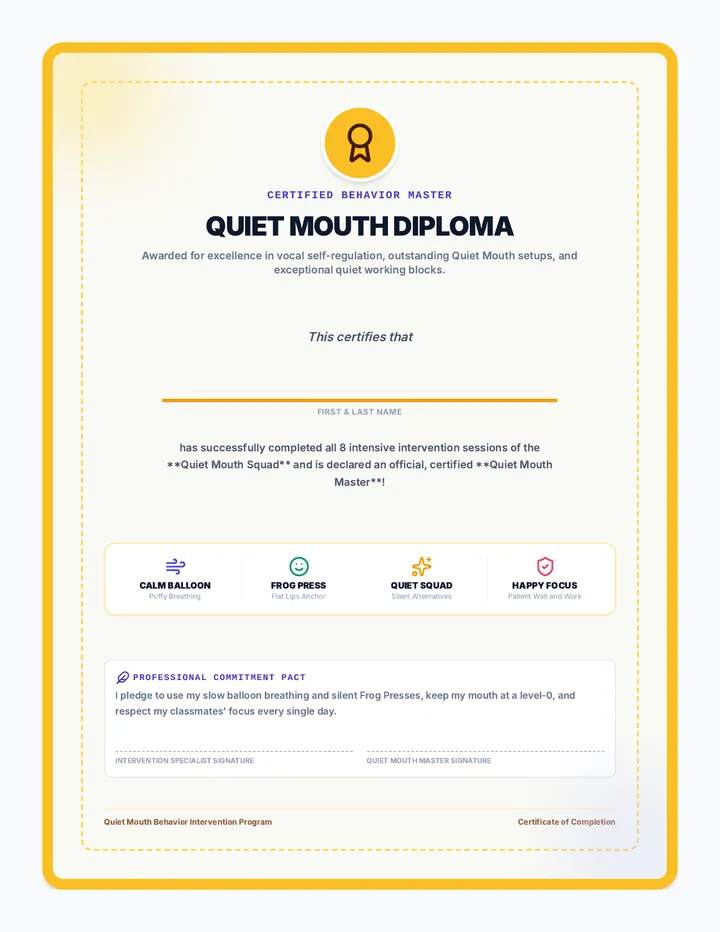
Club Celebration Certificate Certified Behavior Master
I Need Script Diploma
Awarded for excellence in academic frustration regulation, advanced Script setup, and outstanding quiet waiting behavior.
This certifies that
First & Last Name
has successfully completed all 8 intensive intervention sessions of the **I Need Script Club** and is declared an official, certified **I Need Script Master**!
Bubble Breath Calming Breath
Desk Setup Pictures Ready
Point & Ask Calm Voice Script
Coping Power Patient Waiting
My Promise Pact
I promise to stay calm when stuck, point to my Help or Break picture, say in a quiet, whispering voice "Help, please!" or "Break, please!", and wait calmly every single day.
Teacher Signature
Script Master Signature
I Need Script Behavior Intervention Program Certificate of Completion
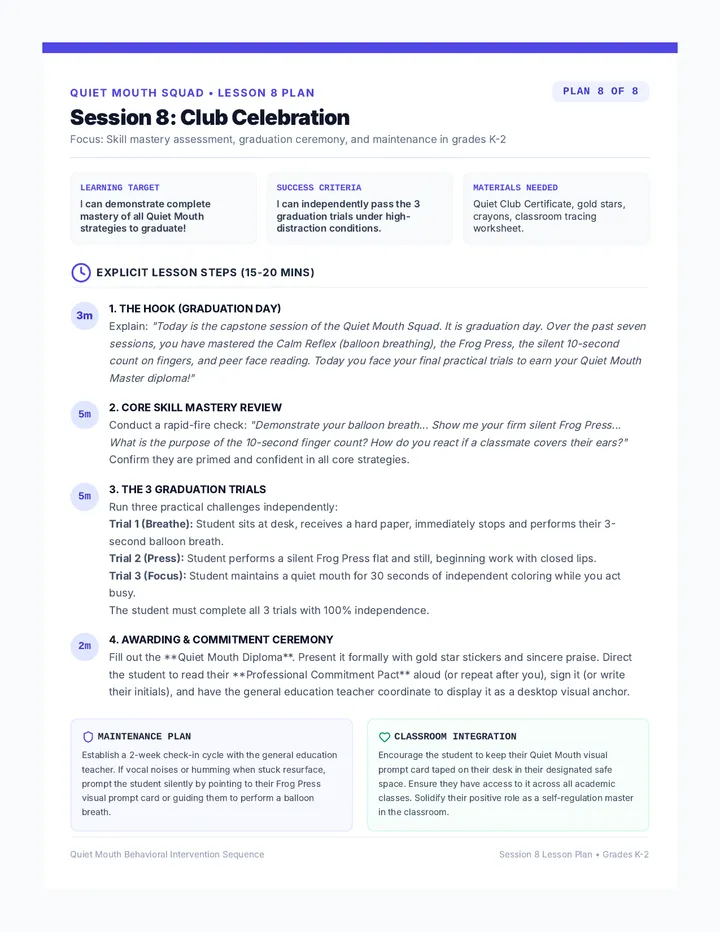
Club Celebration Lesson Plan I Need Script Club • Lesson 8 Plan
Session 8: Club Celebration
Focus: Skill mastery assessment, graduation ceremony, and maintenance in grades K-2
Plan 8 of 8
Learning Target
I can demonstrate complete mastery of all "I Need" Script strategies to graduate!
Success Criteria
I can independently pass the 3 graduation trials under high-distraction conditions.
Materials Needed
Celebration Certificate, crayons, gold seals, pens, classroom math worksheet.
Explicit Lesson Steps (15-20 mins)
3m
1. The Hook (Graduation Day)
Explain: "Today is the capstone session of the I Need Script Club. It is graduation day! Over the past seven sessions, you have mastered the Calm Reflex, the desk setups, pointing to pictures, saying 'Help, please' in a calm whisper voice, and waiting calmly. Today you face your final 3 trials to graduate as a Script Master!"
5m
2. Core Skill Mastery Review
Conduct a rapid-fire check: "Demonstrate your Bubble breaths... Show me your desk icon pointing... What do you say in a whisper voice? How do you count to 10 slowly on your fingers? What do you do if I am busy with another friend?" Confirm they are primed and confident in all core strategies.
5m
3. The 3 Graduation Trials
Run three practical challenges independently:
Trial 1 (Breathe): Student sits at desk, receives a hard paper, immediately stops and performs their 3 "bubble blowing" breaths.
Trial 2 (Signal): Student points to their Help or Break icon and says in a whispering voice: "Help, please!" , keeping their body still and relaxed.
Trial 3 (Wait): Student maintains a quiet body while you help another classmate for 20 seconds.
The student must complete all 3 trials with 100% independence.
2m
4. Awarding & Commitment Ceremony
Fill out the **I Need Script Diploma**. Present it formally with sincere praise and maybe a high-five! Direct the student to read their **Promise Pact** aloud, sign it (or write their name), and have the general education teacher coordinate to keep it displayed as a desktop visual anchor.
Maintenance Plan
Establish a 2-week check-in cycle with the general education teacher. If vocal protesting (screaming, whining, saying "No!") when stuck resurfaces, prompt the student silently by pointing to their desk card.
Classroom Integration
Encourage the student to keep their Help/Break card taped to the corner of their desk. Ensure they have access to it across all academic classes. Solidify their positive role as a self-regulation master in the classroom.