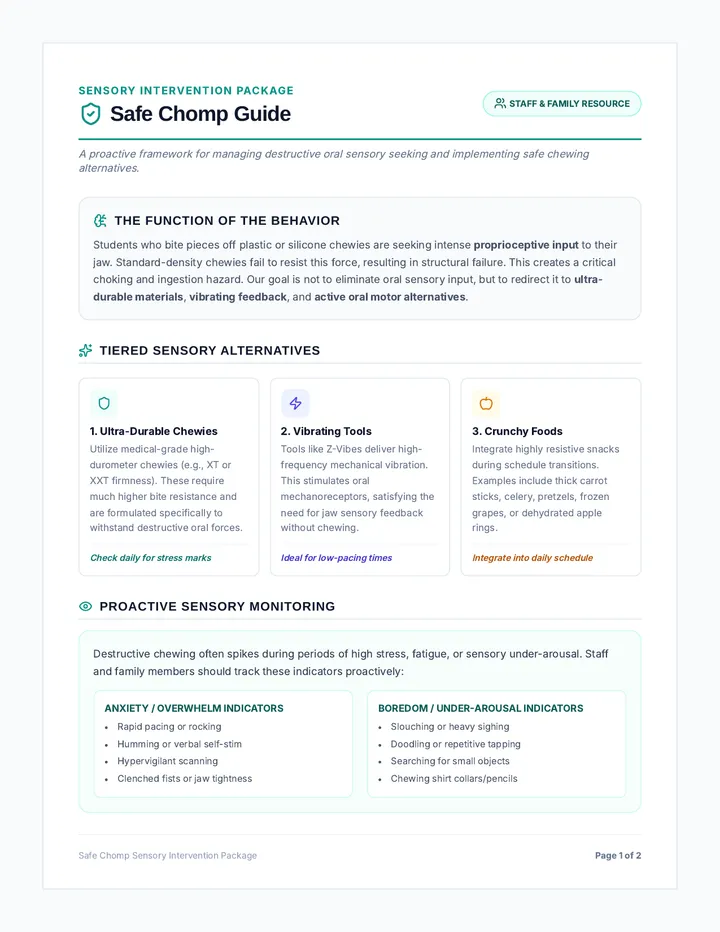
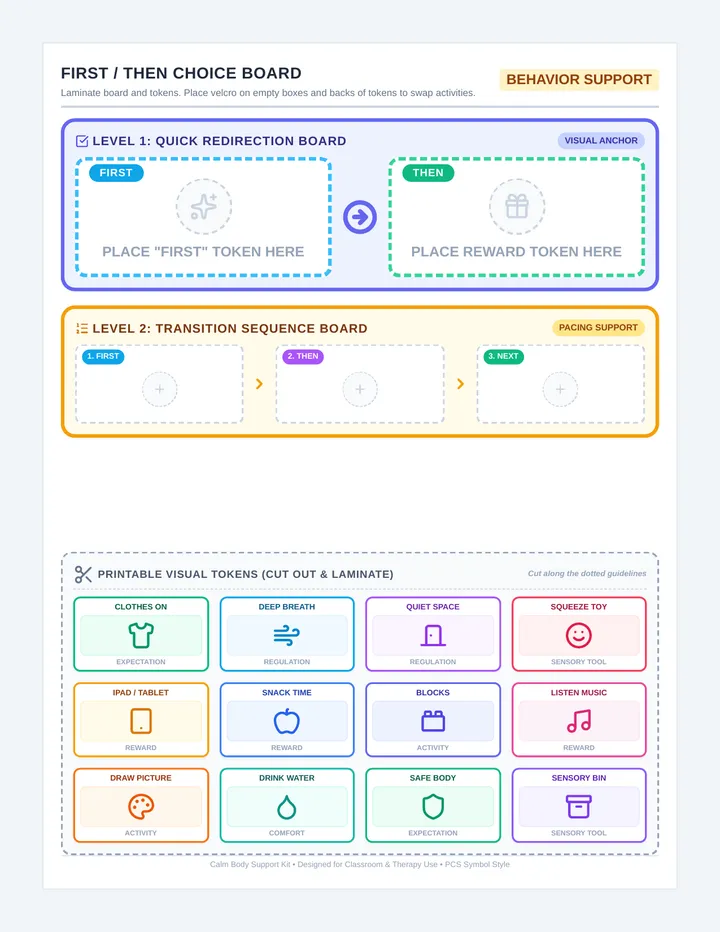
Classroom reference poster for Lesson 4, summarizing how to identify 'Hot Spots' and providing quick strategies for sensory regulation.
An answer key for the Word Safari Practice Worksheet, covering syllable division and affix building. Updated for consistency with the practice sheet.
A two-page practice worksheet for syllable division (VCCV and VCV) and affix building (prefixes and suffixes) with a safari explorer theme. Improved spacing and clean student work areas. Corrected scrambled definitions and affix sentence consistency.
A combined resource featuring a social story to help students manage choice-based frustration and a behavior reflection worksheet for processing desk-flipping incidents.
A comprehensive teacher-facing guide providing insights into the functional behavior of desk-flipping, as well as specific instructional strategies for implementing forced-choice interventions.
An answer key for the Hidden Valley Worksheet, including a pattern reference guide for VCV, VCCV, and affixes. Optimized to fit on a single page.
A two-page reading passage and comprehension worksheet focused on VCCV, VCV, and prefix/suffix patterns with a jungle expedition theme. Darkened legends and writing guides for better visibility. Simplified layout for clean PDF rendering. Corrected word classifications. Increased work area spacing.
An exemplar answer key for the Theme Investigation log using the story "The Tortoise and the Hare" to demonstrate the granular evidence-gathering process.
A guide for teachers providing scaffolding strategies for executive function and comprehension, plus a universal theme bank.
A high-contrast, text-focused slide deck that guides students through 5 specific pieces of evidence to reach a final theme conclusion, designed for clarity and focus.
A simplified, granular detective-themed graphic organizer that breaks theme identification into 6 specific evidence pieces with expanded writing space and no distracting visuals.
A high-contrast, black-and-white Peace Flower coloring page designed for students to practice conflict resolution strategies while being creative. Features a second page with cut-out communication cards for AAC support.
A sophisticated, district-branded slide deck for 4-5th grade students on device leadership, reframed for a classroom cart environment with desk-primary and floor-optional workspaces. Includes Interactive Modeling. Standardizes sidebar branding for UCSD.
A teacher guide for 4-5th grade students on Chromebook care, featuring the updated learning objective and success criteria while covering all core device care habits. Reframed for classroom cart environment. Includes Interactive Modeling.
A district-branded slide deck for 2-3rd grade students on device guardianship, featuring updated learning objectives and success criteria. Standardizes sidebar branding for UCSD. Focuses on desk workspace setup and includes explicit Interactive Modeling steps. Revised for sidebar consistency and contrast.
A teacher guide for 2-3rd grade students on Chromebook care, featuring the updated learning objective and success criteria while covering all core device care habits. Includes Interactive Modeling for setting up a safe desk workspace. Fixes page break issues.
A district-branded slide deck for K-1 students on Chromebook care, featuring the updated learning objective and comprehensive care habits. Standardizes sidebar branding for UCSD.
A teacher guide for K-1 students on Chromebook care, featuring the updated learning objective and success criteria while covering all core device care habits. Includes Interactive Modeling for moving with the device.
A simplified scenario-based practice worksheet for students using AAC or who are minimally verbal. Features clear icons and single-choice answers to reinforce the best Peace Petal for common conflicts.
A parent handout designed to support inclusive conflict resolution at home, providing tips for families of students who use AAC or are minimally verbal to practice the 'Peace Petals' framework.
An inclusive, highly visual slide deck for the 'Peace Petals' lesson, featuring simplified text, large icons, and symbol support to engage students who are minimally verbal or use AAC.
Visual scenario cards designed for students who are minimally verbal or use AAC. Each card features a clear, icon-based conflict and a selection of the four Peace Petals for easy communication and choice-making.
A specialized communication board for recess, featuring key vocabulary for conflict resolution, the four Peace Petals, and basic playground needs. Ideal for students using AAC or who are minimally verbal.
A visual-choice worksheet for students who are minimally verbal or use AAC, featuring large icons and simplified options for communicating recess problems and solutions.
A visual poster and a set of mini-reminders featuring high-contrast symbols and simplified text to support students who are minimally verbal or use AAC.
A teacher-facing facilitator guide for the inclusive 'Peace Petals' lesson, providing specific strategies for supporting students who are minimally verbal or use AAC.
A hands-on cut-and-paste sorting activity where students categorize visual cards into 'Body Clues' (physical signs of anger) and 'Expected Choices' (appropriate calm-down actions). Cards use neutral colors to ensure students sort based on meaning rather than color-matching.
A high-contrast, step-by-step visual poster for classroom display. It outlines a four-step process (Stop, Feel, Breathe, Choose) to help students manage anger, using large numbered icons and simple directives. All steps fit on a single page for optimal visibility.
A multi-page social story designed for students with low cognitive functioning. It uses simple language, large icons, and clear visual cues to explain what anger feels like in the body and how to make calm, expected choices.
A simplified, high-visual social story for 2nd graders with low cognitive function, teaching the emotional and behavioral steps of waiting for a turn.
Large, high-contrast visual cue cards for classroom use, featuring "Stop," "Wait," "Go," and "Breathe" signals to support turn-taking transitions.