Math IEP Goals Reference Guide
EdPlan Compliant Grade 7 Mathematics
Standards-Based IEP Goals & Objectives
Present Levels Aligned
Format: Given [C], [S] will [B], [Ext]
Baseline Present Levels
Targeted standards: 7.EE.B.4.a (Equations with variables on either/both sides) & 7.RP.A.2.d (Graph interpretation, unit rate & slope).
EdPlan Goal Formulation Syntax
{Given [Condition]}, [Student] will {[Targeted Skill/Behavior]}, {to this extent [Criteria]}.
Domain 1
Expressions & Equations • 7.EE.B.4.a
Linear Equations (Variables on Either Side)
Annual Measurable Goal Target: 36 Weeks
Given grade-level algebraic word problems and linear equations featuring variables on either or both sides of the equal sign (e.g., \(px + q = r\), \(r = px + q\), or \(ax + b = cx + d\)), [Student] will formulate the algebraic equation, apply inverse operations to collect like terms and isolate the variable, and state the solution with appropriate context units, with at least 80% accuracy across 4 out of 5 consecutive bi-weekly curriculum-based probes.
1.1 Objective 1: Scaffolding with Balance Model Organizer & Step Checklist
Benchmark: Q2
Given a structured balance-scale graphic organizer and a 4-step self-monitoring checklist for balancing equations with variable terms on either side, [Student] will translate word scenarios into equations and solve for the unknown variable using inverse operations, achieving at least 80% accuracy on 3 consecutive progress monitoring probes with minimal teacher prompting.
Condition: Balance organizer + checklist
Behavior: Formulate & isolate variable
Criteria: 80% acc. (3 consecutive probes)
1.2 Objective 2: Independent Multi-Step Equations with Rational Numbers
Benchmark: Q3
Given 5 unprompted grade-level word problems involving positive/negative rational numbers and variable terms positioned on either side of the equation, [Student] will independently define the variable, write the linear equation, and compute the exact solution, scoring at least 4 out of 5 items correct (80%) on 4 out of 5 independent work samples.
Condition: Independent grade-level probes
Behavior: Define variable, write & solve
Criteria: 4/5 items (80%) on 4/5 samples
IEP Team Guidance: Transition student from visual balance models to abstract symbolic equations by Q3.
Page 1 of 2
EdPlan Compliant Goal Area 2 & Implementation
Proportional Graphs, Unit Rate & Slope
Standard: 7.RP.A.2.d
Progress Monitoring Framework
Domain 2
Ratios & Proportional Relationships • 7.RP.A.2.d
Graph Interpretation: (0,0), (1,r), (x,y), Unit Rate & Slope
Annual Measurable Goal Target: 36 Weeks
Given coordinate plane graphs representing real-world proportional relationships, [Student] will explain in written or verbal form the contextual meaning of the origin \((0,0)\), the unit rate / slope point \((1, r)\), and any arbitrary point \((x, y)\) in terms of the constant rate of change and situation, achieving an average rubric score of at least 85% across 4 out of 5 consecutive progress monitoring tasks.
2.1 Objective 1: Identifying Slope & Unit Rate \((1,r)\) with Sentence Frames
Benchmark: Q2
Given a labeled proportional graph and a structured sentence frame template linking slope/unit rate (e.g., "The line has a slope of [r], meaning the point (1, r) shows that for every 1 [x-unit], there are [r] [y-units]"), [Student] will identify and interpret \((0,0)\) and the unit rate / slope point \((1,r)\), with 80% accuracy on 4 consecutive instructional checks.
2.2 Objective 2: Independent Contextual Analysis of Slope & Points \((x,y)\)
Benchmark: Q3
Given standard grade-level proportional graphs without sentence frames, [Student] will independently determine the slope / unit rate \((k = \frac{y}{x})\) and write complete contextual interpretations of \((0,0)\), \((1,r)\), and arbitrary coordinates \((x,y)\), scoring 85% or higher on 3 out of 4 consecutive classroom probes.
Specially Designed Instruction (SDI)
- Visual Balance Scale: Model moving variable terms across the equal sign using balance drawings.
- Slope Triangles & Color Cues: Draw "rise/run" triangles on graphs connecting \((0,0)\) to \((1,r)\) and \((x,y)\).
- Self-Monitoring Checklist: Step 1: Identify origin \((0,0)\), Step 2: Calculate slope \(\frac{\Delta y}{\Delta x}\), Step 3: Interpret unit rate \((1,r)\).
Data Collection Protocol
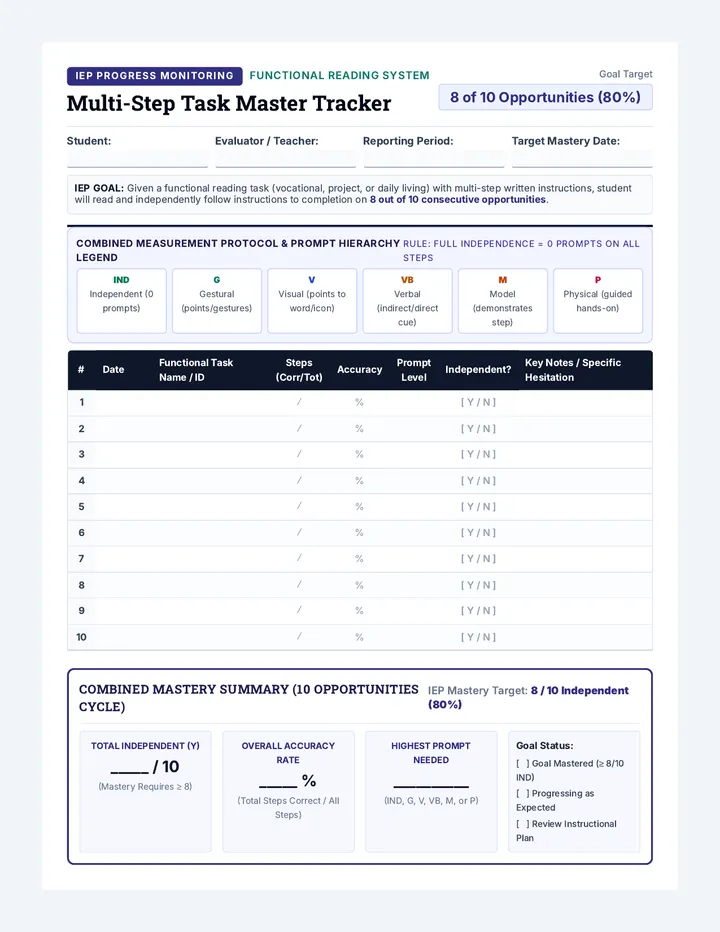
Measurement Tool: 5-item bi-weekly probes & rubric
Frequency: Bi-weekly (min. 6 data points/quarter)
Reporting: Quarterly IEP Progress Reports
Compliance Check: Meets IDEA requirements for measurable annual goals, short-term benchmarks, and SDI alignment.
Page 2 of 2