A clear, highly visual quiz page assessing fraction identification, naming, and equivalent fraction concepts. Uses simple language ("Yes/No") and large visual models to reduce cognitive load while verifying student understanding.
A teacher-facing facilitation guide and answer key for the Math Mission Rescue lesson. Includes instructional objectives, common misconceptions for IEP students, scaffolding strategies, and step-by-step solutions for all worksheet problems.
A scaffolded 3rd-grade math worksheet featuring 2-step addition and subtraction word problems with a 'Space Repair' theme. Includes a 4-step checklist for each problem and separate workspaces for each step to support students with IEPs.
A visual slide deck designed for 3rd-grade students with IEPs, introducing a structured 4-step checklist (Read, Plan, Solve, Check) for solving multi-step addition and subtraction word problems within a space-themed 'Mission Control' context.
A visual observation puzzle where students tally pizza toppings to solve a freezer unlock code. Scrambled tally list and clarified size-based sorting logic. Fixed page break and opacity.
A simple identification worksheet for students to identify where they live and characteristic traits of continents like Antarctica.
A large-format slide deck for group instruction. Features 4 sentences per slide, realistic world photography, and integrated AAC symbols for communication support. Includes multiple continents.
A symbol-supported adapted book focusing on all 7 continents. Features 4 sentences per page and realistic world photo framing to support literacy and communication for kindergarten students. Includes all 7 continents with Unsplash photography.
An exemplar answer key for the Theme Investigation log using the story "The Tortoise and the Hare" to demonstrate the granular evidence-gathering process.
A guide for teachers providing scaffolding strategies for executive function and comprehension, plus a universal theme bank.
A guide for educators to facilitate the use of the Earth is Home adapted book. Includes prompting levels, vocabulary goals, and modeling strategies for AAC users.
A large-format slide deck for group instruction. Features 4 sentences per slide, realistic world photo framing, and integrated AAC symbols for communication support.
A high-contrast, text-focused slide deck that guides students through 5 specific pieces of evidence to reach a final theme conclusion, designed for clarity and focus.
A high-contrast, symbol-supported adapted book for kindergarten students. Features 4 sentences per page, realistic world photography from Unsplash, and integrated AAC symbols for literacy support.
A simplified, granular detective-themed graphic organizer that breaks theme identification into 6 specific evidence pieces with expanded writing space and no distracting visuals.
A high-contrast, black-and-white Peace Flower coloring page designed for students to practice conflict resolution strategies while being creative. Features a second page with cut-out communication cards for AAC support.
Day 2 homework assignment where students convert tally marks into numerical data and complete a partially constructed bar graph. Includes a reflection question on data-driven decision making.
A worksheet for Day 2 where students conduct a class survey, tally the results, and construct their own bar graph from scratch. Includes a checklist for essential graph components.
A creative spring-themed foldable craft for the interactive notebook. Includes pop-up bar graph elements stylized as sports equipment and a garden-themed background for mounting.
Instructional slides for Day 2: Building the Box Score. Guides students through the process of surveying classmates, tallying data, and constructing their own bar graphs, ending with instructions for a spring-themed craft.
Day 1 homework assignment featuring a bar graph analysis task with a scale of 2. Includes questions on data interpretation, comparison, and a challenge problem.
Interactive notebook guided notes and a data analysis worksheet focused on interpreting a spring-themed bar graph. Includes fill-in-the-blank terminology and comparative questions.
Instructional slides for Day 1: Analyzing Action. Covers the anatomy of a bar graph, understanding scales and intervals, and comparative data analysis.
An answer key for the Five Minute Flyers worksheet, providing solutions for elapsed time problems in 5-minute increments.
An answer key for the Quarter Time Quest worksheet, providing solutions for elapsed time problems in 15-minute increments.
A Level 2 worksheet centered on calculating elapsed time in 5-minute increments. Features visual clock support with all 12 numbers and flight-themed word problems.
A Level 1 worksheet focused on calculating elapsed time in 15-minute increments. Includes visual clock comparisons with all numbers 1-12 and thematic word problems.
An answer key for the Time Facts Worksheet, providing correct answers for basic time units, clock anatomy, and the conceptual time challenge.
A conceptual worksheet covering basic time facts, including units of time (seconds, minutes, hours, days, weeks, years) and functional clock knowledge. Includes fill-in-the-blank and short explanation questions.
An answer key for the Giant Clock Worksheet, providing a clearly labeled example of all hour and minute positions. Includes key concepts and next step suggestions for teachers.
A full-page clock worksheet featuring one large clock face. Students fill in the 12 hour circles and 12 five-minute increment boxes, perfect for initial instruction or detailed practice.
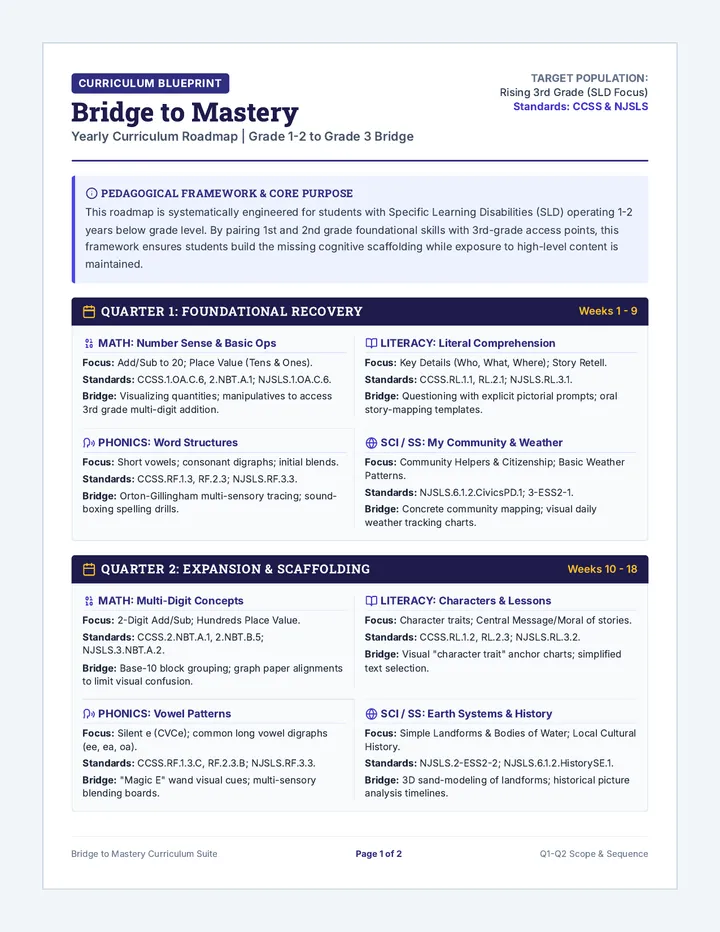
A comprehensive teacher guide for the "Data Detectives" lesson. Includes lesson objectives, a detailed pacing guide, instructional strategies for slides and activities, common misconceptions, and differentiation tips for supporting and challenging students. Revised to fix layout, spacing, and page break issues.
A hands-on sorting activity for measures of center. Students calculate the mean for 12 data cards (Case Files) and sort them into folders based on their values. Includes workspace for calculations and a thematic detective-inspired sorting mat. Revised to fix page breaks and student work area layout.
An answer key for the Clock Master Worksheet, displaying the correct placement of all 12 hours and 5-minute increments. Includes teaching tips for instruction.
A practice worksheet with four clock faces on a single page. Students fill in color-coded hour circles and enlarged minute boxes to learn clock anatomy and five-minute intervals.
A presentation introducing clock anatomy, hour placement, and minute tracking by fives. Includes visual diagrams with all 12 numbers and step-by-step instructions.
A thematic vocabulary reference sheet for measures of center. Includes clear definitions and "Investigation Tips" for mean, median, mode, and range, along with a dossier of supplementary statistical terms like outliers, distribution, and skewed data. Revised to fix page breaks and include more terms.
A detailed answer key for the "Final Verdict" assessment and "Case Closed" escape room. Provides step-by-step solution paths for mean, median, and missing value problems. Revised to fix page breaks, degree symbol rendering, and layout consistency.
A two-part assessment on measures of center. Part I focuses on summarizing data using mean and median calculations with time and group size contexts. Part II challenges students to find missing data values given the mean. Revised to fix page breaks, footer placement, and work area sizing.
A teacher/parent implementation guide designed for older students, focusing on collaborative debriefing and a tactical approach to implementing the 'Commute Protocol' social story.
A four-station "Data Detective" escape room activity. Students solve puzzles involving mean (time data), median (negative temperature data), mode (group sizes), and a missing value challenge to unlock "vault codes." Includes workspace for calculations and distinct thematic sections for each puzzle. Revised to fix page breaks, contrast, and box sizing.
A mature, tactical 'Commute Protocol' social story booklet designed for a 14-year-old boy, using respect-based language and a high-tech blueprint aesthetic to address school transitions and refusal.
A guided notes document and practice worksheet for measures of center. Features fill-in-the-blank definitions for mean, median, and mode, a step-by-step strategy guide for finding missing data values, and three categorized "Case File" practice problems. Revised to fix page breaks and student work area alignment.
A slide deck introducing measures of center (mean, median, mode) using a detective theme. Includes definitions, step-by-step examples with time, temperature, and group size data, and interactive practice problems. Revised to fix slide overflow and rendering issues.
A sophisticated, district-branded slide deck for 4-5th grade students on device leadership, reframed for a classroom cart environment with desk-primary and floor-optional workspaces. Includes Interactive Modeling. Standardizes sidebar branding for UCSD.
A teacher guide for 4-5th grade students on Chromebook care, featuring the updated learning objective and success criteria while covering all core device care habits. Reframed for classroom cart environment. Includes Interactive Modeling.
A district-branded slide deck for 2-3rd grade students on device guardianship, featuring updated learning objectives and success criteria. Standardizes sidebar branding for UCSD. Focuses on desk workspace setup and includes explicit Interactive Modeling steps. Revised for sidebar consistency and contrast.
A teacher guide for 2-3rd grade students on Chromebook care, featuring the updated learning objective and success criteria while covering all core device care habits. Includes Interactive Modeling for setting up a safe desk workspace. Fixes page break issues.
A district-branded slide deck for K-1 students on Chromebook care, featuring the updated learning objective and comprehensive care habits. Standardizes sidebar branding for UCSD.
A teacher guide for K-1 students on Chromebook care, featuring the updated learning objective and success criteria while covering all core device care habits. Includes Interactive Modeling for moving with the device.
A simplified scenario-based practice worksheet for students using AAC or who are minimally verbal. Features clear icons and single-choice answers to reinforce the best Peace Petal for common conflicts.