Internal mental processes including memory, attention, and problem-solving. Examines how individuals acquire, process, and store information through schema development and metacognition.
A four-part series for middle schoolers on Aristotelian logic and philosophy, focusing on categorization, reasoning, and ethics, with a historical tie-in to Alexander the Great.
Une série de modules de formation destinés aux conseillers pédagogiques pour renforcer leur expertise en ingénierie de formation continue, spécifiquement appliquée à l'enseignement du français à l'école primaire.
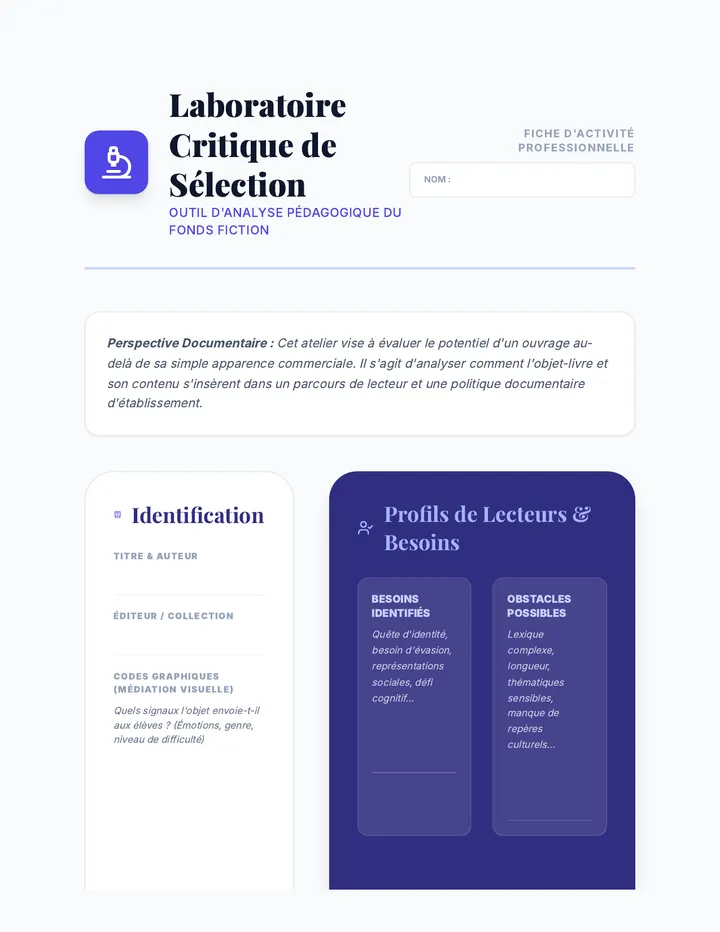
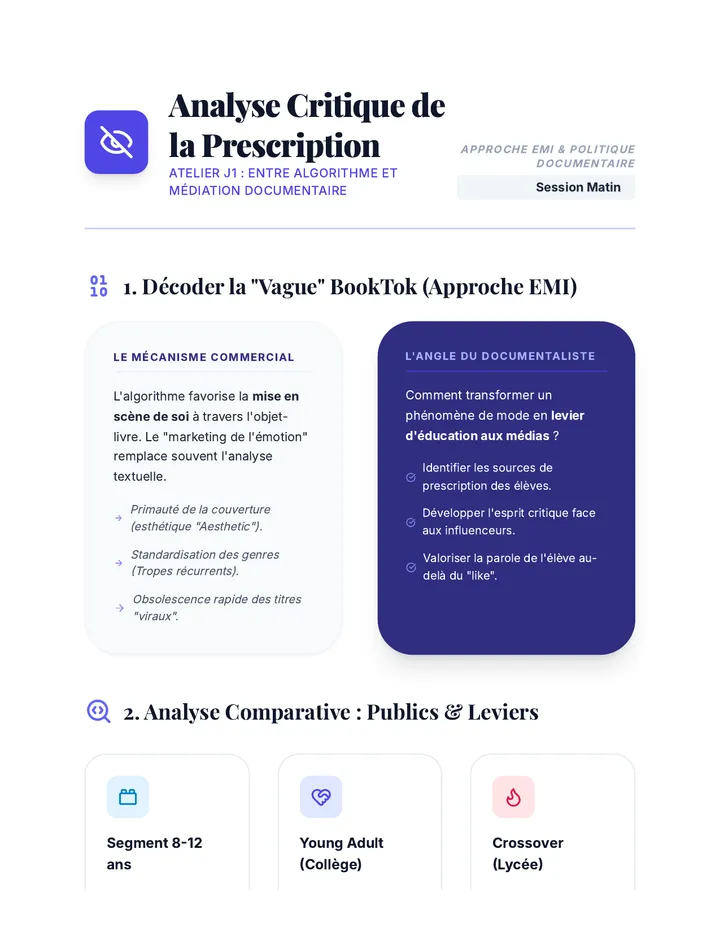
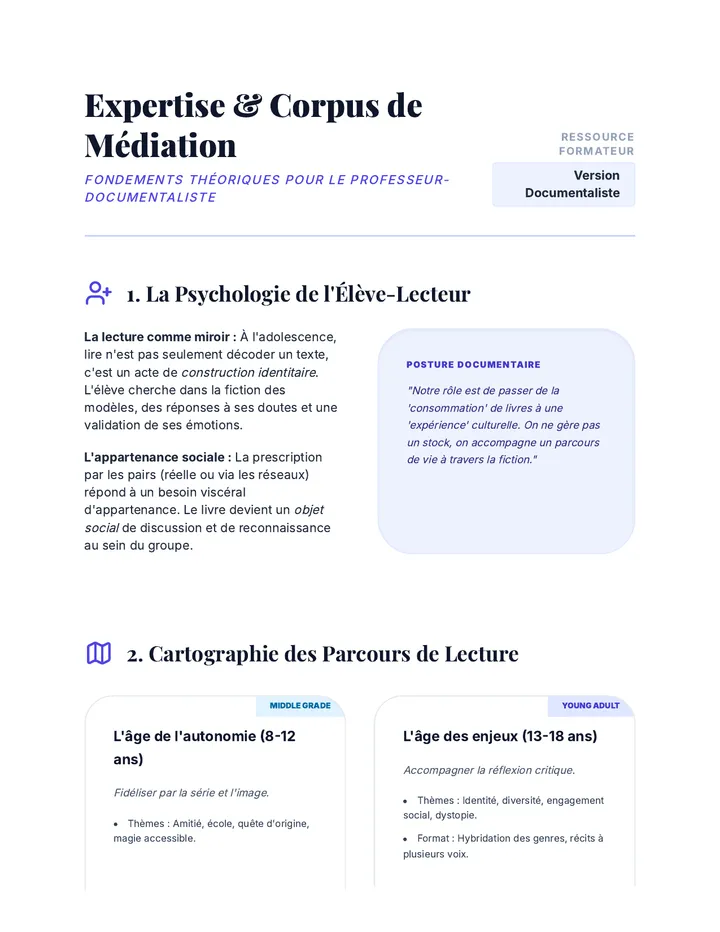
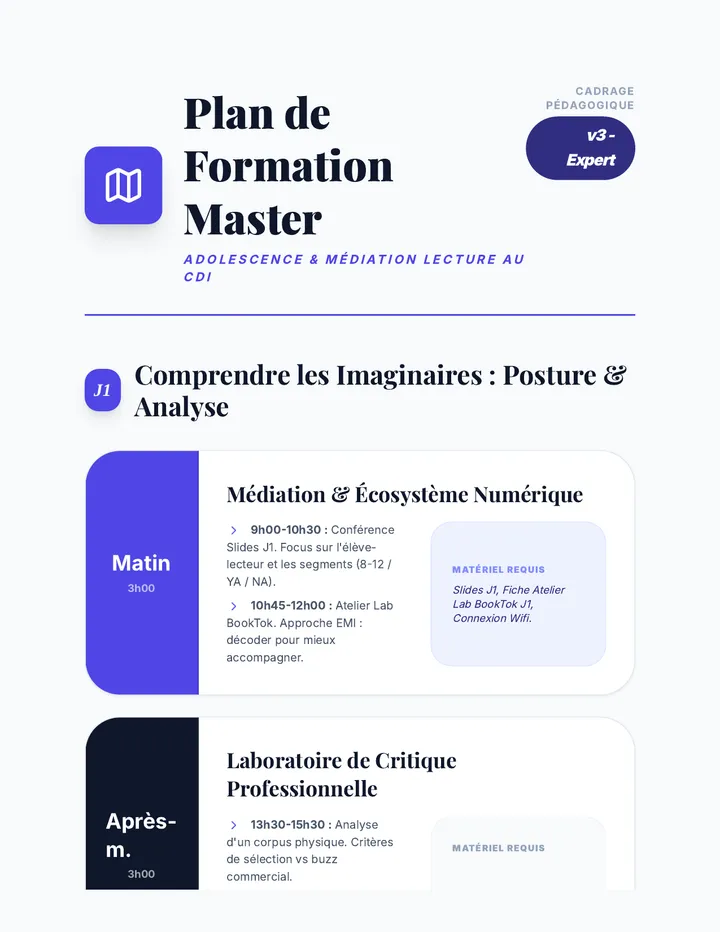
Une formation pour les professeurs-documentalistes centrée sur la médiation culturelle et l'accompagnement des pratiques de lecture des adolescents. L'objectif est de concilier la réalité de l'édition actuelle avec les missions pédagogiques du CDI.
A comprehensive multi-day review sequence for psychology units on emotion, motivation, memory, and forgetting, featuring structured study aids, interactive challenges, and practice assessments.
A two-day intensive sequence for high school students to master media literacy skills, focusing on bias detection, fact-checking, and the analysis of political narratives in the modern digital age.
A 12-lesson intensive course on reasoning and critical thinking, aligned with the 'Reasoning Skills Success' framework. This sequence covers everything from the distinction between reason and emotion to complex logical fallacies, statistical analysis, and deductive/inductive logic.
A critical exploration of behavioral psychology, focusing on the tension between intrinsic and extrinsic motivation. Students analyze the ethical implications of reward systems in education, technology, and society.
This sequence provides a rigorous introduction to operant conditioning for undergraduate students, focusing on the technical application of positive reinforcement. It covers the Three-Term Contingency, discrimination between consequences, operational definitions, motivational operations, and theoretical critiques.
This sequence examines the psychological and ethical limits of positive reinforcement. Students analyze the 'Overjustification Effect', the impact of rewards on creativity, and the ethics of behavioral nudging, concluding with a critical audit of real-world incentive systems.
Focusing on bottom-up reasoning, this sequence explores how researchers and policy-makers use inductive frameworks to establish probability rather than certainty. Students examine the criteria for cogency, engaging with statistical generalization, causal inference, and abductive reasoning (inference to the best explanation).
A graduate-level psychology sequence exploring the intersection of Albert Bandura's Social Learning Theory with modern neuroscience (mirror neurons) and digital ecosystems (algorithms, AI, and social media). Students critically synthesize classical theory with contemporary research to propose theoretical updates for the digital age.
This workshop-style sequence explores the psychological principles of observational learning, focusing on Albert Bandura's concepts of self-efficacy and the four stages of modeling. Students transition from theoretical understanding to practical application by designing and testing instructional tutorials that optimize skill acquisition for their peers.
A high school child development lesson using a jigsaw strategy to explore Piaget's four stages of cognitive development, featuring expert research and peer-to-peer teaching.
A comprehensive look at why we remember and why we forget, covering the stages of memory, types of interference, and strategies for improving recall.
This lesson explores the Gurmat perspective on the five senses, moving from sensory bondage to spiritual mastery through the teachings found in the 'Slave to the Senses' discourse.
An exploration of TikTok's psychological and marketing influence, focusing on algorithmic power, social proof, and peer-driven trends through modeled annotation practices.
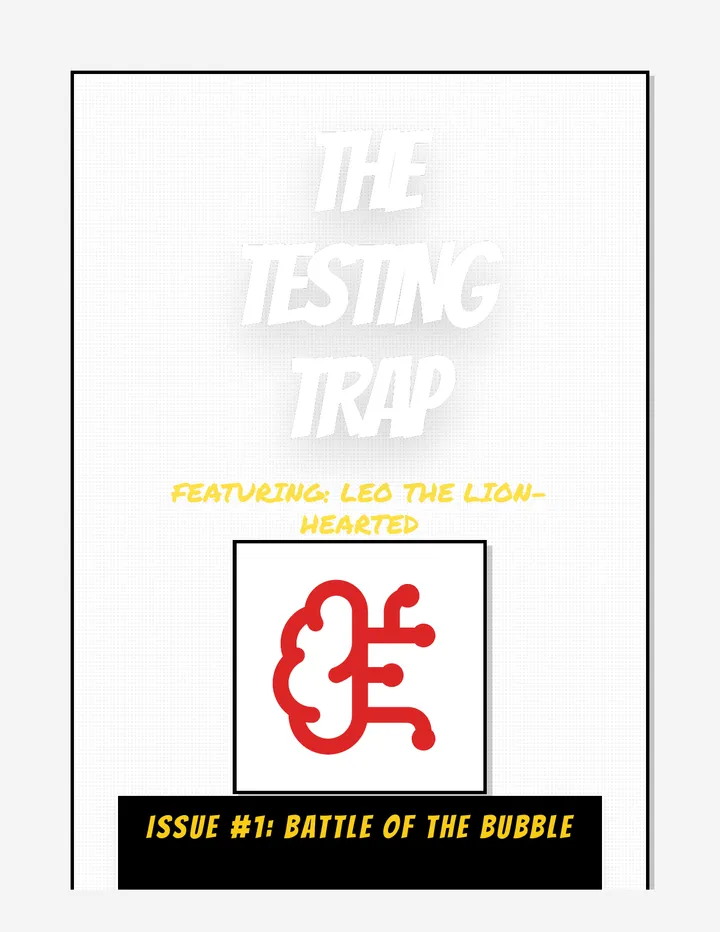
An exploration of the history, mechanics, and fairness of standardized testing through the lens of a neurodivergent student's experience. This lesson uses a retro-style comic to illustrate the disconnect between traditional testing and real-world intelligence.
An exploration of John Searle's famous thought experiment, examining the distinction between syntax and semantics and the debate over Strong Artificial Intelligence.
A comprehensive 99-minute lesson exploring child development theorists (Piaget, Erikson, Vygotsky, Bowlby) with a focus on infancy, featuring collaborative research and guided note-taking.
An immersive simulation where students step into the roles of world leaders during the thirteen days of the Cuban Missile Crisis. Students must balance national security, international pressure, and the personal weight of potential nuclear war.
This lesson explores the transformative power of radio and film in 1920s America, focusing on the birth of celebrity culture and the rise of a consumer economy driven by national advertising. Students will analyze how mass media synchronized American social norms and economic habits.
A project-based learning unit exploring human development across the lifespan, focusing on social-emotional, cognitive, and physical growth through creative, higher-order thinking tasks.
A comprehensive lesson introducing Lev Vygotsky's sociocultural theory of cognitive development. Students will explore the Zone of Proximal Development, the role of Scaffolding, and the importance of the More Knowledgeable Other through collaborative activities.
An undergraduate psychology lesson exploring the cognitive mechanisms of 'choking' under pressure, focusing on Distraction Theory and Explicit Monitoring Theory. Students will analyze these theories and design an original experiment to test the effects of pressure on non-sport tasks.