Framing the Facts Slides Breaking the Frame
Navigating Bias and Perspective in the Political Landscape
Media Mindset
Day 01
The Lens Matters
In a 24-hour news cycle, information isn't just delivered—it's designed.
"The way we see the world depends on who holds the camera."
Bias
A personal or institutional perspective that influences how information is presented.
Framing
The social construction of a social phenomenon—how an issue is "packaged."
Fact vs. Opinion
Objective Fact
• Can be proven or disproven
• Based on evidence/observation
• Constant regardless of observer
"The unemployment rate is 4.2%."
Subjective Opinion
• Reflects a belief or feeling
• Uses value-based language
• Cannot be strictly proven
"The unemployment rate is dangerously high."
The Bias Toolkit
Omission
Leaving out one side of an article, or a series of articles over a period of time.
Placement
Where a story is placed (front page vs. back page) or where facts appear within a story.
Spin
Using "loaded language" or subjective tone to influence the reader's interpretation.
Case Study: Loaded Language
Version A
"The candidate slashed the budget, gutting essential social services."
Version B
"The candidate streamlined the budget, optimizing fiscal responsibility."
Same event. Different frame.
Quick Discussion
Why would a news outlet choose "gutting" instead of "optimizing"? Who is their intended audience?
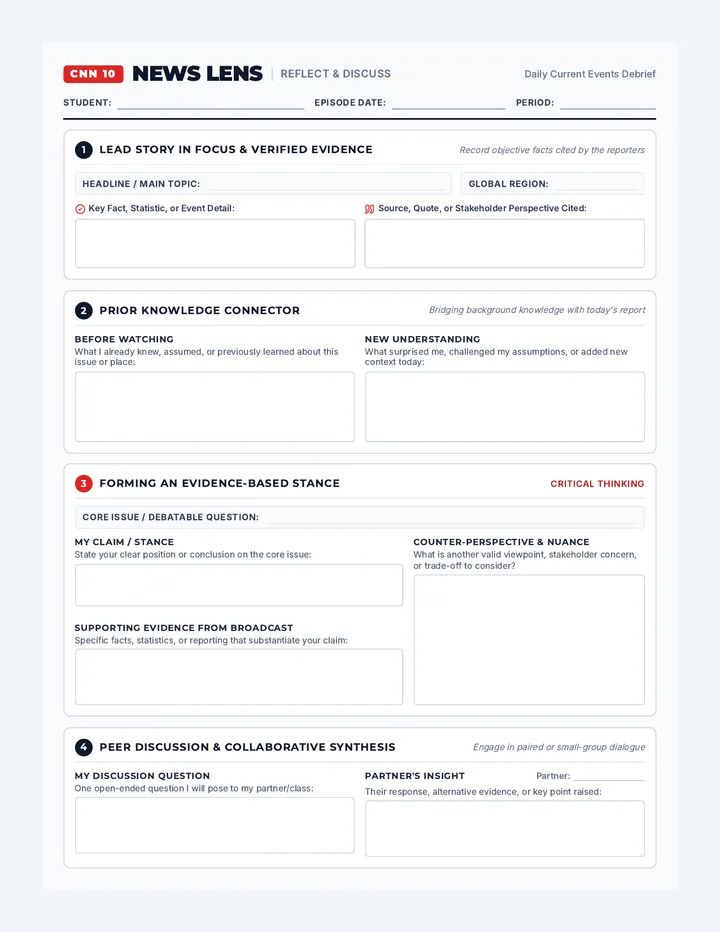
Source Analysis Organizer Source Analysis Organizer
Media Literacy Investigation
Name:
Date:
Part 1: The Source
Article Title / Headline
News Organization / Author
Primary Goal of Piece
Inform
Persuade
Entertain
Target Audience
Part 2: Fact vs. Opinion
Statement from Source Fact? Opinion?
|
| |
|
|
| |
|
|
Part 3: Framing & Bias
Loaded Language Checklist
List words used to evoke emotion or suggest judgment (e.g., "failed policy" vs. "revised plan").
Perspective Omission
Whose voices or viewpoints are missing from this piece?
Placement Analysis
Where is the most important evidence located? Top or bottom?
Final Verdict
How would you describe the overall "frame" of this story? Is it biased? Why or why not?
Breaking Frame Teacher Guide Breaking the Frame
Teacher Facilitation Guide
DAY 01
Objectives
Define and identify media bias, framing, and omission.
Distinguish between objective fact and subjective opinion in news text.
Analyze how "loaded language" shapes public perception.
Pacing
Intro (10m)
Hooks & Definitions
Direct Instruction (15m)
Types of Bias & Framing
Guided Practice (20m)
Group Source Analysis
Closing (10m)
Reflection & Exit Ticket
Required Materials
Framing the Facts Slides
Source Analysis Organizer
2-3 Short News Clips/Articles
Discussion Prompt Framework
On Framing:
"If we change the headline from 'Candidate Proposes Budget Cuts' to 'Candidate Declares War on Education,' how does that change the reader's expectation of the article?"
On Omission:
"Who is being quoted in this story? If the story is about a new city law, but only city officials are quoted and not residents, what might we be missing?"
Universal Design & Accommodations
Visual Learners
Use the highlighted "Loaded Language" examples in the slides. Provide physical highlighters for the Source Analysis organizer.
ELL / Reading Support
Pre-teach vocabulary: Bias, Omission, Framing, Perspective . Use text-to-speech tools for the news clips.
Advanced Learners
Challenge students to "re-frame" a biased article to be as neutral as possible using only objective facts.
Teacher Tip: Neutral Ground
Avoid using current local political examples that might be too polarized for a first-day discussion. Use historical examples or national policy issues to maintain a focus on mechanics rather than politics .
The Truth Filter Slides The Truth Filter
Comparing Perspectives and Unmasking Misinformation
Media Mindset
Day 02
The Echo Chamber
Algorithms prioritize engagement over accuracy.
Algorithmic Bias
The automatic curation of content based on your past behavior, leading you deeper into a specific viewpoint.
You
Opinion A
Opinion A
Opinion A
Opinion A
Misinformation Red Flags
Rage-Baiting
Content designed specifically to trigger anger or outrage, which is the fastest way to get shared online.
Context Stripping
Using a real quote or video but removing the surrounding details that change its meaning.
Imposter Content
Websites or social media handles that mimic trusted brands to spread false claims.
Fabricated Claims
100% false stories presented as breaking news, often from unknown or shadowy sources.
The News Showdown
Today, you are the editor. We are going to look at how two major networks cover the exact same political event.
FOX NEWS
Network A
CNN
Network B
What to Look For
The Headline
Which verbs are used? What is the "mood"?
The Imagery
What photo was chosen? Does it look flattering or critical?
The Experts
Who are they quoting? What are their credentials?
Exit Question
If you only ever read news that you already agree with, what happens to your ability to solve problems?
News Showdown Comparison News Showdown
Comparative Media Analysis
Name:
The Mission
Analyze how two different news organizations cover the exact same event. Identify the specific choices editors made to shape the narrative for their specific audience.
Source A: Fox News
Headline Analysis
Record headline and key verbs here...
Visual Framing
Describe the primary image/thumbnail. What emotion does it evoke?
Expert Voices
Who is interviewed? What are their credentials/biases?
Source B: CNN
Headline Analysis
Record headline and key verbs here...
Visual Framing
Describe the primary image/thumbnail. What emotion does it evoke?
Expert Voices
Who is interviewed? What are their credentials/biases?
Synthesis & Reflection
1. Compare the "villains" and "heroes": In each source, who is portrayed as doing something wrong, and who is portrayed as being right or heroic?
2. The "Omission" Test: What fact or context did Source A include that Source B ignored (or vice versa)?
3. Audience Awareness: Based on these differences, how would you describe the typical viewer of Source A vs. Source B?
Media Literacy Rubric Media Literacy Assessment Rubric
Evaluation of Critical Analysis Skills
Criterion 4 - Mastered 3 - Proficient 2 - Developing 1 - Beginning Identifying Bias & Framing Clearly identifies nuanced bias, framing, and specific loaded language with multiple pieces of evidence. Identifies bias and framing using specific examples from the text. Identifies basic bias but lacks specific textual evidence or clear explanation. Struggles to identify bias or confuses it with factual reporting. Fact vs. Opinion Consistently distinguishes between facts and opinions, even when opinions are masked as factual statements. Accurately distinguishes between most facts and opinions in a variety of contexts. Distinguishes between obvious facts and opinions but misses more subtle instances. Frequently confuses opinion-based statements with objective facts. Comparative Analysis Provides a sophisticated comparison of how different outlets shape narratives via omission and imagery. Accurately compares two sources and identifies at least two major differences in coverage. Describes differences between sources but fails to explain the impact of those differences. Provides surface-level observations without meaningful comparison of narrative. Misinformation Literacy Can explain complex misinformation strategies (rage-bait, context stripping) and identify them in real-time. Identifies common misinformation red flags and explains why they are suspicious. Identifies that a source is suspicious but cannot articulate the specific strategy used. Unable to distinguish between high-quality journalism and low-quality misinformation.
Total Score Calculation
Mastered (15-16 pts) A
Proficient (12-14 pts) B
Developing (8-11 pts) C
Beginning (0-7 pts) D/F
Teacher Comments The Truth Filter Teacher Guide The Truth Filter
Teacher Facilitation Guide
DAY 02
Day 2 Objectives
Identify common strategies used to spread misinformation (rage-bait, context stripping).
Analyze the role of algorithms in creating digital "echo chambers."
Perform a comparative analysis of news coverage across different political lenses.
Pacing
Intro (10m)
Algorithms & Echo Chambers
Direct Instruction (15m)
Misinformation Red Flags
News Showdown (20m)
Fox vs. CNN Comparison
Debrief (10m)
Discussion & Rubric Review
Required Materials
The Truth Filter Slides
News Showdown Worksheet
Media Literacy Rubric
Key Facilitation Points
The Showdown Setup:
Before class, select a specific recent event (e.g., a policy debate or a protest). Provide students with the homepage or top story from both Fox News and CNN. Ask them to look specifically for differences in adjectives used in headlines.
Managing Polarization:
Remind students that the goal is not to determine who is "right," but to analyze the process of news creation. Use phrases like "How does this outlet serve its audience's expectations?"
Day 2 Accommodations
Collaborative Support
Pair students for the News Showdown activity. Heterogeneous grouping (pairing strong readers with developing readers) helps with the analysis of complex headlines.
Scaffolded Writing
Provide sentence starters for the reflection: "Source A emphasizes _____ while Source B focuses more on _____."
Group Discussion Prompts
"Think about your own social media feed. What is one topic you only ever see one side of? How does that impact your opinion of people on the other side?"
"Is it possible for any news organization to be truly 100% neutral? Why or why not? If not, what should be the standard for 'good' journalism?"
Algorithm Audit Extension Algorithm Audit
Extension Activity: Digital Echoes
Name:
The Social Media Sandbox
Algorithms are designed to keep you on an app as long as possible. To do this, they feed you content that matches your existing beliefs. This is called an Echo Chamber . In this extension, you will investigate how your digital world is being curated for you.
1 The Observation Phase
Open a social media app of your choice (TikTok, Instagram, X/Twitter). Scroll through the first 10 posts on your "For You" or main feed. Tally the themes:
Topics I Agree With
____ / 10
Topics I Disagree With
____ / 10
Neutral/Other
____ / 10
2 Breaking the Filter
If you wanted to "confuse" your algorithm and get it to show you more diverse viewpoints, what 3 types of content or creators would you have to start following or liking?
3 The Critical Reflection
How does seeing ONLY content you agree with make you feel about the "other side"?
What is the "cost" of convenience? Is it worth having an app that "knows you" if it also limits what you know about the world?
Extension Tip: Try "Incognito Mode" to see what a "Neutral" feed looks like.