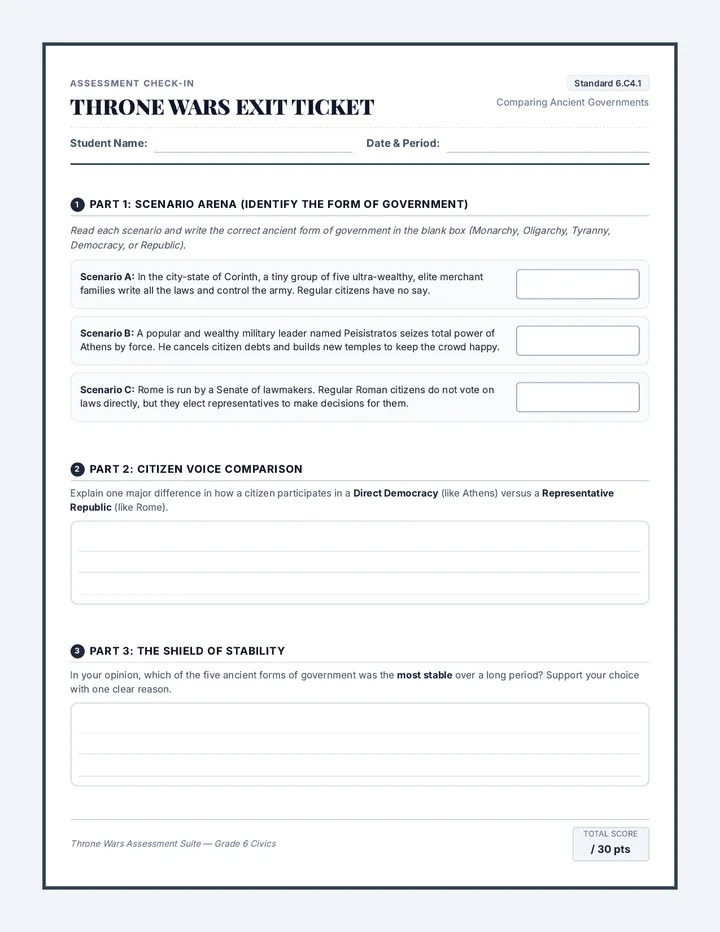
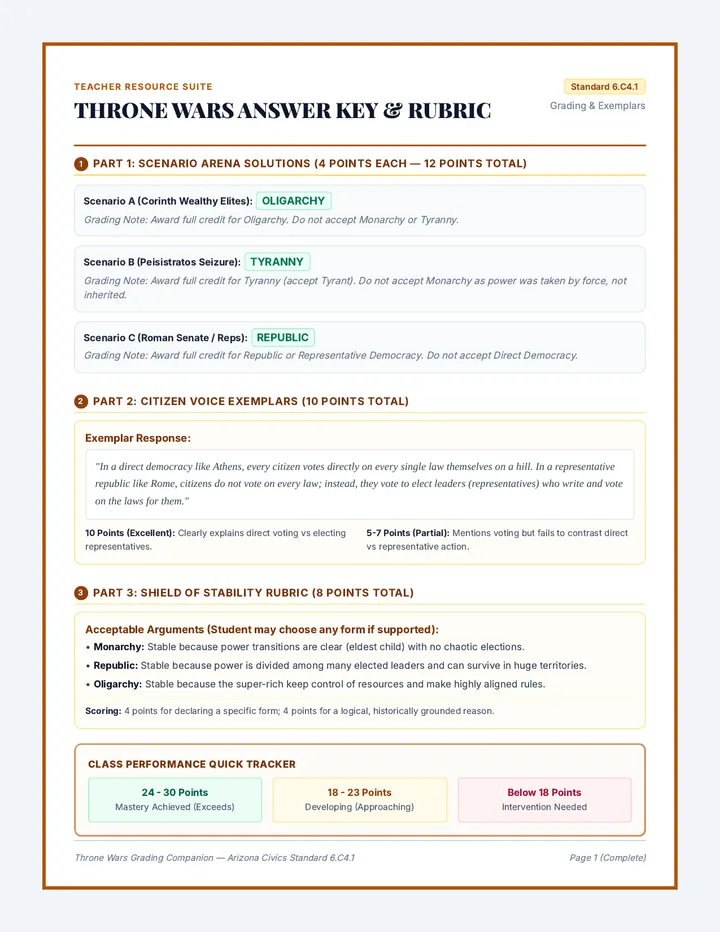
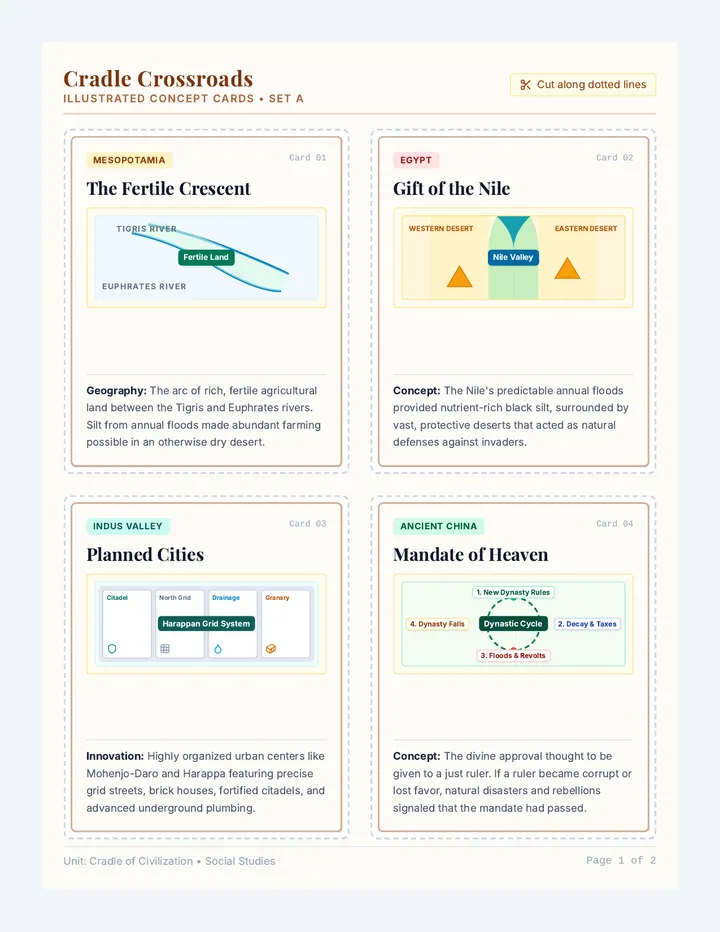
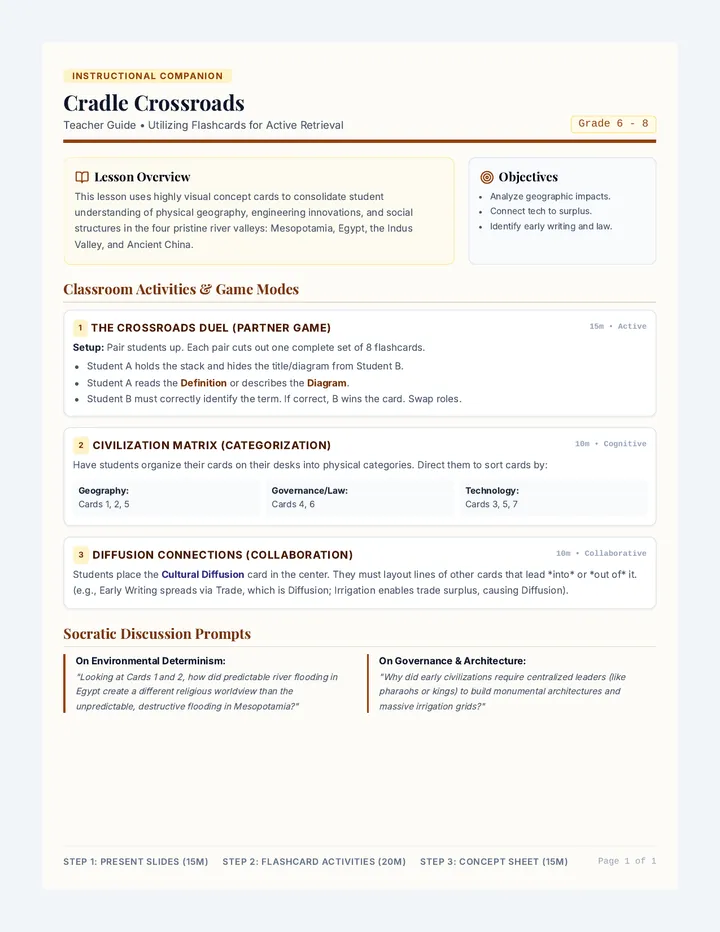
Era Mastery Quiz Era Essentials Assessment
History Hub // Module 01
Student Name
Date
PART I
Vocabulary Match
1. Urbanization
2. Corroboration
3. Sourcing
4. Jim Crow Laws
A. Questioning the author's purpose and bias.
B. State and local laws enforcing segregation.
C. Comparing sources to establish accuracy.
D. Mass movement from rural farms to cities.
PART II
Era Analysis
5. Which of the following was a primary cause of the American Revolution?
The invention of the assembly line
Disputes over taxation/representation
Conflict between Axis/Allied powers
The Civil Rights Act of 1964
6. What was a major economic result of the Industrial Revolution?
A return to small-scale family farming
The abolition of all global tax systems
Mass production and lower goods costs
The end of racial segregation in schools
PART III
Critical Thinking
7. Why is "contextualization" essential when studying the World Wars? How does it help us understand decision-making?
8. Identify one Civil Rights leader and explain how they utilized specific evidence or claims to advocate for social change.
History Unleashed PBL Guide PBL Project Guide
History Unleashed
Transforming the Past into the Present
The Mission
Select ONE era we've studied and create a modern "artifact" explaining its significance. Use at least two Historical Thinking Skills (Sourcing, Context, Corroboration, or Close Reading) in your final product.
Pathway Options
1. Archive Podcast
Record a 5-min interview with a key figure. Focus on motivations and obstacles.
2. Industrial Infographic
Compare Industrial Revolution life to the modern "Digital Revolution."
3. Museum Exhibit
Curate 5 primary sources with labels explaining source and context.
4. Justice Mural
Design a mural representing the Civil Rights struggle with a written rationale.
Project Checklist
I chose ONE focus era.
I used TWO thinking skills.
I showed "Lasting Impact."
My work is polished.
Success Criteria
Historical Accuracy 25 pts
Use of Thinking Skills 25 pts
Creativity & Design 25 pts
Thinking Skills Anchor Chart The History Detective's Toolkit
Mastering Historical Thinking Skills
"History isn't just a list of names and dates. It's a mystery we solve using evidence."
Sourcing
Ask about the author's background and purpose before reading.
Who created this?
Why was it written?
Primary or secondary source?
Contextualization
Connect the document to the time and place it was created.
What was happening then?
How did people think then?
Why did this happen then?
Corroboration
Compare multiple accounts of the same event.
What do other sources say?
Which parts are consistent?
What are conflicting details?
Close Reading
Examine specific claims, evidence, and language.
What is the author's main claim?
What evidence is provided?
What tone does the author use?
One source is never the whole story. Look for the gaps!
Era Comparison Organizer One Page Archive Copy
Chronicle Comparison Matrix
AGENT: ____________________________
DATE: ____________________
MISSION: Analyze the four pivotal eras. Compare their goals, leaders, and impacts. Use your "Historical Thinking Skills" to ensure accuracy.
Era Main Conflict / Goal Key Leader / Group Lasting Impact Amer. Revolution (1775–1783)
| | | |
| Ind. Revolution
(Mid 1700s–1800s)
| | | |
| World Wars
(1914–1918 / 1939–45)
| | | |
| Civil Rights
(1954–1968)
| | | |
Archive Synthesis
1. Identify one common theme shared by at least two of these eras:
2. Which era caused the most significant change for ordinary people? Why?
Era Mastery Flashcards Era Essentials Flashcards
Vocabulary Mastery: Revolution, Industry, Conflict, & Rights
DOC_ID: VOCAB-771
REF: HISTORY-CHRONICLES
Instructions: Cut along the dashed lines. Fold in half or glue to cardstock. Terms are on the left, definitions/context on the right.
American Revolution
Taxation without Representation
The grievance that the American colonists were being taxed by a British Parliament in which they had no elected officials to voice their interests.
Industrial Revolution
Urbanization
The large-scale movement of people from rural areas to cities, primarily driven by the growth of factory jobs and new technologies.
World Wars
Total War
A type of conflict where nations mobilize all available resources—including civilians and the economy—to support the war effort.
Civil Rights
Non-Violent Resistance
The practice of achieving social or political goals through symbolic protests, civil disobedience, or economic boycotts without using physical violence.
American Revolution
Unalienable Rights
Rights that cannot be taken away or denied, famously listed in the Declaration of Independence as life, liberty, and the pursuit of happiness.
Industrial Revolution
Assembly Line
A manufacturing process in which parts are added as the semi-finished assembly moves from workstation to workstation, greatly increasing speed.
World Wars
League of Nations
The first international organization established after WWI whose principal mission was to maintain world peace and prevent future global conflicts.
Civil Rights
Jim Crow Laws
State and local laws that enforced racial segregation in the Southern United States, existing until the mid-1960s.