Application of clinical and behavioral psychology to the legal and criminal justice systems. Examines criminal profiling, witness reliability, jury selection, and the assessment of mental competency in legal proceedings.
A comprehensive 11th-grade psychology sequence exploring the intersection of human behavior and the legal system, covering profiling, memory reliability, the insanity defense, jury selection, and case analysis.
This unit explores the intersection of psychology and the law, covering profiling, memory reliability, interrogations, the insanity defense, and jury dynamics. Students apply psychological theories to legal contexts through simulations and case analysis.
A comprehensive graduate-level sequence on the clinical assessment of competency to stand trial and criminal responsibility, focusing on legal standards, assessment instruments, and ethical considerations.
An undergraduate sequence exploring the psychological and legal intersection of competency and criminal responsibility. Students learn to apply legal standards like Dusky and M'Naghten, assess malingering, predict violence risk, and prepare for expert testimony.
This graduate-level sequence explores the detection and analysis of micro-expressions and subtle affect. Students move from theoretical foundations of emotional leakage to high-fidelity real-time clinical simulations.
A graduate-level sequence focused on the mechanics, psychology, and technical execution of formal cross-examination and witness control, modeled after law school clinical programs.
An advanced undergraduate sequence focusing on the art of cross-examination through evidentiary scrutiny, credibility impeachment, and psychological non-verbal strategies in legal and academic contexts.
A high school psychology unit exploring the subjective experience of dreams and the biological malfunctions of sleep. Students move from psychoanalytic interpretations to neurobiological theories, ending with the diagnosis of sleep disorders and the creation of evidence-based sleep hygiene plans.
This graduate-level sequence explores the malleability of human memory, focusing on cognitive mechanisms of distortion, source monitoring, and the misinformation effect. Students analyze the transition from theoretical models of reconstruction to their high-stakes applications in forensic and clinical settings.
A 12th-grade psychology unit exploring the reconstructive nature of memory, focusing on theories of forgetting, memory distortion, the misinformation effect, and the impact of amnesia on the legal system.
A high school psychology unit exploring the fallibility and reconstructive nature of human memory, focusing on interference, schemas, the misinformation effect, and legal implications.
A 10th-grade psychology unit exploring the fallibility and reconstructive nature of human memory, covering forgetting, interference, schemas, and the legal implications of eyewitness testimony.
This lesson explores the psychological factors and interrogation techniques that lead to confessions, with a specific focus on why innocent suspects might confess to crimes they didn't commit.
A fast-paced opening activity designed to spark debate and critical thinking about the insanity defense through primary source analysis. Students examine historical legal standards and grapple with the moral complexities of criminal responsibility.
An exploration of the legal complexities of police interrogations and the psychological impact of media-driven forensic expectations on modern courtrooms.
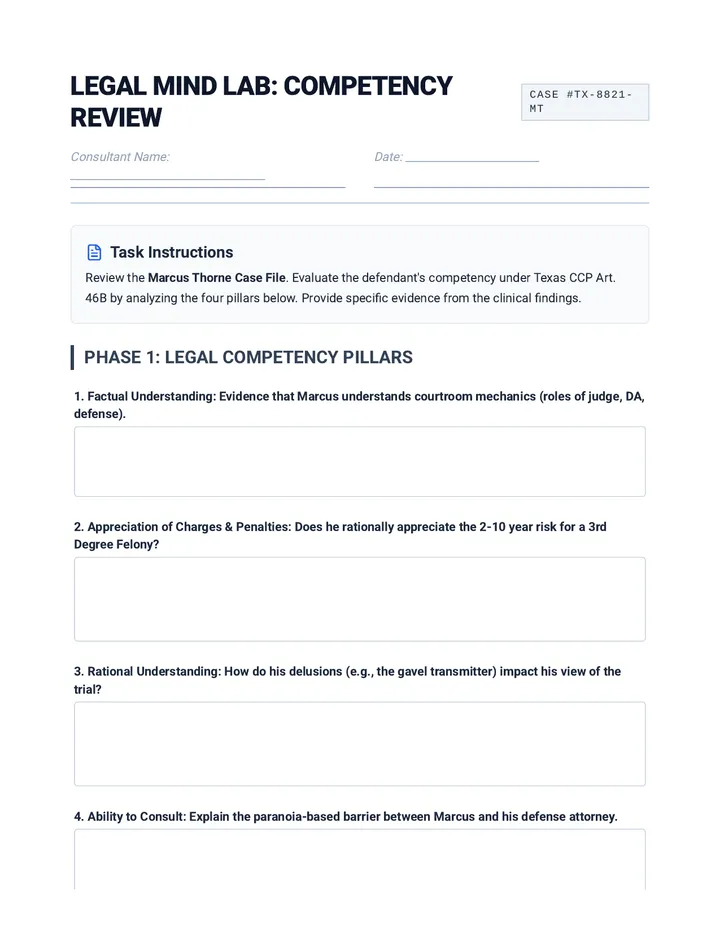
A forensic mental health simulation where students or patients analyze a criminal case and competency report for a defendant with Schizoaffective Disorder charged with a felony in Texas.
An exploration of Hans Eysenck's criminal personality theory, focusing on the intersection of biology, behaviorism, and personality traits like extraversion and neuroticism.
This lesson explores Hans Eysenck's criminal personality theory, focusing on the biological and environmental factors that contribute to criminal behavior and identifying the four higher-order factors of personality.
A high-level legal analysis of the transition from the 'Separate but Equal' doctrine of Plessy v. Ferguson to the 'Inherently Unequal' ruling of Brown v. Board, focusing on the shift from strict legal interpretation to sociological evidence.