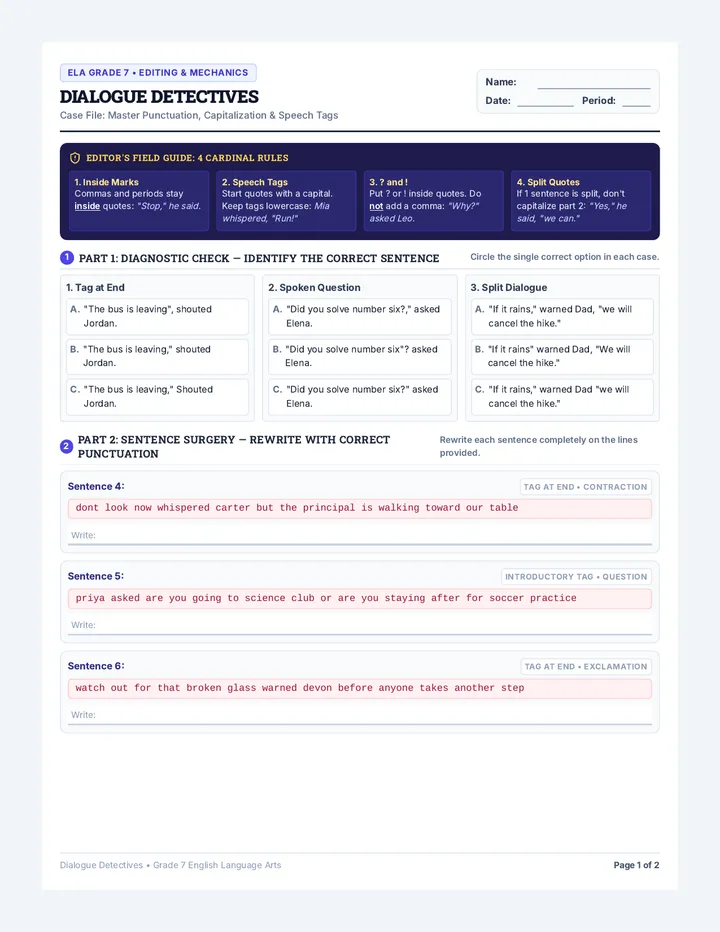
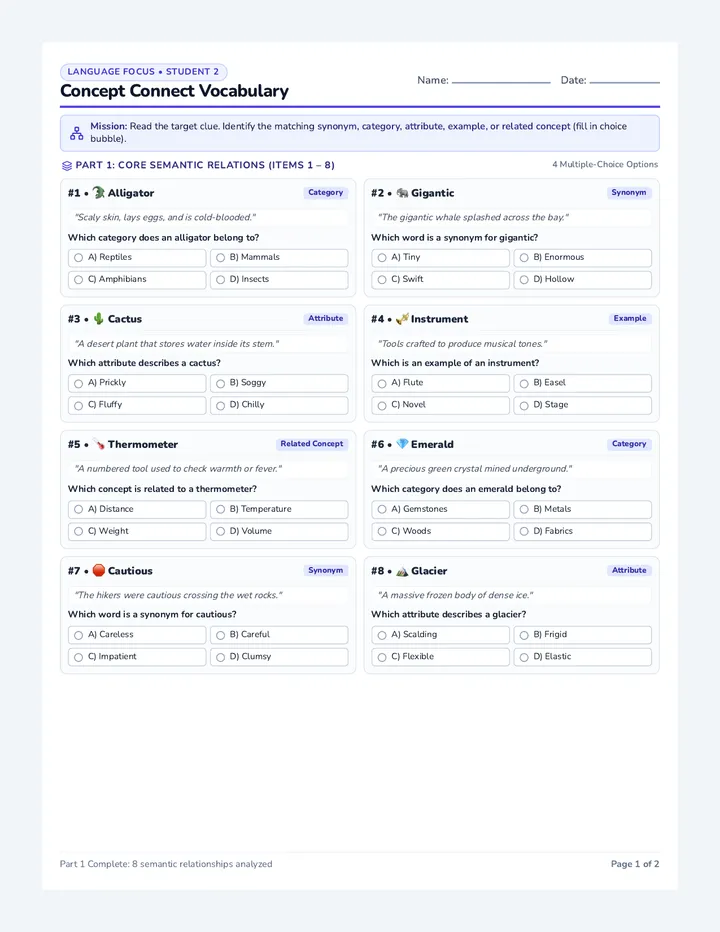
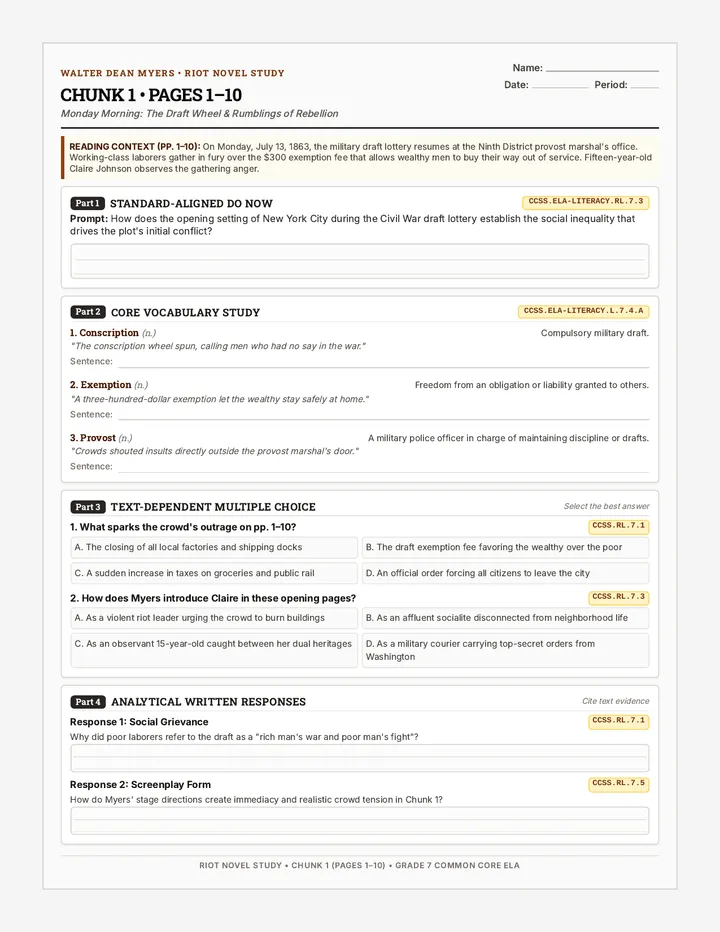
State Bound Notes Worksheet State Bound Notes
Chapters 31–39 Reading Guide
Player:
Date:
Vocabulary Hustle
Match the word from the text to its correct meaning.
1
Distressed
2
Hypocrite
3
Regret
4
Legend
5
Epic
A person who acts against their own beliefs.
Extremely impressive or heroic; grand in scale.
Suffering from extreme anxiety or pain.
A person famous for many generations.
To feel sad or disappointed over the past.
A Message from Jaxon
In Chapter 37, Tre goes into Jaxon’s room. What does he find to wear to the big pep rally, and why does he choose this specific item?
Sketch Zone: The Regional Trophy
In Chapter 38, Tre and the team are celebrated at a pep rally. Draw the trophy or a fan sign.
Post-Game Analysis
1. How does Tre's relationship with Wes change in Chapter 31? What does Wes send him?
2. In Chapter 34, the Warriors win the Regional Championship 101–99. How does Tre describe the feeling of the buzzer sounding?
3. Tre receives a life-changing letter in Chapter 37. Where is it from and what does it say?
"Being a Warrior is the last time I'll ever be special."
4. Why is this championship about more than just basketball for the Red Lake community?
Scouting Report
In Chapter 39, who is the player they see highlights of on SportsCenter ? Why is the team so quiet while watching him?
Game Day Notes Worksheet Game Day Notes
Rez Ball: Chapters 16—21
Name:
Date:
Warm Up: Word Match
DRAW LINES TO MATCH
Documentary
Varsity
Ogichidaa
Defeated
The main team representing a school.
Feeling like you have lost or failed.
A movie telling a true story with facts.
The Ojibwe word for "Warriors."
Word Collector
Write down 3 words you heard in today's reading that are new to you:
The Sketch Zone
Visualize the basketball game or Tre's emotions. Draw what you see in your mind.
Post-Game Analysis: Comprehension
In Chapter 17, Tre receives life-changing news from Coach Whitefeather. What is the big news?
Tre's new jersey says "Ogichidaa." What does this word mean to Tre personally?
The game against Bemidji was intense. Why did Tre have to watch the end of the game from the bench?
After the game, Tre feels "broken inside." How do his teammates show they have his back in the locker room?
Character Reflection: How is Tre different from the start of the book now that he is on Varsity?
Listen
Discuss
Complete
State Bound Answer Key State Bound Key
Chapters 31–39 Answer Key
TEACHER RESOURCE
Vocabulary Hustle
1. Distressed: Suffering from extreme anxiety, sorrow, or pain.
2. Hypocrite: A person who acts against their own stated beliefs.
3. Regret: To feel sad, repentant, or disappointed over the past.
4. Legend: A person whose fame or notoriety makes them famous for generations.
5. Epic: Extremely impressive or heroic; grand in scale.
A Message from Jaxon
Tre finds Jaxon's "Superboy" shirt . He chooses to wear it because it fits him perfectly, symbolizing his connection to his brother and carrying Jaxon's legacy into the big game. It represents his bond with Jaxon and his readiness to step into the spotlight.
Post-Game Analysis
1. How does Tre's relationship with Wes change in Chapter 31? What does Wes send him?
They reconcile after tension. Wes sends Tre a video of him playing basketball and a text message saying "I love you bro," which repairs their friendship.
2. In Chapter 34, the Warriors win the Regional Championship 101–99. How does Tre describe the feeling?
Tre describes the buzzer as the "sweetest sound I've ever heard." He feels pure joy as the entire Red Lake community erupts in celebration.
3. Tre receives a life-changing letter in Chapter 37. Where is it from and what does it say?
The letter is from the University of Minnesota (the Gophers). It expresses interest in Tre as a student-athlete for their basketball program.
4. Why is this championship about more than just basketball for the Red Lake community?
It's about pride and representation. After centuries of loss and broken treaties, winning regionals proves they are "legends" and brings hope to the rez.
5. Who is the player they see highlights of on SportsCenter in Chapter 39?
They see Jacob Griffin from Crestview Christian Academy. They are quiet because they realize how talented he is and that he is their next elite opponent.
Game Day Answer Key Teacher Answer Key
Rez Ball: Chapters 16—21
Warm Up: Word Match
Documentary: A movie telling a true story with facts.
Varsity: The main team representing a school.
Ogichidaa: The Ojibwe word for "Warriors."
Defeated: Feeling like you have lost or failed.
Comprehension Highlights
1. What is the big news in Chapter 17?
Coach Whitefeather tells Tre that he is being moved up from Junior Varsity (JV) to the Varsity basketball team.
2. What does "Ogichidaa" mean to Tre?
Literally means "Warriors." To Tre, it signifies strength, clarity, and carrying the legacy of his team and family.
3. Why did Tre have to sit on the bench at the end of the Bemidji game?
He fouled out (picked up his 5th foul). He had to watch his team lose from the sidelines.
4. How do his teammates show support in the locker room?
They comfort him; one teammate (Kevin) gives him an apple and tells him not to hang his head. They remind him it's only the second game of the regular season and he did well.
5. Character Reflection: How has Tre changed?
Tre is moving from self-doubt and grief over Jaxon toward finding his own place as a leader and a warrior. He feels the pressure but is starting to embrace his role on Varsity.
Teacher Reference Only • Chapters 16-21 Overview
Championship Quiz Worksheet State Bound Quiz
Chapters 31–39 • Final Push
Player:
Date:
Multiple Choice: Circle the correct answer
1. In Chapter 31, what does Wes send to Tre that helps fix their friendship?
A
A pair of new basketball shoes
B
A video he edited and a message saying "I love you bro"
C
A scouting report for the next game
D
An apology letter from Khiana
2. When Tre and his dad practice in Chapter 32, what does Dad say Tre has done that is more important than stats?
A
He moved people and brought the community together
B
He broke the school scoring record
C
He became a better leader than Jaxon
D
He finally learned how to dunk like a pro
3. What is the score of the Warriors' win against Baudette in Chapter 33?
A
99–97
B
101–99
C
127–49
D
94–87
4. In Chapter 34, who do the Warriors play in the high-stakes Regional Championship?
A
Bemidji
B
Moorhead
C
Clearbrook
D
Crestview Christian
5. What is the final score of the Regional Championship game in Chapter 34?
A
101–99
B
77–71
C
88–86
D
94–87
6. In Chapter 35, Tre gets caught lying to his parents. What was he actually doing?
A
Practicing alone at the school gym
B
Drinking and partying with teammates
C
Visiting Jaxon's grave late at night
D
Driving to Minneapolis to scout the competition
7. In Chapter 37, what does Tre decide to wear to the big pep rally?
A
A pair of Jaxon's lucky basketball shorts
B
A "Superboy" shirt that belonged to Jaxon
C
His own customized state championship jersey
D
A tribal headband given to him by the elders
8. In Chapter 37, Tre receives a recruitment letter from which university?
A
University of North Dakota
Multiple Choice Answer Key Quiz Answer Key
Rez Ball Multiple Choice Quizzes
Grading Guide
Game Day (16–21)
B
A
C
D
B
B
C
A
C
D
Big League (22–30)
C
A
B
A
D
C
B
A
D
A
State Bound (31–39)
B
A
C
C
A
B
B
C
B
B
Grading Breakdown
10/10 = 100%
9/10 = 90%
8/10 = 80%
7/10 = 70%
6/10 = 60%
5/10 = 50%
Big League Answer Key Big League Key
Chapters 22–30 Answer Key
Teacher Reference
Warm Up: Word Match
Claustrophobic: Feeling trapped in a crowded or small space.
Highlight: The best or most exciting part of a game.
Stereotype: A common (and often unfair) idea about a group.
Suspension: Being told you cannot play on the team for a while.
Post-Game Analysis
1. What is inside the box from Dad, and why is it emotional?
Dad gives Tre a framed jersey of Jaxon's . It's emotional because it honors his late brother and shows his dad's pride in Tre carrying on Jaxon's legacy.
2. How does Tre trick the defender in the Minneapolis game?
Tre uses a crossover dribble and a step-back move to create space, making the defender think he's driving before shooting the game-winner.
3. Whose school record does Tre break in Chapter 26?
Tre breaks the single-game scoring record previously held by his brother Jaxon .
4. Why do Tre and Wes get into a physical fight at the party?
They fight because Wes is jealous and frustrated about Tre's growing fame and the attention he's getting from Slam Magazine, leading to built-up tension exploding.
5. Why is Tre worried about the Slam Magazine feature?
Tre is worried about the pressure of expectations and how his community or teammates might view him as "selling out" or becoming too big for the rez.
6. What is the team "pact" in Chapter 30?
The team agrees to stay sober (no drinking/smoking) and stay away from parties for the rest of the season to focus on winning the state championship.
Big League Notes Worksheet The Big League
Rez Ball: Chapters 22—30
Name:
Date:
Warm Up: Word Match
Draw lines
Claustrophobic
Highlight
Stereotype
Suspension
The best or most exciting part of a game.
Being told you cannot play on the team.
Feeling trapped in a crowded space.
A common (unfair) idea about a group.
Word Collector
Write down 3 new words you heard today:
The Sketch Zone
Sketch a scene from the Mall or Tre opening his gift.
Post-Game Analysis
On Christmas Day, Tre opens a box from his dad. What is inside, and why is this gift so emotional?
In the game against Minneapolis, Tre hits a incredible game-winning shot. How does he trick the defender?
In Chapter 26, Tre breaks a school record for the most points in a game. Whose record was he breaking?
Why do Tre and his best friend Wes get into a physical fight?
Slam Magazine wants to feature Tre! Why is Tre worried even though he should be happy?
In Chapter 30, the team makes a serious "pact" (promise) after the party. What are they agreeing to do?
Listen
Discuss
Complete
Game Day Quiz Worksheet Game Day Quiz
Chapters 16—21 • Part 1
NAME:
In Chapter 17, why does Coach Whitefeather pull Tre aside into his office?
He wants to kick Tre off the basketball team.
He is moving Tre up from the JV team to Varsity.
He wants Tre to help edit the school documentary.
What is the meaning of the word "Ogichidaa" on Tre's new jersey?
It means "Teammate" in the Ojibwe language.
It means "Champion" or "Winner."
It means "Warriors" and represents Tre's people.
Why was Tre so upset after the game against Bemidji?
He fouled out of the game and his team lost.
He didn't get to wear his new shoes for the game.
The coach told him he was being moved back to JV.
Page 1 of 2
How does Kevin show he is a good teammate to Tre in Chapter 19?
He gives Tre his starting spot on the team.
He shares an apple and tells Tre not to hang his head.
He offers to help Tre with his schoolwork.
Based on the chapters, how does Tre feel about being on Varsity?
He is confident and thinks the games are easy.
He is bored and wishes he was back playing JV.
He feels the pressure and is afraid of failing his team.
What is Wes doing with his camera for the documentary in Chapter 16?
Filming an interview with Tre about his basketball skills.
Taking pictures of the gym to sell to the newspaper.
Hidden filming of the coach to find out his secrets.
How does Tre's dad react to the news of Tre making Varsity in Chapter 17?
He gets angry because he thinks Tre isn't ready.
He gives Tre money and tells him to go celebrate with friends.
He tells Tre that he must study harder now.
Eyes on the Rim • Finish Strong
Page 2 of 2
What is Tre's jersey number on the Varsity team?
Number 1
Number 10
Number 23
In Chapter 18, why does Coach Whitefeather say he brought Tre up to Varsity?
Because he felt sorry for Tre losing his brother.
Because Tre has the talent and the "chemistry" of the team needs him.
Because Tre's dad asked him for a special favor.
At the end of Chapter 21, what does Mason tell Tre about his performance?
Big League Quiz Worksheet The Big League Quiz
Chapters 22—30 • Part 1
NAME:
On Christmas Day, what is the significance of the shoes Tre's dad gives him?
They were shoes Tre's brother, Jaxon, used to wear for Christmas.
They were the first pair of basketball shoes Tre ever owned.
They were expensive shoes Tre's dad won at the casino.
How did Tre win the high-stakes game against the Minneapolis team?
He hit a long three-point shot after a crossover move.
He made two free throws in the final second of the game.
He stole the ball and made a game-winning slam dunk.
What was Tre's record-breaking moment in Chapter 26?
He achieved 54 points, breaking Jaxon's all-time record.
He had the most rebounds in a single game in school history.
He broke the record for the most games won in a season.
Page 1 of 3
Why is Tre and Wes's friendship falling apart in these chapters?
They are both competing for the same spot on the Varsity team.
Wes is upset that Tre is getting all the attention from scouts.
Tre feels betrayed by Wes dating Khiana and things got violent.
What is Tre's biggest fear at the end of Chapter 30?
He thinks he will fail the school's drug and alcohol test.
He is afraid his fighting will blow his chance with Slam Magazine.
He is scared that the Minneapolis team will want a rematch.
In Chapter 22, what song is playing in the mall that Nate finds so annoying?
"Last Christmas" by Wham!
"All I Want for Christmas is You" by Mariah Carey.
"Jingle Bells" rock version.
What does Coach Whitefeather say to the team at halftime of the Minneapolis game?
That they are doing a great job and should keep it up.
That they are playing scared and need to quit worrying about getting dunked on.
That he is going to resign if they don't win.
Page 2 of 3
In Chapter 24, how many points does Jaxon's record-high game have?
33 points
53 points
100 points
Why does Uncle Ricky tease Tre in Chapter 25?
Because Tre has too many followers on social media and highlight clips.
Because Tre forgot to bring the snacks to the family dinner.