A comprehensive annual functional skills pacing framework for grades K-8. This framework structures a whole-school alignment across living, social-emotional, and community safety domains, optimized for special education administrators, resource teachers, and service providers.
Deepen core hygiene, utensil coordination, and collaborative peer strategies. This period targets self-management in complex shared layouts like the school cafeteria, community spaces, or play zones.
K-2 Foundational Band Focus: Meals & Play
Targeted Skills
Living: Use standard dining utensils. Social: Share materials with prompting. Safety: Identify approved school helpers.
Demonstrates understanding of 4 specific private zones vs. public zones on visual sorting assessment.
6-8 Transitional Band Focus: Domestic Living
Targeted Skills
Living: Apply deodorant; wipe tables. Social: Respect classmate body margins. Safety: Express safe ways to report harassment.
Supports & Strategies
Locker task cards, hygiene checklists, "I-Statement" scripts for setting body space expectations.
Mastery Benchmarks
Independently applies deodorant and wipes work surfaces following a 5-point rubric with 80% accuracy.
Journey Community Schools • Special Education Department Page 2 of 4
Journey Community Schools • Pacing Guide
Phase III: Mobility & Active Advocacy
Spring (Feb - Mar)
Phase Objective
Enhance self-advocacy, compound school navigation, and public safety responses. Focuses on transitioning physical actions toward community settings and adapting to sudden external scheduling changes.
K-2 Foundational Band Focus: Drill Safety
Targeted Skills
Living: Carry cafeteria trays securely. Social: Apply a 3-step deep breathing task. Safety: Quiet response to sirens.
Supports & Strategies
Weighted practice trays, sound-dampening ear protectors, visual deep-breathing guide charts.
Mastery Benchmarks
Maintains physical calmness (no screaming or running) during unexpected drill sirens using sensory supports.
3-5 Active Agency Band Focus: Campus Navigation
Targeted Skills
Living: Separate cafeteria food waste. Social: Express standard verbal boundaries. Safety: Safely browse approved websites.
Correctly sorts 4 out of 5 lunch tray items into garbage, recycle, or compost categories independently.
6-8 Transitional Band Focus: Transit & Prep
Targeted Skills
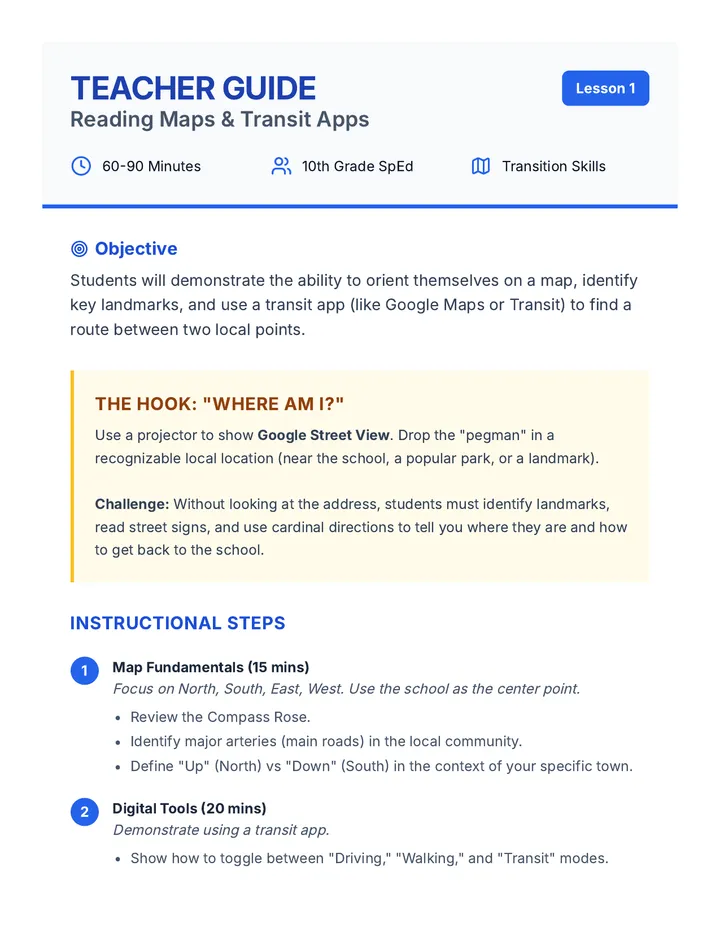
Living: Microwave assembly routines. Social: Contact parents for emergency picks. Safety: Read city and transit maps.
Supports & Strategies
Step-by-step physical visual microwave checklists, mock mobile emergency dialing scripts.
Mastery Benchmarks
Locates a designated bus route on a district map and indicates correct target station with 100% precision.
Journey Community Schools • Special Education Department Page 3 of 4
Journey Community Schools • Pacing Guide
Phase IV: Vocational Futures & Transitions
Spring II (Apr - May 21)
Phase Objective
Pre-vocational skills, monetary transactions, and direct student advocacy during annual placement planning sessions. Reinforce transferability of acquired skills to summer routines and subsequent school year placements.
K-2 Foundational Band Focus: Desk Cleaning
Targeted Skills
Living: Sanitize desks with a checklist. Social: Express standard physical appreciation. Safety: Walk safely on local playgrounds.
Supports & Strategies
Checklists with photos, token reinforcement boards, social scripts for saying "thank you."
Mastery Benchmarks
Successfully cleans workspace independently with 100% coverage using a visual check card.
3-5 Active Agency Band Focus: Tasks & Tokens
Targeted Skills
Living: Plant care & paper shredding. Social: Manage token economy options. Safety: Simulate crosswalk safety rules.
Presents/advocates at least 2 personal goals and 1 sensory preference in their mock IEP meeting.
Journey Community Schools • Special Education Department Page 4 of 4
3-5 Active Agency Band
Grades 3-5
Focus is on school-wide participation, peer compromise dynamics, independent hygiene routines, desk-job responsibility, and pedestrian/crosswalk simulation.
01
Workspace Stewardship
Sorting personal bins, desk organization checklists, paper shredding, and routine classroom job structures.
02
Peer Dialogue & Play
Using rock-paper-scissors prompt boards and visual timers to solve play disputes independently with peers.
03
Separated Waste Disposal
Navigating cafeteria lines and sorting leftover materials (landfill, compost, recycle) based on visual indicators.
04
Body Boundary Dynamics
Distinguishing appropriate private vs. public activities and maintaining body awareness in locker/restroom environments.
Journey Leadership Briefing Slide 4 of 7
6-8 Pathways to Independence
Grades 6-8
Focus is on secondary school transitions, pre-vocational task compliance, domestic meal prep, financial basic values, transit mapping, and self-advocacy development.
01
Pre-Vocational Task Work
Maintaining campus/locker organization, executing multi-step jobs, and knowing key work hazard tags.
Interpreting public bus routes, identifying primary street landmarks, and planning simple neighborhood routes.
04
Individual IEP Advocacy
Preparing mock IEP goals and expressing communication / classroom accommodations directly in annual meetings.
Journey Leadership Briefing Slide 5 of 7
Assessment & Specialist Coordination
Specialist Integration
Standardizing the pacing model allows Occupational Therapists (OT), Physical Therapists (PT), and Speech-Language Pathologists (SLP) to pre-align physical and sensory supports directly to the monthly thematic phase.
Data-Driven Benchmarks
Progress monitoring must occur bi-weekly using standardized district observation rubrics. Mastery requires 4 out of 5 consecutive independent trials over at least 10 instructional days.
All physical checklists and visual supports are archived in the shared District Portal for instantaneous retrieval.
Journey Leadership Briefing Slide 6 of 7
Implementation & Rollout
Next steps for school leaders, instructional coaches, and special education specialists to initiate school-wide pacing alignment:
Step 1 • Summer Briefing
Inventory Supports
Gather and print localized classroom check-lists, schedules, first-then boards, and sensory items matching Phase I.
Step 2 • August PD
Specialist Sync
Conduct scheduling meetings with OTs, PTs, and SLPs to map specific student accommodations onto the Phase objectives.
Step 3 • August Launch
Establish Baselines
Conduct first-week baseline evaluations on arrival/dismissal routines, setting initial pacing speeds per classroom.
Journey Leadership Briefing Slide 7 of 7
Journey Community Schools • Special Education Department Page 2 of 2