Chatter Control Cheat Sheet
Teacher Quick Reference
Chatter Control Cheat Sheet
Middle School Edition
Grades 6–8 Management
The Golden Middle School Rule: Never talk over side-chatter. Praise the behavior you want to multiply, address blurts with private dignity, and always use calm, low-tone certainty.
High-Impact Attention Getters
Dignified, non-infantilizing call-ins that work with 11–14 year-olds.
-
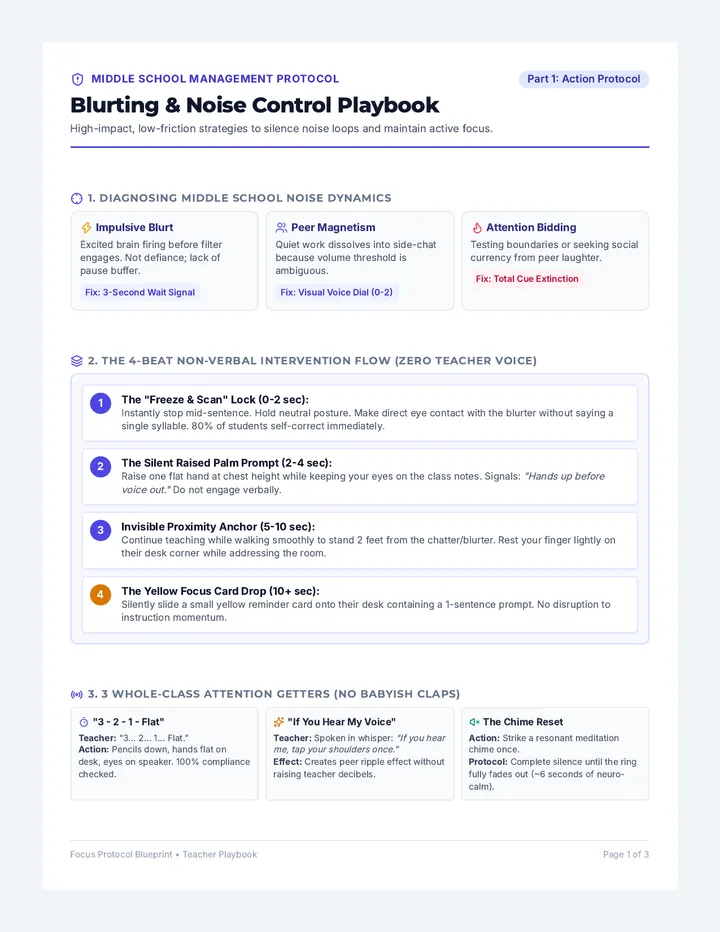
The 3-Second Count:
"Eyes on the board in 3... materials down in 2... 100% silent in 1."
-
Rhythm Claps / Taps:
Double-tap the desk; students must echo twice without speaking.
-
Direct Command Cue:
"If you can hear my voice, tap your pen once." (Repeat at lower volume).
Non-Verbal Micro-Cues
Correct without breaking instructional flow or triggering defensiveness.
-
The Proximity Glide:
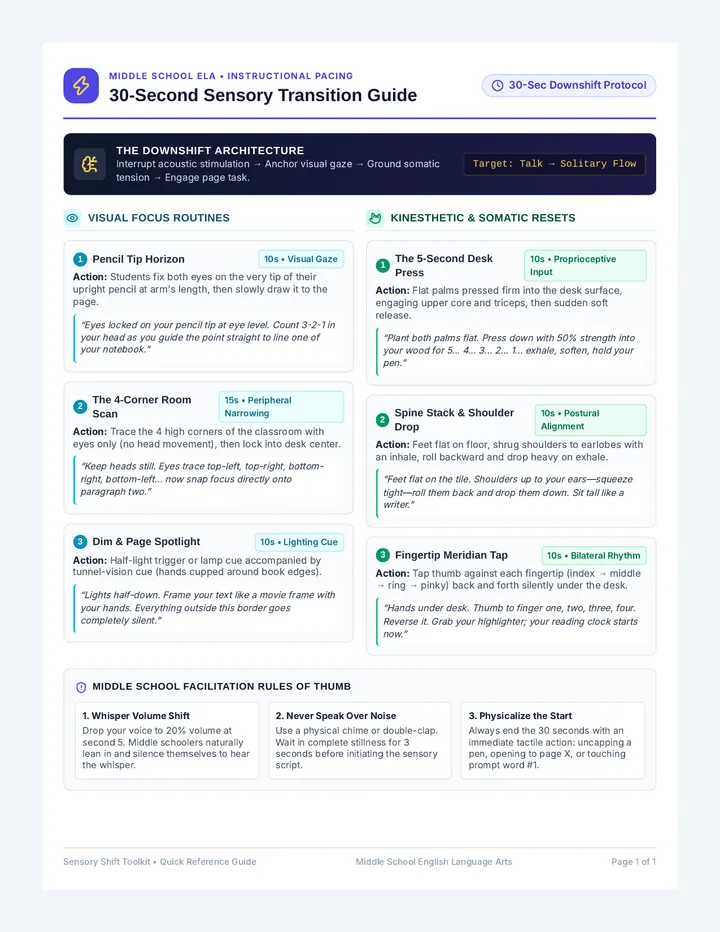
Walk calmly toward the chatter while continuing your lesson. Stand 3 ft away.
-
The Strategic Pause:
Stop mid-sentence, look warmly at the clock or board. Wait silently for 4–5 sec.
-
Desk Sticky Tap:
Place a mini sticky note on their desk stating: "Voice 0 now, thank you."
Word-for-Word De-Escalation Scripts
When someone blurts out an answer:
"Hold that brilliant thought! Put it in the queue with a raised hand so everyone gets thinking time."
When side chatter interrupts direct teaching:
"I need 100% of minds locked onto step 2 right now. We'll open partner talk in exactly 4 minutes."
When a student defends: "I was just asking about work!":
"I appreciate you wanting to be on track. The expectation is Level 0. Ask me directly with a signal."
When noise creeps up during independent work:
"Reset check: Room is currently at Level 2, but the task requires Level 0. Returning to silence in 3, 2, 1."
Focus Flow Toolkit • Teacher Strategy Guide Page 1 of 2
Systematic Discipline
Consequence Ladder & Incentives
Consistent & Predictable
The 4-Step Blurting & Chatter Consequence Ladder
1
Tier 1: Silent Non-Verbal Cue / Visual Warning Zero Public Drama
Eye contact, two-finger gesture toward anchor chart, or yellow cue card gently placed on table corner.
2
Tier 2: Private 1-on-1 Check-In (Low Whisper) Reframe & Choice
Crouch by desk: "Alex, this is your official redirection. You can focus here or move to the independent desk. What's your plan?"
3
Tier 3: Temporary Relocation (The "Focus Station") Logical Separation
Move to solo desk for 10 minutes to finish the task. "Let's reset your focus over here without distractions."
4
Tier 4: Restorative Reflection & Family Touchpoint Accountability
2-minute post-bell reflection conversation + brief parent email note focused on teamwork and classroom learning rights.
The Decibel Challenge (Class)
Draw 5 tally boxes on the whiteboard each morning. If the class maintains appropriate voice levels throughout the period without an emergency reset, they keep their tally mark.
Milestone Reward: 20 tally marks = 15 minutes of free-choice Friday music / trivia session.
The "Blurt Buffer" Bank
Give the room 3 "Grace Blurts" on the corner of the board per period. If 1 or more remain at dismissal, praise the impulse control and log 1 collective team point.
Middle School Appeal: Gamifies self-regulation without feeling childish or patronizing.
Emergency 60-Second Classroom Reset
Protocol
When the entire room gets overly chaotic: Stand at front, raise hand silently. Do not yell.
1. Physical Stand "Everyone stand up behind your chair in silence."
2. Deep Breath "Inhale for 4 seconds... exhale slowly for 4 seconds."
3. Clean Re-entry "Sit in silence. Level 0 resumes immediately."
Focus Flow Toolkit • Teacher Strategy Guide Page 2 of 2
Noise Navigator Poster
Classroom Decibel Standards
NOISE NAVIGATOR
Active Mission Levels
Match the Task: Check the designated level on the board before speaking. Self-Regulation in Action
0 Level
TOTAL SILENCE
Silent Solo
Independent work, direct instruction, quizzes/tests, and emergency safety drills.
Zero Voices 100% Deep Focus
1 Level
SPY WHISPER
Elbow Partner
Peer editing, turn-and-talk check-ins, whisper partner reading.
6-Inch Voice Only 1 person hears
2 Level
TABLE TALK
Small Group
Group projects, lab investigations, table brainstorming, collaborative tasks.
Table Perimeter Doesn't leave pod
3 Level
ROOM SPEAKER
Presentation
Whole-class share out, student speeches, class debates, asking public questions.
Clear Projection All 4 corners hear
4 Level
OUTSIDE VOICE
Not in Class
Courtyard, athletic fields, gym, pep rallies. Never during indoor academic time.
Open Air Only Outdoor space only
Pro-Tip: When the teacher raises a hand with a number (0, 1, 2), match that volume instantly.
FOCUS FLOW TOOLKIT
Blurt Filter Anchor Poster
Classroom Culture Anchor
The 3-Second Blurt Filter
Respect & Self-Control
Pause & Scan (Before You Speak)
Middle school minds move fast! Take 3 seconds to run your thought through these three checkpoints:
1
Is it on topic?
Does this connect directly to what we are learning right now?
2
Is someone speaking?
Wait until the teacher or classmate has fully finished.
3
Is a hand raised?
Raise your hand and wait for acknowledgement.
Universal Silent Signals (No Blurting Needed)
Signal silently from your desk
1
1 Finger Restroom / Water
2
2 Fingers Tissue / Pencil
3
3 Fingers Tech / Supplies
Raised Palm Question / Answer
The Idea Parking Lot
Have an off-topic question, funny thought, or random idea? Write it down on a sticky note instead of blurting it out. Post it on the class Parking Lot board for the final 5-minute Q&A.
Silent "Me Too" Connection
Agree with a classmate's comment? Flash the silent "shaka" / pinky-and-thumb connection sign instead of shouting "YES, SAME!". Keep the classroom flow intact.
Classroom Agreement: When you resist the urge to blurt, you give everyone in the room equal time to think, process, and succeed.
Focus Flow Toolkit • Student Anchor Poster Printable Poster (18x24 or 8.5x11)