Fidelity Focus Lesson Plan Fidelity Focus
Lesson Plan • Individualized Support
Time Required
45 Minutes
The Purpose
Consistent application of a Behavior Intervention Plan (BIP) is crucial for students to achieve their behavioral goals. It creates a predictable and supportive environment, helping them build positive habits and experience success. This lesson empowers students to take an active role in understanding and advocating for the consistent use of their personalized supports.
Objectives
Students will understand the importance of consistent BIP implementation and identify strategies to improve fidelity.
Preparation
Review the lesson flow and slide deck.
Prepare the My Support Plan Success slide deck for projection.
Print copies of Reflecting on My Routines journal for each student.
Print or project the BIP Implementation Rubric .
Materials List
Whiteboard or Projector
My Support Plan Success (Slides)
Reflecting on My Routines (Journal)
BIP Implementation Rubric
At a Glance
Audience
Grades 3-10
Approach
Discussion & Reflection
Setting
Tier 3 / Individual
Focus Area
Plan Fidelity
Instructional Sequence
5m
Warm-Up: What is "Consistency"?
• Begin by asking students what "consistency" means to them in daily life (e.g., bedtime, chores, sports practice).
• Discuss why consistency matters: routines build habits and help achieve goals.
• The Bridge: Introduce the idea that consistency is also vital when working on behavior goals.
10m
Introduction to Fidelity Checks
• Project Slides 1-3 . Compare the BIP to a recipe: it needs specific steps and ingredients to work.
• Define Fidelity: Doing something exactly as planned, every time.
• Discuss why high fidelity makes sure the plan is actually working for them .
• Ask for general examples of consistency (e.g., getting a reward every time vs. sometimes).
15m
Self-Reflection: My Routines
• Distribute Reflecting on My Routines Journal .
• Guide students through prompts (Project Slides 4-5 ).
• Emphasize: This is personal reflection, not for grading or judgment. It helps them understand their own needs.
• Circulate and offer support as they write.
10m
Understanding the Rubric
• Distribute the BIP Implementation Rubric (Project Slides 6-7 ).
• Explain that a rubric helps everyone see what "success" looks like.
• Walk through criteria (Beginning to Exemplary). Focus on how this helps them communicate their needs to adults.
5m
Wrap-Up: Consistency Counts!
• Recap main points (Slide 8). Remind students they are key partners in their plan.
• Exit Prompt: Share one thing learned or one way to ensure supports are applied consistently.
My Support Plan Success Slides Consistency
Counts!
My Support Plan Success
What does "consistent" mean to you?
Think about things you do regularly, like:
Bedtime routines
Chores
Practicing a sport or instrument
"Why is doing these things the same way, every time, important?"
Your Recipe for Success
Just like baking a cake needs the right ingredients and steps, your support plan is a recipe to help you succeed!
To make sure the recipe works, what do you think is super important?
What is Fidelity?
Fidelity means doing something exactly as it was planned.
High Fidelity
The plan is followed precisely.
Low Fidelity
The plan is NOT followed precisely.
Why is HIGH fidelity important for YOUR support plan?
Time to Reflect!
Sometimes, we need to pause and think about how things are going.
Think about our own routines.
Consider how consistently our supports are used.
Journal Time!
1
Read each prompt carefully.
2
Write down your honest thoughts.
3
This is YOUR thinking time to help YOU understand your supports better!
How do we know if our plan is being followed consistently?
We can use a rubric!
A rubric is like a guide that shows us what successful and consistent support looks like. It helps everyone understand expectations clearly.
1
Beginning
2
Developing
3
Proficient
4
Exemplary
You've Got This!
Consistency helps you reach your goals.
Fidelity means your plan is working as it should.
YOU are a key part of your own success!
Thank you for learning today!
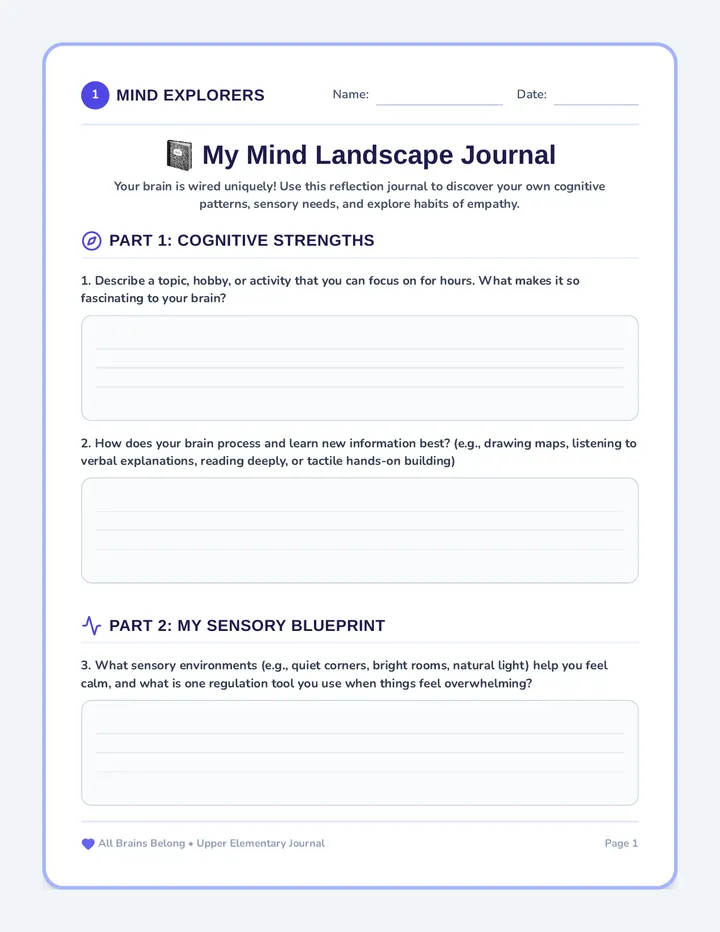
Reflecting on My Routines Journal My Routines Journal
Self-Reflection & Support Check
Name: __________________________
Date: ___________________________
"This journal is a space for you to think about your own support plan and how it helps you. There are no right or wrong answers, just your honest thoughts!"
1
My Daily Routines
Think about your school day. What are some routines or predictable things that happen? How do these routines help you feel calm and ready to learn?
2
My Support Plan in Action
You have a special support plan to help you with your learning and behavior. What are some parts of your plan that you remember being used today or this week?
3
How Consistent is My Support?
"Consistency" means doing something the same way, every time. How often do you feel the adults around you use your support plan exactly as it's designed?
Almost Always
Most of Time
Sometimes
Rarely
Explain why you chose that answer. Give an example if you can.
4
What Helps Me?
When your support plan is used consistently, how does it help you? What feels different?
5
My Ideas for Consistency
What is one idea you have that might help everyone use your support plan more consistently? (Reminder, signal, visual aid, etc.)
BIP Implementation Rubric BIP Implementation Rubric
Consistency Counts Success Guide
Fidelity Level
1 - 4
This rubric helps us understand how consistently your Behavior Intervention Plan (BIP) is being used. Consistent use helps you succeed!
Criteria Beginning (1) Developing (2) Proficient (3) Exemplary (4) Use of Strategies Strategies are rarely or inconsistently applied. Strategies are sometimes applied, but not always as planned. Strategies are applied most of the time as planned. Strategies are consistently applied exactly as planned. Timing & Prompts Supports are often late or missed. Supports are provided with some delays or inconsistent prompts. Supports are provided in a timely manner with appropriate prompts. Supports are consistently provided proactively and at the right time. Adult Response Adults respond differently each time to behaviors. Adults sometimes respond as outlined in the BIP. Adults usually respond consistently according to the BIP. Adults consistently respond to behaviors exactly as outlined in the BIP. Student Awareness Student is unaware of the BIP or how it works. Student has some understanding of the BIP but is unsure how it applies. Student understands the BIP and can identify when strategies are used. Student actively understands the BIP, can identify fidelity, and can advocate for their supports. Data Collection Data on BIP effectiveness is rarely or poorly collected. Data is sometimes collected, but may be incomplete or inconsistent. Data is usually collected accurately and consistently. Data on BIP effectiveness is collected accurately and consistently to inform adjustments.
Student Self-Advocacy Check:
Use this rubric to talk to your teachers or support staff about how your plan is working for you. Your feedback helps make the plan better!