Ancient Empires Reading Packet
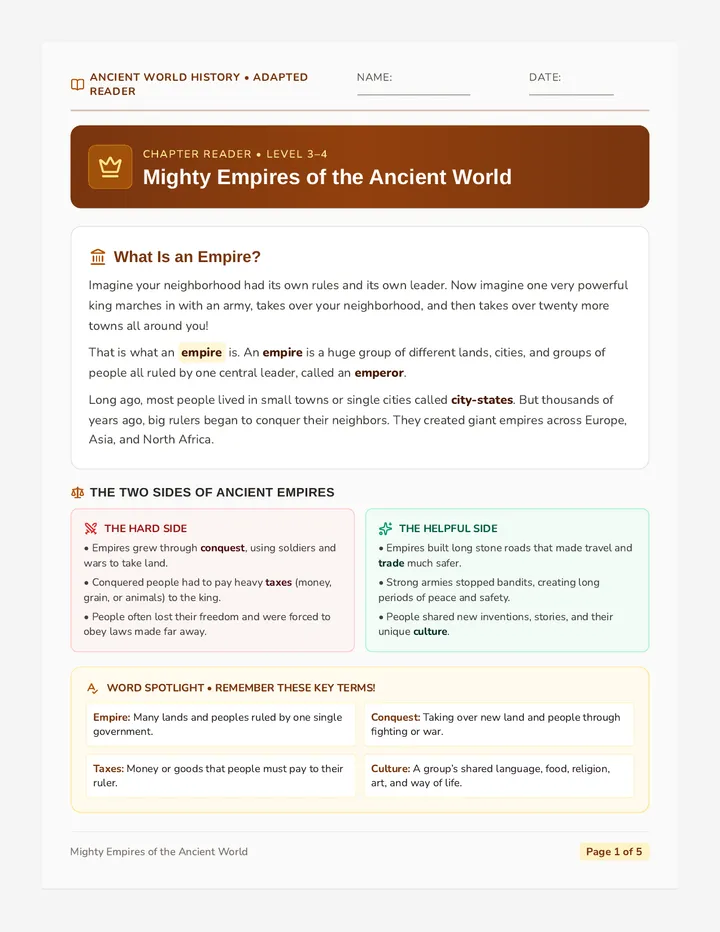
Ancient World History • Adapted Reader
Name: Date:
Chapter Reader • Level 3–4
Mighty Empires of the Ancient World
What Is an Empire?
Imagine your neighborhood had its own rules and its own leader. Now imagine one very powerful king marches in with an army, takes over your neighborhood, and then takes over twenty more towns all around you!
That is what an empire is. An empire is a huge group of different lands, cities, and groups of people all ruled by one central leader, called an emperor.
Long ago, most people lived in small towns or single cities called city-states. But thousands of years ago, big rulers began to conquer their neighbors. They created giant empires across Europe, Asia, and North Africa.
The Two Sides of Ancient Empires
The Hard Side
- • Empires grew through conquest, using soldiers and wars to take land.
- • Conquered people had to pay heavy taxes (money, grain, or animals) to the king.
- • People often lost their freedom and were forced to obey laws made far away.
The Helpful Side
- • Empires built long stone roads that made travel and trade much safer.
- • Strong armies stopped bandits, creating long periods of peace and safety.
- • People shared new inventions, stories, and their unique culture.
Word Spotlight • Remember These Key Terms!
Empire: Many lands and peoples ruled by one single government.
Conquest: Taking over new land and people through fighting or war.
Taxes: Money or goods that people must pay to their ruler.
Culture: A group’s shared language, food, religion, art, and way of life.
Mighty Empires of the Ancient World Page 1 of 5
Ancient World History • Timeline & Powers 600 B.C.E. to 600 C.E.
Visual Guide
A Map of Ancient Time
Over 1,000 Years of History
Historians organize time using dates. B.C.E. means "Before Common Era" (counting backwards to year zero), and C.E. means "Common Era."
750–336 B.C.E. Greece
Greek City-States
Greece was not one big empire. It was made of separate cities like Athens and Sparta that loved independence and invented democracy.
553–330 B.C.E. Middle East
The Great Persian Empire
A gigantic empire in the Middle East. Persian kings built long royal roads, allowed local people to keep their religions, and collected steady taxes.
509–27 B.C.E. Rome
The Roman Republic
Before it had emperors, Rome was a republic where citizens elected leaders to a council called the Senate.
336–323 B.C.E. Eurasia
Alexander the Great
A young king from Greece marched his army across Egypt and Persia all the way to India, spreading Greek ideas everywhere he went.
221 B.C.E.–220 C.E. China
China: The Qin and Han Dynasties
After fighting in the Warring States period, China united under its first emperor and grew into a powerful trading giant.
27 B.C.E.–180 C.E. Rome
The Pax Romana (Roman Peace)
The golden age of the Roman Empire. Rome ruled over 50 million people, protected trade routes, and built giant monuments.
Big Clash: Persians and Greeks
Around 490 B.C.E., the massive Persian Empire attacked Greece. Persia was hundreds of times larger than Greece! But the small Greek city-states joined forces to protect their homes. The Greeks won surprising victories at famous battles like Marathon and Salamis, showing that even giant empires could be defeated!
Mighty Empires of the Ancient World Page 2 of 5
Ancient World History • Focus on Rome Page 121 in Textbook
Case Study One
Rome: From Republic to Empire
From Citizens Voting to One Man Ruling
For nearly five hundred years, Rome was proud to be a republic. In a republic, there is no king. Instead, free citizens elected leaders to speak for them in a group called the Senate. Roman citizens valued simple living, teamwork, and loyalty to their city.
But as Rome conquered more lands around the Mediterranean Sea, Rome became super wealthy. Powerful army generals—like Sulla, Pompey, and the famous Julius Caesar—recruited their own private armies. The soldiers were loyal to their generals, not to Rome! This caused a terrible civil war (a war where people of the same country fight each other).
Emperor Augustus and the Roman Peace
When the civil war ended, Julius Caesar’s adopted son, named Octavian, took control. He was given the special title Augustus (meaning "the honored one"). He became the very first Roman emperor.
Augustus was very clever. He knew Romans hated kings, so he called himself the "First Citizen" and let the Senate keep meeting. But in reality, Augustus held all the power because he controlled the entire army.
What Was the Pax Romana? 27 B.C.E. – 180 C.E.
Pax Romana means "Roman Peace." For two hundred years, Rome had almost no major civil wars. A Greek traveler named Aelius visited Rome and was amazed:
"Now, anyone can travel safely from one end of the empire to the other. People have put down their weapons. The whole world feels like it is at a great festival!"
Think About It:
Would you rather live in a republic where you help choose your leaders, or in an empire with one strong emperor who promises peace and safety?
Mighty Empires of the Ancient World Page 3 of 5
Ancient World History • Focus on China (Part 1) Pages 121–122 in Textbook
Case Study Two • Part 1
China: From Seven Warring States to One Empire
Seven Kingdoms at War
Long ago, China had been united under ancient dynasties like the Xia, Shang, and Zhou. But by 500 B.C.E., that unity fell apart completely. Seven competing kingdoms fought endless wars for hundreds of years during a chaotic time called the Warring States period.
People desperately wanted peace and order. In the western state of Qin, a ruthless king built a powerful army equipped with sharp iron weapons. In just ten short years, he crushed all rival states! In 221 B.C.E., he reunited China and named himself Qin Shihuangdi, which means "The First Emperor."
Ruling with Iron: A Philosophy Called Legalism
Unlike Emperor Augustus in Rome, Qin Shihuangdi did not hide his power. He ruled using a strict belief system called Legalism.
• Harsh Punishments: Laws were crystal clear. Anyone who disobeyed faced severe punishments, jail, or forced labor.
• Burning of Books: Scholars who criticized the emperor were punished, and ancient history books were burned to stop disagreements!
The Great Wall of China
Emperor Qin forced hundreds of thousands of workers to connect giant stone and dirt walls across northern China to keep out wandering invaders.
The Terra-Cotta Army
To guard his giant underground tomb forever, Qin ordered craftspeople to shape more than 8,000 life-sized clay soldiers, each with a unique face!
Mighty Empires of the Ancient World Page 4 of 5
Ancient World History • Focus on China (Part 2) & Review Page 122 in Textbook
Case Study Two • Part 2
Making Everything Match & The Han Golden Age
Making Things Match Across China (Standardization)
Before Qin, each of the seven kingdoms had different coins, different measurements, and different writing styles. Emperor Qin ordered that everything must match:
• Same Money (Currency): Round copper coins with square holes could be used anywhere in China.
• Same Weights & Measures: Merchants used the exact same scale cups and measuring sticks.
• Same Cart Axles: All wagon wheels were built the exact same width to fit road grooves!
• Same Written Language: Everyone wrote Chinese characters the exact same way.
The Gentler Han Dynasty & Confucianism
Because Emperor Qin was so harsh, people rebelled right after he died. The Qin Dynasty collapsed after only 15 years!
In 206 B.C.E., the famous Han Dynasty took over. Han rulers kept China united, but they got rid of harsh Legalism. Instead, they adopted Confucianism—a philosophy that taught respect for family, kindness, honest leaders, and education. The Han Dynasty lasted for over 400 years!
Reading Check: Show What You Learned!
1. Why did the seven kingdoms in China fight during the Warring States period?
2. Name two things Emperor Qin made standard (matching) across all of China:
3. How was the Han Dynasty different and kinder than the Qin Dynasty?
Mighty Empires of the Ancient World Page 5 of 5
Empire Words Flashcards
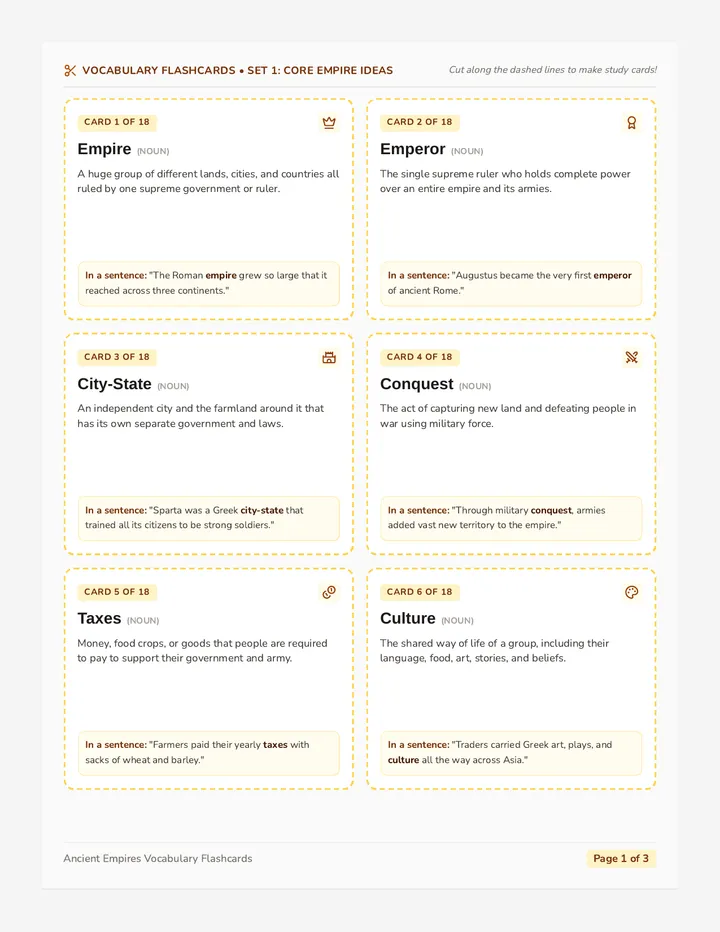
Vocabulary Flashcards • Set 1: Core Empire Ideas
Cut along the dashed lines to make study cards!
Card 1 of 18
Empire
(Noun)
A huge group of different lands, cities, and countries all ruled by one supreme government or ruler.
In a sentence: "The Roman empire grew so large that it reached across three continents."
Card 2 of 18
Emperor
(Noun)
The single supreme ruler who holds complete power over an entire empire and its armies.
In a sentence: "Augustus became the very first emperor of ancient Rome."
Card 3 of 18
City-State
(Noun)
An independent city and the farmland around it that has its own separate government and laws.
In a sentence: "Sparta was a Greek city-state that trained all its citizens to be strong soldiers."
Card 4 of 18
Conquest
(Noun)
The act of capturing new land and defeating people in war using military force.
In a sentence: "Through military conquest, armies added vast new territory to the empire."
Card 5 of 18
Taxes
(Noun)
Money, food crops, or goods that people are required to pay to support their government and army.
In a sentence: "Farmers paid their yearly taxes with sacks of wheat and barley."
Card 6 of 18
Culture
(Noun)
The shared way of life of a group, including their language, food, art, stories, and beliefs.
In a sentence: "Traders carried Greek art, plays, and culture all the way across Asia."
Ancient Empires Vocabulary Flashcards Page 1 of 3
Vocabulary Flashcards • Set 2: Ancient Rome
Cut along the dashed lines to make study cards!
Card 7 of 18
Republic
(Noun)
A government with no king, where citizens elect leaders to make laws and decisions for them.
In a sentence: "Before it became an empire, Rome was a proud republic where citizens voted."
Card 8 of 18
Senate
(Noun)
A council of respected leaders and elders in ancient Rome who debated, voted, and guided laws.
In a sentence: "Members of the Roman Senate wore white wool togas with purple borders."
Card 9 of 18
Citizen
(Noun)
A legal member of a country or city who has protected rights and responsibilities, like voting.
In a sentence: "Being a Roman citizen gave people special legal rights and court protections."
Card 10 of 18
Civil War
(Noun)
A violent conflict fought between different groups or ambitious generals of the same nation.
In a sentence: "Rival generals dragged Rome into a destructive civil war."
Card 11 of 18
Augustus
(Proper Noun)
Julius Caesar's adopted son Octavian, who became Rome's first emperor and established peace.
In a sentence: "Emperor Augustus ruled Rome wisely and rebuilt many marble temples."
Card 12 of 18
Pax Romana
(Noun)
"Roman Peace"—a 200-year era of safety, stability, and expanding trade across the Mediterranean.
In a sentence: "During the Pax Romana, merchants traveled without fear of bandits."
Ancient Empires Vocabulary Flashcards Page 2 of 3
Vocabulary Flashcards • Set 3: Ancient China
Cut along the dashed lines to make study cards!
Card 13 of 18
Warring States
(Noun)
A chaotic time when seven rival kingdoms in China fought continuously for power.
In a sentence: "The Warring States period finally ended when Emperor Qin united China."
Card 14 of 18
Dynasty
(Noun)
A line of rulers from the same family who pass royal power down through generations.
In a sentence: "The Han dynasty ruled China for over four hundred peaceful years."
Card 15 of 18
Legalism
(Noun)
A strict philosophy that used severe punishments and rigid rules to keep complete control.
In a sentence: "Emperor Qin used Legalism to punish anyone who disobeyed his laws."
Card 16 of 18
Great Wall
(Proper Noun)
A massive stone border wall built across northern China to defend against invading tribes.
In a sentence: "Soldiers guarded the Great Wall from high watchtowers along the hills."
Card 17 of 18
Terra-Cotta Army
(Noun)
Over 8,000 life-sized clay soldiers buried underground to guard Emperor Qin's tomb forever.
In a sentence: "Every soldier in the Terra-Cotta Army has a unique carved face."
Card 18 of 18
Confucianism
(Noun)
A gentle Chinese philosophy teaching kindness, family respect, honesty, and fair rulers.
In a sentence: "The Han emperors used Confucianism to govern China with morality and care."
Ancient Empires Vocabulary Flashcards Page 3 of 3