Founding America Teacher Guide Curriculum Master Guide • Grades 1–4 Unit Duration: 10 Instructional Days
The Founding of the United States: 2-Week Master Pacing Guide
Multi-grade instructional roadmap with multi-tiered supports, daily activities, and vetted historical search inquiries.
Grades 1–2 Focus (Foundational & Concrete)
Emphasize storytelling, historical symbols (Liberty Bell, flag, bald eagle), picture-based colony matching, map coloring, and guided read-aloud vocabulary with oral repetition.
Grades 3–4 Focus (Analytical & Guided Inquiry)
Deepen cause-and-effect reasoning (taxation without representation), regional economic contrasts (timber vs. cash crops), document analysis (Declaration excerpts), and short written reflections.
Week 1 Pacing: The Thirteen Colonies to the Revolutionary Spark
Days 1 – 5
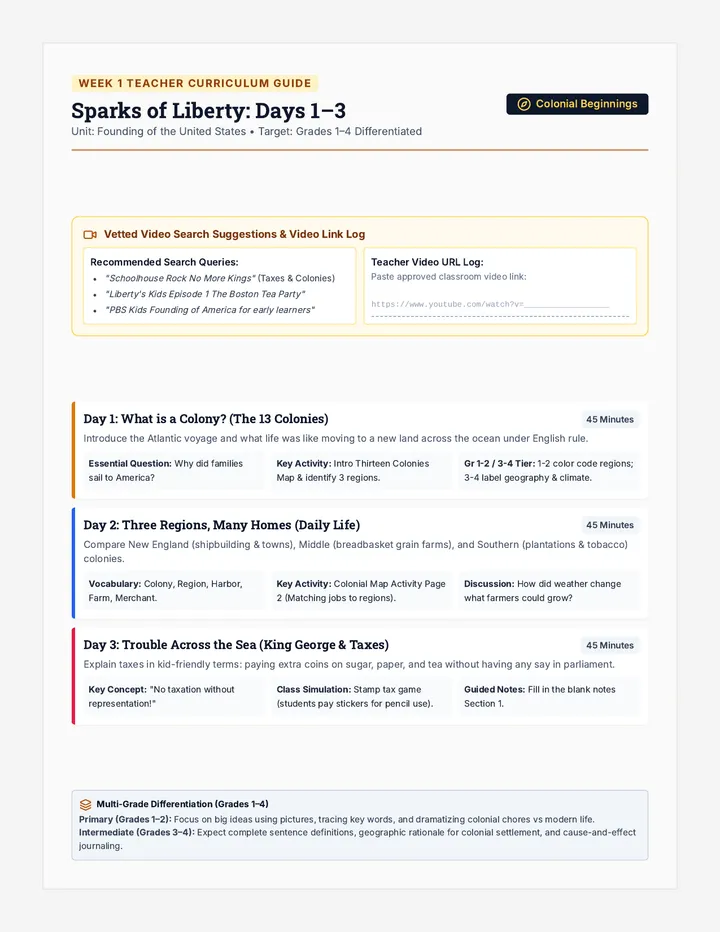
Day 1
Crossing the Ocean & The Thirteen Colonies Topic: Geography & Atlantic Crossing
Introduce the 3 colonial regions (New England, Middle, Southern). Color-code the Thirteen Colonies Map.
Search Tip: "13 colonies geography for elementary kids" • Target: 4-6 min animation
Day 2
Daily Life, Jobs & Artisans in Colonial Towns Topic: Blacksmiths, Coopers, & Farms
Compare colonial homes and chores to modern life. Complete the Colonial Life fill-in-the-blank notes.
Search Tip: "colonial life children chores colonial williamsburg" • Target: 5 min doc
Day 3
Taxes, Trouble & "No Taxation Without Representation!" Topic: Stamp Act & Unfair Rules
Simulate a classroom button/sticker tax to demonstrate colonial frustration. Introduce King George III.
Search Tip: "no taxation without representation explained for kids" • Target: 3-5 min
Day 4
The Boston Tea Party & Early Boycotts Topic: Boston Harbor Protest (1773)
Examine why colonists dumped tea into Boston Harbor. Discuss peaceful vs. defiant protests.
Search Tip: "boston tea party story for elementary school" • Target: 4-5 min story
Day 5
The Midnight Ride & The Shot Heard 'Round the World Topic: Paul Revere & Lexington/Concord
Trace Paul Revere's lantern signal ("one if by land, two if by sea"). Mid-unit review check.
Search Tip: "paul revere midnight ride cartoon kids" • Target: 4 min narrative
Unit: Founding Freedom • Lesson 1 Teacher Materials Page 1 of 2
Curriculum Master Guide • Week 2 & Media Guide Days 6 – 10
Week 2 Pacing: Independence, Constitution, and American Symbols
Day 6
1776: The Declaration of Independence Topic: Thomas Jefferson & July 4th
Discuss the meaning of "life, liberty, and the pursuit of happiness." Practice John Hancock's large signature.
Search Tip: "declaration of independence explained elementary school" • Target: 4-6 min
Day 7
George Washington & The Revolutionary Soldiers Topic: General Washington & Valley Forge
Explore how everyday farmers formed the Continental Army. Highlight endurance and leadership.
Search Tip: "george washington biography for kids animated" • Target: 5 min biography
Day 8
The Constitutional Convention & "We The People" Topic: Creating the Rules (1787)
Introduce the Preamble. Explore why laws help communities cooperate and solve problems together.
Search Tip: "the constitution we the people for kids" • Target: 4-5 min educational video
Day 9
Three Branches of Government & The Bill of Rights Topic: Balance of Power & Personal Freedoms
Use the "Tree of Government" metaphor (Legislative, Executive, Judicial). Match core rights.
Search Tip: "3 branches of government for elementary kids" • Target: 4 min cartoon
Day 10
American Symbols Showcase & Celebration of Liberty Topic: Liberty Bell, Flag, Eagle & Review
Unit showcase: student presentation of founding symbol detectives and comprehensive unit wrap-up.
Search Tip: "symbols of the united states for kids" • Target: 4 min recap
Best Practices for Video Clips in Grades 1–4
Keep Clips Under 6 Min: Elementary attention peaks at 3–5 minutes. Pause at minute 2 to ask: "What problem are the colonists facing?"
Active Viewing Tasks: Give students one word to listen for (e.g., "tax", "liberty", "colony"). Have them give a quiet thumbs-up when heard.
Post-Video Debrief: Ask: "If you lived in 1776, would you want to sign the Declaration?" Encourage 1st-4th grade partners to share.
Core 8 Unit Vocabulary Terms
Colony: Land ruled by a distant nation.
Tax: Money paid to a government for public use.
Liberty: Freedom to make choices and live freely.
Independence: Standing on your own without a king.
Boycott: Refusing to buy goods in protest.
Constitution: The supreme set of rules for a country.
Rights: Protections that belong to every person.
Citizen: An official member of a community or nation.
Unit: Founding Freedom • Lesson 2 Teacher Materials Page 2 of 2
Thirteen Colonies Map Packet Name: Date: Grade:
Geography & History Exploration
The Thirteen Original Colonies
Atlantic Coast (1607–1776)
New England Region
NH, MA, RI, CT
Rocky soil & cold winters
Thick pine forests & timber
Shipbuilding & fishing ports
Map Color: Blue 🟦
Middle Region
NY, PA, NJ, DE
"Breadbasket Colonies"
Wheat, rye & grain mills
Diverse trade in Philly & NYC
Map Color: Yellow / Orange 🟨
Southern Region
MD, VA, NC, SC, GA
Warm climate & long growing season
Rich fertile soil for crops
Large farms: tobacco & rice
Map Color: Green 🟩
Atlantic Coast Colony Map Diagram
Color each regional box using the color key above
1. Northern Region Cold & Rocky
Massachusetts • New Hampshire • Rhode Island • Connecticut
Write Region Name:
2. Central Region Breadbasket
New York • Pennsylvania • New Jersey • Delaware
Write Region Name:
3. Southern Region Warm & Fertile
Maryland • Virginia • North Carolina • South Carolina • Georgia
Write Region Name:
Colonial Region Clue Hunt (Write: New England, Middle, or Southern)
1. Known as the "Breadbasket" because farmers grew lots of wheat:
2. Cold winters, rocky soil, and deep harbors for wooden ships:
3. Sunny and warm with huge plantations of rice, indigo, and tobacco:
Thirteen Colonies Map Packet • Social Studies Grades 1–4 Page 1 of 2
Name: Date: Grade:
Guided Notes & Vocabulary
Colonial Life to the Revolutionary Spark
Student Notes
Official Word Bank (Use each word once)
5 Key Terms
Colony Tax Representation Tea Party Paul Revere
Fill in the Missing History Words
1. A settlement ruled by another country across the ocean is called a .
2. King George III ordered the American colonists to pay a heavy on goods like sugar, paper stamps, and tea.
3. The colonists were angry because they had no (or voice) in the British government to vote on laws.
4. In 1773, colonists disguised themselves and threw 342 crates of tea into the harbor during the Boston .
Colony to Liberty Slides History Unit • Grades 1–4 Lesson 1: The Spark of Liberty
Colony to Liberty:
The Road to American Freedom
How thirteen separate colonies came together to stand up for their rights, challenge a king, and build a new nation.
13 Colonies • Taxes & Protests • The Midnight Ride
Colonial Geography
Life in the Three Colonial Regions
New England
NH, MA, RI, CT
• Rocky soil & cold winters
• Fishing cod & whales
• Building sturdy ships
Ocean Traders ⚓
Middle Colonies
NY, PA, NJ, DE
• The "Breadbasket"
• Rich wheat & rye fields
• Bustling market towns
Grain & Trade 🌾
Southern Colonies
MD, VA, NC, SC, GA
• Warm & sunny climate
• Fertile black soil
• Tobacco, rice & indigo
Farming & Crops ☀️
Class Question: Which colonial region would your family choose to call home?
Growing Conflict
Trouble Brewing: Taxes & Tea
Unfair Taxes from Britain
King George III and the British Parliament made the colonists pay extra tax money on sugar, newspapers, and tea.
"No Taxation Without Representation!"
The colonists had no lawmakers in Britain to vote on these rules!
The Boston Tea Party (1773)
• On a cold December night, colonists boarded three merchant ships.
• They dumped 342 wooden chests of British tea into the ocean.
• The harbor smelled like tea for days! Colonists refused to pay the tax.
This bold protest proved the colonists were ready to stand together for their freedom!
Media Exploration Slot
Video Spotlight: The Boston Tea Party
Historical Video Placement
Recommended Search:
(Ideal Duration: 3 to 5 Minutes)
Look & Listen While Watching:
Why were the colonists so upset about the tea tax?
What disguise did the Sons of Liberty wear?
What did King George do after the tea was tossed?
Give a quiet thumbs-up when you hear the word "Boycott" in the clip!
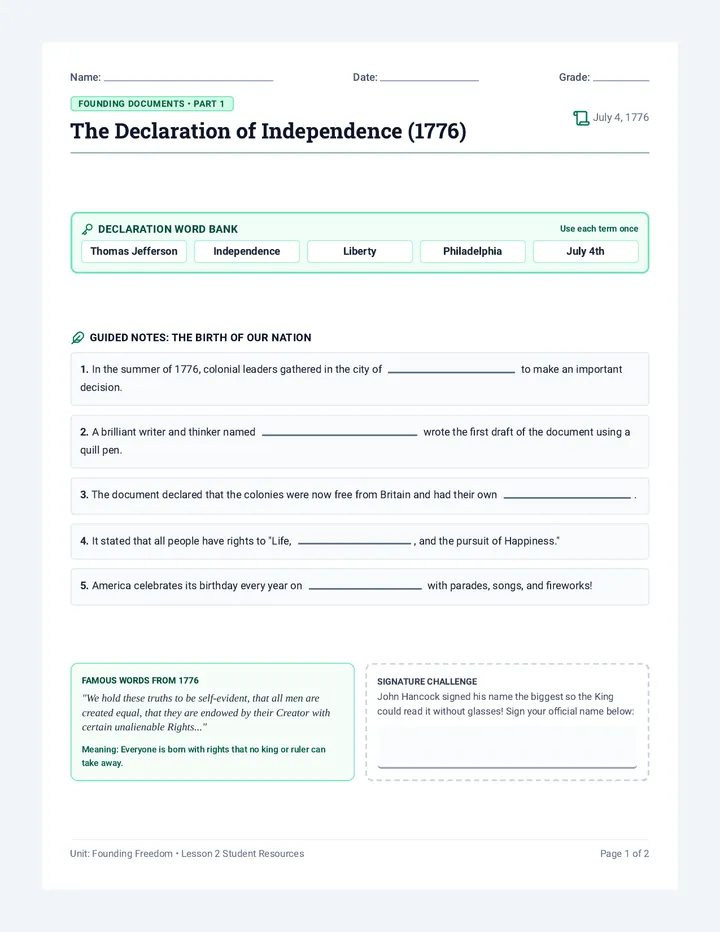
Freedom Documents Guided Notes Name: Date: Grade:
Founding Documents • Part 1
The Declaration of Independence (1776)
July 4, 1776
Declaration Word Bank
Use each term once
Thomas Jefferson Independence Liberty Philadelphia July 4th
Guided Notes: The Birth of Our Nation
1. In the summer of 1776, colonial leaders gathered in the city of to make an important decision.
2. A brilliant writer and thinker named wrote the first draft of the document using a quill pen.
3. The document declared that the colonies were now free from Britain and had their own .
4. It stated that all people have rights to "Life, , and the pursuit of Happiness."
5. America celebrates its birthday every year on with parades, songs, and fireworks!
Famous Words from 1776
"We hold these truths to be self-evident, that all men are created equal, that they are endowed by their Creator with certain unalienable Rights..."
Meaning: Everyone is born with rights that no king or ruler can take away.
Signature Challenge
John Hancock signed his name the biggest so the King could read it without glasses! Sign your official name below:
Unit: Founding Freedom • Lesson 2 Student Resources Page 1 of 2
Name: Date: Grade:
Founding Documents • Part 2
The U.S. Constitution & Three Branches
1787 Philadelphia
The Supreme Law of the Land Written in 1787
The Constitution is our country's highest rulebook. It starts with the three most famous words in American history: "We the People..." , which means the government gets its power directly from everyday citizens, not a royal monarch!
The Three Branches of United States Government
1. Legislative
Congress (Capitol)
Senators and Representatives meet to write, debate, and vote on national laws.
Job: Makes the Laws 📜
2. Executive
The President (White House)
The President leads the nation, commands the armed forces, and signs laws.
Job: Enforces the Laws 🏛️
3. Judicial
Supreme Court Judges
Nine Justices listen to cases and make sure laws match the Constitution.
Job: Interprets the Laws ⚖️
Branch Check (Write: Legislative, Executive, or Judicial)
1. Which branch includes the President of the United States?
Founding Symbols Activity Pack Name: Date: Grade:
Flashcards & Study Tool
Founding America: 8 Core Vocabulary Cards
Cut or Keep Whole
1. Colony
Noun • Settlement
A land or settlement ruled by another distant country across the sea.
"Virginia was the first English colony."
2. Liberty
Noun • Freedom
The power and freedom to make your own choices and live without unfair control.
"The Liberty Bell rang out for freedom."
3. Tax
Noun • Government Fee
Money collected by a government to pay for public services like roads and defense.
"Colonists refused to pay the king's tea tax."
4. Independence
Noun • Self-Rule
Freedom from being governed or ruled by another person, king, or outside country.
"July 4th celebrates American Independence."
5. Boycott
Verb • Protest
Refusing to buy, use, or trade certain goods as a peaceful way to protest an unfair rule.
"Families boycotted British tea and cloth."
6. Constitution
Noun • Supreme Law
The written set of supreme principles and fundamental rules that guide our government.
"The Constitution starts with 'We the People'."
7. Rights
Noun • Protections
Important human freedoms guaranteed to every person that laws must protect and honor.
"The Bill of Rights protects freedom of speech."
8. Citizen
Noun • Community Member
A recognized legal member of a country or community who has duties and protected rights.
"Good citizens vote and help their neighbors."
Founding Symbols Activity Pack • Elementary History Page 1 of 2
Name: Date: Grade:
National Symbols & Review
American Symbols & Citizen Mission
Unit Finale
Part A: American Symbols Detective (Match Symbol to Meaning)
1. The Liberty Bell _____
2. The American Bald Eagle _____
3. The 13 Red & White Stripes _____
A. Represents the thirteen original American colonies that united in 1776.
B. Chosen as the national bird because of its courage, strength, and wild freedom.
C. Famous bell in Philadelphia with a crack that rang to read the Declaration.