Sparks Pacing Guide Week 1 Teacher Curriculum Guide
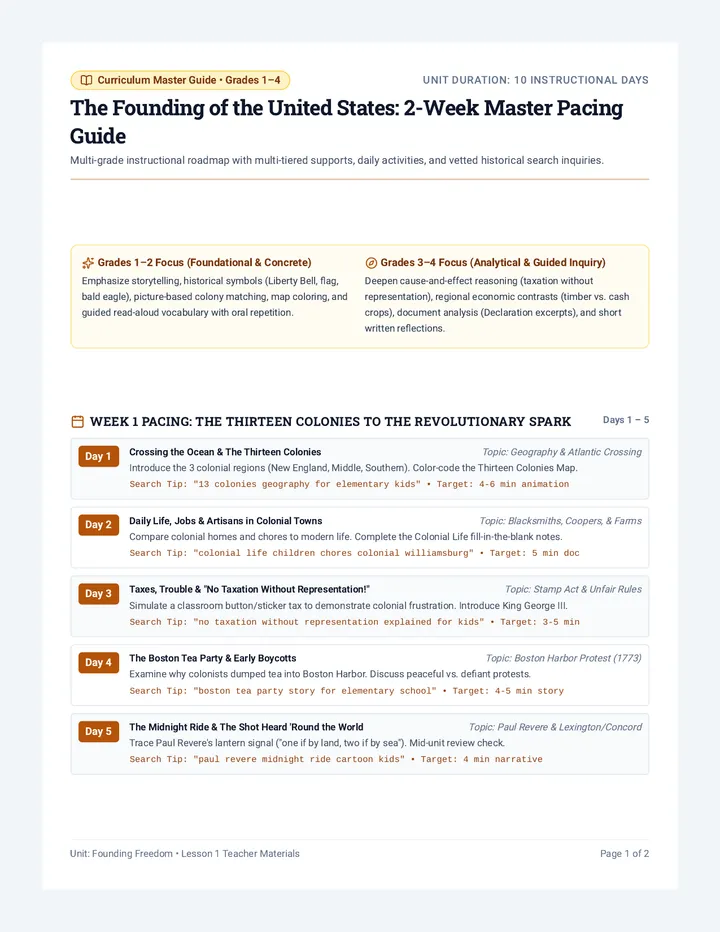
Sparks of Liberty: Days 1–3
Unit: Founding of the United States • Target: Grades 1–4 Differentiated
Colonial Beginnings
Vetted Video Search Suggestions & Video Link Log
Recommended Search Queries:
"Schoolhouse Rock No More Kings" (Taxes & Colonies)"Liberty's Kids Episode 1 The Boston Tea Party" "PBS Kids Founding of America for early learners"
Teacher Video URL Log:
Paste approved classroom video link:
https://www.youtube.com/watch?v=\_\_\_\_\_\_\_\_\_\_\_\_\_\_\_\_\_\ _
Day 1: What is a Colony? (The 13 Colonies)
45 Minutes
Introduce the Atlantic voyage and what life was like moving to a new land across the ocean under English rule.
Essential Question: Why did families sail to America?
Key Activity: Intro Thirteen Colonies Map & identify 3 regions.
Gr 1-2 / 3-4 Tier: 1-2 color code regions; 3-4 label geography & climate.
Day 2: Three Regions, Many Homes (Daily Life)
45 Minutes
Compare New England (shipbuilding & towns), Middle (breadbasket grain farms), and Southern (plantations & tobacco) colonies.
Vocabulary: Colony, Region, Harbor, Farm, Merchant.
Key Activity: Colonial Map Activity Page 2 (Matching jobs to regions).
Discussion: How did weather change what farmers could grow?
Day 3: Trouble Across the Sea (King George & Taxes)
45 Minutes
Explain taxes in kid-friendly terms: paying extra coins on sugar, paper, and tea without having any say in parliament.
Key Concept: "No taxation without representation!"
Class Simulation: Stamp tax game (students pay stickers for pencil use).
Guided Notes: Fill in the blank notes Section 1.
Multi-Grade Differentiation (Grades 1–4)
Primary (Grades 1–2): Focus on big ideas using pictures, tracing key words, and dramatizing colonial chores vs modern life.
Intermediate (Grades 3–4): Expect complete sentence definitions, geographic rationale for colonial settlement, and cause-and-effect journaling.
Week 1 Teacher Curriculum Guide
Sparks of Liberty: Days 4–5
Boston Tea Party to the Declaration of Independence
July 4, 1776
Day 4: Protests & Midnight Rides (Boston Tea Party)
45 Minutes
The Sons of Liberty dump 342 chests of British tea into Boston Harbor; Paul Revere rides through the night warning that troops are coming.
Instructional Sequence:
Read-Aloud: The Boston Tea Party or graphic picture book.
Guided Notes Section 2: Boston Tea Party and Paul Revere.
Role-play: Town criers delivering the news across the classroom.
Video Search & Screening Tip:
Search: "Boston Tea Party for kids PBS" . Preview clips for age-appropriate portrayal of historical civil protest.
Teacher Link: https://youtu.be/\_\_\_\_\_\_\_\_\_\_\_\_\_\_\_\ _
Day 5: A New Birthday (The Declaration of Independence)
45 Minutes
Thomas Jefferson pens the historic words: "Life, Liberty, and the pursuit of Happiness." 56 leaders sign their names in Philadelphia on July 4, 1776.
Class Activity:
Introduce the giant signature of John Hancock. Students practice writing their own signatures with feather quills (or calligraphic pens) on faux-parchment paper.
Assessment & Review:
Complete Guided Notes Section 3 and play the Founding Words Vocabulary Match game in small groups or pairs.
Materials Checklist (Week 1)
Thirteen Colonies Map Study (1 per student)
Revolution Guided Notes (1 per student)
Founding Words Matchcards (cut & bag sets)
Crayons/colored pencils (red, blue, green)
Recommended Read-Alouds
• John, Paul, George & Ben by Lane Smith
• A More Perfect Union by Betsy Maestro
• Independent Dames by Laurie Halse Anderson
• George vs. George by Rosalyn Schanzer
End-of-Week Formative Assessment Questions:
1. If someone made rules for you without ever asking your opinion, how would you feel?
2. Why is July 4th still celebrated with parades and fireworks across America today?
Colonies Map Activity Colonial Geography • Grade 1–4
The Thirteen American Colonies Map
Name:
Date:
Map Explorer Instructions:
Color the colonies in each of the three regions using the color key below. Then find and label the Atlantic Ocean.
New England (Blue)
NH, MA, RI, CT
Middle Colonies (Green)
NY, NJ, PA, DE
Southern Colonies (Red)
MD, VA, NC, SC, GA
Atlantic Ocean
N
W E
S
1. New England Region Cold Winters • Rocky Soil • Fishing
Massachusetts (MA)
New Hampshire (NH)
Rhode Island (RI)
Connecticut (CT)
2. Middle Colonies ("Breadbasket") Wheat & Grain • Busy Mills
New York (NY)
Pennsylvania (PA)
New Jersey (NJ)
Delaware (DE)
3. Southern Colonies Warm Climate • Rich Farmland
Maryland (MD)
Virginia (VA)
North Carolina (NC)
South Carolina (SC)
Georgia (GA) - southernmost colony
Geography Reflection:
Which ocean borders all 13 American colonies to the east?
The __________________________________________________________________
Color each box as you find each colony • Page 1 of 2
Part 2 & Teacher Answer Key
Colonial Regions Match & Key
Answer Guide Included
Activity: Who Am I? Match each clue to its colonial region!
A. New England
B. Middle Colonies
C. Southern Colonies
1. We had rocky soil and cold winters, so many of us became fishermen and shipbuilders.
2. We grew so much wheat and grain that people called us the "Breadbasket" of America.
3. We had long warm sunny days and huge farms growing crops like rice and tobacco.
4. Benjamin Franklin lived in Philadelphia, one of the busiest cities in this region.
Teacher Reference & Answer Key
Clue Matching Answers:
1. New England (A) — Rocky soil, fishing, lumber.2. Middle Colonies (B) — "Breadbasket", wheat.3. Southern Colonies (C) — Long growing season.4. Middle Colonies (B) — Philadelphia, Pennsylvania.Ocean Answer: Atlantic Ocean
Discussion Prompts for Teachers:
Revolution Notes Worksheet Fill-in-the-Blank History Notes
The Road to Independence
Name:
Date:
Official Word Bank (Use each word once)
Thirteen King George III Tax Tea Thomas Jefferson July 4, 1776 Liberty
1
Trouble with the King Across the Sea
Long ago, there were colonies along the eastern coast of America.
The ruler of Great Britain was named . He ordered colonists to follow his laws even though they lived thousands of miles away.
The British government made colonists pay a on paper, sugar, and stamps. Colonists were upset because they had no voice in government!
2
The Boston Tea Party Protest
In 1773, a group called the Sons of Liberty marched to Boston Harbor.
They climbed onto three British ships and dumped 342 chests of British into the cold water to protest unfair rules!
3
The Birth of a Free Nation
Colonial leaders met in Philadelphia and chose to write a declaration of freedom.
He wrote that all people are created equal and have rights to Life, , and the pursuit of Happiness.
On , colonial leaders officially adopted the Declaration of Independence!
Patriot Sketchpad: Draw John Hancock's Famous Big Signature or a Tea Crate!
Unit: Founding of the United States • Student Notes Page 1 of 2
Educator Resource • Answer Key
The Road to Independence: Answer Key
Teacher Guide
Section 1: Trouble with the King
• Blank 1: Thirteen colonies along the eastern coast.
• Blank 2: Ruler was named King George III .
• Blank 3: Made colonists pay a tax on paper, sugar, and stamps.
Classroom Talking Point: Ask students: "If your friend got to decide all your recess games without asking you, is that fair?" That connects them directly to "No taxation without representation."
Section 2: The Boston Tea Party
• Blank 4: Dumped 342 chests of British tea into Boston Harbor.
Fun History Fact: 342 chests held over 90,000 pounds of loose tea leaves! The harbor smelled like cold black tea for weeks.
Section 3: The Birth of a Free Nation
• Blank 5: Chose Thomas Jefferson to draft the document.
• Blank 6: Rights to Life, Liberty , and the pursuit of Happiness.
• Blank 7: Adopted on
Founding Words Flashcards Founding Vocabulary • Cards Set A
Founding Words Flashcards
Cut along dashed lines
Pocket chart or study card use
Use these illustrated cards for word walls, flashcard partner practice, or interactive notebook sorting!
1. Colony
Simple Definition:
A community or settlement of people in a new land ruled by their home country far across the sea.
Colonial Sentence:
"Virginia was the very first English colony settled in America."
2. King
Simple Definition:
A male monarch who inherits power and rules a kingdom or country for life.
Colonial Sentence:
"King George III made rules for people living far away in America."
3. Tax
Simple Definition:
Money that people are required to pay to a government to help pay for services, roads, and soldiers.
Colonial Sentence:
"The colonists were angry about a new tax on tea and paper."
4. Liberty
Simple Definition:
The power and freedom to make your own choices, live fairly, and not be held under unfair control.
Colonial Sentence:
"The Liberty Bell in Philadelphia was rung to celebrate liberty !"
Founding Vocabulary • Cards 1–4 of 8 • Cut along the dotted outer lines
Founding Vocabulary • Cards Set B
Founding Words Flashcards (Part 2)
Cut along dashed lines
Pocket chart or study card use
Cards 5 through 8: Independence, Protest, Delegate, and Rights.
5. Independence
Simple Definition:
Being completely free from the control or rule of another person or government.
Colonial Sentence:
"On the 4th of July, we celebrate America's independence ."
6. Protest
Simple Definition:
Speaking or acting out publicly to show that you disagree with an unfair rule or law.
Colonial Sentence:
"Dumping tea into Boston Harbor was a dramatic protest ."
7. Delegate
Simple Definition:
A person chosen by their community to speak, vote, and make decisions on their behalf.
Colonial Sentence:
"Benjamin Franklin was a respected delegate from Pennsylvania."
8. Rights
Simple Definition:
Nation Builders Pacing Guide Week 2 Teacher Curriculum Guide
Birth of a Nation: Days 6–8
Unit: Founding of the United States • Target: Grades 1–4 Differentiated
New Government
Week 2 Video Search Suggestions & Video Link Log
Recommended Search Queries:
"Schoolhouse Rock The Preamble" (We the People song)"Three Branches of Government for elementary kids" "National Geographic Kids American Symbols"
Teacher Video URL Log:
Paste approved classroom video link:
https://www.youtube.com/watch?v=\_\_\_\_\_\_\_\_\_\_\_\_\_\_\_\_\_\ _
Day 6: General Washington & The Revolutionary War
45 Minutes
How brave colonial soldiers (Continental Army) persevered through winter at Valley Forge under George Washington's leadership to win independence.
Essential Question: What made Washington a great leader?
Key Activity: Valley Forge diary sketch or letter from camp.
Discussion: What does "perseverance" mean when times are hard?
Day 7: "We the People" (Writing the Constitution)
45 Minutes
Delegates gathered in Philadelphia in 1787 to create a plan of government that works for everyone. Introduce the famous words: "We the People".
Core Text: The Preamble simplified for elementary learners.
Class Activity: Draft a "Classroom Constitution" with shared rules.
Guided Notes: We the People Notes Section 1.
Day 8: Three Branches of Government (A Fair Balance)
45 Minutes
Explain how no single person has all the power: Congress writes laws, the President leads and signs laws, and the Supreme Court makes sure laws are fair.
Visual Model: 3-Legged Stool (each branch supports the nation).
Guided Notes: Complete Section 2 with branch symbols.
Grades 3-4 Deep Dive: Checks & balances roleplay game.
Elementary Conceptual Teaching Tip
Young children often think the President makes every rule like a king. Emphasize that in America, leaders work as a team and citizens choose them by voting!
Week 2 Teacher Curriculum Guide
Birth of a Nation: Days 9–10
The Bill of Rights, American Symbols, and Unit Culmination
We The People Notes Government & Freedom • Grades 1–4
We The People Guided Notes
Name:
Date:
Official Word Bank
Constitution We the People President Congress Supreme Court Bill of Rights Fair
1
The Supreme Law of the Land
In 1787, American leaders met in Philadelphia to write the , which is the master plan for our nation's government.
The very first three words of the Preamble are written in giant letters: "", showing that citizens hold the true power.
2
The Three Branches of Government
To keep any single leader from having too much power, our government was split into three equal branches:
1. Lawmakers
Writes and votes on laws for the country:
2. Leader
Carries out laws and leads the military:
3. Judges
Decides if laws are fair and constitutional:
3
Protecting Our Freedoms
The first ten amendments added to the Constitution are called the .
They promise that the government must always be and protect our freedom of speech and the press.
Think & Draw: What does freedom of speech look like to you?
Unit: Founding of the United States • Student Notes Page 1 of 2
Educator Resource • Answer Key
We The People: Answer Key
Teacher Guide
Section 1: The Supreme Law
• Blank 1: Constitution — Written in Philadelphia in 1787.
• Blank 2: We the People — Shows government gets its authority from citizens.
Section 2: The Three Branches
• Lawmakers: Congress (meets in the U.S. Capitol; made of the Senate and House of Representatives).
• Leader: The President (lives and works in the White House; signs bills into law).
• Judges: The Supreme Court (nine justices who make sure laws follow the Constitution).
Kid-Friendly Analogy: Think of a sports team: Congress writes the rules of the game, the President acts as team captain on the field, and the Supreme Court acts as the referee who ensures everyone plays fairly!
Section 3: Protecting Our Freedoms
• Blank 1: Bill of Rights — Added in 1791 (10 amendments).
• Blank 2: Must always be fair .
Class Choral Chant: The Preamble in Simple Words
American Symbols Activity Patriotic Symbols • Grades 1–4
American Symbols Detective
Name:
Date:
Symbols are special pictures, animals, or objects that stand for big ideas like freedom, bravery, and unity. Match each clue to the correct symbol!
A. The Liberty Bell
Rung in Philadelphia, Pennsylvania
B. The American Bald Eagle
National bird chosen in 1782
C. The Stars and Stripes (Flag)
50 Stars and 13 Stripes
D. The Statue of Liberty
Welcomes people in New York Harbor
Clue Detective: Write the matching letter (A, B, C, or D) next to each clue!
1. I have a famous large crack down my side and was rung to proclaim freedom to all the land!
2. I soar high in the sky and represent American strength, freedom, and courage.
3. My 13 red and white stripes honor the original colonies, and my 50 stars represent our states today.
4. I hold a glowing golden torch in one hand and a tablet dated July 4, 1776 in the other.
Design Your Own Symbol of Freedom Draw an eagle, bell, flag, or original symbol!
Founding Freedom Unit • American Symbols Detective Page 1 of 2
Educator Resource • Answer Key
American Symbols Key & Story Guide
Teacher Guide
Matching Answers & Quick Checks
1. A (The Liberty Bell)
Inscribed with: "Proclaim LIBERTY Throughout all the Land unto all the Inhabitants Thereof."
2. B (The American Bald Eagle)
Chosen because it is unique to North America and represents sovereign majesty.
3. C (The Stars and Stripes)
Red stands for valor, White for purity/innocence, Blue for vigilance and justice.
4. D (The Statue of Liberty)
Sculpted by Frédéric-Auguste Bartholdi; a gift of friendship from the people of France.
Fascinating Symbol Trivia to Share with Students:
• Franklin's Turkey Debate: Benjamin Franklin famously wrote in a private letter to his daughter that he thought the bald eagle had "bad moral character" because it stole fish from other hawks, and suggested the wild turkey was a much more respectable, courageous American bird!
• The Liberty Bell's Mystery Crack: Nobody knows the exact day or time the Liberty Bell cracked for the first time. It was recast twice in Philadelphia, but cracked again when rung for George Washington's birthday in 1846.
• Flag Star History: When the United States began in 1777, the flag had only 13 stars in a circle. Each time a new state joined the Union, a star was added on the 4th of July following admission.
Founding Quest Review Unit Final Review • Grades 1–4
Young Patriots Review Quest
Name:
Date:
Congratulations on completing our 2-week journey through the founding of America! Show what you know below.
Part 1: Order of History (Write numbers 1, 2, 3, and 4 from first to last)
Colonists dump tea into Boston Harbor to protest taxes.
Settlers sail across the ocean to build the 13 colonies.
Leaders sign the U.S. Constitution and create 3 branches.
Leaders adopt the Declaration of Independence on July 4.
Part 2: Multiple Choice (Fill in the circle next to the best answer)
1. Who wrote the primary draft of the Declaration of Independence?
George Washington
Thomas Jefferson
King George III
2. Why did the Constitution divide our government into three separate branches?
To make laws faster
To keep power balanced
To please the king
3. How many stars and stripes are on the modern American flag?
50 stars & 13 stripes
13 stars & 50 stripes
100 stars & 10 stripes
Part 3: Young Citizen Reflection (Write 1–2 complete sentences)
What is one freedom or right you are grateful to have in America today?
Founding Freedom Unit • Young Patriots Review Quest Page 1 of 2
Educator Resource • Answer Key
Young Patriots Review: Answer Key
Scoring Guide
Part 1: Timeline Chronology Key (Order 1–4)
Order 1: Settlers sail across ocean to build 13 colonies (1607–1732).
Order 2: Colonists dump tea into Boston Harbor (1773).
Order 3: Leaders adopt the Declaration of Independence (July 4, 1776).
Order 4: Leaders sign U.S. Constitution and create 3 branches (1787).
Part 2: Multiple Choice Key
• Question 1: Thomas Jefferson (Primary author).
• Question 2: To keep power balanced (Checks and balances so no single ruler dominates).
• Question 3: 50 stars & 13 stripes (50 states and 13 original colonies).
Part 3: Reflection Scoring Guidance
Accept any thoughtful response that identifies a protected freedom or personal right:
"I am grateful for freedom of speech so I can share my opinions and ideas peacefully." OR "I am glad we have the right to learn, read books, and choose our leaders by voting."