Trail Blazers Reading Worksheet
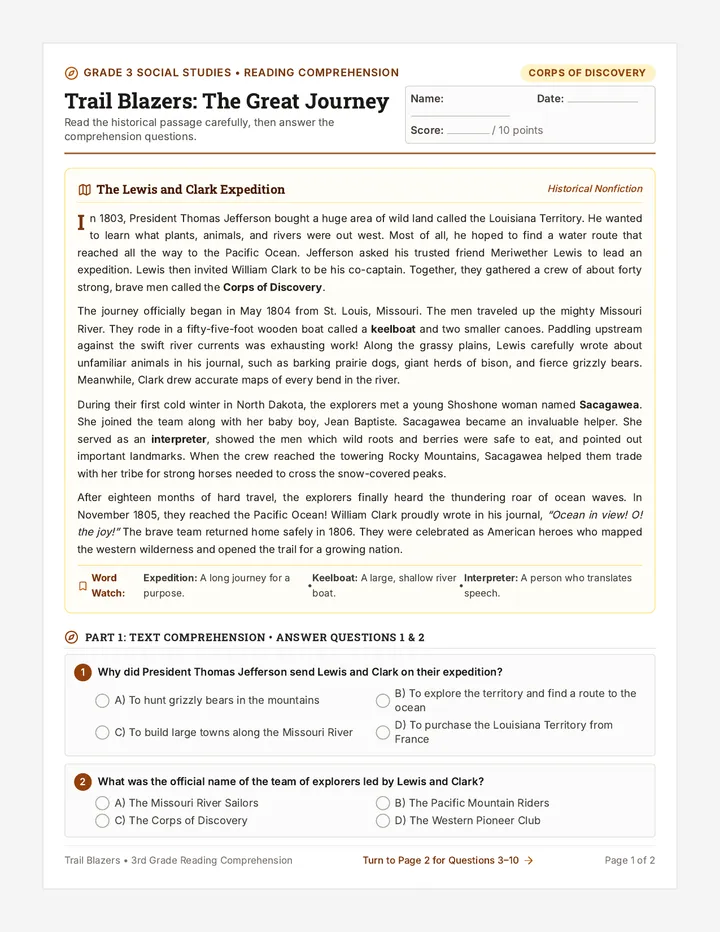
Grade 3 Social Studies • Reading Comprehension Corps of Discovery
Trail Blazers: The Great Journey
Read the historical passage carefully, then answer the comprehension questions.
Name:
Date:
Score: / 10 points
The Lewis and Clark Expedition
Historical Nonfiction
In 1803, President Thomas Jefferson bought a huge area of wild land called the Louisiana Territory. He wanted to learn what plants, animals, and rivers were out west. Most of all, he hoped to find a water route that reached all the way to the Pacific Ocean. Jefferson asked his trusted friend Meriwether Lewis to lead an expedition. Lewis then invited William Clark to be his co-captain. Together, they gathered a crew of about forty strong, brave men called the Corps of Discovery.
The journey officially began in May 1804 from St. Louis, Missouri. The men traveled up the mighty Missouri River. They rode in a fifty-five-foot wooden boat called a keelboat and two smaller canoes. Paddling upstream against the swift river currents was exhausting work! Along the grassy plains, Lewis carefully wrote about unfamiliar animals in his journal, such as barking prairie dogs, giant herds of bison, and fierce grizzly bears. Meanwhile, Clark drew accurate maps of every bend in the river.
During their first cold winter in North Dakota, the explorers met a young Shoshone woman named Sacagawea. She joined the team along with her baby boy, Jean Baptiste. Sacagawea became an invaluable helper. She served as an interpreter, showed the men which wild roots and berries were safe to eat, and pointed out important landmarks. When the crew reached the towering Rocky Mountains, Sacagawea helped them trade with her tribe for strong horses needed to cross the snow-covered peaks.
After eighteen months of hard travel, the explorers finally heard the thundering roar of ocean waves. In November 1805, they reached the Pacific Ocean! William Clark proudly wrote in his journal, “Ocean in view! O! the joy!” The brave team returned home safely in 1806. They were celebrated as American heroes who mapped the western wilderness and opened the trail for a growing nation.
Word Watch: Expedition: A long journey for a purpose. • Keelboat: A large, shallow river boat. • Interpreter: A person who translates speech.
Part 1: Text Comprehension • Answer Questions 1 & 2
1 Why did President Thomas Jefferson send Lewis and Clark on their expedition?
A) To hunt grizzly bears in the mountains
B) To explore the territory and find a route to the ocean
C) To build large towns along the Missouri River
D) To purchase the Louisiana Territory from France
2 What was the official name of the team of explorers led by Lewis and Clark?
A) The Missouri River Sailors
B) The Pacific Mountain Riders
C) The Corps of Discovery
D) The Western Pioneer Club
Trail Blazers • 3rd Grade Reading Comprehension Turn to Page 2 for Questions 3–10 Page 1 of 2
Trail Blazers: Comprehension Check
Answer Questions 3 through 10 using details from the reading passage.
Student Name:
3 From which city did the journey start in May 1804?
A) St. Louis, MO
B) Boston, MA
C) Washington, D.C.
D) New Orleans, LA
7 Which ocean did the explorers reach in 1805?
A) Atlantic Ocean
B) Indian Ocean
C) Pacific Ocean
D) Arctic Ocean
4 Why was paddling up the river exhausting work?
A) The river was frozen with thick ice
B) They paddled upstream against swift currents
C) Their keelboat had a heavy motor
D) They had no oars or wooden poles
5 What animals did Lewis record in his journal?
A) Polar bears, penguins, and walruses
B) Prairie dogs, bison, and grizzly bears
C) Kangaroos, koalas, and wild monkeys
D) Camels, cheetahs, and ostriches
6 Which sentence best describes how Sacagawea helped the Corps of Discovery?
A) She built their wooden keelboat from cedar trees.
B) She translated languages, found food, and helped get horses.
C) She sailed back alone to Washington to deliver maps.
D) She commanded the forty soldiers in battle.
8 Number these events in chronological order from 1 (happened first) to 4 (happened last):
Sacagawea joined the crew to help guide and translate.
President Jefferson purchased the Louisiana Territory.
The explorers reached the Pacific Ocean and cheered with joy.
The Corps of Discovery began their journey from St. Louis.
Part 2: Written Response • Write in Complete Sentences
9 How did William Clark’s skill at mapmaking help the United States? Use text evidence from the passage.
10 Which challenge described in the text (swift river currents, wild animals, or snowy mountains) do you think was the hardest? Explain your reasoning.
Trail Blazers • 3rd Grade Reading Comprehension Check your answers and make sure your name is on both pages! Page 2 of 2
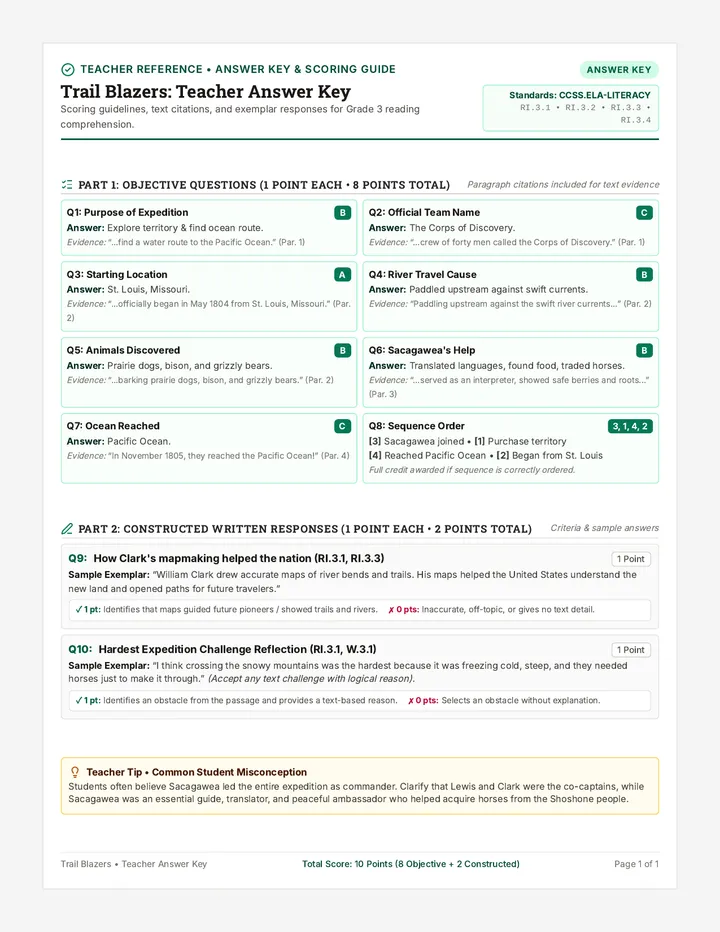
Trail Blazers Answer Key
Teacher Reference • Answer Key & Scoring Guide Answer Key
Trail Blazers: Teacher Answer Key
Scoring guidelines, text citations, and exemplar responses for Grade 3 reading comprehension.
Standards: CCSS.ELA-LITERACY
RI.3.1 • RI.3.2 • RI.3.3 • RI.3.4
Part 1: Objective Questions (1 Point Each • 8 Points Total)
Paragraph citations included for text evidence
Q1: Purpose of Expedition B
Answer: Explore territory & find ocean route.
Evidence: “...find a water route to the Pacific Ocean.” (Par. 1)
Q2: Official Team Name C
Answer: The Corps of Discovery.
Evidence: “...crew of forty men called the Corps of Discovery.” (Par. 1)
Q3: Starting Location A
Answer: St. Louis, Missouri.
Evidence: “...officially began in May 1804 from St. Louis, Missouri.” (Par. 2)
Q4: River Travel Cause B
Answer: Paddled upstream against swift currents.
Evidence: “Paddling upstream against the swift river currents...” (Par. 2)
Q5: Animals Discovered B
Answer: Prairie dogs, bison, and grizzly bears.
Evidence: “...barking prairie dogs, bison, and grizzly bears.” (Par. 2)
Q6: Sacagawea's Help B
Answer: Translated languages, found food, traded horses.
Evidence: “...served as an interpreter, showed safe berries and roots...” (Par. 3)
Q7: Ocean Reached C
Answer: Pacific Ocean.
Evidence: “In November 1805, they reached the Pacific Ocean!” (Par. 4)
Q8: Sequence Order 3, 1, 4, 2
[3] Sacagawea joined • [1] Purchase territory
[4] Reached Pacific Ocean • [2] Began from St. Louis
Full credit awarded if sequence is correctly ordered.
Part 2: Constructed Written Responses (1 Point Each • 2 Points Total)
Criteria & sample answers
Q9: How Clark's mapmaking helped the nation (RI.3.1, RI.3.3)
1 Point
Sample Exemplar: “William Clark drew accurate maps of river bends and trails. His maps helped the United States understand the new land and opened paths for future travelers.”
✓ 1 pt: Identifies that maps guided future pioneers / showed trails and rivers. ✗ 0 pts: Inaccurate, off-topic, or gives no text detail.
Q10: Hardest Expedition Challenge Reflection (RI.3.1, W.3.1)
1 Point
Sample Exemplar: “I think crossing the snowy mountains was the hardest because it was freezing cold, steep, and they needed horses just to make it through.” (Accept any text challenge with logical reason).
✓ 1 pt: Identifies an obstacle from the passage and provides a text-based reason. ✗ 0 pts: Selects an obstacle without explanation.
Teacher Tip • Common Student Misconception
Students often believe Sacagawea led the entire expedition as commander. Clarify that Lewis and Clark were the co-captains, while Sacagawea was an essential guide, translator, and peaceful ambassador who helped acquire horses from the Shoshone people.
Trail Blazers • Teacher Answer Key Total Score: 10 Points (8 Objective + 2 Constructed) Page 1 of 1