War Aftermath Scaffolded Worksheet
Grade 7 Social Studies Road to Revolution • Unit 3
Student Guided Resource
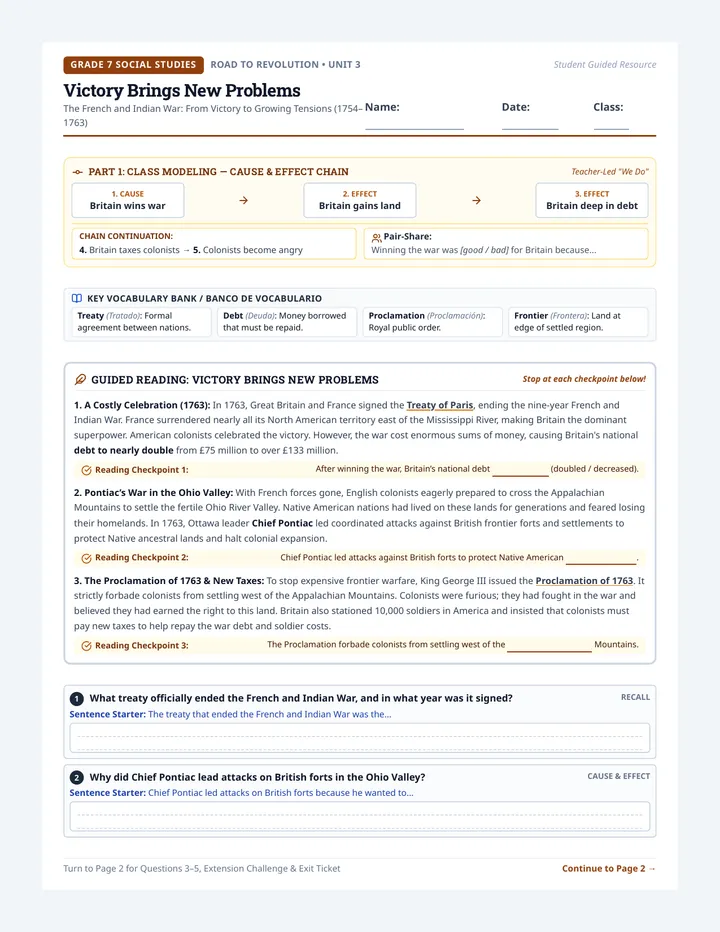
Victory Brings New Problems
The French and Indian War: From Victory to Growing Tensions (1754–1763)
Name:
Date:
Class:
Part 1: Class Modeling — Cause & Effect Chain
Teacher-Led "We Do"
1. Cause
Britain wins war
2. Effect
Britain gains land
3. Effect
Britain deep in debt
Chain Continuation:
- Britain taxes colonists → 5. Colonists become angry
Pair-Share: Winning the war was [good / bad] for Britain because...
Key Vocabulary Bank / Banco de Vocabulario
Treaty (Tratado): Formal agreement between nations.
Debt (Deuda): Money borrowed that must be repaid.
Proclamation (Proclamación): Royal public order.
Frontier (Frontera): Land at edge of settled region.
Guided Reading: Victory Brings New Problems
Stop at each checkpoint below!
1. A Costly Celebration (1763): In 1763, Great Britain and France signed the Treaty of Paris, ending the nine-year French and Indian War. France surrendered nearly all its North American territory east of the Mississippi River, making Britain the dominant superpower. American colonists celebrated the victory. However, the war cost enormous sums of money, causing Britain's national debt to nearly double from £75 million to over £133 million.
Reading Checkpoint 1: After winning the war, Britain’s national debt (doubled / decreased).
2. Pontiac’s War in the Ohio Valley: With French forces gone, English colonists eagerly prepared to cross the Appalachian Mountains to settle the fertile Ohio River Valley. Native American nations had lived on these lands for generations and feared losing their homelands. In 1763, Ottawa leader Chief Pontiac led coordinated attacks against British frontier forts and settlements to protect Native ancestral lands and halt colonial expansion.
Reading Checkpoint 2: Chief Pontiac led attacks against British forts to protect Native American .
3. The Proclamation of 1763 & New Taxes: To stop expensive frontier warfare, King George III issued the Proclamation of 1763. It strictly forbade colonists from settling west of the Appalachian Mountains. Colonists were furious; they had fought in the war and believed they had earned the right to this land. Britain also stationed 10,000 soldiers in America and insisted that colonists must pay new taxes to help repay the war debt and soldier costs.
Reading Checkpoint 3: The Proclamation forbade colonists from settling west of the Mountains.
1 What treaty officially ended the French and Indian War, and in what year was it signed? Recall
Sentence Starter: The treaty that ended the French and Indian War was the...
2 Why did Chief Pontiac lead attacks on British forts in the Ohio Valley? Cause & Effect
Sentence Starter: Chief Pontiac led attacks on British forts because he wanted to...
Turn to Page 2 for Questions 3–5, Extension Challenge & Exit Ticket Continue to Page 2 →
Part 2 (Continued): Critical Thinking & Synthesis
Answer each prompt thoroughly using the provided sentence starters and text evidence.
Name:
3 What did the Proclamation of 1763 strictly forbid American colonists from doing? Key Policy
Sentence Starter: The Proclamation of 1763 strictly forbade American colonists from...
4 Critical Thinking: Why did colonists feel the Proclamation of 1763 was unfair? Use specific evidence from the reading. Evidence
Sentence Starter: The colonists believed the proclamation was unfair because according to the reading,...
5 Critical Thinking: Britain believed colonists should help pay for the war through new taxes. Do you agree or disagree? Explain your reasoning. Perspective
Sentence Starter: I [agree / disagree] with Britain’s decision to tax colonists because...
Extension Challenge (Early Finishers / Honors):
If you were King George III, what compromise could you propose to protect Native lands without enraging colonial settlers?
Daily Formative Assessment: Exit Ticket
Score: _____ / 4
Prompt: How did Britain’s victory in the French and Indian War create new problems between Great Britain and the American colonists?
Sentence Frame: Britain’s victory created new problems because Britain gained vast land but accumulated huge . Consequently, when Britain decided to , the colonists reacted by...
War Aftermath Answer Key
Teacher Resource Master Answer Key
Grade 7 Social Studies • Unit 3
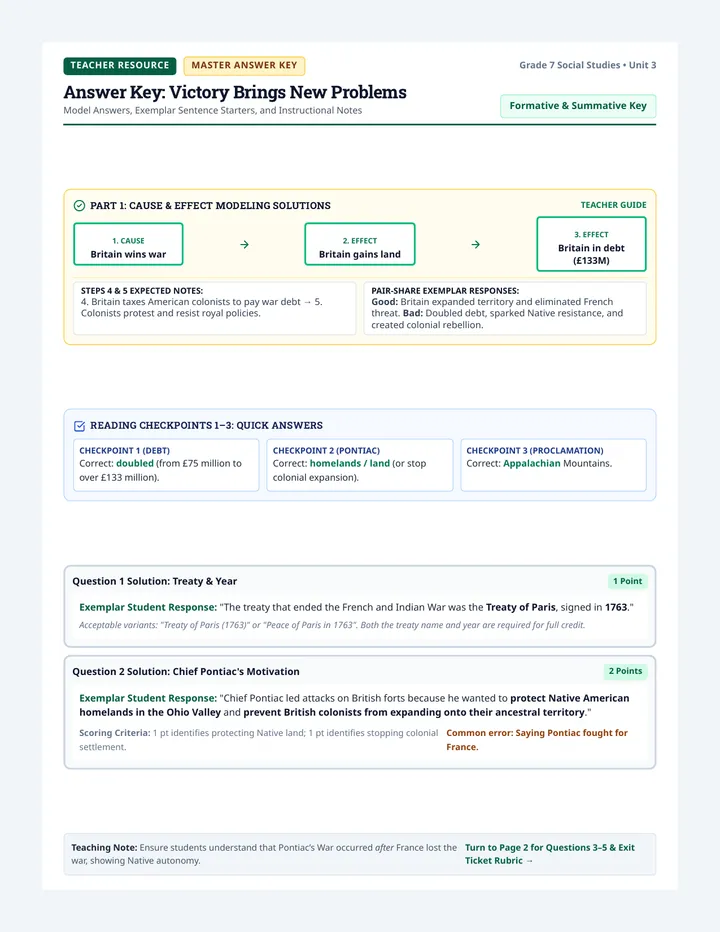
Answer Key: Victory Brings New Problems
Model Answers, Exemplar Sentence Starters, and Instructional Notes
Formative & Summative Key
Part 1: Cause & Effect Modeling Solutions
Teacher Guide
1. Cause
Britain wins war
2. Effect
Britain gains land
3. Effect
Britain in debt (£133M)
Steps 4 & 5 Expected Notes: 4. Britain taxes American colonists to pay war debt → 5. Colonists protest and resist royal policies.
Pair-Share Exemplar Responses: Good: Britain expanded territory and eliminated French threat. Bad: Doubled debt, sparked Native resistance, and created colonial rebellion.
Reading Checkpoints 1–3: Quick Answers
Checkpoint 1 (Debt)
Correct: doubled (from £75 million to over £133 million).
Checkpoint 2 (Pontiac)
Correct: homelands / land (or stop colonial expansion).
Checkpoint 3 (Proclamation)
Correct: Appalachian Mountains.
Question 1 Solution: Treaty & Year 1 Point
Exemplar Student Response: "The treaty that ended the French and Indian War was the Treaty of Paris, signed in 1763."
Acceptable variants: "Treaty of Paris (1763)" or "Peace of Paris in 1763". Both the treaty name and year are required for full credit.
Question 2 Solution: Chief Pontiac's Motivation 2 Points
Exemplar Student Response: "Chief Pontiac led attacks on British forts because he wanted to protect Native American homelands in the Ohio Valley and prevent British colonists from expanding onto their ancestral territory."
Scoring Criteria: 1 pt identifies protecting Native land; 1 pt identifies stopping colonial settlement. Common error: Saying Pontiac fought for France.
Teaching Note: Ensure students understand that Pontiac’s War occurred after France lost the war, showing Native autonomy. Turn to Page 2 for Questions 3–5 & Exit Ticket Rubric →
Master Key: Critical Thinking, Arguments & Exit Ticket
Evaluation rubrics and sample responses for open-ended questions.
Page 2 Key
Question 3 Solution: Proclamation of 1763 Restriction 1 Point
Exemplar: "The Proclamation of 1763 strictly forbade American colonists from and required settlers already living there to return east."