Stone Age Shift Reading Passage3rd Grade Social Studies • Early Humans Stone Age Shift: Daily Life Long Ago Name: Date: Reader's Mission: Long ago, humans lived in two different Stone Age eras: the Paleolithic (Old Stone Age) and the Neolithic (New Stone Age). Read below to discover how farming changed our world! Key Words to Know Nomadic Moving from place to place to find food instead of staying in one home. Fertile Rich, healthy soil packed with good nutrients that help plants grow tall. Domesticate Taming wild animals and plants so they can live with or help humans. Cultivate Caring for soil, planting seeds, and helping crops grow for food. Specialize Focusing on one special job, like making clay pots or building homes. Surplus Having extra food left over after everyone has had enough to eat. 1 A Warming World: On the Move vs. Settling Down About 12,000 years ago, the freezing Ice Age ended. The Earth warmed up, and melting ice created fresh rivers and green valleys. In the Paleolithic Era (Old Stone Age), people were nomadic. They followed wandering herds of mammoths, bison, and deer. When winter arrived or animals moved, families packed their tents and walked to a new camp. In the Neolithic Era (New Stone Age), humans discovered that warm weather made the soil near rivers rich and fertile. Instead of walking forever, they stayed in one place. They built permanent houses out of thick mud bricks, logs, and river stones! 2 Finding Food: Hunter-Gatherers vs. Farmers Paleolithic families were hunter-gatherers. Men hunted wild animals with spears, while women and children gathered nuts, berries, and roots. If the animals fled or snow covered the bushes, food became very hard to find. Neolithic people changed the game: they learned to farm! They began cultivating wheat, barley, and peas. They also learned to domesticate sheep, goats, and cattle for milk, meat, and wool. Farming produced lots of food, creating a food surplus that kept families full all winter! Part 1: Moving & Farming Page 1 of 3 • Turn to Page 2 → Stone Age Shift: Towns, Jobs, and Tools How living together in villages changed human life Page 2 of 3 3 Small Bands vs. Busy Towns Paleolithic nomads lived in small family groups of about 20 to 30 people. It was easy for a small family group to make decisions together around the campfire and share all their food. Because farming provided steady food, Neolithic populations grew quickly! Hundreds of people built homes close together in large villages. One famous ancient city was Çatalhöyük (say: Chah-tahl HOO-yook) in modern Turkey. Living together brought new challenges: people needed chiefs to keep peace, rules to share river water, and ways to clean up trash so disease would not spread. 4 Doing Every Job vs. Having a Special Skill In Paleolithic times, every single person had to know how to do everything: build a shelter, track animals, and chip stone into sharp hand-axes. There was no time for hobbies! With extra food in the Neolithic Era, not everyone had to work in the fields. People could specialize! Some became builders. Others became potters, shaping clay bowls. Weavers made soft linen clothes. Craftspeople carved sharp knives from black volcanic glass called obsidian, and later discovered how to melt copper metal to replace stone tools! The Big Turning Point: Adapting vs. Changing Nature Paleolithic people adapted to nature: they moved wherever wild plants grew and followed wild herds. Neolithic people changed nature: they cleared forests, dug water canals, planted fields, and built stone walls. This farming revolution changed how humans lived forever! Finished reading? On Page 3, use your new knowledge to write three big differences and turning points! Part 2: Towns & Specialization Page 2 of 3 • Turn to Page 3 for Writing → Connect & Write: Big Differences Use details from the reading to write in complete sentences. Name: 1. One way Neolithic homes were different from Paleolithic homes was: 2. One big difference in how they got their food was: 3. Because of specialization, Neolithic people were able to: Think & Reflect: Turning Points 4. The most important turning point of the Neolithic Era was: Unit 1 Response • Stone Age Lifeways Great writing work!
Stone Age Showdown Quiz3rd Grade History Assessment Stone Age Showdown Quiz Paleolithic (Old Stone Age) vs. Neolithic (New Stone Age) Name: Date: Score: _____ / 20 1 Part 1: Multiple Choice Fill in the circle next to the best answer (1 pt each) 1. Why were Paleolithic hunter-gatherers nomadic? A. Followed migrating animal herds B. Wanted to visit big cities C. Looked for copper metal ore D. Planted crops in many fields 2. Why did Neolithic farmers settle near river valleys? A. Rivers scared wild animals away B. River soil was fertile and great for crops C. The water was completely frozen D. No trees could grow near rivers 3. What does it mean to domesticate an animal? A. Hunt wild animals for meat B. Tame animals to live with and help humans C. Paint pictures of animals on caves D. Chase animals into the forest 4. How did creating a food surplus change daily life? A. Everyone had to hunt every single day B. People could specialize in jobs like toolmaking C. Cities quickly shut down D. All people moved into cold caves 5. What was the big difference in how they interacted with nature? A. Paleolithic adapted; Neolithic changed nature B. Neolithic people lived in portable tents C. Paleolithic people built brick towns D. Both eras lived exactly the same way Part 1: 5 Questions • 5 Points Page 1 of 3 • Turn to Page 2 → Part 2: Categorize It! (Paleo vs. Neo) Page 2 of 3 Read each clue. In the big box, write P for Paleolithic or N for Neolithic. 8 Points Total 1. Lived in small nomadic family bands of 20 to 30 people 2. Built sturdy, permanent houses of mud brick and stone 3. Cultivated crops like wheat and barley in rich soil 4. Foraged for wild roots, berries, and hunted wild animals 5. Domesticated sheep, goats, and cattle for milk and meat 6. Packed up portable animal-skin tents when food moved 7. People specialized as potters, weavers, and toolmakers 8. Built large cities like Çatalhöyük with chiefs and rules Part 2: 8 Items • 8 Points Page 2 of 3 • Turn to Page 3 → Part 3: Fill in the Blank & Bonus
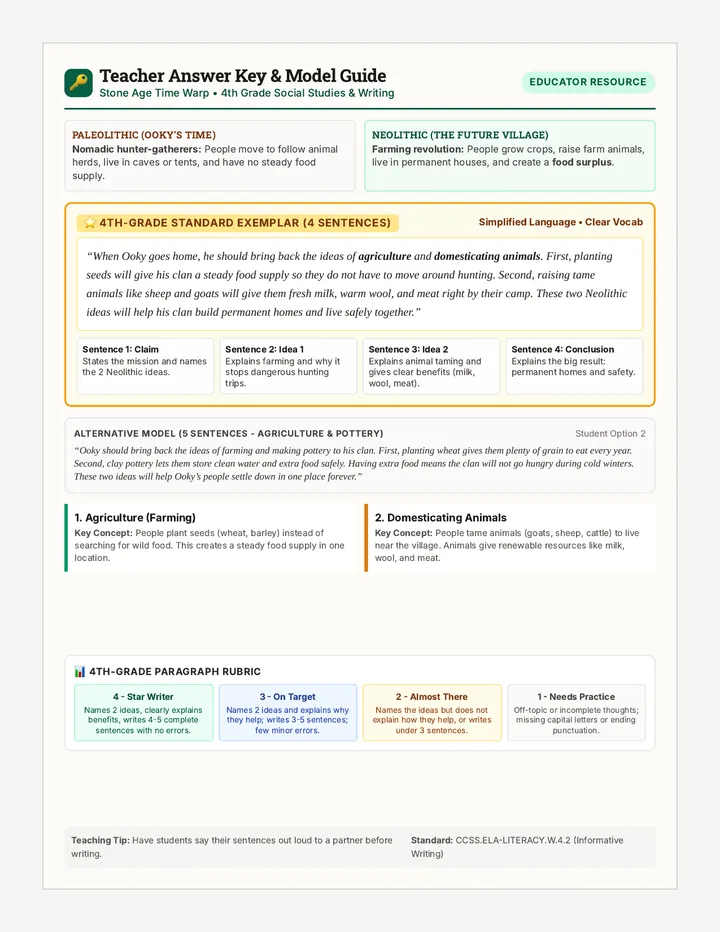
Stone Age Quiz Answer KeyTeacher Guide & Scoring Rubric Stone Age Quiz Answer Key Total Points: 20 pts + 2 Bonus Points Part 1: Multiple Choice 5 pts (1 pt each) Part 2: Categorizing 8 pts (1 pt each) Part 3: Fill in Blank 5 pts (1 pt each) Bonus Challenge +2 Bonus pts 1 Part 1: Multiple Choice Answers 1. A Followed migrating animal herds 2. C Fertile river floodplain soil 3. B Tame animals to help humans 4. C Surplus led to job specialization 5. A Paleo adapted; Neo changed nature 2 Part 2: Categorize It! (Paleo vs. Neo) 1. Small nomadic bands (20-30 people) P (Paleolithic) 2. Permanent mud brick & stone houses N (Neolithic) 3. Cultivated crops in fertile soil N (Neolithic) 4. Foraged wild berries & hunted game P (Paleolithic) 5. Domesticated sheep, goats & cattle N (Neolithic) 6. Packed animal-skin tents to follow food P (Paleolithic) 7. Specialized as potters, weavers, smiths N (Neolithic) 8. Built towns like Çatalhöyük N (Neolithic) 3 Part 3: Fill in the Blank Answers Sentence 1: fertile Sentence 2: nomadic Sentence 3: domesticate Sentence 4: surplus Sentence 5: specialize Sample Responses & Teacher Grading Notes Quiz Bonus Challenge (2 pts): Acceptable responses include: • Neolithic people cleared land and planted crops instead of just gathering wild plants. • They tamed and bred wild animals to live with them. • They built permanent mud brick homes and dug canals for river water. Reading "Connect & Write" Prompts: • Homes: Built permanent mud brick/stone houses instead of portable skin tents. • Food: Cultivated crops and raised domesticated animals instead of foraging/hunting. • Specialization: Could do specific jobs like weaving, pottery, copper toolmaking, or trade. Grade 3 Social Studies Assessment Key • Stone Age Lifeways Classroom Ready