Collision Slides Two Worlds Collide
Whose story are we telling?
Imagine This...
"Today, the sky changed. Gigantic metal birds descended from the clouds, their wings screaming. Strange beings stepped out—their skin was shiny and hard like mirrors. They held glowing sticks that made thunder. We didn't know if they were gods or monsters."
How would you react? What would you call these 'visitors' in your diary?
The Parallel
For Indigenous people in 1492, the arrival of European ships was just as strange and world-altering as an alien invasion would be today.
The ships were "floating mountains." The armor was "metal skin." The cannons were "thunder sticks."
Perspective changes everything.
Perspective A: The Journal
"I landed on a very large island... I gave it the name San Salvador. The people here go as naked as when their mothers delivered them. They are very well built, with very handsome bodies and very good faces... They should be good servants and very intelligent."
— Christopher Columbus, 1492
Goal
Discovery & Profit
Tone
Superior & Observational
Key Word
"Servants"
Perspective B: The Oral History
"A thing like a ball of fire appeared... It made a great noise, like a bell being struck. The strangers came from the east. Their skin was very white, and they had long beards. Their animals were like giant deer but stronger. We welcomed them, but they brought a great sickness that we had never seen."
— Aztec/Nahua Accounts (compiled later)
Reaction
Fear & Confusion
Observation
Sickness & Strange Animals
Key Word
"Sickness"
Double Vision: Analyzing the Arrival
European Accounts
Focused on naming the land.
Viewed people as resources.
Saw themselves as "discoverers."
Indigenous Accounts
Focused on the shock of the event.
Described strange new technology/animals.
Saw the visitors as an "invasion."
How do different perspectives shape the way we understand history?
If only one person writes the story, is the whole story being told?
Double Vision Worksheet Double Vision
Name: ________________________________
Date: ________________________________
Comparing Perspectives on the First Encounter
History is often described as a story. But what happens when there is more than one person telling the story? Today, we are looking at the arrival of Europeans in the Americas from two different viewpoints. Read the sources below and complete the analysis.
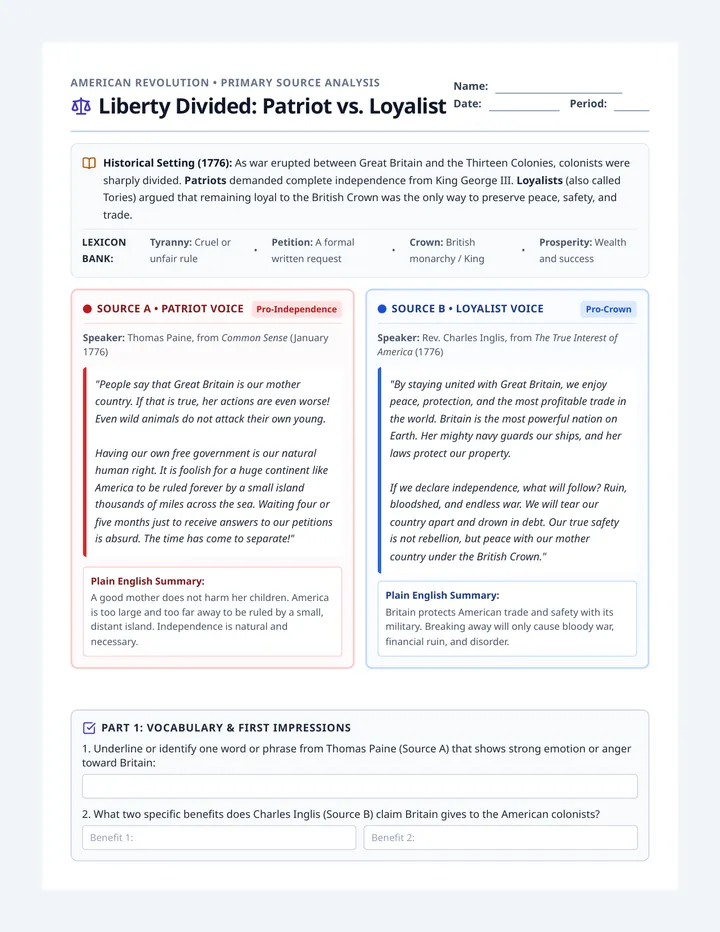
Source A: The Explorer's Journal
"I reached the sea where I discovered many islands... I took possession for our most fortunate King. The people are very generous with what they have... they believe that I come from heaven. They were fearful at first, but soon they came to us. I gave them red caps and glass beads... they are intelligent and should be good servants."
— Adapted from the Journals of Christopher Columbus (1492)
Source B: The People of the Islands
"Floating houses appeared on the horizon. Strange men with hair on their faces and skin like ghosts stepped onto our shores. They wore heavy clothes even in the sun. They carried sticks that spit fire and made the sound of thunder. We gave them water and food, but they were hungry for the yellow metal (gold) and would not stop asking for it. Our world would never be the same."
— Based on Indigenous oral histories and codices
Analysis Matrix
Question Source A (Explorer) Source B (Indigenous) How do they describe the visitors/locals? What is the person's goal or main focus? What is the tone? (Happy? Greedy? Fearful? Scared?)
Thinking Deeper
1. Why do you think the explorer mentions the Indigenous people would be "good servants"? What does this tell us about his perspective?
2. In Source B, why might the Indigenous people describe ships as "floating houses"? What does this tell us about their world before this event?
3. If you were a historian today, which source would you trust more? Or do you need both? Explain your answer.
Collision Guide Two Worlds Collide
Teacher Facilitation Guide
Lesson 1
50 min
Lesson Objective
Students will analyze how historical perspective influences the recording of events by comparing a European explorer’s journal with an Indigenous account of the first encounter.
Key Vocabulary
Perspective
A particular attitude toward or way of regarding something; a point of view.
Primary Source
An artifact, document, or recording that provides first-hand evidence from a historical event.
Colonialism
The policy or practice of acquiring full or partial political control over another country.
Indigenous
Originating or occurring naturally in a particular place; native.
Materials Needed
Collision Slides (Visual aid)Double Vision Worksheet (1 per student)Sticky notes (for the hook activity)
Instructional Sequence
1
The "Alien Invasion" Hook (10 min)
Display Slide 2. Read the anonymous diary entry about "metal birds" and "skin like mirrors." Ask students to turn and talk: What is actually being described?
"The goal is to help students realize that unfamiliar technology or appearances are often described using familiar metaphors (e.g., ships as floating mountains)."
2
Defining Perspective (10 min)
Transition to Slide 3. Use the "Floating Mountain" example to explain that history depends on who is holding the pen. Define Perspective and Primary Source .
3
Deep Dive Comparison (20 min)
Distribute the Double Vision Worksheet . Read Source A (Columbus) aloud as a class. Highlight words like "discovered," "possession," and "servants." Then, read Source B (Indigenous Account). Focus on the shock and the observation of "sickness."
Students work in pairs to complete the Analysis Matrix.
4
The "Big Why" Discussion (10 min)
Facilitate a closing discussion based on Question 3 of the worksheet. Use the prompt: "If the Taino people had written the first history books, how would the 'Age of Exploration' be named differently?"
Common Misconceptions
"History is 100% Fact": Many students think history is a list of true dates. Remind them that history is an interpretation of those dates.
Taino Life Slides The Taino World
Before and After 1492
A Thriving Culture
The Taino were not "primitive." They were skilled farmers, artists, and leaders living in large communities called yucayeques .
Conuco Agriculture: Advanced mounded farming.Zemis: Beautiful carvings of spirits and ancestors.Caciques: Male and female chiefs who led the people.
Taino "Duho" (Ceremonial Chair) - a symbol of authority and skill.
The Encomienda System
The Spanish crown granted "land" to explorers, which included the Indigenous people living on it. This system changed the Taino from free people to forced laborers.
Mining Gold
Dangerous, back-breaking work in riverbeds and caves.
Export Farming
Forced to grow food for Spanish sailors instead of themselves.
Impact
Overwork, malnutrition, and unknown diseases.
The Gold Tribute System
A Hawk's Bell Full of Gold
Every Taino over 14 years old had to provide a small bell's worth of gold dust every 3 months. If they did, they received a copper token to wear around their neck as proof.
"What happened to those who could not find enough gold?"
Resistance: Anacaona
The Taino did not just accept this. Anacaona was a powerful Cacique (queen) who led her people in poetry, song, and diplomatic resistance against Spanish rule.
She refused to accept the "tribute" system and tried to negotiate peace, but was ultimately betrayed by the Spanish governor.
Discussion:
Why is it important to learn about leaders like Anacaona, not just the explorers?
How did the arrival of Europeans change Taino culture forever?
Old World View
"Discovery of a new land and its resources."
Taino Perspective
"A struggle for survival and cultural preservation."
Taino Tribute Task The Tribute Bell
Labor and Loss in the Caribbean
Name: ________________________________
Date: ________________________________
Part 1: What is "Wealth"?
Taino View of Gold
"Gold was used to make beautiful jewelry and art. It was shiny and pretty, like the sun, but it was not used for money. People shared what they grew and what they made."
Value = Beauty & Community
Spanish View of Gold
"Gold was used to buy ships, pay soldiers, and build palaces back in Spain. The more gold an explorer found, the more powerful and rich he became."
Value = Power & Profit
How did these two different views of gold lead to conflict? Explain below:
The System of Tribute
A "Hawk's Bell"
A small bell about 1-2 inches wide.
"Columbus ordered that every Taino person over the age of 14 must bring a bell full of gold dust to him every three months. If they did, they were given a copper token to wear as protection. If they did not, they were severely punished."
The Reality:
There was not much gold in the rivers of Hispaniola. The Taino had to spend all day, every day, searching for gold instead of growing food for their families.
1. Why was the "Tribute System" impossible for many Taino families? Use evidence from the text above.
2. In your own words, describe how the Encomienda system changed the daily life of a Taino child.
3. Anacaona was a Taino queen who resisted this system. Why do you think she felt it was important to fight back, even though the Spanish had more weapons?
Taino Lesson Plan The Taino and Columbus
Lesson Plan & Facilitation
Lesson 2
60 min
Objectives
Identify characteristics of Taino culture prior to 1492.
Explain the mechanics and impact of the Encomienda and Gold Tribute systems.
Discuss the role of Anacaona as a leader of Taino resistance.
Key Materials
Taino Life Slides
Taino Tribute Task
Small bell (optional prop)
Step-by-Step Procedure
0-10m
The Taino Gallery (Slides 1-2)
Use Slide 2 to introduce Taino culture. Emphasize their complexity: Conuco farming was highly efficient; Caciques could be women. Ask: "Does this look like a 'lost' or 'uncivilized' people?"
10-25m
System of Shift (Slides 3-4)
Explain the Encomienda . It wasn't just land; it was people. Use the "Hawk's Bell" visual on Slide 4. If you have a small bell, show it to emphasize how tiny it is, yet how difficult it was to fill with gold dust.
Discussion Point: "Why would the Spanish value gold more than the Taino did?" (Focus on the concept of global trade vs. local community).
25-45m
Tribute Analysis (Worksheet)
Distribute the Taino Tribute Task . Students should work independently or in pairs. Walk around and prompt students to think about the "hidden" costs of the tribute system (e.g., if you are mining all day, you aren't planting corn; your family goes hungry).
45-60m
Anacaona & Resistance (Slide 5)
End on a note of agency. Introduce Anacaona. Explain that resistance isn't always a battlefield; it can be diplomacy, culture, and refusing to submit. Ask students to share their responses to Question 3 on the worksheet.
Teacher Background: The Real Anacaona
Anacaona was a Cacica (female chief) in Xaragua (modern-day Haiti). She was known as a composer of areitos (ceremonial songs and poems). Initially, her people sought peace through trade, but as Spanish demands for tribute and labor became unbearable, she shifted to organizing resistance. In 1503, during a peace negotiation, Spanish forces trapped and executed many Taino leaders, including Anacaona. Her story is a vital counter-narrative to the idea that Indigenous people were "passive" victims.
Key Takeaway
The loss of population wasn't just disease; it was the total breakdown of social and agricultural systems caused by forced labor.
Strategy and Secrets Slides Strategy & Secrets
The Fall of the Aztec Empire
A City on the Water
In 1519, Tenochtitlan (the Aztec capital) was larger and cleaner than almost any city in Europe.
Chinampas: "Floating" gardens that fed 200,000 people.Templo Mayor: Massive pyramids in the city center.Empire: They controlled millions of people across Central Mexico.
Spanish soldiers said it looked like an "enchanted vision."
The Great Question
"How did Hernán Cortés—with only 500 soldiers—defeat an empire of millions?"
The Simple Answer (Wrong):
"They just had better guns and steel armor."
The Complex Answer (Right):
"They used Alliances , Translation , and Politics ."
The Secret Weapon: Alliances
Many groups in Mexico hated the Aztecs because they were forced to pay heavy tribute (taxes) and provide people for rituals.
The Tlaxcalans
They were the Aztecs' biggest rivals. They provided Cortés with tens of thousands of warriors. Without them, the Spanish would have been crushed.
Malintzin (Malinche)
A gifted Indigenous woman who spoke many languages. She was the translator and advisor who helped Cortés make these deals.
Smallpox: The Invisible Soldier
A single infected soldier brought a disease the Aztecs had no immunity to. It killed nearly half of the city's population during the final battle.
The Fall of Tenochtitlan (1521)
Cortés didn't just walk into the city. He led a siege —cutting off food and water for months.
The Tlaxcalans and Spanish surrounded the city by boat and land.
Smallpox weakened the Aztec warriors and their leaders.
The empire finally collapsed, and a new Spanish colony was built on top of the ruins.
If Indigenous allies were so important, why does history often focus only on Cortés?
Think about who wrote the first accounts of the conquest. How would a Tlaxcalan soldier tell this story differently than Cortés?
Aztec Alliance Map Alliance Map
The Fall of Tenochtitlan
Name: ________________________________
Date: ________________________________
The Situation: Mexico, 1519
The Aztec Empire is the most powerful force in the region. They rule over many different groups. However, being powerful makes you enemies. When Hernán Cortés arrives, he realizes he cannot win alone. He needs friends.
Identifying the Groups
Group 1
The Aztecs
"We control the trade and the temples. Everyone pays us tribute. These newcomers are strange, but we are many."
Group 2
The Tlaxcalans
"The Aztecs are our enemies. They take our people and our wealth. We want to see them fall."
Group 3
The Spanish
"We have guns and horses, but we are only a few hundred. We need thousands more to take the capital."
Mapping the Connections
Tlaxcalans
Spanish
Tenochtitlan (Aztecs)
Alliance
Why did they join together?
Attack
Attack
1. Why was Malintzin (Malinche) so important to Cortés? (Hint: Think about how he made friends with the Tlaxcalans).
2. If you were the Tlaxcalans, would you have helped the Spanish? Why or why not?
3. Modern historians often call the fall of the Aztecs an "Indigenous Revolution" rather than a "Spanish Conquest." Why do they use that name?
Conquest Facilitator Guide Alliances & Conquest
Teacher Facilitator Guide
Lesson 3
60 min
Key Concept
The conquest of Mexico was not a simple military victory for the Spanish. It was a complex political event where local Indigenous groups used the Spanish as much as the Spanish used them to overthrow the Aztec Empire.
"Focus on Strategic Reasoning : Help students understand that groups like the Tlaxcalans were making logical choices for their own survival and power."
Simulation Kit
3 Group Placards (Aztec, Tlaxcalan, Spanish)"Tribute Tokens" (Small slips of paper or cubes)Strategy & Secrets Slides Aztec Alliance Map
Mini-Simulation: The Shifting Balance (20 min)
1. Setup
Divide the class into three unequal groups: Aztecs (60%), Tlaxcalans (35%), and Spanish (5% - just 2 or 3 students). Give the Aztecs a large pile of "Tribute Tokens."
2. The Struggle
The Aztecs must "collect tribute" from the Tlaxcalans (take half their tokens). Tlaxcalans will naturally be angry. The Spanish arrive and offer a deal: "Help us defeat the Aztecs, and you keep your tokens."
Crucial Turn:
The Spanish have "Secret Weapons" (represent guns/horses with a rule that they count for 10 warriors). Ask the Tlaxcalans: "Will you join the strangers?"
3. Reflection
Debrief: "Tlaxcalans, why did you switch sides? Spanish, could you have won without them? Aztecs, how did you feel when your neighbors turned on you?"
Classroom Flow
Hook:
Use the simulation above. It establishes the "Enemy of my Enemy" logic immediately.
Instruction:
Go through the Strategy & Secrets Slides . Focus heavily on Malintzin —she is often left out of textbooks but was the literal 'voice' of the conquest.
Practice:
Students complete the Aztec Alliance Map . Ensure they understand that the "Alliance" was the green box connecting the Tlaxcalans and Spanish.
Perspective Check
Many sources call Malintzin a "traitor." However, for many Indigenous groups, the Aztecs were the invaders. Helping Cortés was an act of liberation for her people. Encourage students to see the complexity rather than just good guys vs. bad guys.
Keeping the Fire Slides Keeping the Fire
Stories of Cultural Resistance
Resistance is more than war
When people are told they cannot speak their language, practice their religion, or eat their traditional foods, they find ways to keep their culture alive secretly .
Active Resistance
Battles, revolts, and physically fighting back against invaders.
Cultural Resistance
Preserving language, recipes, songs, and stories in private.
Survival through Seeds
Indigenous people were forced to grow European crops like wheat, but they secretly continued to plant their own sacred foods.
Maize (Corn)
More than just food; it was part of their identity and religion.
Cacao (Chocolate)
An Aztec and Maya drink that Europeans eventually loved and stole.
"Every meal was a small act of rebellion."
The Power of "Mixing"
"If we are forced to follow a new religion, we will blend it with our own so it can survive."
Ancient Spirit
New Religion
Syncretism
This is why many celebrations today (like Day of the Dead) have both Indigenous and European roots.
Unspoken Resistance: Language
Nahuatl
Spoken by the Aztecs. Words like Chocolate , Tomato , and Avocado come from this language!
Quechua
Spoken by the Incas. Today, over 8 million people still speak it in the Andes mountains.
Maya
Over 30 Mayan languages are still spoken today in Central America. They never truly "disappeared."
If a culture survives for 500 years against all odds, who really "won"?
Language
Food
Traditions
Resistance Records Worksheet Resistance Records
Preserving Culture Against All Odds
Name: ________________________________
Date: ________________________________
Part 1: Active vs. Cultural
Resistance is not always a battle with swords. Sometimes it is a battle to keep your identity. Read the examples below and sort them into the correct category.
Active Resistance
Definition: Physical action or direct fighting.
Cultural Resistance
Definition: Keeping traditions, language, or beliefs alive.
The Examples Bank
Planning a city-wide revolt
Secretly teaching children Maya words
Destroying a Spanish mine or ranch
Continuing to plant sacred corn seeds
Mixing ancient spirits with new holidays
Refusing to move to a colonial town
Part 2: Living History
Many words we use every day come from Nahuatl (the language of the Aztecs). This is a form of cultural continuity—the culture didn't disappear; it became part of ours.
Xocolātl
Modern English:
Chocolate
Tomātl
Modern English:
Tomato
Āhuacatl
Modern English:
Avocado
If you were forbidden from using these words, how would it feel to secretly use them anyway? Why would that be an act of resistance?
1. Why is "Cultural Resistance" sometimes more successful than "Active Resistance" over hundreds of years?
2. In many parts of the Americas, Indigenous people still wear traditional clothing and hold ancient festivals. What does this tell you about the strength of their cultures?
Resistance Discussion Guide Cultural Resistance
Facilitation & Discussion Guide
Lesson 4
50 min
Lesson Focus
While "conquest" is the term often used for this era, it implies a total ending. This lesson shifts the focus to continuity . Students explore how Indigenous cultures adapted and survived through "hidden" forms of resistance like language, food, and religious blending.
Key Question for Students:
"If a group of people is forced to change their name, their god, and their laws, but they still eat their ancestors' food and speak their ancestors' language, have they truly been conquered?"
Vocabulary
Active Resistance: Direct confrontation (e.g., The Pueblo Revolt).Cultural Resistance: Subtle preservation of identity (e.g., language).Syncretism: The blending of different beliefs or cultures into something new.Continuity: The fact that something continues to happen or exist.
Facilitated Discussion Points
The "Hidden" nature of culture
Context: Europeans often thought they had successfully converted Indigenous people because they saw them attending church.
Prompt: "Why would it be easier for the Spanish to stop a battle than to stop a family from speaking their own language at the dinner table?"
Food as a Time Machine
Context: Many foods we think of as "classic" Mexican or Italian foods didn't exist before 1492. Maize, beans, and squash were the "Three Sisters" of Indigenous farming.
Prompt: "How does eating a corn tortilla today connect a person to a Taino or Aztec farmer from 600 years ago?"
Survival vs. Disappearance
Context: Many textbooks describe Indigenous civilizations as "disappearing" or "collapsing."
Prompt: "If over 8 million people still speak the Inca language (Quechua) today, is it fair to say the Inca 'disappeared'? How can we change that sentence to be more accurate?"
Teacher Note: The Power of Syncretism
When students complete Part 1 of the worksheet, pay special attention to the example: "Mixing ancient spirits with new holidays." This is Syncretism . Explain that this was a brilliant strategy. By mapping their own spirits onto Catholic saints, Indigenous people could worship their traditional figures in plain sight of the Spanish priests. This is why many Latin American cultures have unique religious traditions found nowhere else in the world.
Historical Agency • Cultural Resilience • Modern Impact
Truth in Ink Slides Truth in Ink
The Power of Rewriting History
Spotting the Lean
Bias is when a writer shows favor for one side of a story while ignoring the other. In history, this happens when we use Loaded Words .
One-Sided Words
"Heroic"
"Savage"
"Discovered"
"Brave conquerors"
Neutral/Balanced Words
"Arrival"
"Conflict"
"Indigenous people"
"Interaction"
Example: A Biased Textbook
Biased Version
"The heroic explorers arrived in a wild and empty land. They discovered many wonders and brought civilization to the uneducated natives who lived there."
What's wrong with this?
"It ignores the millions of people who were already there. It makes one side sound like 'heroes' and the other side sound like 'nothing'."
The Historian's Rulebook
Include Both
Mention the impacts on Indigenous groups, not just the goals of the explorers.
Use Neutral Verbs
Swap "discovered" for "encountered" or "arrived." Swap "savages" for "residents" or "citizens."
State Facts
Focus on what happened (trade, war, disease) rather than who was "good" or "bad."
Practice: The Taino
Textbook Says:
"Columbus brought religion and modern farming to the Caribbean islands."
Historian (YOU) Says:
Possible Rewrites:
"The arrival of Europeans disrupted the Taino agricultural system."
"Columbus attempted to introduce European religions, leading to cultural resistance."
History is not just about what happened—it's about how we tell it.
Today, you are the author. Use your facts, your neutral language, and your balanced perspectives to build a better narrative.
History Rebuilt Worksheet History Rebuilt
Revision Workshop
Name: ________________________________
Date: ________________________________
Part 1: The Biased Narrative
"In 1492, the brave explorer Christopher Columbus discovered America. He and his heroic men brought civilization and religion to the empty wilderness of the New World. Although there were some primitive tribes there, they were soon conquered by the superior technology of the Spanish explorers."
Circle or list 3 "Loaded Words" from above:
1. ________________________________
2. ________________________________
3. ________________________________
Why are these words problematic?
Your Task: The Revision
Rewrite the paragraph above. Use the facts you have learned over the last four lessons to create a balanced , accurate , and neutral account.
Mention Indigenous groups
Use neutral verbs
Acknowledge conflict/impact
My Revised Narrative:
Self-Reflection: Which change are you most proud of in your rewrite, and why?
Narrative Mastery Rubric Narrative Mastery
Assessment Rubric & Grading Guide
Final Task
Assessment
Purpose of Assessment
This rubric evaluates the student's ability to synthesize historical facts with an understanding of perspective and bias. The goal is not "perfect" writing, but a demonstrated shift from a one-sided narrative to a balanced account that respects both European and Indigenous agency.
Criterion Mastery (3) Developing (2) Beginning (1) Neutral Language Consistently avoids "loaded" words like 'heroic' or 'primitive'. Uses neutral verbs like 'arrived' or 'encountered'. Attempts to use neutral words, but 1-2 biased terms remain in the text. Relies heavily on biased or one-sided language from the original text. Multiple Perspectives Includes specific details about Indigenous groups (e.g., Taino, Aztec, Tlaxcalan) and their reactions/impact. Mentions Indigenous groups but lacks specific detail or focuses only on European actions. Fails to include Indigenous perspective; remains a one-sided "discovery" narrative. Historical Accuracy Correctly identifies facts like the tribute system, alliances, or the impact of disease. Mentions historical facts but may have minor errors in timing or details. Contains significant historical inaccuracies or ignores factual evidence. Self-Reflection Clearly articulates why a specific change was made and why it improves the history. Explains a change, but the reasoning is vague or simple. Does not provide a reflection or cannot explain the changes made.
What to Look For
"Look for the 'But' or the 'However'. A student reaching mastery will often write: 'The Spanish arrived to trade, but the Taino were soon forced into labor.' This shows they are balancing the motivations and the impacts of the event."
Support Strategies
If a student is struggling, give them a "Sentence Starter" such as: "When Europeans first arrived in 1492, the Indigenous people reacted by..." or "While some explorers sought gold, the impact on local communities was..."