Tribal Lands Comparison Worksheet
Grade 6 Social Studies • Early North America
Name:
Date:
Period:
First Peoples, Diverse Lands
How Geography, Climate, and Natural Resources Shaped Native American Cultures
Front: Reading Guide
Environmental Adaptation: Long before European arrival, hundreds of sovereign Indigenous nations flourished across North America. Rather than following a single way of life, each nation developed customs, dwellings, foods, and technologies tailored to its distinct physical environment. As you read the regional profiles below, notice how geography dictated how each group survived and built community.
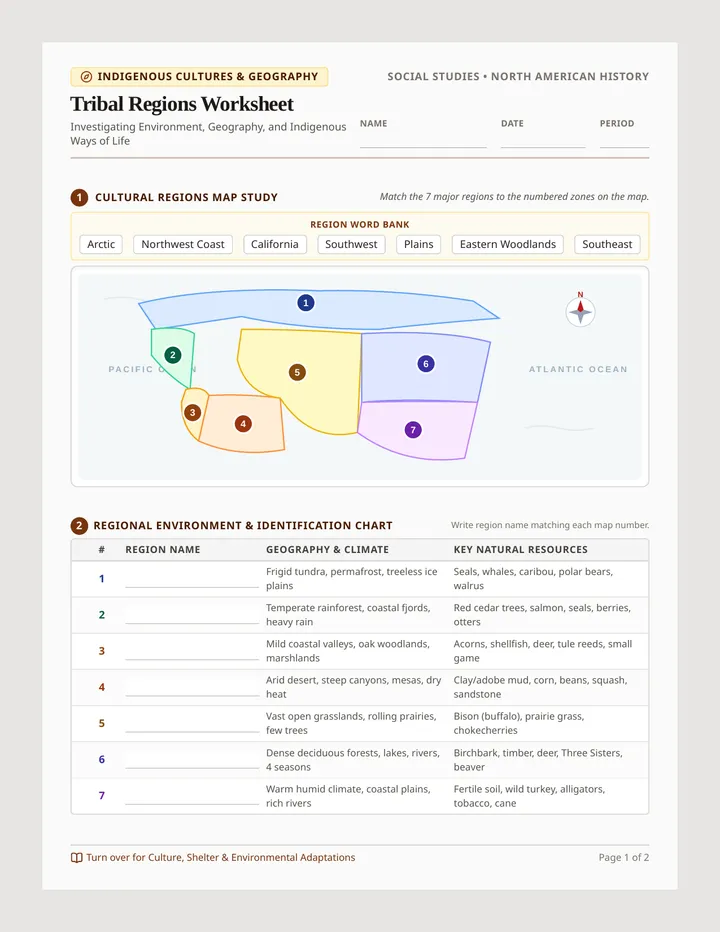
Eastern Woodlands
Haudenosaunee • Cherokee
- Environment: Dense deciduous forests, abundant lakes, rivers, and moderate four-season climate with rich rainfall.
- Dwellings: Large bark-covered multi-family longhouses (up to 100 ft long) and domed woodland wigwams.
- Food & Diet: Farming the "Three Sisters" (corn, beans, squash); hunting white-tailed deer; freshwater fishing; harvesting maple sap.
- Cultural Hallmark: Birchbark canoes; woven wampum shell belts for treaties; Haudenosaunee Great Law of Peace (representative governance).
The Great Plains
Lakota • Cheyenne • Comanche
- Environment: Vast semi-arid rolling grasslands and open prairies with extreme summer heat, severe winter blizzards, and few trees.
- Dwellings: Cone-shaped buffalo-hide tipis designed for rapid breakdown and mobility; earth lodges along major rivers.
- Food & Diet: Nomadic bison (buffalo) hunting; gathering wild prairie turnip, chokecherries, and sage; river-valley crop trade.
- Cultural Hallmark: Complete use of buffalo (horns for spoons, hide for clothing, sinew for bowstrings); travois sleds; hide painting histories.
The Southwest
Hopi • Zuni • Navajo • Apache
- Environment: Arid canyonlands, steep mesas, and desert plateaus with intense sun, little rainfall, and flash flood cycles.
- Dwellings: Multi-tiered adobe (sun-baked clay brick and stone) pueblos built on cliff ledges or mesas, accessed by wooden ladders.
- Food & Diet: Mastered dry-farming techniques and canal irrigation to grow drought-resistant corn, squash, and beans; pine nuts and small game.
- Cultural Hallmark: Intricate clay pottery; turquoise jewelry; cotton cloth weaving; carved kachina figures representing natural spirits and rain.
Pacific Northwest
Haida • Tlingit • Coast Salish
- Environment: Mild, humid coastal temperate rainforests, rugged rocky shoreline, giant red cedar trees, and cold ocean waters.
- Dwellings: Permanent, sturdy cedar plank houses housing multiple generations under massive carved roof beams.
- Food & Diet: Plentiful seafood: Pacific salmon runs, halibut, sea mammals, clams; gathered forest berries, roots, and hunted deer.
- Cultural Hallmark: Towering carved cedar totem poles displaying clan lineages; 60-foot dugout canoes; ceremonial potlatch feasts.
Part 1: Quick-Check Understanding
Circle the correct answer based on the reading above
1. Why did Great Plains tribes use conical tipis rather than stone pueblos?
A. They needed portable homes to follow migrating bison herds.
B. The plains were covered in dense cedar forests.
C. Adobe bricks could not withstand constant ocean rain.
D. Longhouses were illegal under tribal treaties.
2. Which agricultural trio was known as the "Three Sisters"?
A. Wheat, barley, and wild rice
B. Corn, beans, and squash
C. Potatoes, pine nuts, and sage
D. Cotton, tobacco, and sunflower
3. What primary natural material enabled Pacific Northwest totem poles and canoes?
A. Hardened sun-baked desert clay
B. Giant western red cedar trees
C. Carved limestone and volcanic basalt
D. Braided sweetgrass and buffalo hide
Turn over to complete the comparison chart →
Part 2: Regional Cultures Comparison Chart
Directions: Synthesize the reading from page 1. Complete each cell of the matrix with concise, specific factual details.
Back: Analysis
| Cultural Region | Climate & Terrain | Shelter & Materials | Primary Food Sources | Arts, Tools & Traditions |
|---|
| | | | |
| Eastern Woodlands | | | | |
e.g., Haudenosaunee
|
|
|
|
|
|
Great Plains
e.g., Lakota, Cheyenne
|
|
|
|
|
|
Southwest
e.g., Hopi, Pueblo
|
|
|
|
|
|
Pacific Northwest
e.g., Haida, Tlingit
|
|
|
|
|
Part 3: Evidence-Based Analysis Questions
Answer in complete, thoughtful sentences using textual evidence
1. Housing & Geography: Compare the shelter of the Southwest (pueblos) with that of the Great Plains (tipis). How did building materials and portability directly reflect each region's natural environment and lifestyle?
2. Resource Abundance & Culture: Pacific Northwest communities held elaborate gift-giving "potlatches," while Southwest communities built stone granaries to guard stored corn. How did food availability and climate create these contrasting customs?
3. Resource Stewardship: Indigenous peoples practiced deep respect for nature by using every part of harvested resources. Choose one specific resource (e.g., cedar tree, bison, or clay) and explain three different ways it was utilized.
Worksheet Completion Checklist:
Matrix completed (all 4 rows) Complete sentences in Part 3 Specific evidence cited