Africa Geography and Trade Worksheet World History Series
Africa: Geography & Trade
Name:_________________
Date:_________________
Geography Challenge
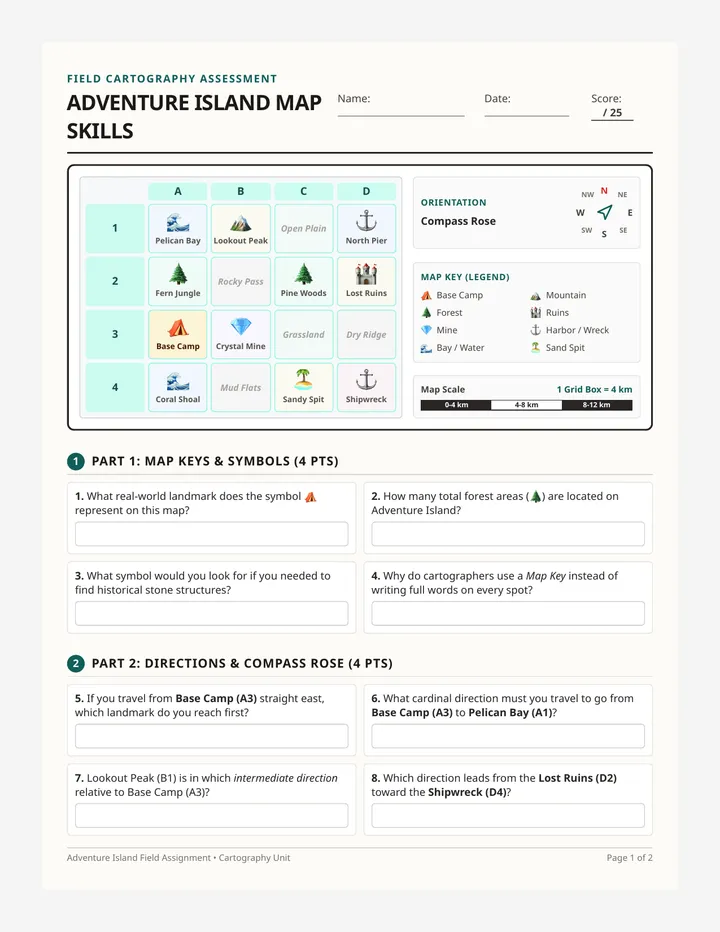
Africa is the second-largest continent on Earth, completely surrounded by water. Let's locate its main borders and see how they helped empires trade!
1 Part 1: Map and Border Matching
A: Mediterranean Sea
B: Atlantic Ocean
C: Indian Ocean
D: Red Sea
E: Sahara Desert
Write the correct letter (A-E) next to each feature:
___
Atlantic Ocean
The giant ocean to the west of Africa.
___
Sahara Desert
The largest hot desert in the world, in North Africa.
___
Mediterranean Sea
The water body bordering Africa to the north.
___
Indian Ocean
The ocean to the southeast of Africa.
2 Part 2: Trade Vocabulary Match
Draw a straight line to connect each word to its SPED-friendly definition:
1. Domestication
2. Surplus
3. Caravan
4. Barter
Trading goods directly for other goods without using coins or money.
Having extra food or items left over after meeting basic needs.
Taming and training wild animals to help with human work and farming.
A large group of travelers, camels, or traders crossing a dry desert together.
Turn page for Part 3 & 4 Page 1 of 2
World History Series
Africa: Geography & Trade
Name:_________________
Date:_________________
🗂️ Word Bank
Gold Salt Caravan Desert Barter Surplus
3 Part 3: The Story of the Silent Trade
In ancient Africa, two massive groups of people needed to trade with each other. The people of the West African forests had plenty of sparkling ___________, but they desperately needed ___________ to preserve their food and stay healthy.
In North Africa, desert miners had a massive ___________ of mineral salt but had very little precious metals. To solve this, they formed a massive ___________ of camels and traveled across the hot ___________.
When they met, they did not speak each other's languages. They used a system called ___________ where they left their items on the ground and used brass weights to trade fairly without speaking.
4 Part 4: Explain Your Thinking
1. Why did the desert people need gold, and the forest people need salt?
Sentence frame: The desert people wanted gold because _______, while the forest people needed salt to _______.
2. How did brass weights help merchants trade fairly during negotiations?
Sentence frame: Merchants used brass weights to make sure that _______.
Great job completing today's independent practice! Page 2 of 2
Africa and Sumer Teacher Guide Teacher Pacing & Scaffolding Supplement
Africa & Sumer Teacher Guide
Target Audience: SPED / Scaffolded Week 3 Completion
Purpose: Use this guide to finish Wednesday's Africa lesson and deliver Thursday's Sumer lesson. Built specifically to maximize OTRs (Opportunities to Respond), Turn & Talks (T&T), and CFUs (Checks for Understanding) for high-support, high-rigor classrooms.
1. Wednesday: Finishing Africa Trade (Last 15 Mins)
Independent Practice (10 Min) OTR Focus
Distribute the Africa Geography and Trade Worksheet . Have students work independently or in structured pairs.Teacher Script: "Use your word bank at the top of page 2 to help complete the historical story. Use the sentence frames for your explanation!"
Check For Understanding (3 Min) Batch Call
Review Part 3 (Silent Trade Story). Do a rapid-fire verbal choral response to increase OTRs.Teacher Script: "West Africans traded gold... and North Africans traded? (Choral: SALT!). Excellent!"
Exit Ticket / Closure (2 Min) T&T Check
Ask: "Would you rather take a pound of gold or salt in ancient times?" Have them Turn and Talk for 45 seconds, then cold-call 2 students.
2. Thursday: Sumerian Inventions Lesson (55 Mins)
Daily Objective (SWBAT)
Name and explain how Cuneiform, the Wheel, and the Ox-driven Plow solved daily problems in ancient Sumer.
Do Now (5 Min)
Complete multiple-choice questions 1-6 from previous day's African trade lecture. Review incorrect answers only.
I Do / Guided Video Practice (17 Min) Interactive Prompts
Play documentary video at 0.5 speed or standard speed. Freeze at key minutes:0:00 - 1:03: What are they credited for? (Ziggurats, Cuneiform).12:18 - 13:09: How did first farmers change life? (Built permanent villages and had a surplus).Turn & Talk (1 Min): "What is the connection between farming and population size?" (More food = more babies!)
We Do: Jigsaw Reading & Matching (11 Min) Peer Support
Pair students up. Assign Group A to read "Writing/Art" (Page 18) and Group B to read "Sumerian Cleverness" (Page 17). Students share facts to complete their Sumerian Inventions Graphic Organizer together.
Turn page for Friday Lesson Plan & Drills Page 1 of 2
Teacher Pacing & Scaffolding Supplement
Africa & Sumer Teacher Guide
Sumerian Inventions Graphic Organizer Mesopotamia Unit
Sumerian Inventions
Name:_________________
Date:_________________
The Clever Inventors
The ancient Sumerians lived in the fertile land between two rivers. To make their lives easier, they invented incredible tools that we still use in some way today!
1 Part 1: Match the Invention to its Purpose
Draw a line from the Sumerian invention to the problem it solved:
Cuneiform
Wedge-shaped writing
The Wheel
Circular transportation
Ox-Driven Plow
Farming tool
Ziggurat
Stepped temple tower
Problem: Hard, dry soil was too difficult to break up by hand to plant seeds.
Problem: People had no way to keep record of trades, taxes, and crop harvests.
Problem: People wanted to build giant temple homes to be closer to their gods in the sky.
Problem: Moving heavy farm goods across long distances was too slow and tiring.
2 Part 2: Inventions Check
Why was writing records down so important for Sumerian traders?
A) To draw pretty pictures for art class.
B) To track trades and count grain crops.
Turn page for the Graphic Organizer Page 1 of 2
Mesopotamia Unit
Sumerian Inventions
Name:_________________
Date:_________________
3 Part 3: Inventions in Action Graphic Organizer
Fill out the missing details about the three major inventions of Sumer:
Sumerian Invention
How did it solve a problem?
How does it help today? (Finish line)
Cuneiform
Sumerians could write down trade contracts, keep laws, and list their grain harvests.
Sentence Starter: Today, writing helps us to _______________________
The Wheel
Sumerians could carry heavy goods on wooden carts and travel to faraway towns easily.
Sentence Starter: Today, wheels help us to ________________________
Ox-Driven Plow
Sumerians could break up hard river soil faster, allowing them to grow lots of food.
Sentence Starter: Today, plows help us to ________________________
4 Part 4: Explain One Invention
Choose ONE invention from the organizer above. Explain why that invention was the most important for helping their civilization grow:
Civilizations Review Stations Handout Review
Ancient Empires Stations
Name:_________________
Date:_________________
Interactive Review Instructions
Move through the class review stations in pairs. Complete each station challenge together before the timer buzzer rings!
1 Station 1: Trans-Saharan Gold & Salt Trade
Read the trade statement below. Fill in the missing trade items (Gold or Salt):
Item A:
Found in West African forests. Highly shiny and used as decoration: ___________
Item B:
Mined in the dry Sahara Desert. Absolutely essential to keep food fresh: ___________
Multiple Choice Check:
How did traders cross the hot Sahara Desert fairly and safely?
A) Travel alone on horses.
B) Form camel caravans and barter.
2 Station 2: Neolithic & Agricultural Revolution
Decide whether each statement is TRUE or FALSE by circling the correct letter:
1. Domesticating animals means taming wild beasts to help humans on farms.
T F
2. Before the agricultural revolution, humans always stayed in permanent villages.
T F
3. A surplus of crop foods meant that people could finally do non-farming jobs.
T F
Turn page for Station 3 & Drills Page 1 of 2
Friday Interactive Review
Ancient Empires Stations
Name:_________________
Date:_________________
3 Station 3: Sumerian Inventions
Match the Sumerian invention to its modern-day usage:
Cuneiform
Led to writing notebooks, laws, and texts today.
The Wheel
Led to bicycle tires, car wheels, and plane gears.
Ox-Driven Plow
Led to giant modern tractors that farm massive fields.
Select one invention. Why is it still important in our lives today?
I think the ________ is still important because today we use it to _______________________________________
4 Part 4: Rapid Whiteboard Drill Record
Working with your partner, write down the matching key vocabulary term. First team to finish accurately, wins!
1
Definition: Bringing water from rivers to dry crop fields.
2
Definition: Moving from place to place to find food.
3
Definition: Doing different non-farming jobs (e.g. baker, weaver).
4
Definition: A massive hot region of sand in North Africa.
Weekly Civilizations Assessment Unit 1 Weekly Assessment
Ancient Civilization Assessment
Name:_________________
Date:_________________
Directions: Read each question carefully. Circle or bubble the best letter choice. Ensure all answers are written clearly.
Section A: Multiple Choice
1. What were the two main items traded along the West African and North African trade routes?
A Ivory and precious silks
B Gold and mineral salt
C Kola nuts and heavy iron tools
D Spices and decorated fabrics
2. Why was salt considered just as valuable as gold in many parts of the ancient world?
A It was incredibly beautiful and rare
B It was very easy to mine everywhere
C It was essential for food and health
D It was used only for palaces of kings
3. The term "Neolithic Revolution" refers directly to a massive historical shift from:
A Using fire to using stone spears
B Gathering wild foods to producing crops (farming)
C Living in permanent brick villages to being nomadic
D Developing iron plows to only using hunting bows
4. What was an important direct population result of the Agricultural Revolution?
A The human population rapidly grew and stayed in one place
B The human population declined due to lack of food resources
C People became completely nomadic and moved daily
D People stopped trading entirely with neighbor kingdoms
Turn page for Section B & C Page 1 of 2
Unit 1 Weekly Assessment
Ancient Civilization Assessment
Name:_________________
Date:_________________
Section B: Key Vocabulary Match
Write the letter of the correct definition next to each vocabulary term:
1. ___ Irrigation
2. ___ Specialization of Labor
3. ___ Nomadic
4. ___ Surplus
A. Having extra food or supplies left over after survival needs are met.
B. Bringing water from local rivers to dry crop fields through dug trenches.
C. Moving from place to place constantly to search for food; having no permanent home.
D. People doing different non-farming jobs (such as weavers, blacksmiths, bakers).
Section C: Short Written Response
5. Name ONE Sumerian invention (such as cuneiform, the wheel, or the plow) and explain how it solved a daily problem.