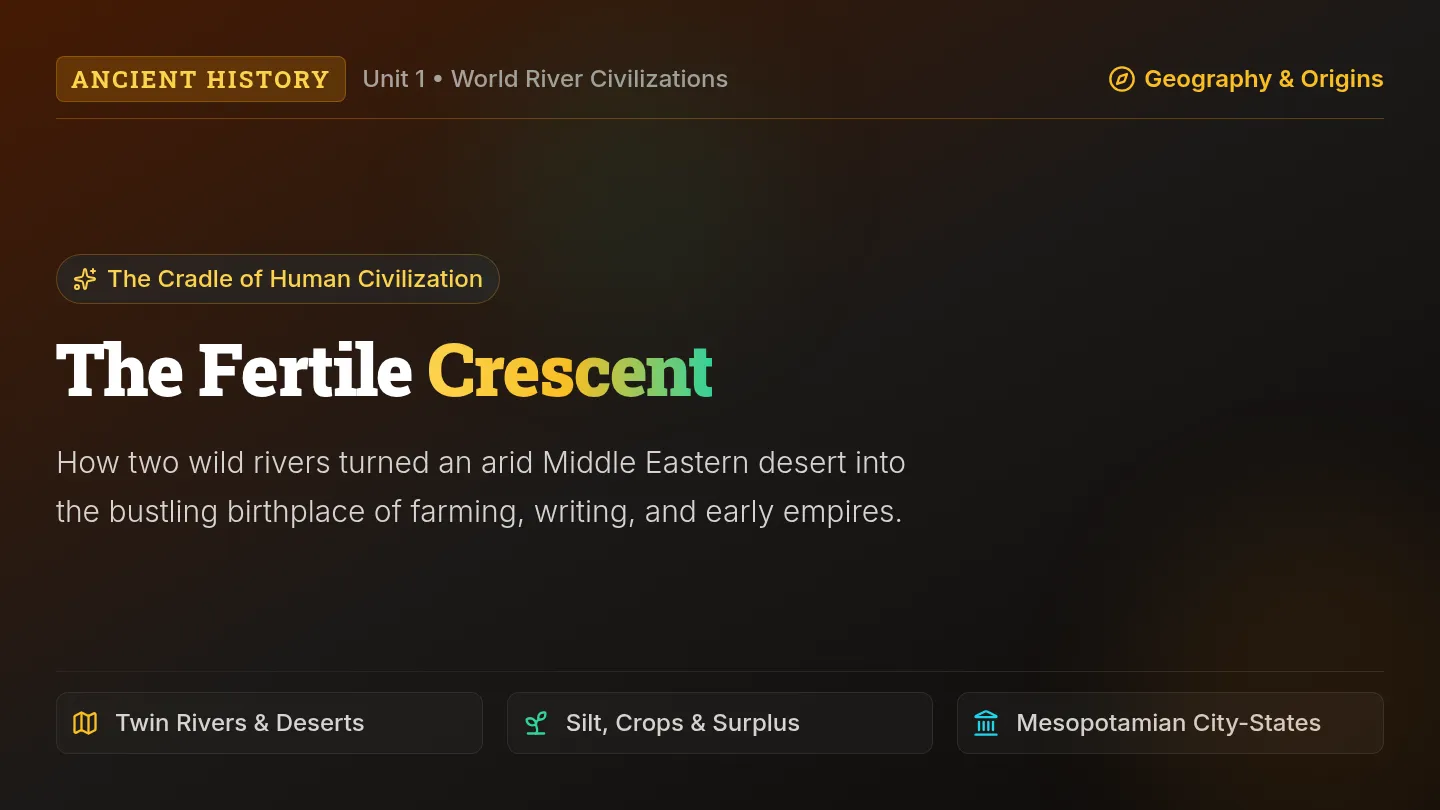
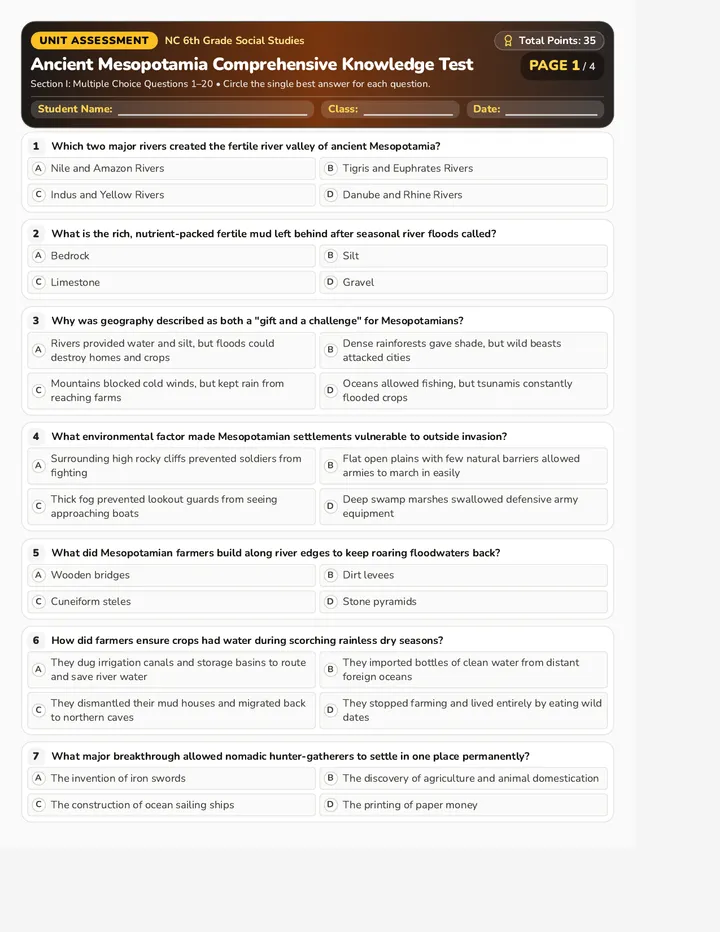
A comprehensive 6th-grade social studies unit exploring how the Tigris and Euphrates river valleys shaped agriculture, early settlements, environmental challenges, and the rise of Mesopotamian civilization.
Fresh Water: Essential for drinking, cooking, and sustaining farm animals.
Fish & Food: Provided reliable daily protein and waterfowl for food.
Transportation: Boats moved grain and trade goods easily between cities.
Fertile Silt: Floodwaters deposited rich mud that made desert soil produce crops.
Floods Were Destructive CHALLENGE
Unpredictable Flooding: Northern mountain snowmelt rushed down without warning.
Destroyed Mud Homes: Rushing water easily dissolved sun-dried mud bricks.
Washed Away Crops: Violent floods drowned crops right before harvest.
Required Levees: Farmers had to construct tall dirt levees to hold rivers back.
Dry Seasons & Drought CHALLENGE
Water Shortages: Months without rain caused river levels to drop to narrow trickles.
Baked Clay Ground: Scorching sun turned moist soil into hard, cracked crust.
Canals & Basins: Farmers dug irrigation ditches to channel river water miles to fields.
Few Natural Barriers CHALLENGE
Flat Open Plains: No high mountain chains or wide oceans shielded Mesopotamia.
Vulnerable to Attack: Rival city-states and nomads could easily march across open plains.
Thick City Walls: To stay safe, cities built enormous mud-brick protective walls.
Why It Matters — Synthesis
These advantages and challenges influenced how Mesopotamians farmed, built cities, created irrigation systems, and protected their communities.
Check for Understanding: Circle the correct answer
1. Why were cities vulnerable to enemy invasion?
A) Dense jungle blocked vision
B) Flat lands had few natural barriers
2. How did farmers solve dry season water shortages?
A) Built irrigation canals to route water
B) Abandoned cities and moved away
Part 5
Guided Practice: Benefits vs. Challenges Sort
PAGE 3 / 4
🎯
Objective: Analyze how geography brought both benefits and challenges to explain adaptation.
Step-by-Step Task
1 Read the 8 statements below.
2 Sort into Benefits or Challenges.
3 Synthesize how humans adapted.
Evidence Statements to Sort: Write each statement into the matching T-Chart column
Rivers provided water
Rivers provided fish
Rivers provided transport
Fertile soil grew crops
Floods were unpredictable
Floods destroyed crops
Dry seasons caused drought
Few natural barriers
Benefits (Gifts)
4 Items
1
2
3
4
✓ Evidence that supported civilization growth
Challenges (Obstacles)
4 Items
1
2
3
4
✓ Environmental hazards that tested settlers
Think and Discuss: How Did Geography Force Adaptation?
Slide 10 Guided Discussion
Review your T-chart. How did these combined benefits and challenges push Mesopotamians to invent new technology and organize governments?
Stem: Geography forced people in Mesopotamia to adapt by...
Part 6
Independent Practice: Helpful or Harmful?
PAGE 4 / 4
Objective: Support an argument with evidence explaining if geography was more helpful or harmful.
Slide 11 Task
Sentence Starters to Use in Your Response:
"I think geography was more..." "One example is..." "Another example is..." "This shows that..."
?
Central Question: Was geography more helpful or harmful to Mesopotamians?
Select & Provide 2 Evidences
My Claim:
Circle one: MORE HELPFUL OR MORE HARMFUL
Example 1 from Today's Lesson:
Example 2 from Today's Lesson:
My Written Response (Full Paragraph): Write 3–4 sentences connecting claim & evidence
Share with a Partner: Partner Discussion Check
My partner said...
We agreed / disagreed because...
LESSON CLOSURE & EXIT TICKET: Turn in to teacher
Question: How did Mesopotamians adapt to their environment? (Write one complete answer).
Learning to plant seeds and domesticate animals allowed people to settle in one place permanently.
3. Irrigation Control
Mesopotamians invented canals and levees to control wild floods and direct river water to fields.
Irrigation Canals WATERWAY
Dug Trenches: Deep ditches carved into the ground to carry water miles away from riverbanks.
Expanded Farmland: Converted dry, desert ground into fertile green crop rows.
Community Labor: Required hundreds of workers to dig and clean out silt build-up.
🌊 Moved water to where it was needed
Protective Levees BARRIER
High Dirt Walls: Built along river edges to keep roaring mountain floodwaters from overflowing.
Gates & Sluices: Farmers poked holes or gates in levees to gently flood fields when ready.
Saved Villages: Prevented sun-dried mud homes from collapsing during spring floods.
🛡️ Kept raging floodwaters back
Storage Basins RESERVOIR
Holding Ponds: Large reservoirs dug into the ground to store excess floodwater for dry summer months.
Drought Protection: Ensured barley, wheat, dates, and sheep had water during scorching rainless periods.
Year-Round Crops: Allowed multiple annual harvests instead of just one risky season.
💧 Saved water for rainless dry seasons
Key Synthesis (Slide 23)
"Geography created challenges, but Mesopotamians used their ingenuity to turn problems into opportunities!" By organizing massive work crews to build canals and levees, early farmers laid the groundwork for government and permanent civilization.
Check for Understanding: Circle the correct answer
1. What primary purpose did levees serve?
A) They blocked rivers to prevent destructive floods
B) They acted as trade roads between empires
2. Why did irrigation require cooperation and leadership?
A) Each person had to guard their own puddle
B) Entire communities had to dig and maintain shared canals
Part 5
Guided Practice: The Chain of Change (Slide 23)
PAGE 3 / 4
🎯
Objective: Trace how irrigation and farming led step-by-step to the birth of the world's first cities.
Slide 23 Graphic
Study the 5 progressive steps below from the slide. Analyze how each step directly caused the next step to happen.
From Farming to Cities: 5-Stage Evolution Step 1 → Step 5 Sequential Cause & Effect
1
Farming
Irrigation made it possible to grow crops regularly on fertile river soil.
2
Surplus
Reliable farming produced more food than farmers needed to survive.
3
Population
With abundant food, families grew and far more people lived together.
4
Jobs
Extra food meant not everyone had to farm; people specialized in crafts, trade, & law.
5
Cities
Specialized jobs and large populations formed city-states like Ur, Uruk, & Babylon.
Connecting the Links in the Chain (Answer with evidence)
Written Analysis
Question 1: Why was an agricultural food surplus the required bridge between farming and specialized jobs? (Why couldn't people have jobs like blacksmith or weaver before a surplus existed?)
Question 2: When thousands of people live together in cities with different jobs, what new problems arise that require laws and government? Give one concrete example.
Connect to Permanent Settlement
Historical Impact
Irrigation allowed people to farm the exact same plot of land year after year without depleting moisture. This reliable food supply encouraged permanent settlements that eventually grew into the world's most famous early city-states: Ur, Uruk, and Babylon.
Part 6
Independent Practice: Cause-and-Effect Synthesis
PAGE 4 / 4
Slide 24 Independent Task: Complete the Flowchart & Explain How Irrigation Led to Civilization
Mandatory Words
Required Words: surplus jobs civilization
Check off each word as you write!
Cause-and-Effect Flowchart (Fill in each box) How Irrigation Transforms Society
A Cause: Technology
What did farmers build to control river water?
B Effect on Food Supply
What happened to crop supply (use "surplus")?
C Result for Society
What emerged (use "jobs" & "civilization")?
Written Response: Explain How Irrigation Built Civilization Write 3–4 complete sentences
Lesson Closure (Slide 25): Be ready to share one complete answer
Why was a food surplus so important to the development of early cities?
EXIT TICKET (Slide 26): Answer before leaving class
How did irrigation help lead to the development of civilization?
1. Organized Cities URBAN CORE
Hubs of Daily Life: Built cities like Ur, Uruk, and Babylon where thousands lived, traded, and worshiped.
Protective Mud Walls: Enormous thick walls encircled cities to guard against enemy invasions.
Central Bazaars: Bustling marketplaces allowed farmers to exchange barley for textiles and tools.
Preserved History: Recorded laws, medical recipes, prayers, and heroic stories like the Epic of Gilgamesh.
✍️ Preserved knowledge, contracts, and legal standards
Key Synthesis (Slide 9)
"These characteristics worked together to help Mesopotamia develop from small farming villages into an organized civilization." No single feature stood alone—each reinforced the others.
Quick Check: Circle the best historical answer
1. Why was cuneiform writing initially created?
A) To record trade deals, grain inventories, and taxes
B) To send casual letters across foreign oceans
2. What was the central building in a Mesopotamian city?
A) A stone amphitheater
B) A mud-brick temple called a ziggurat
Part 5
Guided Practice: Match the Examples (Slide 10)
PAGE 3 / 6
🎯
Objective: Match concrete Mesopotamian examples to the correct characteristic of civilization.
Slide 10 Task
Review the 4 core examples featured in class: Ziggurats, Cuneiform, Kings, and Farmers. Connect each to its primary characteristic and explain its function.
Example A: Ziggurats TEMPLE
Characteristic: Religion & Public Works
How did this feature help the civilization function and stay organized?
Example B: Cuneiform WRITING
Characteristic: Record Keeping & Communication
How did this feature help the civilization function and stay organized?
Example C: Kings GOVERNMENT
Characteristic: Government & Social Hierarchy
How did this feature help the civilization function and stay organized?
Example D: Farmers SPECIALIZED LABOR
Characteristic: Food Surplus & Economy
How did this feature help the civilization function and stay organized?
Class Discussion: How Features Worked Together
Slide 10 Discussion Prompts
Choose two features from above and explain how they depended on one another (e.g., how did Kings rely on Cuneiform? Or how did Ziggurats rely on Farmers?).
Part 6
Independent Practice: Mesopotamia: An Organized Civilization
PAGE 4 / 6
Slide 11 Independent Task: Complete the Sentence & Written Response
3 Requirements
Start With: "Mesopotamia was a civilization because..."
1 Include at least 3 characteristics
2 Use vocabulary from bank
3 Explain how it created order
Slide 11 Vocabulary Bank: Incorporate into your written response
organized cities government religion social hierarchy specialized jobs cuneiform ziggurats trade farming laws
My Written Response (Full Paragraph): Write 4–5 complete sentences
Lesson Closure (Slide 12): Be ready to share one complete answer
Which characteristic of civilization do you think was most important? Why?
EXIT TICKET (Slide 13): Answer before leaving class
Name three characteristics of civilization:
Part 7
The Lawgiver: Hammurabi's Code of Laws
PAGE 5 / 6
Primary History Reading: The First Written Code of Law
Standard 6.C&G.1
Around 1750 BCE, King Hammurabi united the warring city-states of Mesopotamia under the Babylonian Empire. To keep order across such a vast territory, Hammurabi recognized that spoken rules and local customs caused confusion and unfairness. He gathered judges and legal scholars to compile 282 specific laws into a single unified legal system.
Hammurabi ordered these 282 laws to be permanently carved in cuneiform script onto an enormous eight-foot-tall monument made of black basalt stone (called a stele). At the top of the stele, an engraving depicted Hammurabi receiving a ring and staff directly from Shamash, the Babylonian god of justice. By placing these carved stones in public plazas at the center of cities, everyone—rich or poor, noble or commoner—could know exactly what the laws were, and corrupt leaders could not secretly alter them.
Hammurabi's Code was famous for its core principle: "an eye for an eye, a tooth for a tooth" (known as the law of retaliation, or lex talionis). The idea was that the punishment should directly match the crime committed. However, laws were not applied equally to everyone: punishments were far harsher if a commoner or enslaved person harmed a noble than if a noble harmed someone of lower social status.
Despite its harshness, Hammurabi's Code marked a revolutionary leap forward in world history. For the first time, society was governed by written public laws rather than the random whims or temper of individual rulers. It established that citizens had legal responsibilities, builders had to construct safe buildings, doctors were held accountable, and contracts had to be honored.
Ancient Babylonian Statutes (From the Basalt Stele): Historical Primary Evidence
Law 229 (Builders): If a builder builds a house poorly and it collapses killing the owner, that builder shall be put to death.
Law 196 (Injuries): If a man knocks out the eye of another man of equal rank, they shall knock out his eye.
Law 218 (Surgeons): If a physician operates with a bronze blade and causes death, his hands shall be cut off.
Law 53 (Canals/Property): If a farmer neglects his levee and water floods his neighbor's corn, he must pay back the lost corn.
Check for Understanding: Write 1–2 complete sentences
Why was carving laws publicly into stone steles better than letting kings make up punishments in their heads?
Name:
Block:
Date: 9-14-26
Hammurabi's Code Activity: Be the Judge
Directions: Read each situation. Decide what you think the punishment should be. Then compare your decision to Hammurabi’s law.
PAGE 6 / 6
1 A builder constructs a house, but the house collapses because it was built poorly.
My punishment:
Why?
2 A person steals grain from another person.
My punishment:
Why?
3 A person injures another person during a fight.
My punishment:
Why?
4 A doctor makes a serious mistake while treating a patient.
My punishment:
Why?
5 A person owes money but refuses to repay the debt.
My punishment:
Why?
6 A person damages another person’s property.
My punishment:
Why?
Final Challenge: Create your own Hammurabi-style law. Legal Innovator
If someone
then
.
Why is your law fair?
1. Massive Mud-Brick Walls DEFENSE
Guarded Gates: High walls with heavy bronze gates locked every night to keep citizens safe.
Wartime Refuge: When enemy raiders attacked, outside farmers fled inside walls for protection.
🛡️ Solved the problem of flat, unprotected plains
2. King & Military Army AUTHORITY
Royal Authority: Kings claimed gods chose them to lead armies and enforce justice.
Military Defense: Standing soldiers with copper spears protected canals, crops, and trade roads.
👑 Enforced city laws and settled border disputes
3. The Grand Ziggurat RELIGION
City Heart: Located at the absolute center; priests collected grain offerings from harvests.
Patron Deity: Each city-state honored a specific god (e.g., Ur honored the moon god Nanna).
🛕 Served as civic town hall, bank, and sacred shrine
4. Resource Conflict RIVALRY
Water Disputes: Upstream cities could divert river water, starving downstream cities.
Border Wars: Growing populations fought violently over scarce fertile land and canal access.
⚔️ Competition over resources sparked regular warfare
Key Synthesis (Slide 9)
"Competition over resources sometimes caused conflict." Because Mesopotamia was not a united empire yet, neighboring city-states constantly balanced trade alliances with armed rivalry.
Quick Check: Circle the correct answer
1. What did each city-state have that made it independent?
A) Its own king, laws, army, and patron god
B) Its own language and completely different alphabet
2. Why did neighboring city-states fight one another?
A) Over control of precious water and fertile farming land
B) They wanted to sail across the Atlantic Ocean
Part 5
Guided Practice: City-State Need → Response (Slide 10)
PAGE 3 / 4
🎯
Objective: Complete the CITY-STATE → NEED → RESPONSE framework to evaluate civic solutions.
Slide 10 Framework
As cities grew, new problems emerged. Study how Mesopotamian leaders created specific organizational responses to each growing need.
1 Growing Population → Need Protection → City Walls & Army Defense Response
Explain the Response: Why did open plains make city walls necessary, and how did rulers organize citizen labor to build them?
2 Farming Desert Soil → Need Water → Irrigation Systems Resource Response
Explain the Response: How did canals and levees allow a city-state to feed tens of thousands of citizens reliably year-round?
3 Crowded Urban Center → Need Organization → Government & Laws Civic Response
Explain the Response: What would happen to city life if there were no written laws, property records, or court judges?
Independence vs. Competition
Critical Inquiry
While each city-state enjoyed complete independence, their shared need for the Tigris and Euphrates waters meant they could never truly ignore their neighbors. Cooperation built canals; competition sparked wars.