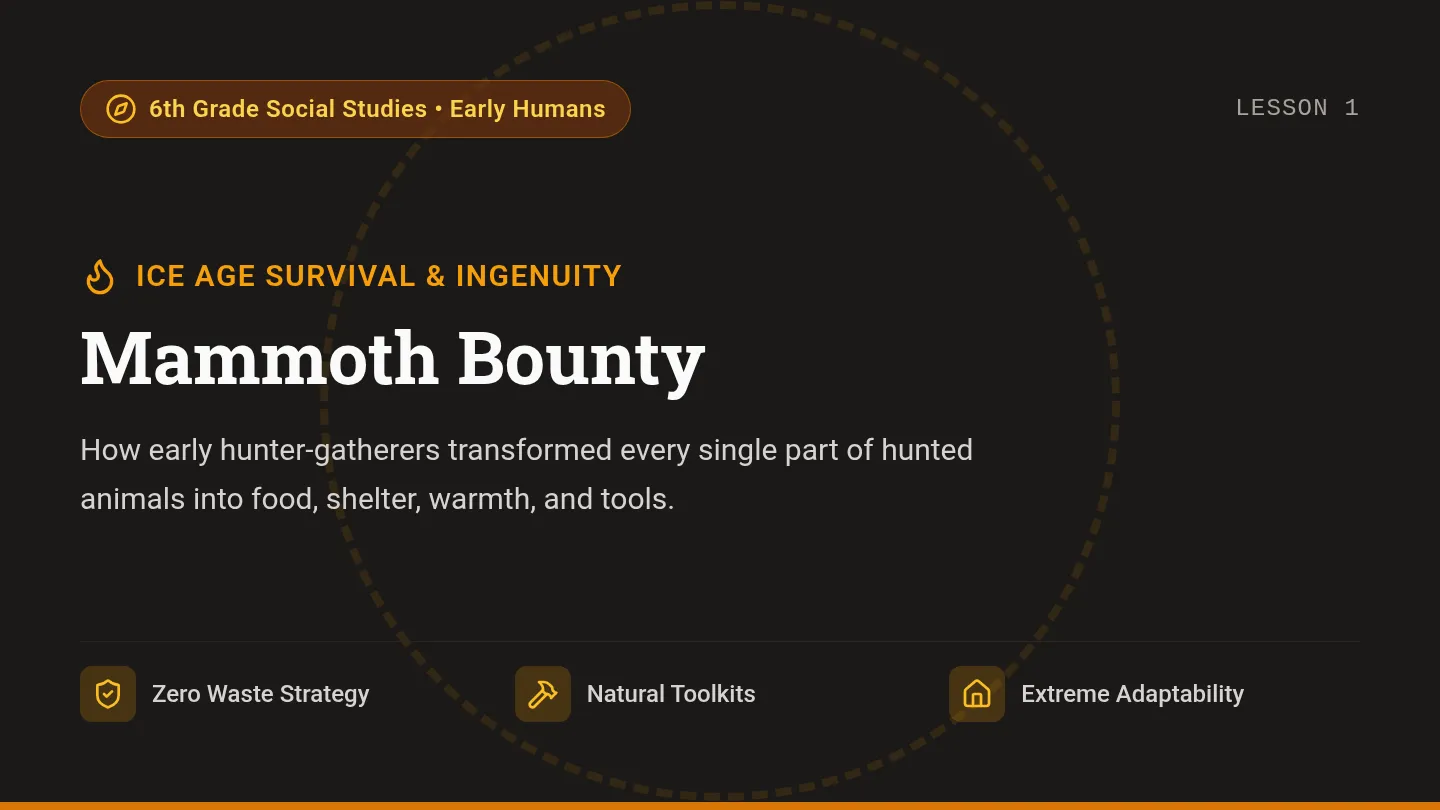
A comprehensive 6th-grade social studies sequence investigating Paleolithic hunter-gatherers through survival strategies, technological innovation, and artifact analysis. Students examine how early humans adapted across diverse biomes and decipher primary archaeological evidence.
Egalitarian: A social system where all members possess equal rights and access.
Materials & Setup Checklist
Projection for Forager Toolkit Slides
Class set: Forager Toolkit Student Worksheet (2-sided)
Teacher copy: Forager Toolkit Answer Key & Rubric
Optional physical artifacts: river stones, cordage, or leather scraps
Unit 1: Early Humans & Paleolithic Societies Page 1 of 2
Facilitation Notes & Scripts
Forager Toolkit: Instructional Strategies
Teacher Reference
Guiding Questions & Discussion Prompts
Hook Prompt (Slide 2): "If you had to survive in the wilderness today, would you choose to look for wild berries and roots, or try to hunt an elk with a wooden spear? Why?"
Teacher Cue: Guide students to realize that hunting burns enormous calories and carries high risk of injury. Tubers don't run away!
Technology Prompt (Slide 3): "Why was the eyed bone needle just as revolutionary as the flint handaxe?"
Expected Response: Without tailored clothing, humans could never survive sub-zero ice ages or cross the Beringia land bridge into the Americas.
Social Structure Prompt (Slide 4): "Why was hoarding food or having a king impossible for a nomadic band of 30 people?"
Expected Response: Without refrigerators or grain silos, meat rots. You cannot store wealth, so sharing ensures that when you fail to find food tomorrow, others feed you.
Common Misconceptions & Corrections
Misconception: "Man the Hunter" Only
Students often assume men strictly hunted and women only cared for children. Evidence: 2020 burial excavations in Peru (Wilamaya Patjxa) revealed female hunters buried with big-game projectile points. Labor was flexible.
Misconception: Constant Starvation & Misery
Students envision cavemen starving in dark caves. Evidence: Paleolithic skeletal remains show varied, nutritious diets, dense bones, and lower rates of arthritis than early agrarian societies.
Multi-Tiered Differentiation Strategies
ELL / Multilingual
Provide visual tool flashcards with labeled cross-sections. Allow sentence starters for the Band Council vote (e.g., "I recommend our band moves to the river valley because...").
Students Needing Support
Pre-fill two tool functions on the Part 1 matrix. Assign specific defined roles within the band simulation (e.g., Scout, Elder, Toolmaker, Scribe).
Advanced / Extension
Ask students to draft a mini "Paleolithic Constitution" outlining 3 ethical rules that prevent wealth hoarding and maintain harmony in nomadic bands.
Formative Assessment & Exit Check Criteria
Evaluate Part 4 on the student worksheet. A proficient response must state: (1) why plant gathering provided the primary daily caloric foundation, and (2) how nomadic mobility necessitated an egalitarian social structure where sharing was an essential survival strategy rather than optional charity.
[ Option 2 ] River Oak Bluff: Camp inside sheltered limestone caves. Abundant acorn caches and dried river fish, but fresh animal hides for winter clothing will be scarce.
Your Band's Decision & Justification (Why did you choose this route over the other?):
B Dilemma 2: Dividing the Band's Labor (14 Adults Available)
Assign your 14 active adults to the tasks below to survive the upcoming freeze:
Task 1: Big Game Hunt
Tracking reindeer herds
Adults:
Task 2: Acorn & Firewood
Harvesting winter fuel & food
Adults:
Task 3: Clothing & Shelter
Sewing furs & winterizing tent
Adults:
*Total must equal 14 adults. Children and elders assist in camp.
4 Part 4: Historical Reflection
Explain why Paleolithic band survival required an egalitarian (equal and shared) social structure instead of a single powerful ruler who kept the best food for himself:
Lesson 1: The Forager Toolkit • Student Investigation Sheet Page 2 of 2
2 - Developing
States that people shared because they were "friendly," lacking connection to nomadic resource constraints and survival economics.
1 - Beginning
Provides inaccurate claims or states that hunter-gatherers had kings and paid taxes in meat.
Key Concept: Humans modify available natural materials to solve environmental problems.
Archaeological Exhibit B
03 / Lascaux & Chauvet, France
Site Date: ~17,000–36,000 BCE
The Sacred Galleries of Deep Earth
Deep within pitch-black limestone caverns, hundreds of meters from daylight, Paleolithic artists created monumental murals.
Master Paint Chemistry
Charcoal (black), red and yellow ochre (iron oxide minerals) ground into powder and mixed with animal fat, saliva, and bone marrow.
Three Competing Theories: Why Paint Caves?
1. Hunting Ritual Magic
Capturing the spirit of animals on stone to ensure successful upcoming hunts.
2. Shamanic Ceremonies
Flickering grease lamps in acoustic chambers created altered spiritual states and youth initiation rites.
3. Ecological Information Maps
Detailed recordings of animal anatomy, herd migrations, and seasonal coats across generations.
Crucial Fact: People did not sleep in these deep galleries—they entered only for sacred rituals.
Archaeological Exhibit C
04 / Willendorf & Dolní Věstonice
Date: ~25,000–30,000 BCE
The Venus Figurines: Mobile Art
Over 200 small carved figurines have been discovered across 2,000 miles from the Pyrenees to Siberia.
Why Are They So Similar?
Carved with exaggerated curves and without detailed faces, they were shared across vast distances as symbols of kinship, fertility, and survival networks during harsh glaciations.
Pocket-Sized
Standing only 4 to 6 inches tall, easily carried in leather pouches during migrations.
Early Ceramics
At Dolní Věstonice, artists baked clay figurines in kilns—the world's earliest fired ceramic art.
Symbolic Power
Honored childbirth, maternal health, and seasonal rebirth in high-mortality ice ages.
Social Glue
Shared artistic styles prove distant bands communicated and traded continuously.
Key Takeaway: Art was not luxury; it was vital communication and spiritual survival technology.
Historical Investigation
Forensic Lab
Artifact Detective Mission Briefing
Step into the shoes of an archaeologist. Analyze three primary artifacts and distinguish between physical facts and historical deductions.
1
Observe Evidence
Record exactly what is physically visible (materials, wear, size).
2
Infer Lifestyle
Deduce how the object solved an environmental or social challenge.
3
Write C-E-R Claim
Construct an evidence-backed argument: "Paleolithic humans were..."
Open your Artifact Detectives Student Dossier to begin.
Unit 1: Early Humans & Paleolithic Societies Page 1 of 2
Forensic Inquiry Strategies
Artifact Detectives: Facilitation Notes
Teacher Reference
Teaching the Observation vs. Inference Distinction
Sixth graders frequently confuse what they see with what they think it means. Use the following explicit contrast before students open their dossiers:
Observation (Fact):
"I see a circle of mammoth lower jaws interlocked with ash in the middle." (Direct sensory evidence that cannot be disputed).
Inference (Deduction):
"Because wood was absent, they engineered homes out of bones and burned marrow for fuel." (Logical conclusion based on evidence).
Key Facilitation Questions During Station Work
Prompt for Station 1 (Dwellings):"If a woolly mammoth skull weighs over 200 pounds, what does that tell us about the teamwork and organization of the band that built the hut?"
Prompt for Station 2 (Cave Art):"Why would artists crawl into dangerous, oxygen-deprived caverns half a mile underground to paint, instead of painting on outdoor cliffs?"
Prompt for Station 3 (Figurines):"Why did pregnant or maternal figures dominate early portable art rather than statues of hunters or warriors?"
Multi-Tiered Differentiation Support
ELL / Language Support
Provide a sentence frame for the C-E-R paragraph: "Paleolithic humans adapted to harsh environments by [Claim]. For example, at Mezhyrich they used [Evidence]. This demonstrates that [Reasoning]."
Academic Intervention
Pair students with a peer investigator. Focus their analysis primarily on Stations 1 and 2, completing Station 3 collaboratively during whole-class review.
Advanced / Gifted
Challenge students to evaluate the "Acoustic Resonance Theory": Why are the densest cave paintings located in chambers that produce the greatest musical echo?
Claim-Evidence-Reasoning (C-E-R) Mastery Criteria
Claim: States clearly that early humans adapted through technological and cultural innovation rather than biological change. Evidence: Cites at least two specific artifacts (e.g., Mezhyrich bone dwellings, Lascaux ochre paint, or eyed needles). Reasoning: Explains how these artifacts overcame environmental barriers (shelter in treeless tundra, social bonding, extreme cold).
Central Historical Question:How did Paleolithic hunter-gatherers use technological and cultural adaptations to survive and thrive in extreme environments?
[ CLAIM ] Answer the central question in one clear statement:
[ EVIDENCE ] Cite two specific artifacts/sites from your dossier:
[ REASONING ] Explain how your evidence proves human ingenuity:
Strong argumentative claim; cites two specific artifacts with accurate site contexts; clearly explains the connection between material innovation and environmental adaptation.
3 - Proficient
Clear claim answering the prompt; cites at least one or two artifacts; provides reasonable explanation of how tools/shelter aided survival.
2 - Developing
Claim is vague; mentions artifacts generally without naming specific evidence or explaining how they solved environmental problems.
1 - Beginning
Lacks a claim; provides historically inaccurate statements (e.g., humans had cars or metal heaters).