Sumerian City States Worksheet Ancient Mesopotamia
Cradle of Civilization
Geography, Irrigation, and the Rise of Sumerian City-States
Name: ______________________
Date: _________________
Part 1: Vocabulary Sandbox
Match each key term with its operational definition in ancient Mesopotamian society.
1. Fertile Crescent The crescent-shaped region in the Middle East where agriculture and the first civilizations first flourished.
2. Silt Fine, nutrient-rich soil deposited by floodwaters, vital for producing highly abundant seasonal crops.
3. Irrigation The artificial redirection and control of river water through canals, dams, and levees to nourish parched farmland.
4. City-State An independent urban center and its surrounding agricultural territories, operating as its own sovereign nation.
Part 2: Geography as Destiny
Ancient Mesopotamia, the "land between rivers," lay nested between the mighty Tigris and Euphrates rivers. Although the soil was rich, agriculture here was a high-stakes gamble. Rain was sparse and unpredictable. In the spring, snowmelt from the northern mountains rushed down, violently flooding the dry southern plains. Without warning, these flash floods washed away mud-brick homes and planted seeds.
To survive, early Sumerians engineered their environment. By digging massive canals to carry floodwaters into holding pools, and constructing clay levees to block raging torrents, they tamed the wild waters. Through coordinated labor, they could water crops even during summer droughts. This systematic irrigation generated vast agricultural surpluses—more food than farmers needed to feed themselves.
Freed from basic survival tasks, some Mesopotamians became artisans, priests, scribes, and administrators. Over time, independent agricultural towns coalesced around these economic cores, morphing into fortified, sovereign city-states like Ur, Uruk, and Lagash.
Guided Prompt
How did the unpredictable flooding of the Tigris and Euphrates rivers directly lead to the development of a complex, centralized government in early Sumer?
Write your response below:
Mesopotamia Rising Sequence • Lesson 1 Page 1 of 2
Primary Source Analysis
In Praise of the Canals
Document A: Sumerian Hymn (c. 2100 BCE)
"O great canals, dug by the mighty kings, filled with the waters of abundance! You make the dry fields laugh with grain; you carry life to the gates of our cities. Without you, our gardens would yield only dust, our sheep would wander the dry sands, and the temples of the gods would stand empty. Let the waters flow from the mountains, let the locks hold fast, and let the city of Ur sing the songs of your praise."
Document-Based Questions
1. Underline or highlight the phrase in Document A that shows the emotional or economic impact of irrigation water on the landscape. Explain what this description tells us about Sumerian life.
Analyze here:
2. According to Document A, who was responsible for digging the canals? What does this reveal about who held power and authority in these city-states?
Analyze here:
3. Synthesize: Why would empty temples (mentioned in Document A) be linked directly to the failure of irrigation canals? Connect this to the religious beliefs of Sumerians.
Synthesize here:
Mesopotamia Rising Sequence • Lesson 1 Page 2 of 2
Cradle of Civilization Slides Part 1: Geography & Power
Cradle of Civilization
How wild rivers, engineering genius, and agricultural surplus forged the world's first city-states.
Mesopotamia Rising Sequence Slide 1 of 5
The Double-Edged Rivers
Tigris & Euphrates
The Greek word Mesopotamia translates to "the land between rivers."
In the spring, melting snow from the northern Zagros Mountains flooded the southern plains with absolute violence, bringing nutrient-rich silt but destroying homes in its wake.
The River's Paradox
Too much water washed away crops and brick dwellings. Too little water caused immediate, catastrophic droughts. Survival required extreme human ingenuity.
Mesopotamia Rising Sequence Slide 2 of 5
Taming the Floods
The Irrigation Revolution
Canals & Pools
Sumerians dug miles of deep channels to carry floodwaters away from cities and straight into holding reservoirs.
Levees & Gates
Thick dirt and clay walls kept wild floodwaters back, while wooden gate barriers controlled water flow to farms.
Mass Labor
Constructing and cleaning channels required thousand-person work forces, giving birth to early civic organization.
Mesopotamia Rising Sequence Slide 3 of 5
The Surplus Cycle
Stable Irrigation
Agricultural Surplus
Division of Labor
Fortified City-States
Sovereign Cities
The Rise of Sumerian City-States
By 3000 BCE, walled centers like Ur, Uruk, and Lagash emerged. Each had its own monarch, defensive army, patron deity, and dedicated trading markets. Because irrigation systems crossed city boundaries, dispute management between these centers catalyzed diplomacy and formal war.
Mesopotamia Rising Sequence Slide 4 of 5
Reflect & Discuss
The Blueprint of Society
"Environmental adversity does not destroy civilizations; it acts as the spark that forces them to build."
Class Discussion Questions:
Could the Sumerians have built cities if the floods had been mild and completely predictable?
In what ways do our modern cities still struggle with the same geographical challenges of Mesopotamia?
Cradle of Civilization Teacher Guide Teacher Resource • Key & Guide
Cradle of Civilization Guide
Pedagogical Roadmap & Answer Keys for Lesson 1
1. Instructional Pathway & Pacing
Hook & Vocab (15 Min)
Introduce the slides. Define Fertile Crescent, silt, irrigation, and city-states. Connect geography to human survival efforts.
Guided Analysis (20 Min)
Students read "Geography as Destiny" and answer the Guided Prompt on floodwaters. Circulate to check core comprehension.
Primary Source (25 Min)
Read "In Praise of the Canals" out loud. Lead students through DBQ questions. Finish with a structured whole-class debrief.
2. Common Student Misconceptions
Misconception: Mesopotamia was a single, unified empire from its inception.Misconception: The rivers flooded on a safe, predictable cycle (like the Nile River in Egypt).
3. Worksheet Exemplar Answers
Page 1 Guided Prompt: Floodwaters & Government Development
Exemplar: Taming the unpredictable floodwaters required massive infrastructure projects (canals, dams, reservoirs) that could not be built by individual families. This demanded organized, cooperative labor across hundreds of people, which created a natural need for regional planners, administrators, and kings to coordinate and enforce work shifts.
Page 2 DBQ 1: "Make the dry fields laugh with grain"
Exemplar: The personification of "dry fields laugh[ing]" indicates that irrigation brought joy and dramatic economic prosperity to Sumerians. Water transformed barren, dusty earth into a fertile breadbasket, directly keeping populations alive and well-nourished.
Page 2 DBQ 2 & 3: Divine Kings & Empty Temples
Exemplar: Document A credits "mighty kings" with digging the canals, reinforcing their divine right to rule. If the canals failed, fields dried up, causing starvation. This meant no crop offerings could be delivered to feed the temple gods, signaling that the gods were angry with the king's administration.
Mesopotamia Rising Sequence • Teacher Resource Guide Lesson 1 Guide
Clay and Cuneiform Worksheet Ancient Mesopotamia
Clay and Consequence
The Birth of Scribes, Pictographs, and Cuneiform Tablets
Name: ______________________
Date: _________________
Part 1: Word Slabs (Vocabulary)
Cuneiform "Wedge-shaped" writing made by pressing a reed stylus into soft, wet clay.
Scribe An elite, highly trained professional record-keeper and state writer.
Pictograph A simple drawing or picture that represents a physical object or concrete concept.
Edubba A Sumerian "tablet house" or elite school where young boys trained to be scribes.
Part 2: From Sheep to Script
Writing did not begin with poetry or epic myth; it began with tax receipts and inventory audits. As Sumerian city-states boomed, merchants and city administrators could no longer track thousands of bushels of wheat, jars of sesame oil, or heads of sheep by memory alone.
Initially, Mesopotamians used hollow clay balls called bullae filled with tiny clay tokens representing goods. To verify the inventory without breaking the ball, they began pressing the shapes of the tokens into the soft clay outer shell. Soon, they realized they didn't need the hollow ball or the actual tokens at all—they just needed a flat, portable slab of wet clay and a sharpened reed.
Early drawings were realistic pictographs . However, scratching curves into wet, sticky clay was slow and messy. Around 2500 BCE, clever scribes turned their reeds sideways to press quick, triangular, wedge-shaped lines into the clay. This developed into cuneiform , a stylized, complex system of hundreds of symbols.
Scriptorium Prompt
Why was the transition from realistic pictographs to abstract cuneiform wedge-symbols such a revolutionary advancement for Sumerian administrators?
Write your response below:
Mesopotamia Rising Sequence • Lesson 2 Page 1 of 2
Sumerian Scriptorium Lab
Cracking the Clay Code
Evolution of Key Symbols (c. 3000 BCE -> 1000 BCE)
English STAR 𒀭
English WATER 𒀀
English GRAIN 𒊺
English HEAD 𒊕
English KING 𒈗
Document B: Scribe Student Lament (c. 2000 BCE)
"The monitor of the tablet house said, 'Why did you speak without permission?' and flogged me. The school father said, 'Your tablet is not clean!' and whipped me. The teacher said, 'Your cuneiform wedges are clumsy!' and beat me. Yet I persevered, for to be a scribe is to stand above all other professions; a scribe knows no hunger, commands armies, and guides the empire."
1. Scribe Training: Look at the evolution chart above. If a scribe pressed the characters 𒈗 (King) followed by 𒀀 (Water) on a legal clay tablet, what translation could the tax collector deduce? Explain your logic.
Scribes of Sumer Slides Part 2: Clay & Consequence
Scribes of Sumer
The technology of writing, the elite lives of scribes, and the power of the written word in Mesopotamian civilization.
Mesopotamia Rising Sequence Slide 1 of 5
Who Invented Writing?
The Accountants' Necessity
Writing did not start with myths, literature, or religion. It was invented to record transactions .
When cities expanded, merchants had to keep track of vast inventories. They used hollow clay containers (bullae ) filled with distinct, physical shape-tokens representing specific agricultural commodities.
Early Inventories
Over time, scribes realized that drawing the token's outline on a flat clay slab eliminated the need for heavy, breakable token boxes entirely.
Mesopotamia Rising Sequence Slide 2 of 5
Evolution of Script
The Cuneiform Breakthrough
1
Realistic Pictographs
Early symbols were drawings of physical things—heads, jars, bulls, stars. Drawing complex curves in moist, sticky clay was slow and sloppy.
2
The Reed Stylus
Around 2500 BCE, writers began utilizing a cut marsh reed to stamp clean, straight triangular wedges instead of drawing lines.
3
Abstract Ideograms
Symbols grew highly abstract, rotated 90 degrees sideways, and evolved into over 600 complex phonetic and concept characters.
Mesopotamia Rising Sequence Slide 3 of 5
The Edubba
To become a scribe, students spent decades memorizing characters, writing layout principles, and math equations under strict supervision.
Discipline included physical beatings for lazy writing.
Sumerian Scribes
Monopolizers of Information
Because less than 1% of the population was literate, scribes became immensely wealthy and powerful. They oversaw legal trials, cataloged international trade deals, wrote down mathematical equations, mapped construction projects, and royal political propaganda.
Mesopotamia Rising Sequence Slide 4 of 5
Class Challenge
Read Like a Scribe
𒀭
STAR
𒈗
KING
𒊺
GRAIN
What does this transaction mean?
𒈗 + 𒊺
How would an official Sumerian tax collector translate this recorded script to the king's guards?
Mesopotamia Rising Sequence Slide 5 of 5
Clay and Consequence Teacher Guide Teacher Resource • Key & Guide
Clay and Consequence Guide
Pedagogical Roadmap & Answer Keys for Lesson 2
1. Instructional Pathway & Pacing
Hook & Context (15 Min)
Go through the slides. Frame the invention of writing as an economic necessity for trade tracking, not creative art.
Active Decoding (25 Min)
Guide students through the "Clay Code" translation lab on page 2. Have them collaborate in pairs to decipher the symbols.
Source & Wrap-up (20 Min)
Analyze the student lament in Document B. Conduct a brief class discussion on how literacy control equates to political authority.
2. Common Student Misconceptions
Misconception: Cuneiform is an alphabet, like English letters.Misconception: Almost everyone in ancient Mesopotamia could read and write.
3. Worksheet Exemplar Answers
Page 1 Guided Prompt: Pictographs vs. Cuneiform Wedges
Exemplar: Pictographs were highly realistic, which made drawing curved lines in moist clay difficult, messy, and slow. Transitioning to triangular wedge-stamps using a straight stylus allowed scribes to register standardized data extremely fast, dramatically increasing administrative efficiency.
Page 2 Challenge 1: Deciphering the Scribe Code
Exemplar: The symbols mean KING (𒈗) and GRAIN (𒊺). The tax collector would deduce that this clay tablet represents the King's official grain supply, a grain tax delivery, or a payment receipt issued from the royal granaries.
Page 2 Challenge 2 & 3: Student Discipline & Elite Power
Exemplar: Scribe schools were highly strict and used severe physical discipline. Families willingly suffered this because graduation ensured elite status. Controlling writing allowed scribes to monopolize administrative records, legal deeds, and agricultural bookkeeping, giving them unmatched control over illiterate classes.
Mesopotamia Rising Sequence • Teacher Resource Guide Lesson 2 Guide
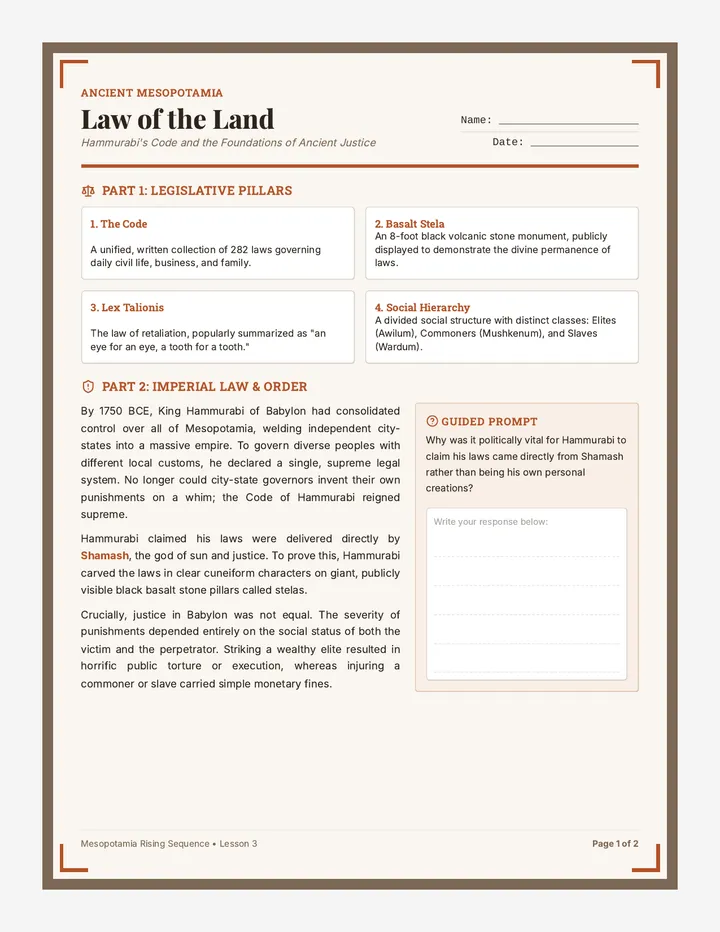
Hammurabi Code Worksheet Ancient Mesopotamia
Law of the Land
Hammurabi's Code and the Foundations of Ancient Justice
Name: ______________________
Date: _________________
Part 1: Legislative Pillars
1. The Code A unified, written collection of 282 laws governing daily civil life, business, and family.
2. Basalt Stela An 8-foot black volcanic stone monument, publicly displayed to demonstrate the divine permanence of laws.
3. Lex Talionis The law of retaliation, popularly summarized as "an eye for an eye, a tooth for a tooth."
4. Social Hierarchy A divided social structure with distinct classes: Elites (Awilum), Commoners (Mushkenum), and Slaves (Wardum).
Part 2: Imperial Law & Order
By 1750 BCE, King Hammurabi of Babylon had consolidated control over all of Mesopotamia, welding independent city-states into a massive empire. To govern diverse peoples with different local customs, he declared a single, supreme legal system. No longer could city-state governors invent their own punishments on a whim; the Code of Hammurabi reigned supreme.
Hammurabi claimed his laws were delivered directly by Shamash , the god of sun and justice. To prove this, Hammurabi carved the laws in clear cuneiform characters on giant, publicly visible black basalt stone pillars called stelas.
Crucially, justice in Babylon was not equal. The severity of punishments depended entirely on the social status of both the victim and the perpetrator. Striking a wealthy elite resulted in horrific public torture or execution, whereas injuring a commoner or slave carried simple monetary fines.
Guided Prompt
Why was it politically vital for Hammurabi to claim his laws came directly from Shamash rather than being his own personal creations?
Write your response below:
Mesopotamia Rising Sequence • Lesson 3 Page 1 of 2
Primary Source Analysis
Hammurabi's Code: Selected Statutes
Document C: Selected Babylonian Statutes (c. 1750 BCE)
Law 196: If an elite man (Awilum) knocks out the eye of another elite man, his eye shall be knocked out.
Law 198: If he knocks out the eye of a commoner (Mushkenum), he shall pay one mina of silver.
Law 199: If he knocks out the eye of an elite's slave (Wardum), he shall pay half of the slave's purchase value.
Law 202: If anyone strikes the cheek of a man of higher social rank, he shall receive sixty blows with an ox-whip in public.
Courtroom Verdicts
1. Under Hammurabi's Code, does the concept of "an eye for an eye" apply equally to all people? Cite specific evidence from Document C (laws 196, 198, or 199) to support your claim.
Stela of Justice Slides Part 3: Law of the Land
Stela of Justice
The unified laws of Babylon, the code of retribution, and the harsh realities of ancient social hierarchy.
Mesopotamia Rising Sequence Slide 1 of 5
The Rise of Babylon
One Empire, One Law
Around 1792 BCE, King Hammurabi forged a mighty empire by conquering and merging the warring city-states of Sumer and Akkad.
To govern a massive, diverse population fairly, he needed to replace hundreds of conflicting local city customs with a single, absolute, unified system of state laws.
Imperial Order
The Code regulated trade deals, land contracts, family inheritance, property damage, and the exact punishments for violent criminal offenses.
Mesopotamia Rising Sequence Slide 2 of 5
written in stone
The Monument of Shamash
Divine Origin
A relief carving at the top showed Shamash, the sun god of justice, handing the laws to Hammurabi, making them holy and unquestionable.
282 Stamped Laws
Carved directly onto an 8-foot black basalt stela in precise cuneiform writing, proving that no judge could alter them on a whim.
Public Display
Erected in the heart of cities so that anyone—even illiterate commoners—could approach the monument and witness their legal rights.
Mesopotamia Rising Sequence Slide 3 of 5
Babylonian Hierarchy
Awilum (Wealthy Elites)
Mushkenum (Free Commoners)
Wardum (Enslaved People)
Inequality Under Law
The Reality of Social Status
Babylonian justice was far from equal. If an elite man blinded another elite, his own eye was poked out. However, if he blinded a commoner , he simply paid a silver fine. If he blinded a slave , he paid only half the slave's purchase value to the owner.
Mesopotamia Rising Sequence Slide 4 of 5
Debate & Dialogue
Lex Talionis: Retributive Justice
"Is a harsh, unyielding law better than no written law at all?"
Critical Legal Scenarios:
Why would a society choose physical retaliation ("eye for an eye") over monetary compensation?
In what ways did Hammurabi's Code create social order, and at what moral cost to its people?
Mesopotamia Rising Sequence Slide 5 of 5
Law of the Land Teacher Guide Teacher Resource • Key & Guide
Law of the Land Guide
Pedagogical Roadmap & Answer Keys for Lesson 3
1. Instructional Pathway & Pacing
Slide Context (15 Min)
Introduce Hammurabi, the unification of Babylon, and the stela monument. Emphasize that law was public and linked to Shamash.
Source Reading (25 Min)
Read Document C (Selected Statutes) aloud with the class. Have students complete DBQs focusing on unequal class punishments.
Mock Trial Debate (20 Min)
Lead a comparative debate: Ask if having a harsh, unequal written code is better or worse than having unpredictable oral customs.
2. Common Student Misconceptions
Misconception: Hammurabi's Code was the first set of written laws in human history.Misconception: "An eye for an eye" meant equal rights for everyone.
3. Worksheet Exemplar Answers
Page 1 Guided Prompt: Divine Law & Divine Authority
Exemplar: By claiming the laws were written by the god Shamash, Hammurabi made the laws sacred, permanent, and immune to human defiance. Challenging the king's law became equivalent to challenging the gods themselves, reinforcing absolute imperial authority.
Page 2 DBQ 1 & 2: Social Inequality & Law 202
Exemplar: No, equality did not exist. Law 196 demands equal retaliation for elites, whereas Law 198 and 199 charge only monetary fines for commoners/slaves. Law 202 mandates severe public whipping for striking an elite, intended to terrorize lower classes and preserve the strict social hierarchy.
Page 2 DBQ 3: Written Law vs. Arbitrary Judges
Exemplar: While Hammurabi's Code was incredibly unequal and harsh, writing the laws on public stone stelas prevented wealthy judges from changing the rules mid-trial. It provided a predictable baseline of consequences that elite rulers were forced to publicly respect and enforce.
Mesopotamia Rising Sequence • Teacher Resource Guide Lesson 3 Guide