Street Law Syllabus and Launch Bundle • Sequence • Lenny.com
Street Law Syllabus and Launch Bundle
A comprehensive 20-week Practical Law course syllabus and initial instructional materials with an emphasis on Family & Juvenile Justice. Designed for high school classrooms, this bundle contains a course syllabus, introductory slide deck, and week 1 & 2 lessons with student worksheets and teacher guides.
Scenario B: The Locked Backpack Box FOURTH AMENDMENT
Marcus is overheard in the hallway telling a friend he has "some fire in his bag." Based solely on this comment, a school security guard stops Marcus, takes his backpack, and finds a small locked metal box inside. The guard demands Marcus open the box. Marcus refuses. The guard pries the box open anyway and finds vape cartridges inside.
Evaluate Marcus's case: Did the security guard have reasonable suspicion to pry open the locked box? Why or why not?
Definitive legal rationales and model student answers for classroom verification.
Tinker v. Des Moines Questions (Page 1)
Q1: What specific symbolic act did the Tinkers perform, and why did they do it?
Model Answer: They wore black armbands to school. They did it as a quiet, symbolic protest against the ongoing Vietnam War and to call for peace.
Q2: Under the Tinker Standard, what must school administrators prove before censoring student speech?
Model Answer: Administrators must provide factual evidence that the speech or expression would lead to a "substantial disruption" of, or "material interference" with, the educational environment and school activities.
New Jersey v. T.L.O. Questions (Page 1)
Q3: Why did the Supreme Court lower the standard to "reasonable suspicion" in schools?
Model Answer: The Court balanced the student's privacy against the school's compelling interest in maintaining safety, order, and a productive learning environment. They ruled that requiring warrants and probable cause would place an undue burden on educational administrators.
Q4: Do you agree with the T.L.O. ruling? Explain why or why not.
Model Answer: (Answers vary, but must show legal comprehension) Pro: Agree because schools contain children and dangerous items (like drugs/weapons) need immediate intervention. Con: Disagree because "suspicion" is subjective and can be abused to target specific students without objective evidence.
Part 3: Scenario Application Analysis (Page 2)
Scenario A: The Protest T-Shirt (Maya's Case)
Ruling: Unconstitutional (Invalid Ban / Violation of Maya's Rights)
Legal Reasoning: Under the Tinker standard, school officials cannot censor student speech simply because it is controversial, critical, or "uncomfortable." To ban the shirt, they must prove it would cause a "substantial disruption." Since no protests, fights, or disruptions have occurred, the ban violates Maya's First Amendment rights.
Scenario B: The Locked Backpack Box (Marcus's Case)
Ruling: Unconstitutional (Search Exceeded Scope / Rights Violation)
Legal Reasoning: While the security guard had reasonable suspicion to search Marcus's backpack for contraband because of his comment ("fire in my bag"), prying open a locked box represents a separate, much more invasive search. To search inside a locked box, the school needs a heightened level of suspicion focused on the box itself. Prying it open based solely on vague slang violates Marcus's Fourth Amendment protections under T.L.O.
Teacher Guide: School Gates Rights Page 2 of 2
Option A: Treat Leo as an Adult (Retributive Justice)
Focuses on public safety, property restitution, individual accountability, and explicit deterrence.
How would an Adult Court handle Leo, and what penalty would they seek?
Option B: Treat Leo as a Juvenile (Rehabilitative Justice)
Focuses on brain development limits, psychological trauma therapy, family counseling, and long-term reform.
How would a Juvenile Court handle Leo, and what treatments would they prioritize?
Your Personal Verdict: Which path serves Leo and the community best? Justify your choice (3-4 lines).
Student Worksheet: Juvenile Justice Organizer Page 2 of 2
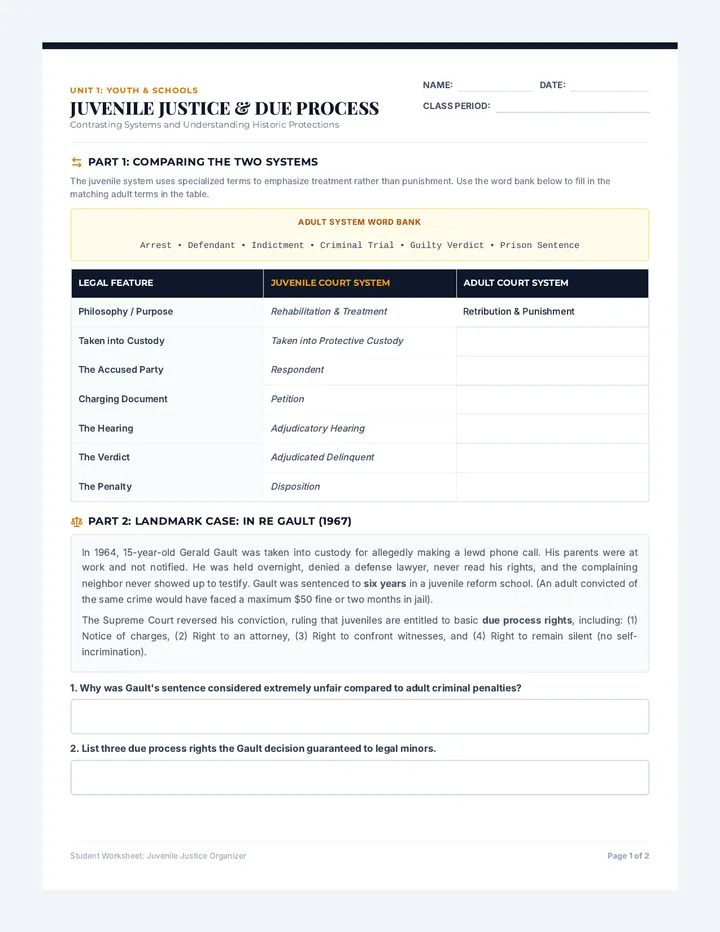
Disposition → Prison Sentence
Part 2: In re Gault Questions
Q1: Why was Gault's sentence considered extremely unfair compared to adult penalties?
Model Answer: For a minor crime (an obscene phone call) which would have cost an adult only a $50 fine or 2 months in jail, Gault was sentenced to 6 years in reform school. He faced disproportionate incarceration without standard legal protections.
Q2: List three due process rights the Gault decision guaranteed to legal minors.
Model Answer: (Students must list any three of the following four): (1) Right to receive notice of the charges against them, (2) Right to legal counsel, (3) Right to confront and cross-examine witnesses, and (4) Right against self-incrimination (to remain silent).
Part 3: Policy Debate Options (Joyride Dilemma)
Option A: Treat Leo as an Adult (Retributive Justice arguments)
Model Rationale: Adult court would charge Leo with Grand Theft Auto (felony) and Criminal Mischief. Prosecution would seek conviction, juvenile detention or youth probation, and mandate restitution of $4,000 to the victim. This prioritizes victim recovery, holds Leo strictly accountable, and deters others from theft.
Option B: Treat Leo as a Juvenile (Rehabilitative Justice arguments)
Model Rationale: Juvenile court handles Leo's case as a delinquency petition. The court prioritizes rehabilitation by mandating counseling, structural family therapy, and cognitive-behavioral classes. Leo may receive a deferred disposition, clean record options, and supervision to address the root causes of trauma and lack of parental supervision.
Teacher Guide: Juvenile Justice & Gault Page 2 of 2