Civics Kickoff Slides
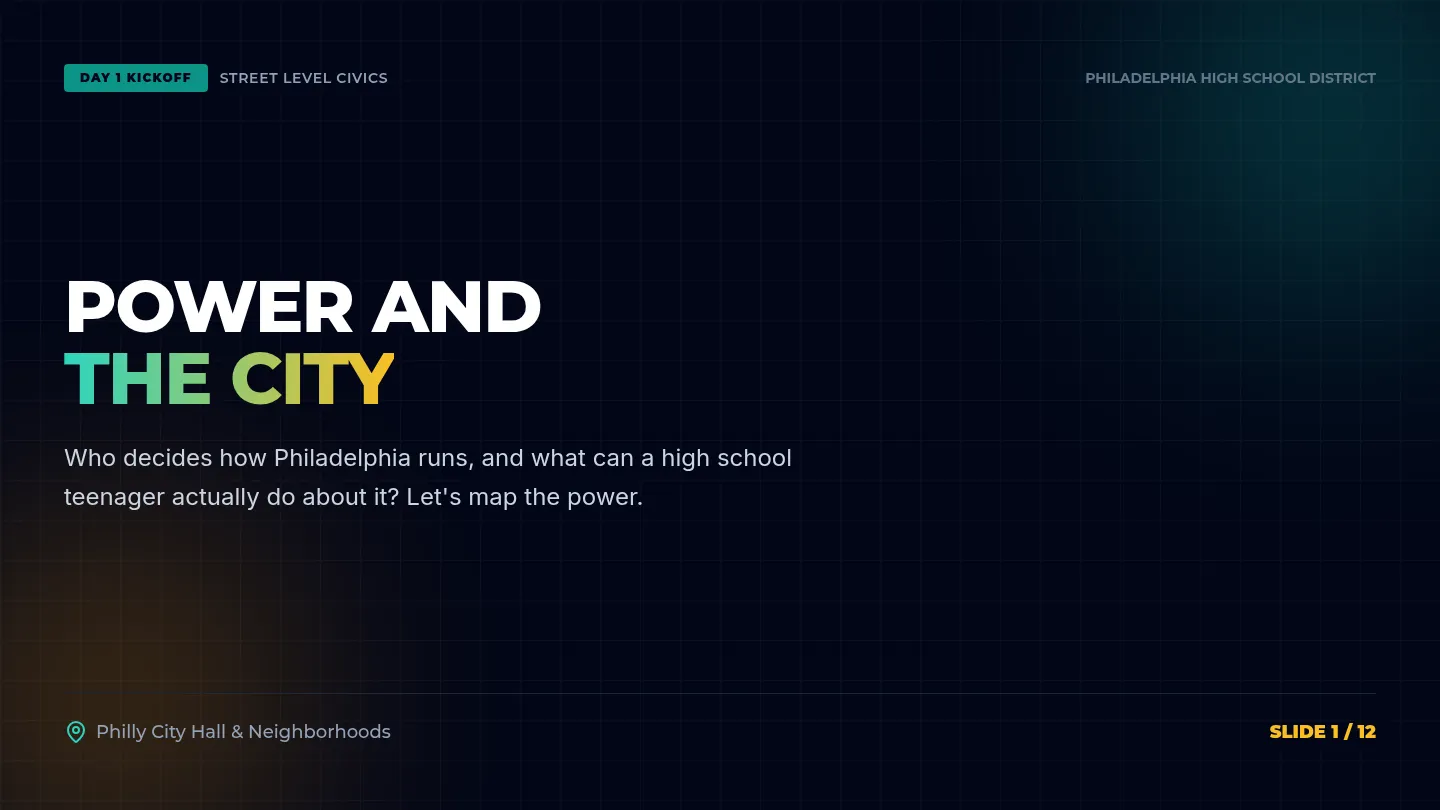
Day 1 Kickoff STREET LEVEL CIVICS
PHILADELPHIA HIGH SCHOOL DISTRICT
POWER AND
THE CITY
Who decides how Philadelphia runs, and what can a high school teenager actually do about it? Let's map the power.
Philly City Hall & Neighborhoods
SLIDE 1 / 12
Day 1 Kickoff STREET LEVEL CIVICS
Defining
Power
Civics isn't just about dusty history books. Civics is the study of power—how it's acquired, shared, challenged, and used.
Formal Authority
Power written into law. Mayors, City Council, and police chiefs have formal authority to write laws, collect taxes, and make rules.
System Power
People Power
Power through numbers and organizing. Boycotts, protests, neighborhood cleanups, and voting block groups can force leaders to act.
Community Power
Discussion: Where do you see these types of power in your neighborhood? SLIDE 2 / 12
Day 1 Kickoff STREET LEVEL CIVICS
LOCAL IMPACT AREAS
How Local Decisions Impact Philly Teenagers Every Day
SEPTA Student Keys
Who funds your school transit card? City budget negotiators and SEPTA board members decide who gets free rides.
Impact: Freedom of movement to schools and jobs.
School Policy
Why are there no AC units in old high schools, or why do start times shift? Philadelphia Board of Education makes these calls.
Impact: Classroom comfort, health, and sleep schedules.
Teen Curfews
Why does Center City have a 10 PM curfew during summer? City Council writes the legislation and the Police Department enforces it.
Impact: Civil liberties and youth-centric spaces.
Look at your Day 1 Worksheet! Complete the "Everyday Power" Reflection. SLIDE 3 / 12
Day 1 Kickoff STREET LEVEL CIVICS
CASE STUDY
The Transit Debate:
A Civic Case Study
In 2024, debates sparked over making transit free for students and low-income riders, or increasing security sweeps on trains.
Who holds the power here? The SEPTA Board? The Mayor? High school student riders organizing a petition?
CLASSROOM CHAT
How would you change Philadelphia's transit system?
Day 1 Action Plan: Get ready to share your findings tomorrow! SLIDE 4 / 12
Day 2 STREET LEVEL CIVICS
PHILADELPHIA GOVERNMENT
Inside Philly's Civic Machine
CITY HALL
HUSTLE
Who writes the laws, signs the checks, and actually represents YOUR district? Let's crack open Philadelphia's structural blueprint.
Structure & Roles of City Government
SLIDE 5 / 12
Day 2 STREET LEVEL CIVICS
THE BALANCE OF POWER
The Dual Pillars of Philadelphia Government
The Executive Branch
The Mayor
- Enforces city laws and manages daily operations.
- Appoints heads of departments (Police, Streets, Health).
- Proposes the annual city budget (how tax dollars are spent).
The Legislative Branch
City Council
- Drafts, debates, and passes local laws and codes.
- Approves or rejects the Mayor's budget proposal.
- Consists of 17 members: 10 Districts & 7 At-Large.
Think: If the Mayor wants to build a park, who holds the wallet? SLIDE 6 / 12
Day 2 STREET LEVEL CIVICS
COUNCIL BLUEPRINT
10 Districts + 7 At-Large
Philadelphia is divided geographically into 10 Council Districts. Every physical neighborhood has exactly one district councilmember.
The remaining 7 At-Large Councilmembers represent the entire city. That means every Philly citizen has 8 total representatives in City Council!
Do you know which District you live or go to school in? Check your Day 2 worksheet!
SCENARIO RUN
Who is Responsible?
Potholes & Street Lights
Usually handled by district councilmembers pushing city agencies (Streets Department) to fix neighborhood-specific issues.
Citywide Minimum Wage or Safety Laws
Debated and voted on by all 17 Councilmembers, then sent to the Mayor to be signed into municipal law.
Your Voice counts! District representatives are highly sensitive to neighborhood phone calls. SLIDE 7 / 12
Day 2 STREET LEVEL CIVICS
THE ROW OFFICES
The Row Offices: Government Beyond the Mayor
District Attorney
Philly's top prosecutor. Decides which crimes are charged and how the justice system operates locally.
Elected Independent
City Sheriff
Enforces court orders, runs foreclosure sales, and manages courthouse security and transport.
Elected Independent
City Controller
The independent financial auditor. Tracks every tax dollar to ensure no waste, fraud, or abuse.
Elected Auditor
City Commissioners
A three-member bipartisan board that registers voters, operates local voting booths, and certifies elections.
Elected Directors
Row offices hold massive power, yet voter turnout for them is extremely low. SLIDE 8 / 12
Day 3 STREET LEVEL CIVICS
CIVIC HEALTH
Organizing, Voting, and Advocating
STREET LEVEL
ACTION
You don't have to wait until you are 18 to make waves. Let's explore youth advocacy networks and measure your own civic baseline.
Avenues of Youth Civic Agency
SLIDE 9 / 12
Day 3 STREET LEVEL CIVICS
YOUTH LEADERSHIP
Unlocking Youth Power in Philadelphia
Youth Commission
An official 21-member advisory board appointed by the Mayor & City Council. Advises on parks, education, and jobs.
Ages 12-23 Eligible
Public Comment
Any Philadelphian can testify live at City Council hearings or School Board meetings. Student testimony holds massive emotional power.
No Minimum Age
Local Coalitions
Groups like Philly Student Union (PSU) and Youth United for Change (YUC) organize protests, advocate for resources, and train student leaders.
Student Led
Civic agency is built by practice, not just waiting for permission. SLIDE 10 / 12
Day 3 STREET LEVEL CIVICS
CIVIC PLAYBOOK
THE ACTION CYCLE
The Student Advocacy
Playbook
When something in your city is broken, follow this tactical civic process to pressure local decision-makers.
1
Define the Issue & Authority
Identify the specific problem (e.g., transit costs) and research who actually has the power to fix it.
2
Mobilize with Evidence
Collect peer survey data or stories. Build a petition or craft public testimony to show community impact.
3
Exert Strategic Pressure
Call representatives, attend public hearings, and tag local row offices in public, organized digital campaigns.
Your Diagnostic Quiz is up next! Use it to explore your own baseline civic ideas. SLIDE 11 / 12
Review STREET LEVEL CIVICS
KICKOFF WRAP UP
You Are a Philly Citizen
Philadelphia was the birthplace of American civic dialogue. Today, the conversation is yours to write in your streets, schools, and city halls. Let's tackle our diagnostic!
Workbook Check
Make sure Days 1 & 2 reflections are finalized for teacher review.
Civic Diagnostic
Ready your pencils for the baseline civic knowledge check!
Unit Kickoff Complete
SLIDE 12 / 12
Power Mapping Worksheet
Day 1 Student Handout
POWER & THE CITY
Street Level Civics: Philly District Kickoff
Unit 1: Local Agency First Week Kickoff
Name: ___________________________
Date: ___________________________
Class Block: __________________
Part 1: Defining Power
Power is the ability to influence or control people, rules, resources, or environments. In public life, it splits into Formal Authority (written into law) and People Power (strength in numbers and organizing).
Scenario A
SEPTA Transit Pass Expansion
Philly students rally outside School District Headquarters requesting transit pass extensions for summer jobs.
Primary Power Type: _______________________
Scenario B
Center City Teen Curfew Ordinance
City Council introduces, votes on, and passes a municipal code setting a 10:00 PM weekend curfew for minors.
Primary Power Type: _______________________
Part 2: Local Power Matrix
Let's map local issues that directly affect your life in Philly. Write the following four issues in the quadrant grid below based on how much Interest you have, and how much Power you think a teenager holds over them:
1. School AC & Cooling
2. SEPTA Key Funding
3. Neighborhood Curfews
4. Rec Center Hours
HIGH POWER LOW POWER
A. High Interest / Low Power
B. High Interest / High Power
C. Low Interest / Low Power
D. Low Interest / High Power
Part 3: Written Advocacy Reflection
Choose one of the issues above that falls in your "High Interest" quadrants. Answer the following questions using complete sentences. Provide specific local details.
1. Why is this issue personal or important to your daily routine in Philadelphia?
2. How might a group of motivated high school students use "People Power" to influence this issue?
Unit 1: Street Level Civics • Day 1 Activity Page 1 of 1
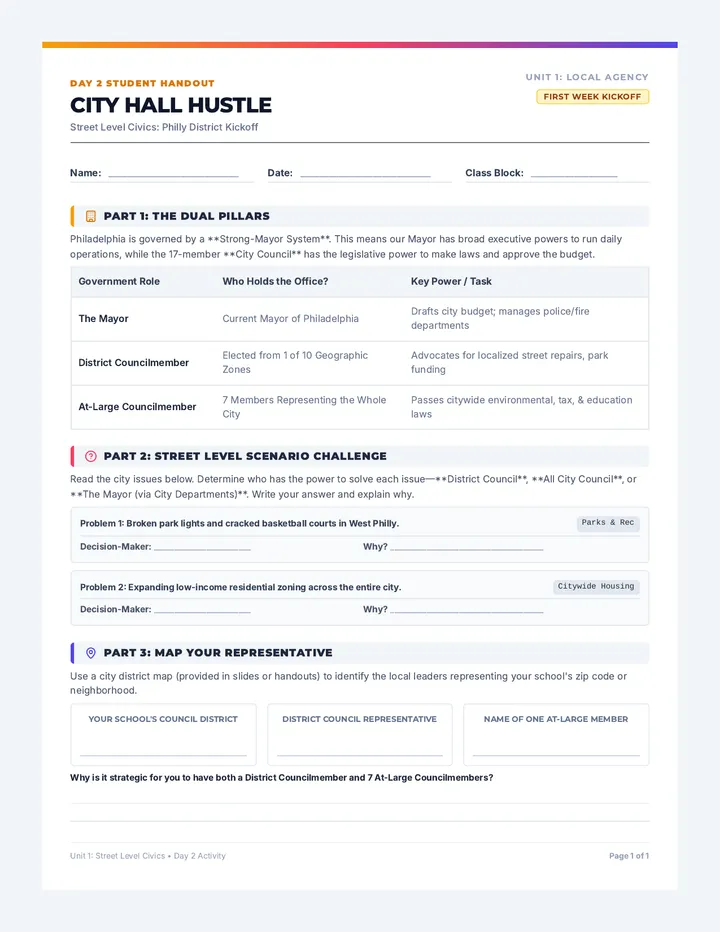
City Hall Worksheet
Day 2 Student Handout
CITY HALL HUSTLE
Street Level Civics: Philly District Kickoff
Unit 1: Local Agency First Week Kickoff
Name: ___________________________
Date: ___________________________
Class Block: __________________
Part 1: The Dual Pillars
Philadelphia is governed by a **Strong-Mayor System**. This means our Mayor has broad executive powers to run daily operations, while the 17-member **City Council** has the legislative power to make laws and approve the budget.
| Government Role | Who Holds the Office? | Key Power / Task |
|---|
| The Mayor | Current Mayor of Philadelphia | Drafts city budget; manages police/fire departments |
| District Councilmember | Elected from 1 of 10 Geographic Zones | Advocates for localized street repairs, park funding |
| At-Large Councilmember | 7 Members Representing the Whole City | Passes citywide environmental, tax, & education laws |
Part 2: Street Level Scenario Challenge
Read the city issues below. Determine who has the power to solve each issue—**District Council**, **All City Council**, or **The Mayor (via City Departments)**. Write your answer and explain why.
Problem 1: Broken park lights and cracked basketball courts in West Philly. Parks & Rec
Decision-Maker: ________________________
Why? ______________________________________
Problem 2: Expanding low-income residential zoning across the entire city. Citywide Housing
Decision-Maker: ________________________
Why? ______________________________________
Part 3: Map Your Representative
Use a city district map (provided in slides or handouts) to identify the local leaders representing your school's zip code or neighborhood.
Your School's Council District
District Council Representative
Name of One At-Large Member
Why is it strategic for you to have both a District Councilmember and 7 At-Large Councilmembers?
Unit 1: Street Level Civics • Day 2 Activity Page 1 of 1
Civics Diagnostic Quiz
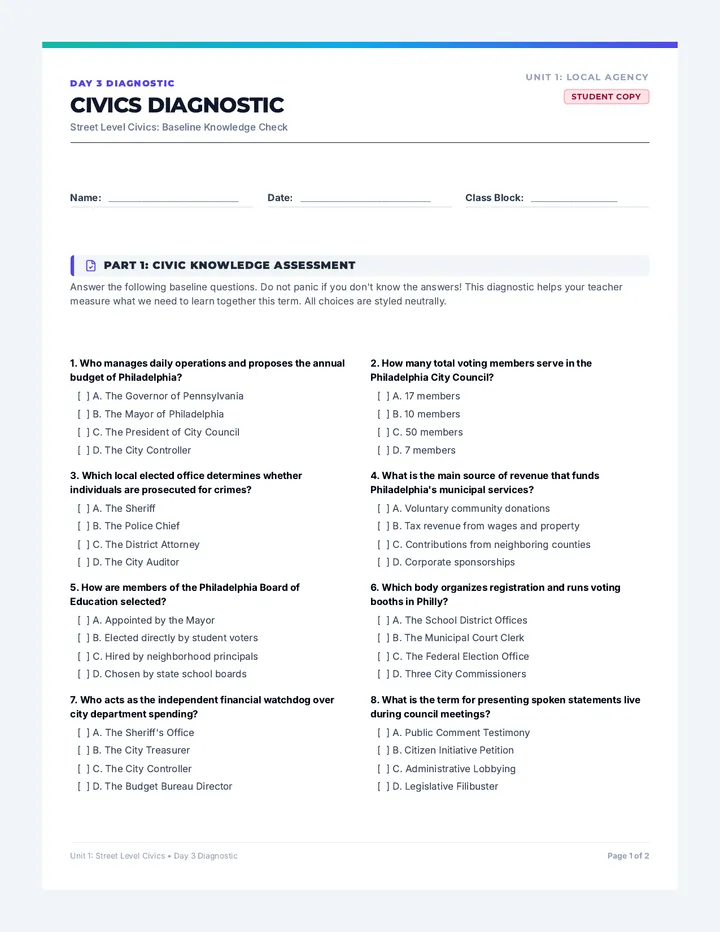
Day 3 Diagnostic
CIVICS DIAGNOSTIC
Street Level Civics: Baseline Knowledge Check
Unit 1: Local Agency Student Copy
Name: ___________________________
Date: ___________________________
Class Block: __________________
Part 1: Civic Knowledge Assessment
Answer the following baseline questions. Do not panic if you don't know the answers! This diagnostic helps your teacher measure what we need to learn together this term. All choices are styled neutrally.
1. Who manages daily operations and proposes the annual budget of Philadelphia?
[ ] A. The Governor of Pennsylvania
[ ] B. The Mayor of Philadelphia
[ ] C. The President of City Council
[ ] D. The City Controller
2. How many total voting members serve in the Philadelphia City Council?
[ ] A. 17 members
[ ] B. 10 members
[ ] C. 50 members
[ ] D. 7 members
3. Which local elected office determines whether individuals are prosecuted for crimes?
[ ] A. The Sheriff
[ ] B. The Police Chief
[ ] C. The District Attorney
[ ] D. The City Auditor
4. What is the main source of revenue that funds Philadelphia's municipal services?
[ ] A. Voluntary community donations
[ ] B. Tax revenue from wages and property
[ ] C. Contributions from neighboring counties
[ ] D. Corporate sponsorships
5. How are members of the Philadelphia Board of Education selected?
[ ] A. Appointed by the Mayor
[ ] B. Elected directly by student voters
[ ] C. Hired by neighborhood principals
[ ] D. Chosen by state school boards
6. Which body organizes registration and runs voting booths in Philly?
[ ] A. The School District Offices
[ ] B. The Municipal Court Clerk
[ ] C. The Federal Election Office
[ ] D. Three City Commissioners
7. Who acts as the independent financial watchdog over city department spending?
[ ] A. The Sheriff's Office
[ ] B. The City Treasurer
[ ] C. The City Controller
[ ] D. The Budget Bureau Director
8. What is the term for presenting spoken statements live during council meetings?
[ ] A. Public Comment Testimony
[ ] B. Citizen Initiative Petition
[ ] C. Administrative Lobbying
[ ] D. Legislative Filibuster