Road to Revolution Master Guide 10th Grade CP American Studies
ROAD TO REVOLUTION
MASTER UNIT ROADMAP
Backward Design Framework
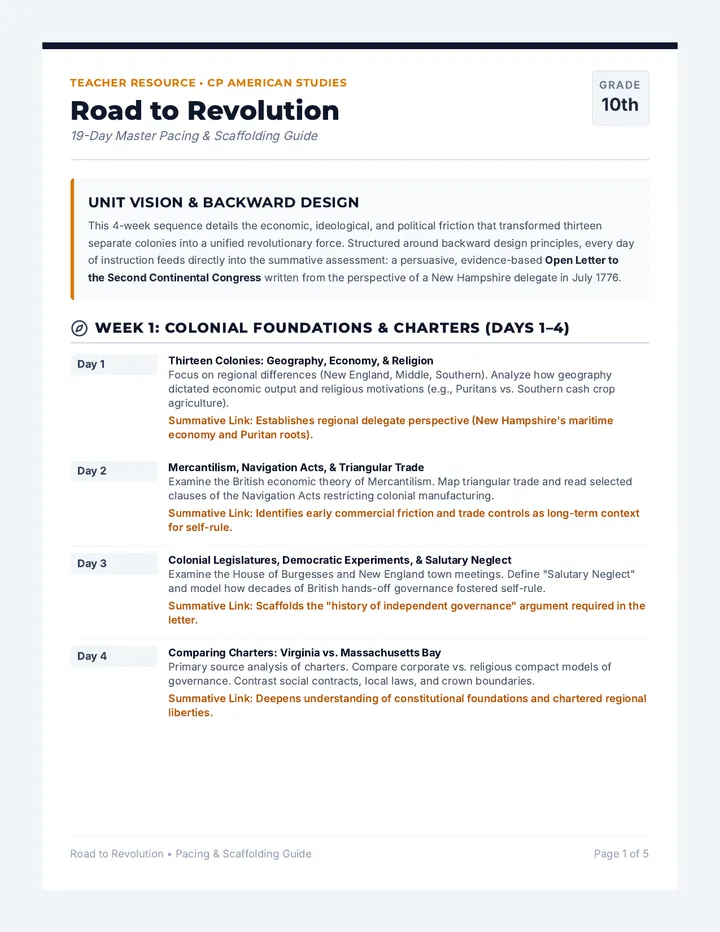
This unit is built around the summative Open Letter to the Second Continental Congress . Every lesson functions as a cognitive laboratory where students analyze raw evidence, unpack constitutional philosophies, and practice writing argumentative components.
Immersive Twist: Each daily lesson features a 15-minute quick-immersion experience where students step into historical perspectives, bridging historical empathy with analytical writing.
Unit Competency Mapping
Lesson Theme Immersive Experience Summative Scaffold Assessment Target 1. Seven Years' War Borderlands Negotiation Intro Context (SS 1.1) French/Native alliances as pre-tension baseline. 2. Consequences Town Council Protest Abuses Narrative (SS 1.1) Deconstruct debt, boundary line, and standing armies. 3. Stamp Act Boycott Coalition Choice Arguable Thesis (ELA 3.1) Formulate a concession-led "Although" thesis statement. 4. Sons of Liberty Correspondence Network Evidence Paragraph (ELA 3.2) Synthesize extra-legal governance and street tactics. 5. Boston Massacre Courtroom Inquest Trial Refuting Bias (ELA 3.2) Deconstruct Paul Revere's print vs. Captain Preston.
The Cognitive Cycle: From Action to Writing
1. Hook & Source Read a primary document to identify perspectives and tensions.
2. Quick Immersion Step into characters to debate, draft, or negotiate live.
3. Debrief & Scaffold Reflect on experiences to build structural letter claims.
4. Exit Ticket Synthesize learning into a modular, physical piece of the summative letter.
10th Grade CP American Studies • Road to Revolution Unit Master Overview Guide
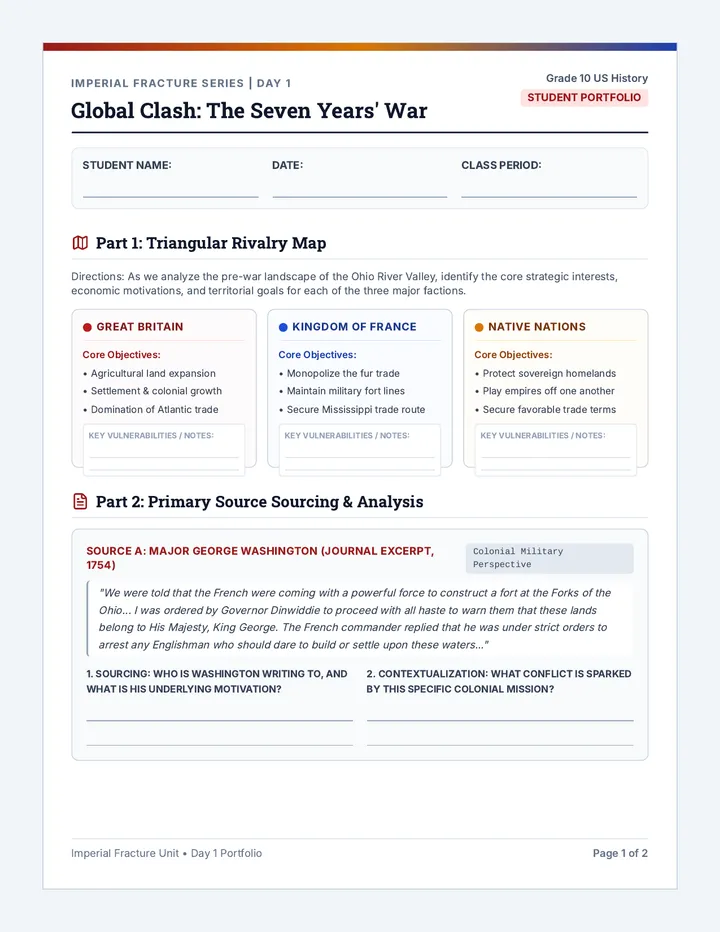
Global Collision Handout Unit: Road to Revolution • Lesson 1
The Seven Years' War & Imperial Alliances
Name: ___________________________
Role: New Hampshire Delegate
The Delegate's Perspective (SS 1.1 - Context): As a respected NH leader, you must trace the roots of this colonial crisis back to the frontier war of your youth. Understand how British military victory transformed Native alliances and established the physical, pre-war baseline for independent rule.
Document A: Minavavana, Chief of the Ojibwe (1761)
"Englishman, although you have conquered the French, you have not yet conquered us! We are not your slaves. These lakes, these woods and mountains, were left us by our ancestors. They are our inheritance; and we will not part with them to any one... Englishman, our father, the King of France, employed our young men to make war upon your nation. In this warfare many of them have been killed; and it is our custom to retaliate, until such time as the spirits of the slain are satisfied."
— Chief Minavavana, addressing British trader Alexander Henry at Michilimackinac, 1761
1. PERSPECTIVE ANALYSIS: Based on Document A, how did Chief Minavavana view the British victory over the French? What does this suggest about future native-imperial relations?
2. THE GEOGRAPHIC SHIFT: The Treaty of Paris (1763) removed France from North America. How did this removal of a competing empire affect the strategic bargaining power of Native nations?
NH Delegate's Journal: The Roots of Discord (Day 1 Exit Ticket)
Step into your persona as the delegate from New Hampshire. Record your journal entry on how the elimination of French power and ongoing Native sovereignty struggles are beginning to rattle the peace. How does this setting prepare our people for self-reliance? (Draft 3-4 sentences to scaffold your letter's background introduction).
Road to Revolution • Lesson 1 Handout & Exit Ticket Student Copy
Global Collision Teacher Guide Lesson 1: Teacher Lesson Plan
The Seven Years' War & Imperial Alliances
DAY 1 PLAN
Essential Question: How did shifting boundaries and alliances after the French defeat transform colonial-crown relations?
Target Standards: SS 1.1: Evaluate historical context.
Materials & Prep Checklist
Printout of Global Collision Handout (Student Copy) for each student.
Prepare negotiation prompt cards (distribute 1 French, 1 British, 1 Native per student triad).
Ensure Road to Revolution Exit Tickets Packet is printed and distributed.
1. Hook & Primary Source Reading (12 mins)
Distribute Handouts. Instruct students to read Document A (Chief Minavavana) . Ask: "How does the Chief establish that a treaty between the French and the British does not mean Native submission?" Have students highlight keywords asserting sovereignty ("inheritance", "not conquered"). Guide students to complete Question 1.
2. Immersive Experience: "Borderlands Negotiation" (18 mins)
Setup: Divide students into triads (French, British, Native). Action: Tell them the year is 1761. France is losing, and British troops are pushing into old French outposts. The Native negotiator must protect tribal land; the Frenchman must secure fur trade safe-passage; the Briton must assert sovereign control of the fort. Goal: Groups have 8 minutes to draft a signed verbal compromise. Watch for the emergence of physical threats versus structural negotiation.
3. Class Debrief & Analysis (10 mins)
Call on two triads to share their compromise. Discuss: "Why was it so difficult for the British and Native negotiators to trust one another?" Connect this directly to the geographic shifts (French removal from the continent). Complete Question 2 on the handout.
4. Summative Writing Scaffold & Exit Ticket (10 mins)
Direct students to the Day 1 Exit Ticket . Students use the class discussion to draft their 3-4 sentence historical context paragraph showing how the removal of the French set up colonial expansion and eventual crown-colonial clash.
Road to Revolution • Lesson 1: Seven Years' War Teacher Resource Guide
The Price of Peace Handout Unit: Road to Revolution • Lesson 2
The Imperial Backlash: Debt, Boundaries, and Armies
Name: ___________________________
Role: New Hampshire Delegate
The Delegate's Perspective (SS 1.1 - Circumstances): As a NH representative, you see imperial policy hardening. Watch how British domestic debt turns into colonial enclosure (Proclamation line) and military intrusion (Quartering). These direct "abuses" are preparing your mind for revolt.
The Debt Crisis
By 1763, the British national debt had skyrocketed from £72 million to £129 million. British taxpayers were heavily burdened, leading Parliament to look across the Atlantic to have colonies pay for their own regional defense.
The Boundary Wall
To prevent costly Indian wars, George III issued the Proclamation of 1763, prohibiting colonial settlement west of the Appalachian Mountains, directly threatening land grants promised to war veterans.
Document B: Washington's Outlook on the Boundary (1767)
"I can look upon this Proclamation in no other light than as a temporary expedient to quiet the minds of the Indians... and any person who neglects the present opportunity of hunting out good lands, and in some measure marking them for his own, in order to keep them from others, will never regain it."
— George Washington, letter to William Crawford, September 21, 1767
1. COGNITIVE DISSONANCE: Compare the British goal for the Proclamation Line (preventing conflict) with George Washington's colonial reaction in Document B. What does this reveal about emerging divides?
2. STANDING ARMIES: In 1765, Parliament passed the Quartering Act to feed and house 10,000 British soldiers. Why did the physical presence of a peacetime military alarm colonists who considered themselves "free English subjects"?
NH Delegate's Journal: Enclosure and Armed Occupation (Day 2 Exit Ticket)
As a NH Delegate witnessing these events, write a journal entry detailing these direct "abuses by the crown." Connect the crippling national debt to the physical intrusion of royal troops and Western limits. (This drafts the "crown abuses" context section of your letter).
Road to Revolution • Lesson 2 Handout & Exit Ticket Student Copy
The Price of Peace Teacher Guide Lesson 2: Teacher Lesson Plan
The Price of Peace: Debt, Boundaries, & Armies
DAY 2 PLAN
Essential Question: How did Britain's post-war structural demands clash with colonial assumptions of geographic and physical liberty?
Target Standards: SS 1.1: Evaluate historical setting & circumstances.
Materials & Prep Checklist
Printout of The Price of Peace Handout (Student Copy) .
Prepare a copy of the Quartering Act of 1765 clause sheet (optional reference).
Prepare the classroom space with a "tavern table" at the front for the simulation.
1. Spatial Hook: The Proclamation Boundary (10 mins)
Show map of 1763 Appalachian boundary line. Guide students to analyze George Washington's 1767 letter (Document B). Ask: "How does Washington's characterization of the line as a 'temporary expedient' show a developing disregard for royal authority?" Fill in Question 1 on the Handout.
2. Immersive Experience: "The Quartering Town Council" (18 mins)
Setup: Designate 1 student as the British Quartermaster and 2 students as Boston tavern/innkeepers. The rest of the class are members of the local Town Council. Action: The Quartermaster demands lodging, food, and 5 gallons of small beer for a regiment of standing British troops, citing the Quartering Act of 1765. The tavern owners must defend their property. The Council must deliberate on whether they have a legal right under English common law to refuse. Debrief: Ask the class: "Why would a standing peacetime army feel like an occupation rather than protection?"
3. Graphic Organizer Analysis: Debt & Taxes (12 mins)
Explain the massive British national debt (£129M). Connect this physical financial pressure directly to the British decision to transition from "salutary neglect" to "direct intervention." Guide students through Question 2 on the Handout.
4. Summative Writing Connection & Exit Ticket (10 mins)
Direct students to the Day 2 Exit Ticket . Students synthesize how British debt, the Proclamation Line, and standing peacetime forces created the primary grievances (the middle section) of their future Second Continental Congress letter.
Road to Revolution • Lesson 2: Consequences of War Teacher Resource Guide
Taxation and Representation Handout Unit: Road to Revolution • Lesson 3
The Stamp Act: Consent vs. Virtual Representation
Name: ___________________________
Role: New Hampshire Delegate
The Delegate's Perspective (ELA 3.1 - Claims): The crisis is at our doorsteps. Parliament has levied the first direct internal tax. As a NH delegate, you must compare British constitutional theories with our local demand for actual representation, drafting your core claim.
A The British Defense: Virtual Representation
"The inhabitants of the colonies... are represented in Parliament, in the same manner as those of the inhabitants of Great Britain are... [None] of the people of America have a vote in electing members of Parliament. But are they not all British subjects? And are they not all, as such, virtually represented?"
— Thomas Whately, Treasury Secretary under Grenville, 1765
B The Colonial Protest: Actual Consent
"Resolved, That the taxation of the people by themselves, or by persons chosen by themselves to represent them... is the only security against a burdensome taxation... and the distinguishing characteristic of British freedom, without which the ancient constitution cannot exist."
— Patrick Henry, Virginia House of Burgesses, May 1765
1. REASONING COMPARISON: How does Whately justify taxing colonists who have never voted for a Member of Parliament? How does Henry's concept of representation directly refute this?
2. THE NATURE OF THE TAX: Unlike previous customs duties (external tariffs on trade), the Stamp Act was an "internal" tax on everyday domestic items. Why did this shift spark unprecedented, organized colonial unity?
NH Delegate's Journal: The Line in the Sand (Day 3 Exit Ticket)
Our businesses grind to a halt under this stamp paper. Write your thesis statement as a journal entry, using the Although..., because..., therefore... formula. Explain why virtual representation is a constitutional farce and why actual consent is non-negotiable. (This drafts your final letter's core thesis claim).
Road to Revolution • Lesson 3 Handout & Exit Ticket Student Copy
Taxation and Representation Teacher Guide Lesson 3: Teacher Lesson Plan
The Stamp Act & Tax Representation
DAY 3 PLAN
Essential Question: What is the difference between Virtual and Actual representation, and why did this constitutional argument matter?
Target Standards: ELA 3.1: Write arguable claims/theses.
Materials & Prep Checklist
Printout of Taxation and Representation Handout (Student Copy) .
Prepare mock stamp tokens or a red wax seal (optional, for the immersive hook).
Write the "Although..., because..." thesis template on the dry erase board.
1. Dual Source Deep-Dive (15 mins)
Direct students to Document C (Whately) and Document D (Henry). Instruct students to read silently, highlighting key phrases. Lead an analytical comparison. Ask: "How does Whately argue that representation is a state of membership rather than a vote? How does Patrick Henry connect direct taxes to constitutional suicide?" Students complete Question 1.
2. Immersive Experience: "The Stamp Office Boycott" (15 mins)
Setup: Select 1 student to act as the royal stamp distributor. Pass out "blank colonial land contracts". Action: Announce that no student document (handout, notebook) is legally valid unless it receives a physical ink stamp or red seal from the distributor. The distributor charges 1 "participation credit" or a mock currency coin per stamp. Conflict: Introduce a Sons of Liberty boycott group. They must convince the class to refuse to pay the tax. Any student who pays is branded a "traitor to liberties". Watch the group dynamic unfold.
3. Philosophical Debrief (10 mins)
Stop the simulation. Ask: "Why did the peer pressure of the boycott work? How does this demonstrate Patrick Henry's argument that actual consent is the only true defense of property?" Lead students to complete Question 2 on the Handout.
4. Thesis Statement Writing Lab & Exit Ticket (10 mins)
Guide students to the Thesis Writing Zone on their handout. Work through the "Although [concession], because [reasons], [claim]" model. Have them write their drafted thesis on the Day 3 Exit Ticket .
Road to Revolution • Lesson 3: Stamp Act Rebellions Teacher Resource Guide
Patriot Mobilization Handout Unit: Road to Revolution • Lesson 4
The Sons of Liberty & Networked Resistance
Name: ___________________________
Role: New Hampshire Delegate
The Delegate's Perspective (SS 2.1 - Civic Institutions): Unity is forming. Extra-legal committees of correspondence and street organizers are forging a real alternative government. As a NH leader, analyze how these networks operate to prove we are fully capable of independent rule.
Document E: New York Sons of Liberty Association (1773)
"That we will not receive or take, nor knowingly purchase or buy, any tea... as it has been taxed by Parliament without our consent... And that we will declare and look upon any person who shall aid, abet, or assist in the landing or selling of said tea, as a betrayer of the liberties of his country, and will hold no manner of commerce or connection with him."
— Resolutions of the New York Sons of Liberty, November 29, 1773
Sons of Liberty Tactical Matrix
1. Economic Boycott
Signing non-importation agreements, enforcing tea bans, and shunning merchants who trade with Britain.
2. Committees of Correspondence
Establishing shadow letters and networks to coordinate protests and build inter-colonial consensus.
3. Direct Street Action
Erecting liberty poles, protesting under the Liberty Tree, burning effigies, and targeting collectors directly.
1. COERCION AND CONSENSUS: Look closely at Document E. How did the Sons of Liberty handle fellow colonists who did not support their boycotts? What does this imply about peer-to-peer political pressure?
2. INSTITUTION BUILDING: Why are Committees of Correspondence considered the "first shadow government" of America? How did they break down regional separation between 13 colonies?
NH Delegate's Journal: Shadow Government in Action (Day 4 Exit Ticket)
Our networks are hum-active. We coordinate boycotts from Portsmouth down to the Carolinas. Record your journal entry proving that we are no longer disparate crown subjects, but an organized, self-governing political force. (This drafts the "capable of self-rule" section of your final letter).
Road to Revolution • Lesson 4 Handout & Exit Ticket Student Copy
Patriot Mobilization Teacher Guide Lesson 4: Teacher Lesson Plan
Sons of Liberty & Networks
DAY 4 PLAN
Essential Question: How did extra-legal organizations build a unified political and physical infrastructure capable of independent self-rule?
Target Standards: SS 2.1: Explain the role of citizens and interest groups in shaping society.
Materials & Prep Checklist
Printout of Patriot Mobilization Handout (Student Copy) .
Prepare three "Crisis Index Cards" (labeled Boston, Philadelphia, New York).
Ensure Road to Revolution Exit Tickets Packet is accessible.
1. Analyzing the Association Broadside (12 mins)
Guide students to look at Document E (New York Association) . Highlight how the Sons of Liberty threatened social and economic ostracization ("hold no manner of commerce"). Ask: "How does this document prove that colonial resistance was not just a series of random riots, but a highly disciplined economic cartel?" Complete Question 1.
2. Immersive Experience: "Correspondence Network" (20 mins)
Setup: Divide the classroom into three regions: Boston, New York, Philadelphia. Hand each town a specific crisis card. (e.g., Boston: "The Tea Ship Dartmouth has arrived; the Governor refuses to let it return to England!"). Action: Towns must draft a 3-sentence secret circular letter outlining their proposed physical response. They must physically dispatch a student "courier" to walk the message to the other two towns, gather feedback, and return with a unified continental strategy. Debrief: Ask: "How did this simulation model the creation of a shadow postal service and early interstate union?" Complete Question 2 on the Handout.
3. Tactical Matrix Synthesis (8 mins)
Guide students through the Tactical Matrix on the student handout. Analyze the spectrum of Patriot action: from economic boycotts (non-importation) to physical street intimidation (liberty trees) to political coordination (committees).
4. Writing Practice & Exit Ticket (10 mins)
Direct students to complete the Day 4 Exit Ticket . Students write a structured evidence paragraph demonstrating that the colonies had already established functioning networks of self-rule before 1776, directly satisfying the SS 2.1 competency.
Road to Revolution • Lesson 4: Sons of Liberty Teacher Resource Guide
Massacre on King Street Handout Unit: Road to Revolution • Lesson 5
The Boston Massacre: Sourcing Perspectives
Name: ___________________________
Role: New Hampshire Delegate
The Delegate's Perspective (ELA 3.2 - Refute Counterclaims): Blood has been spilled on King Street. The ultimate abuse is now committed by a standing peacetime army. As a NH delegate, you must dissect conflicting testimonies, detect bias, and write your rebuttal.
Source A: Revere's Engraving (1770)
"The print depicts a neat line of British Redcoats organized under an officer, firing a simultaneous musket volley directly into an unarmed, peaceful crowd of Boston citizens under a dark night sky. The Custom House is labeled 'Butcher's Hall'."
— Patriot broadside, distributed throughout the thirteen colonies
Source B: Captain Preston (1770)
"The mob still increased and were more outrageous... striking their clubs or bludgeons one against another, and calling out, 'Come on you rascals, bloody backs, lobster scoundrels, fire if you dare'... At this time I was between the soldiers and the mob... trying to persuade them to depart peaceably."
— Deposition of Captain Thomas Preston, London, 1770
Sourcing & Bias Lab (HIPP)
HIPP Dimension Student Sourcing Analysis (Fill in) Historical Context Intended Audience Purpose / Point of View
NH Delegate's Journal: Blood on King Street (Day 5 Exit Ticket)
Draft a high-tension journal entry refuting the British claim that our people were a lawless mob. Source the bias of Revere or Preston to support your rebuttal, defending our right to revolt. (This drafts the critical "rebutting counterclaims" section of your final Congress letter).
Road to Revolution • Lesson 5 Handout & Exit Ticket Student Copy
Massacre on King Street Teacher Guide Lesson 5: Teacher Lesson Plan
The Boston Massacre Court Sourcing Lab
DAY 5 PLAN
Essential Question: How do historians analyze bias and perspective to reconstruct truth and refute biased historical narratives?
Target Standards: SS 1.1: Analyze connections among events in historical contexts.
Materials & Prep Checklist
Printout of Massacre on King Street Handout (Student Copy) .
Prepare courtroom placards for Preston, Montgomery, and Town witnesses.
Ensure Road to Revolution Exit Tickets Packet is collected at class end.
1. Visual vs. Textual Contrast Hook (10 mins)
Show Revere's engraving (represented on student handout, Source A) and read Preston's court deposition (Source B). Ask: "How do the physical positions of the soldiers differ between these two accounts? Who has the higher level of coordination?" Highlight the propaganda value of Revere's print.
2. Immersive Experience: "King Street Court Inquest" (20 mins)
Setup: Appoint 1 student as Captain Preston, 1 as Private Montgomery (who fired), 2 as Boston town witnesses (hostile to troops), and 1 as John Adams (the defense lawyer). Rest of the class acts as the Grand Jury. Action: John Adams asks Captain Preston if he ordered "fire" or if the crowd shouted it to confuse them. The witnesses claim they heard a clear order from the officer. The Jury must look for contradictions, cross-referencing with the HIPP analysis of Preston's deposition. Debrief: Ask: "What makes Preston's testimony persuasive? What makes Revere's print persuasive? How does bias distort historical truth?"
3. HIPP Sourcing Lab (10 mins)
Walk students through the HIPP table on their handout. Prompt them to fill in the exact Historical Context, Audience, and Purpose of Preston's deposition to understand why his point of view was defensive (written to the British government to avoid hanging).
4. Counterclaim Refutation & Exit Ticket (10 mins)
Direct students to complete the Day 5 Exit Ticket . Students write a targeted refutation of the British/Loyalist narrative that the colonists were a lawless mob. Collect all exit tickets to form their complete drafted open letter portfolio.
Road to Revolution • Lesson 5: Boston Massacre Teacher Resource Guide