A population pyramid shows both past historical shocks and future demographic destiny.
Pattern Recognition
Shape 1: Triangle
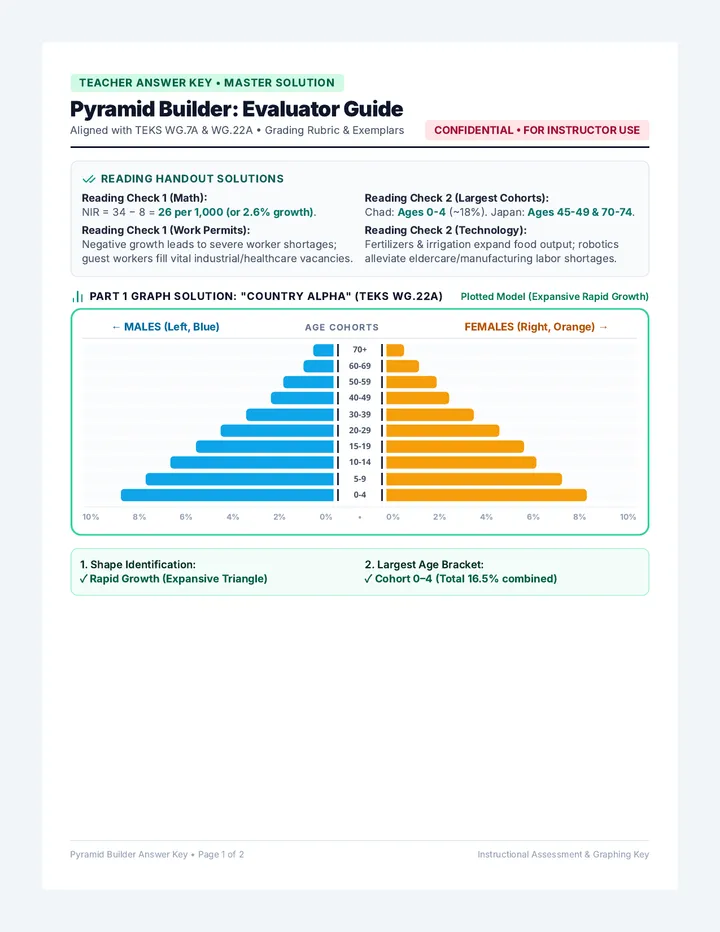
Wide base, rapidly tapering top. Very high birth rates; lower life expectancy.
Examples:
Chad, Nigeria, Afghanistan
Shape 2: Beehive
Straight, column-like sides. Birth rate equals death rate; stable population.
Examples:
United States, France
Shape 3: Cup / Inverted
Narrow base, bulging middle and top. Low birth rates; expanding elderly population.
Examples:
Japan, Germany, Italy
Rule of thumb: Wide Base = Young Society | Narrow Base = Graying Society
Expansive / Rapid
Population: ~15.9 Million
Question for thought: Can technology and agricultural innovation help Chad keep pace?
Constrictive / Negative
Population: ~126.8 Million
Notice: Japan’s death rate exceeds its birth rate — natural growth is negative (-0.2% to -0.3%).
TEKS WG.22A Hands-On Protocol
Step 1
Find center 0% mark. Males extend LEFT; females extend RIGHT.
Step 2
Begin with youngest cohort (0-4) at bottom row. Draw horizontal bars outwards to exact percentage.
Step 3
Move systematically up row by row (5-9, 10-14 ... up to 80+). Ensure bars align precisely.
Step 4
Step back. Identify overall silhouette: Expansive (Rapid), Stationary (Zero), or Constrictive (Negative).
Worksheet Ready: Open your Pyramid Builder Worksheet • Have blue & orange pencils ready!
Pair Discussion (3 Minutes)
The government needs to build 400 new elementary schools in the next five years. Which pyramid shape is this?
The minister of finance issues work visas to recruit 200,000 foreign nurses. Which pyramid shape is this?
The school-age population and retired population remain perfectly balanced year after year. Which shape is this?
Turn to your elbow partner: Share your reasoning for all 3 scenarios before we check.
Exit Ticket Preparation
Imagine you are the Chief Economic Advisor to a nation whose population pyramid base has shrunk by 30% over the last twenty years.
Your Task on Worksheet Part 3:
1. Diagnose their population growth pattern.
2. Predict two major economic challenges they will encounter in 2040.
3. Propose one concrete government policy to solve these challenges.
People Patterns Instructional Deck • End of Slide Session Complete and hand in your worksheet today!
Sub-Saharan Africa • Pop: 15.9 Million
Expansive
In Chad, the base is exceptionally wide. The largest age group is infants and young children (ages 0-4), making up nearly 18% of the country. Over 47% of all citizens are children under age 15. Because children cannot yet work in agriculture or industries, this creates high youth dependency.
Shape: Wide Base Triangle (Rapid Growth)
Key Needs: Infant healthcare, childhood vaccines, clean water wells, building primary schools.
East Asia • Pop: 126.8 Million
Constrictive
In Japan, the base is very narrow. The largest age groups are middle-aged adults (ages 45-49) and older seniors (ages 70-74). Children under age 5 make up under 4% of the country. Japan faces negative population growth, meaning more people pass away each year than babies are born.
Shape: Inverted Cup / Honeycomb (Shrinking)
Key Needs: Eldercare nursing homes, automated manufacturing, pension funding, foreign guest workers.
While some experts worry about rapid population growth exhausting natural resources, others are optimistic. As populations expand, human ingenuity and scientific research also increase. For example, modern chemical fertilizers boost crop yields, and advanced irrigation systems turn dry land into fertile farms to feed more people. Meanwhile, nations with shrinking workforces are pioneering robotics and AI to care for seniors.
1. According to the text, which specific age cohort is the largest in Chad? Which is largest in Japan?
2. Explain one way technological innovation helps a society overcome demographic challenges.
Demography Basics Reading Handout • Page 2 of 2 World Geography • Simplified Learning Resource
| Which age group is largest? |
| | Workforce & Dependency | Is dependency youth-heavy or elderly-heavy?
| Is dependency youth-heavy or elderly-heavy?
| | Public Spending Priorities | Identify 2 critical infrastructure or service needs:
| Identify 2 critical infrastructure or service needs:
| | Future Economic Threat | What happens if resources don't keep up?
| What happens if the labor pool continues shrinking?
|
Individual Assessment
Prompt: Suppose you are the lead economic planner for a nation facing a negative population growth rate (-0.3%) and an inverted pyramid shape.
A. Describe two serious economic consequences this society will experience over the next two decades:
B. Propose one concrete government policy or technological solution (e.g., labor recruitment, retirement adjustments, or automation) to help stabilize this nation’s economy:
Pyramid Builder Worksheet • Page 2 of 2 World Geography • TEKS WG.7A Societal Analysis
| 2. Pension solvency & automated transit. |
| Future Economic Threat | Famine, food insecurity, unemployment, and severe strain on water/housing infrastructure. | Severe labor shortages, factory closures, slowing GDP, tax deficits to pay retiree healthcare. |
Exemplar Student Response:
A. Economic Consequences: (1) The nation will experience a critical shortage of workers across factories, hospitals, and services, driving up production costs and slowing economic growth. (2) Tax revenues from the shrinking workforce will be insufficient to fund rising pensions and healthcare costs for the expanding elderly population.
B. Policy Solution: The government can expand immigration work permits for international healthcare and industrial workers, invest in robotic automation to assist in manufacturing and nursing homes, and raise the retirement age gradually from 65 to 68.
| Score | Criteria | Description |
|---|---|---|
| 4 pts | Advanced Mastery | Accurately graphs Alpha; cites 2 specific economic threats (worker shortage, pension strain); provides a realistic, actionable policy (immigration, automation). |
| 3 pts | Proficient | Minor plotting error (within 0.5%); identifies 2 threats and a general policy with adequate geographic reasoning. |
| 2 pts | Developing | Graph lacks male/female labels or shows incorrect pyramid taper; mentions only 1 vague economic consequence. |
| 1 pt | Emerging / Incomplete | Incomplete graph or fundamental misconception (e.g. confusing rapid growth with aging population). |
Pyramid Builder Answer Key • Page 2 of 2 World Geography • TEKS WG.7A & WG.22A Scoring Standards