PEGS Illustrated Wall Posters Social Studies Toolbox
THE PEGS FRAMEWORK
Four powerful lenses to unlock history, analyze civilizations, and understand our world.
P
POLITICAL
Governments, laws, leadership, rights, and power dynamics.
E
ECONOMIC
Money, resources, trade, jobs, and scarcity.
G
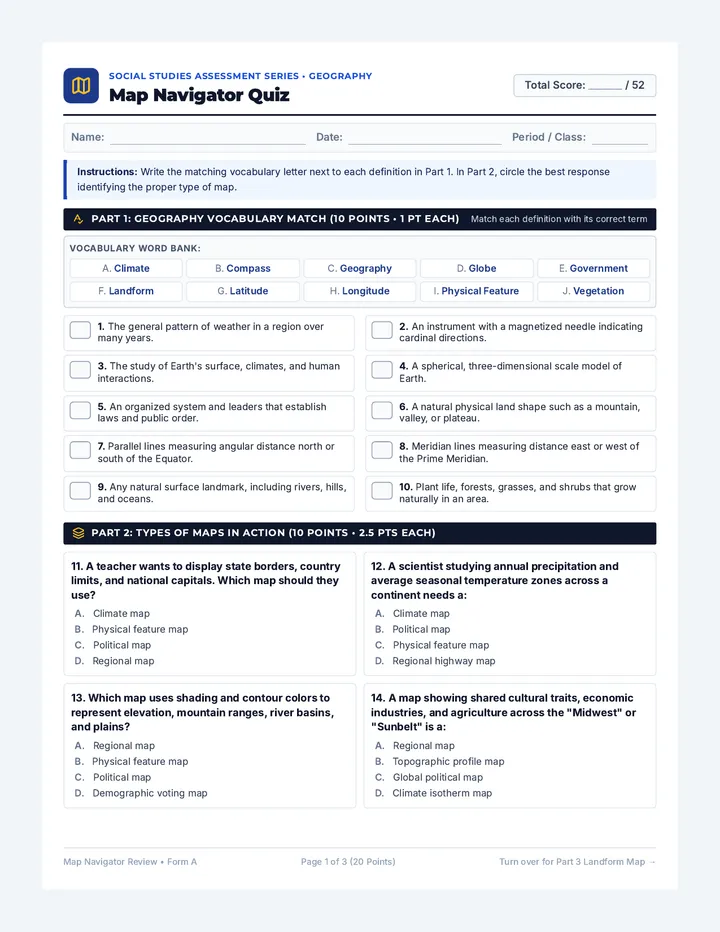
GEOGRAPHIC
Environment, location, maps, climate, and human impact.
S
SOCIAL
Culture, religion, class, daily life, and community traditions.
Analyze like a social scientist!
Use these 4 lenses for every topic
PEGS Category 01
POLITICAL
P
The Core Question
Who is in charge, how did they get power, and how do they keep it?
Look For...
• Government: Kings, presidents, councils, assemblies.
• Laws & Justice: Constitutions, courts, police, and punishments.
• Conflict: Wars, treaties, alliances, and political protests.
• Rights: Voting, freedom of speech, citizenship status.
Key Buzzwords
Monarchy Democracy Empire Treaty Citizen Authority Rebellion
Think: Courts, castles, voting booths, and battlefields.
Historian's Inquiry Checklist
What are the rules of this society?
Who is excluded from holding power?
PEGS Category 02
ECONOMIC
E
The Core Question
How do people make money, trade resources, and meet their daily needs?
Look For...
• Trade & Commerce: Silk Road, markets, importing/exporting goods.
• Jobs & Labor: Farmers, merchants, artisans, factory workers.
• Resources: Coal, gold, timber, water, crops, oil.
• Currency: Coins, bartering, paper money, digital transactions.
Key Buzzwords
Scarcity Import/Export Currency Supply/Demand Agriculture Industry Taxation
Think: Cargo ships, marketplace stalls, wallets, and tax collectors.
Historian's Inquiry Checklist
What is the most valuable resource here?
Who controls the distribution of wealth?
PEGS Category 03
GEOGRAPHIC
G
The Core Question
How does the physical environment shape how people live, and how do people alter the land?
Look For...
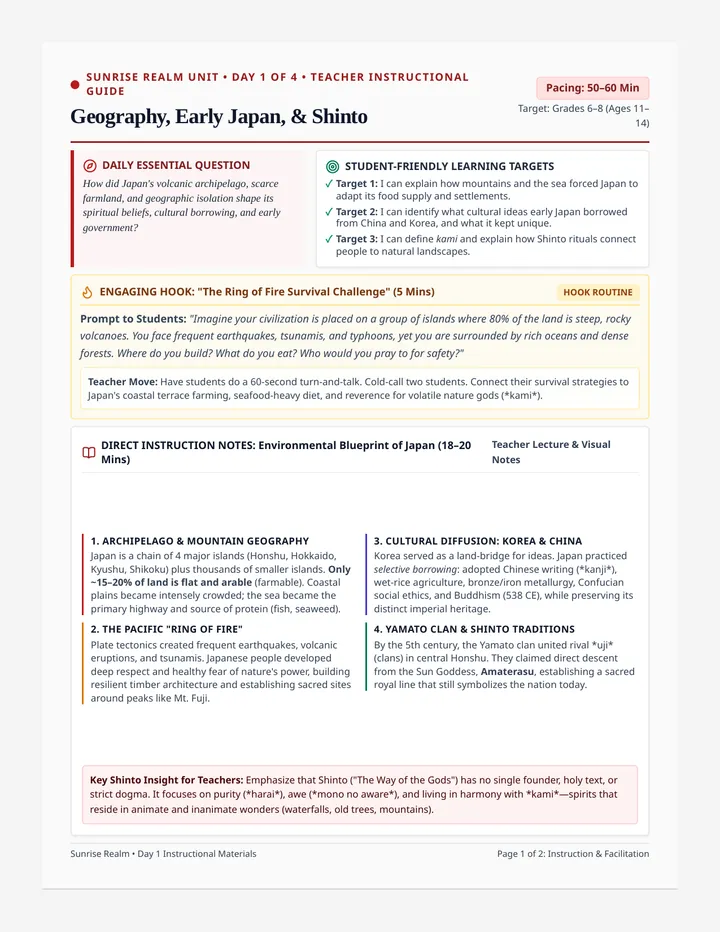
• Physical Features: Mountains, rivers, oceans, deserts.
• Climate & Weather: Temperature, rainfall, seasons, disasters.
• Human-Environment: Bridges, dams, canals, deforestation.
• Movement: Migration, trade routes, barriers, settlement patterns.
Key Buzzwords
Topography Climate Migration Settlement Arable Land Adaptation Natural Barrier
Think: Mountain ranges, riversides, city plans, and climate maps.
Historian's Inquiry Checklist
How did geography protect or isolate this civilization?
How did climate affect their farming?
PEGS Category 04
SOCIAL
S
The Core Question
How do people live, play, communicate, organize, and worship together?
Look For...
• Culture & Art: Music, architecture, literature, fashion, food.
• Social Classes: Nobility, middle class, laborers, social hierarchies.
• Religion & Beliefs: Gods, rituals, temples, values, sacred texts.
• Daily Life: Family structures, schools, recreation, holidays.
Key Buzzwords
Hierarchy Demographics Customs Polytheism Education Tradition Status
Think: Festivals, family portraits, houses of worship, and schools.
Historian's Inquiry Checklist
What values bind this community together?
How do class or gender affect daily life?
PEGS Minimalist Binder Inserts The PEGS Analytical Lens
Social Studies Reference Sheet • Keep in Binder
v1.1 Framework
PEGS is an acronym used to break down civilizations, events, and societies into four interconnected elements. Use this sheet to analyze primary documents, historical eras, and current global events.
P / POLITICAL
Core Concepts & Structures
• Types of government & legal structures
• Military force, conquests, and wars
• Rights, voting systems, & treaties
• Power dynamics, protests, & rulers
"Who controls the rules, holds authority, and resolves societal conflicts?"
E / ECONOMIC
Core Concepts & Structures
• Trade networks, imports, and exports
• Labor systems, standard jobs, & technology
• Currency, taxation, & banking systems
• Natural resource management & scarcity
"How does this society produce, trade, and distribute its wealth and resources?"
G / GEOGRAPHIC
Core Concepts & Structures
• Topography, mountains, oceans, and rivers
• Climate patterns, seasons, & extreme weather
• Human modification of landscape (canals, dams)
• Human migration & natural boundaries
"How does physical environment dictate human settlement and action?"
S / SOCIAL
Core Concepts & Structures
• Class hierarchies & social structures
• Religious systems, philosophy, & values
• Art, architecture, music, literature, & dress
• Family structure, gender roles, & education
"How do people organize into communities and express their cultural identities?"
Designed for Social Studies Interactive Notebooks © 2026 Social Studies Curriculum Lab
The PEGS Inquiry Tool
Step-by-Step Primary Source Analysis Checklist
When reading historical documents, look for clues matching the questions below. Check off each box as you discover evidence in your text, and write margin notes referencing corresponding page numbers.
P
Political Inquiry Checks
Who makes the laws/decrees?
Is there a military involvement?
How are disputes resolved?
Are there struggles for power?
E
Economic Inquiry Checks
What goods are traded or sold?
How are taxes or tributes paid?
What is used as money?
PEGS Framework Slides Social Studies Toolkits Lesson 01: Introduction
Decoding Civilizations with the PEGS Lens
How do social scientists study the past and present? Discover the 4 fundamental categories that shape human history.
Analyze societies like a social scientist
Press Right Arrow to Continue
PEGS Framework P is for Political
POLITICAL
The Core Question
Who holds the power, how did they get it, and what are the rules?
Look for These Clues:
• Government structures (Kings, Presidents, Councils)
• Legal codes , constitutions, courts, and enforcement
• Power struggles , alliances, wars, and treaties
• Citizenship rights , protections, and voting power
Think: Power, laws, leadership, and borders.
01 / 05
PEGS Framework E is for Economic
ECONOMIC
The Core Question
How do people produce, trade, and distribute resources to survive?
Look for These Clues:
• Trade routes , markets, imports, and exports
• Labor systems (Farmers, merchants, specialized jobs)
• Money , bartering systems, currency, and taxes
• Scarcity of natural resources (Gold, water, oil, grain)
Think: Money, goods, services, jobs, and scarcity.
02 / 05
PEGS Framework G is for Geographic
GEOGRAPHIC
The Core Question
How does the environment shape society, and how does society change it?
Look for These Clues:
• Physical geography (Rivers, mountains, climate, oceans)
• Human adaptations (Bridges, canals, cities, roads)
• Settlement locations and urban vs. rural layouts
• Movement of humans , migrations, and natural barriers
Think: Maps, climates, resources, landscape, and location.
03 / 05
PEGS Framework S is for Social
SOCIAL
The Core Question
How do people live, communicate, and organize their daily lives together?
Look for These Clues:
PEGS Application Worksheet Student Application Sheet PEGS-DS01
Name:
Date:
Period:
PEGS Civilization Detective
Put on your social scientist goggles! Choose a historical civilization or current society. Read your assigned text or primary source, extract key details, and categorize them into the four PEGS pillars below.
Target Civilization / Topic
Assigned Source Material
P
Political Clues
List evidence of rulers, laws, military power, or citizen rights.
E
Economic Clues
List evidence of currency, trading partners, resource usage, or jobs.
Go to Page 2 for Geographic & Social analysis Page 1 of 2
Civilization Detective Sheet PEGS Analysis System
G
Geographic Clues
List evidence of climate, terrain features, settlement patterns, or barriers.
S
Social Clues
List evidence of religion, social structure, arts, clothing, or daily customs.
Connections Analysis
Pillars Collide: PEGS elements never exist in isolation. How does one category you identified above influence another ? (For example: How did the *Geography* of the river affect their *Economic* trade, or how did a *Political* law impact their *Social* class systems?)
Always double-check your textual citations! Page 2 of 2
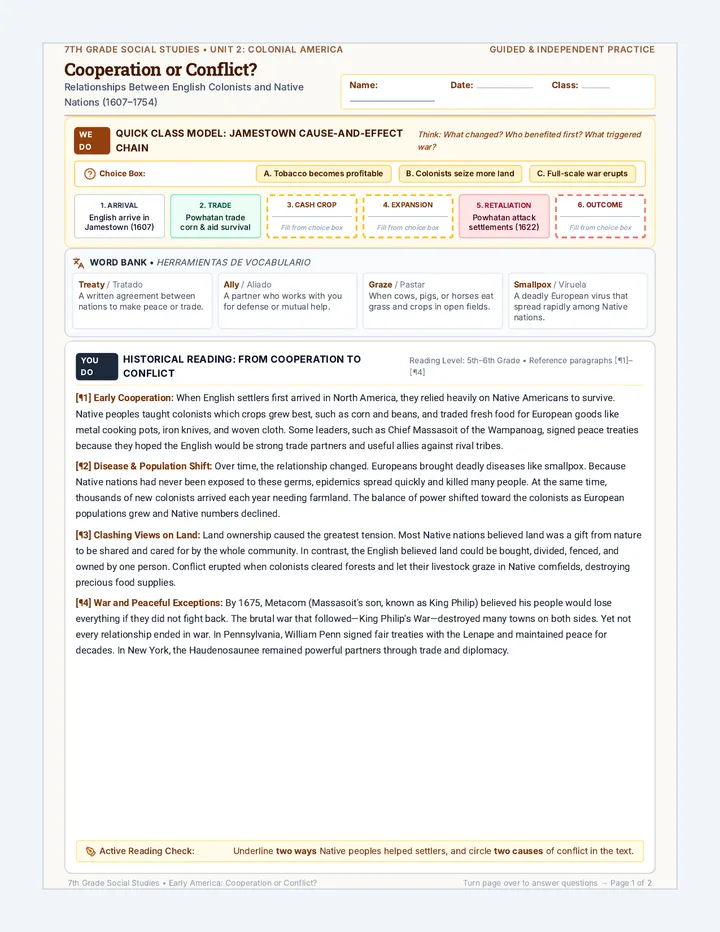
PEGS Teacher Guide Instructional Facilitation Guide Target Grades: 6-12
Introducing PEGS Social Studies Framework
Framework Objective: To equip students with a structured heuristic (PEGS) that dismantles complex societies or historical text into manageable analytical pillars. This guide scaffolds direct instruction using the slides, reinforces with wall posters/binder inserts, and evaluates with the application worksheet.
Suggested Lesson Pacing (60 Minutes)
Phase Duration Key Teacher Actions & Instructional Prompts The Hook 10 Mins Show a random historical artifact (e.g., Roman coin). Ask: "If you found this, what does it tell us about the government? What about daily life? Or trade?" Introduce the PEGS acronym. Direct Instruction 15 Mins Present the PEGS Framework Slides . Define each letter, asking students to copy definitions onto the Minimalist Binder Inserts . Highlight vocabulary. Guided Check 10 Mins Complete the Slide 6 interactive challenge as a class. Have students raise one, two, three, or four fingers to vote for P, E, G, or S. Clarify ambiguities immediately. Independent Lab 20 Mins Distribute the PEGS Application Worksheet and a short reading selection. Walk the room to assist students as they categorize textual citations. Debrief 5 Mins Have students share their "Connections Analysis" responses from Page 2. Emphasize that categories constantly overlap and affect one another.
Teacher Preparation Checklist
Print wall posters (Color, laminated)
Load Slide Presentation onto screen
Print Binder Inserts (Black & White)
Prepare a short primary/secondary text
PEGS Social Studies Lesson Pack Page 1 of 2
PEGS Discussion & Evaluation Tools Teacher Resource Module
Socratic Discussion Prompts by Pillar
Political Prompts
"How would a change in leadership affect safety? What does the scale of legal punishments tell us about their cultural values?"
Economic Prompts
"Why is trading more beneficial than isolation? What role does geographic abundance play in a state's overall wealth?"
Geographic Prompts
"Did nature protect this society, or did it force them to build protective infrastructure? How did physical borders prevent war?"