Lawmaking Labyrinth Assignment U.S. Civics & Government • Senior Assignment
How a Bill Becomes a Law
Navigating Congressional Hurdles, Veto Gates, and Presidential Action
Name:
Date: Period:
Key Concept: Out of ~10,000 bills introduced in each Congress, fewer than 4% become law because bills must survive multiple "veto gates."
1
Part 1: Key Checkpoints & Fatal Obstacles
Word Bank: Discharge Petition • Cloture (60 Votes) • Conference Committee • 2/3 Supermajority
Match each lawmaking obstacle with the correct constitutional or congressional term from the word bank.
A. The Committee Gatekeeper House Rule
A House committee chair refuses to hold hearings on a popular bill. What petition signed by 218 members forces the bill directly to the House floor?
B. The Senate Filibuster Rule XXII
A minority of senators uses continuous debate to block a final vote. What vote ends this filibuster, and how many votes does it require?
C. Two Different Versions Art. I, Sec. 7
The House and Senate pass slightly different versions of the same bill. What temporary joint committee meets to write a single compromise version?
D. Presidential Veto Veto Override
The President rejects and returns a bill unsigned. What fraction of voting members in both chambers is required to override the veto?
2
Part 2: Scenario Analysis • The National Youth Apprenticeship Act
Scenario: The House passes a job training bill that gives funding only to public schools. The Senate amends the bill to also include private and charter programs, passing its amended version. The President supports the Senate version and announces he will veto the House version.
Question 1: What must happen before this bill can be sent to the President's desk? What happens to the bill if the House refuses to vote on the Senate's changes?
Question 2: Congress eventually passes an identical bill and sends it to the President on Day 88. Congress officially adjourns 6 days later. The President takes no action. Does the bill become law? Name this specific outcome.
3
Part 3: Institutional Analysis • Protection or Gridlock?
The Framers of the Constitution created multiple "veto gates" to slow down lawmaking and force broad agreement. Do these hurdles protect our country from rushed, bad laws, or do they cause harmful gridlock? Give one specific example (such as the filibuster or committee power) to support your answer.
Lawmaking Labyrinth Slides U.S. Government • Senior Civics Seminar
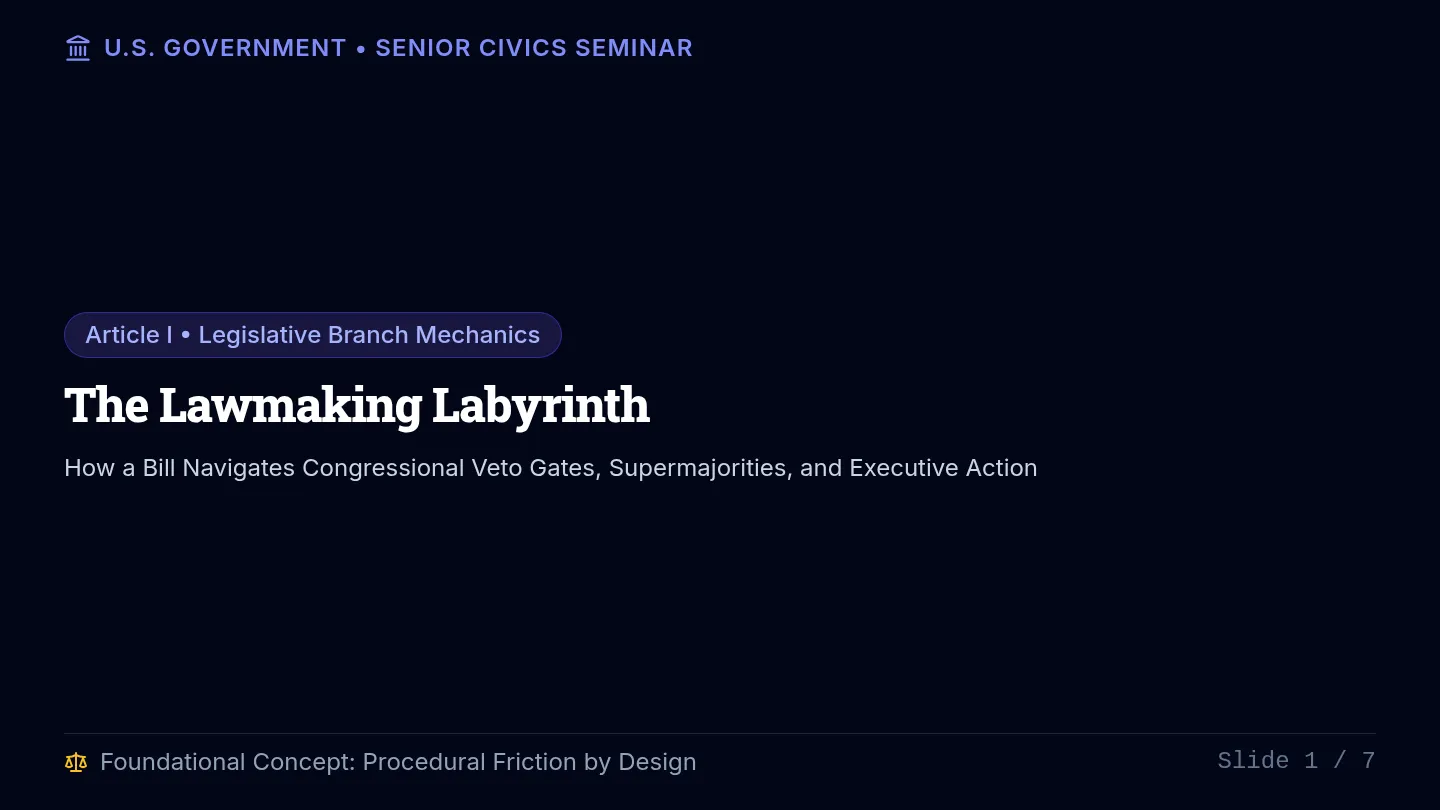
Article I • Legislative Branch Mechanics
The Lawmaking Labyrinth
How a Bill Navigates Congressional Veto Gates, Supermajorities, and Executive Action
Foundational Concept: Procedural Friction by Design
Slide 1 / 7
1
The 4% Reality: Friction by Design
Slide 2 / 7
~10,000
Bills introduced in each 2-year Congress
< 4% (< 400)
Successfully navigate all hurdles into public law
What is a "Veto Gate"?
A procedural choke point where a single committee chair, chamber leader, or minority coalition can block legislation.
The process was designed to frustrate hasty majorities and prevent factional tyranny.
Guiding Question: Is high institutional friction healthy deliberation or gridlock?
2
Veto Gate 1: Committee Gatekeeping
Slide 3 / 7
Where 90% of Bills Die
Standing committees screen bills. The Committee Chair decides whether a bill gets hearings, markup, or pigeonholing (ignored to death).
Gatekeeper Power: Chairs exercise near-total agenda control aligned with majority leadership.
The Rare Bypass: Discharge Petition
In the House, a petition signed by an absolute majority (218 members) can pry a stalled bill out of committee to the floor.
Reality Check: Rare because party leadership punishes members who sign against their chairs.
Assignment Connection: Question 1 on your worksheet tests this exact procedural petition.
3
Veto Gate 2: House Rules vs. Senate Filibuster
Slide 4 / 7
House of Representatives
435 Members
House Rules Committee ("Traffic Cop"):
Sets strict rules for debate time limits and determines whether amendments are allowed.
Culture: Majoritarian control; leadership commands the floor.
United States Senate
100 Members
The Filibuster & Cloture:
Unlimited debate. Ending debate requires invoking Cloture under Rule XXII with 60 votes.
Culture: Supermajoritarian; individual senators hold enormous leverage.
Strategic Impact: A bill with 51 Senate votes can still die without 60 cloture votes.
4
Veto Gate 3: Bicameral Reconciliation
Slide 5 / 7
Article I, Section 7 Mandate: The Identical Text Rule
House and Senate must pass the exact same text. Even minor wording differences require formal chamber reconciliation.
Option A: Chamber Ping-Pong
One chamber votes directly to accept the other chamber's amendments without alterations.
Option B: Conference Committee
A temporary joint panel drafts a compromise Conference Report voted on unamended.
Simulation Alert: Part 2 of your assignment features conflicting House and Senate amendments!
5
Veto Gate 4: The 10-Day Clock on the Oval Desk
Slide 6 / 7
1. Signature
President signs enrolled bill; becomes public law immediately.
2. Regular Veto
President returns bill unsigned. Requires 2/3 vote in both chambers to override.
3. Becomes Law Unsigned
If no presidential action in 10 days while Congress is in session, it becomes law.
4. Pocket Veto
If no action and Congress adjourns before 10 days expire, the bill dies.
Crucial Distinction: Whether Congress is in session dictates outcome #3 versus #4!
6
Senior Synthesis: Deliberation or Dysfunction?
Slide 7 / 7
Federalist No. 62 (Madison)
Bicameral friction and procedural checks prevent volatile factions from enacting impulsive legislation.
• Veto gates foster broad consensus
The Contemporary Critique
In hyper-partisan times, veto gates enable minority obstruction and status-quo paralysis on pressing issues.
• Veto gates entrench gridlock
Assignment Ready: Complete the Lawmaking Labyrinth Worksheet with your partner. Independent • 25 Min
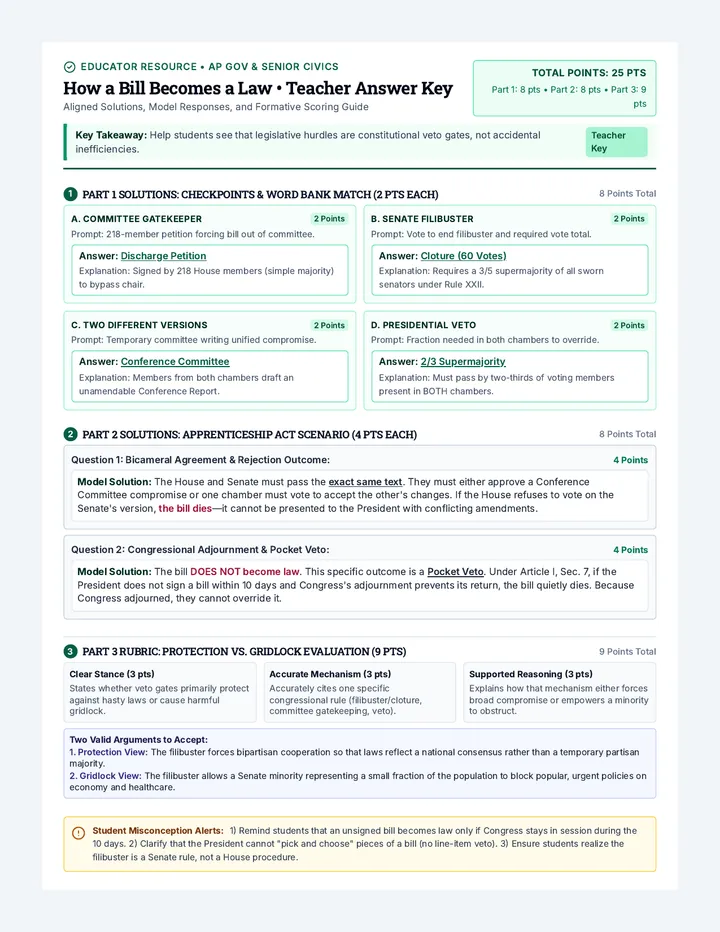
Lawmaking Labyrinth Answer Key Educator Resource • AP Gov & Senior Civics
How a Bill Becomes a Law • Teacher Answer Key
Aligned Solutions, Model Responses, and Formative Scoring Guide
Total Points: 25 Pts
Part 1: 8 pts • Part 2: 8 pts • Part 3: 9 pts
Key Takeaway: Help students see that legislative hurdles are constitutional veto gates, not accidental inefficiencies.
Teacher Key
1
Part 1 Solutions: Checkpoints & Word Bank Match (2 pts each)
8 Points Total
A. Committee Gatekeeper 2 Points
Prompt: 218-member petition forcing bill out of committee.
Answer: Discharge Petition Explanation: Signed by 218 House members (simple majority) to bypass chair.
B. Senate Filibuster 2 Points
Prompt: Vote to end filibuster and required vote total.
Answer: Cloture (60 Votes) Explanation: Requires a 3/5 supermajority of all sworn senators under Rule XXII.
C. Two Different Versions 2 Points
Prompt: Temporary committee writing unified compromise.
Answer: Conference Committee Explanation: Members from both chambers draft an unamendable Conference Report.
D. Presidential Veto 2 Points
Prompt: Fraction needed in both chambers to override.
Answer: 2/3 Supermajority Explanation: Must pass by two-thirds of voting members present in BOTH chambers.
2
Part 2 Solutions: Apprenticeship Act Scenario (4 pts each)
8 Points Total
Question 1: Bicameral Agreement & Rejection Outcome: 4 Points
Model Solution: The House and Senate must pass the exact same text. They must either approve a Conference Committee compromise or one chamber must vote to accept the other's changes. If the House refuses to vote on the Senate's version, the bill dies—it cannot be presented to the President with conflicting amendments.
Question 2: Congressional Adjournment & Pocket Veto: 4 Points
Model Solution: The bill DOES NOT become law. This specific outcome is a Pocket Veto. Under Article I, Sec. 7, if the President does not sign a bill within 10 days and Congress's adjournment prevents its return, the bill quietly dies. Because Congress adjourned, they cannot override it.
3
Part 3 Rubric: Protection vs. Gridlock Evaluation (9 pts)
9 Points Total
Clear Stance (3 pts)
States whether veto gates primarily protect against hasty laws or cause harmful gridlock.
Accurate Mechanism (3 pts)
Accurately cites one specific congressional rule (filibuster/cloture, committee gatekeeping, veto).