or
.
Apply functions, SMART & SWOT
1. Expected 200 orders; actual 150. Manager compares results with target.
Answer:
2. A manager assigns employees to register, drive-through, and food prep.
Answer:
3. A competitor opens nearby with lower prices.
Answer:
4. "Gain 50 new rewards members." Which SMART part is missing?
Answer:
5. A manager asks employees to help choose a schedule.
Answer:
6. A loyal customer base belongs in which SWOT category?
Answer:
Individual • 4 Points
1. Four controlling steps:
results.
Controlling happens
results.
"By when?" =
Style that depends =
Unit 2 Targeted Review • Principles of Business Management Page 2 of 2
Board 3: Leadership Quick Codes
Write: Autocratic → I decide, Democratic → We decide, Open → You decide, Situational → It depends (Task or Employee).
Board 4: SWOT 2x2 Matrix
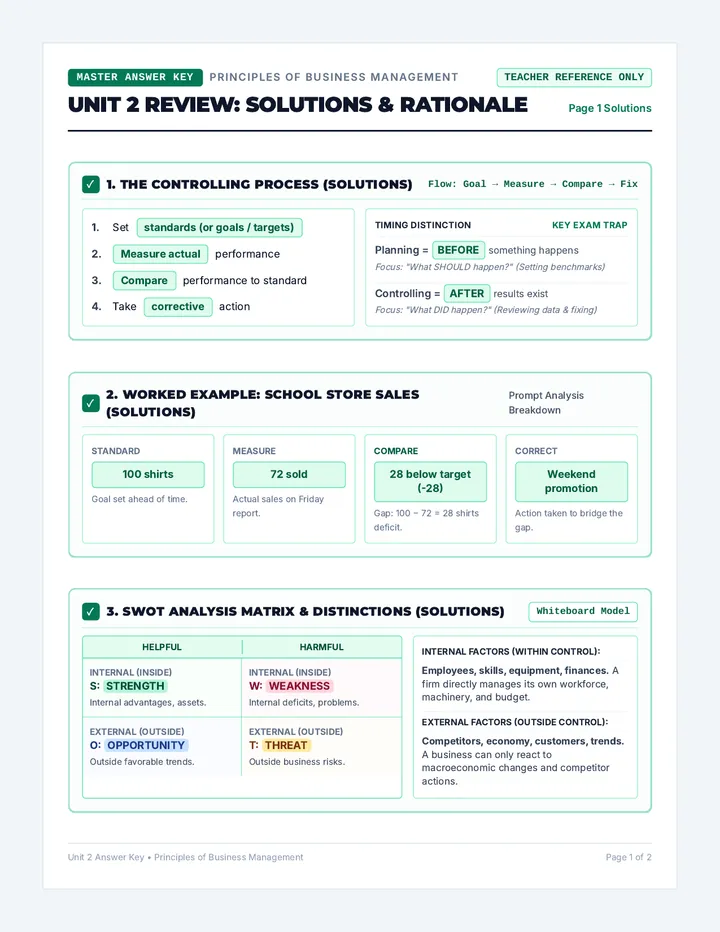
Draw 2x2: Helpful/Harmful columns × Internal/External rows. Below, list: Internal: employees, skills, gear, cash; External: rivals, economy, trends.
Unit 2 Facilitation Guide • Principles of Business Management Page 1 of 2
Page 2 of 2
Misconception 1: "Comparing numbers means we are planning."
Teacher Talk Script: "Ask yourself: Do actual results already exist in this sentence? If the numbers already happened, you aren't planning—you are controlling! Planning looks forward to what SHOULD happen. Controlling inspects what DID happen."
Misconception 2: "If a sentence mentions a day, it is automatically Time-bound."
Teacher Talk Script: "A day satisfies the 'T'—but check the rest of the sentence! In 'Improve customer service by Friday', 'by Friday' is time-bound, but 'improve customer service' is vague. How much? By what score? It is missing the 'M'!"
Misconception 3: "Situational leadership means the manager is indecisive."
Teacher Talk Script: "Situational is the ultimate strategic leadership. A great manager doesn't use a hammer for every problem. If a kitchen catches fire, they go Autocratic. If brainstorming a marketing slogan, they go Democratic. It depends on the task and employee skill level."
Scenario 1 (200 target vs 150 actual) Key question: "What is the manager doing with the target?" → Comparing actual to standard = Controlling.
Scenario 2 (Assigning stations) Key question: "Is this setting a goal, assigning tasks, or checking results?" → Dividing work = Organizing.
Scenario 3 (Competitor price cut) Key question: "Is a competitor inside or outside our firm?" → Outside & harmful = Threat (External).
Scenario 4 (Gain 50 members) Key question: "Can the team tell when this goal must be done?" → No date = Missing Time-bound (T).
Scenario 5 (Employee schedule choice) Key question: "Who makes the choice? One person or the group?" → We decide = Democratic.
Scenario 6 (Loyal customer base) Key question: "Is our own customer loyalty an internal asset or outside risk?" → Internal asset = Strength.
For Emerging Learners / ELL:
Encourage use of the 1-word Quick Codes (I, We, You, Depends) before writing full style names. Keep the School Store example visible on the screen during the scenario challenge.
For Advanced / Fast Finishers:
Have them rewrite the two flawed SMART statements from Section 5 into complete, flawless SMART business objectives with baseline, target metric, and calendar deadline.
Q1 Error: Controlling Steps Reassign 4-step flowchart flashcard exercise before summative.
Q2 Error: Before vs. After Prompt with: "Does a chef taste soup before or after cooking?"
Q3 Error: "By when?" = T Review the whiteboard circle rule: "No deadline = not time-bound."
Q4 Error: Situational Style Highlight: "It depends" indicates Situational leadership every time.
Unit 2 Facilitation Guide • Principles of Business Management Page 2 of 2
A Achievable Is it realistic?
R Relevant Does it matter?
T Time-bound By when?
1. "Reduce wait time from 8 to 5 min."
Missing: Time-bound (T)
Specific and measured (8→5m), but has no deadline date!
2. "Improve customer service by Friday."
Missing: Measurable (M)
Has a deadline (Friday), but "improve" has no metric or score!
1:1 Board Codes
Autocratic I decide Fast, emergencies
Democratic We decide Team discussion & vote
Open (Laissez-faire) You decide Autonomous experts
Situational It depends Flexible adaptation
A manager changes leadership style depending on the task or employee .
6 Items • Full Scoring Rationale
1. Expected 200 orders; actual 150. Manager compares results with target. Controlling (Comparing actuals)
2. A manager assigns employees to register, drive-through, and food prep. Organizing (Allocating staff & tasks)
3. A competitor opens nearby with lower prices. Threat (External risk)
4. "Gain 50 new rewards members." Which SMART part is missing? Time-bound (T) (No deadline)
5. A manager asks employees to help choose a schedule. Democratic (Shared decision)
6. A loyal customer base belongs in which SWOT category? Strength (Internal positive)
4 Points Total
1. Four controlling steps: Set standards → Measure performance → Compare performance to standard → Take corrective action
2. Planning = BEFORE results; Controlling = AFTER results.
3. "By when?" = Time-bound (T) 4. Depends = Situational
Unit 2 Answer Key • Principles of Business Management Page 2 of 2