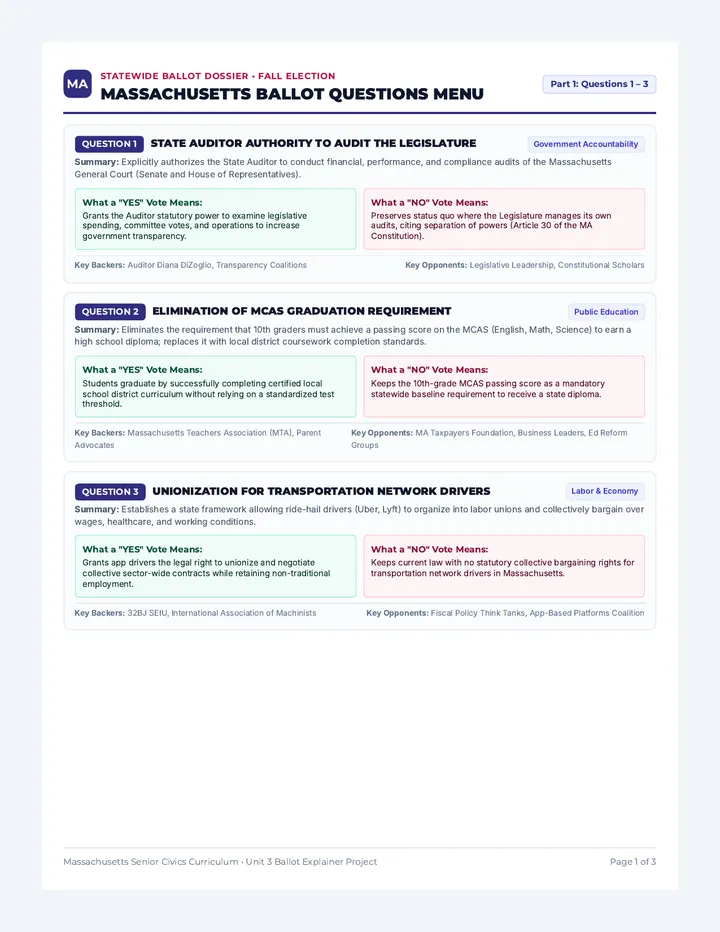
A senior civics project unit where students research and produce concise, nonpartisan explainer videos on Massachusetts statewide ballot questions to educate voters ahead of the November election. Students analyze policy trade-offs, fiscal implications, and stakeholder arguments while mastering civic communication.
Maintains status quo. Opponent arguments, economic/regulatory concerns, and opposing coalitions.
2:25 – 3:00
5. Fiscal & Next Steps
State budget note, tax/spending projections, and where voters find verified ballot info.
Tip: Rehearse with a stopwatch! Target pacing is ~130 words per minute. Standard AV Pacing
Production Quality
Visual & Accessibility Standards
Burned-In Captions
All videos must have synchronized open captions with 100% correct spelling of civic and legal terms.
Universal Accessibility
Clean Voiceover
Record in a quiet space with an external mic. Music bed must stay at -22dB under vocal narration.
Broadcast Audio
Dynamic Graphics
No endless slides of text. Use comparison charts, lower-third titles, callout boxes, and verified quotes.
Engaging Visuals
Always cite on-screen: “Source: MA Office of Campaign & Political Finance (OCPF)” Mandatory Citation Rule
Collaboration
Newsroom Team Roles
4 Specialist Roles
1
Civic Policy Lead
Analyzes the official legal text and state fiscal notes. Audits donor filings and campaign finance coalitions on OCPF.
2
Lead Scriptwriter
Writes the timed two-column audio-visual script. Translates dense policy into clear, conversational plain English.
3
Motion & Video Editor
Designs infographics, creates lower-third titles, edits timeline cuts, and burns in synchronized captions.
4
Nonpartisan Auditor
Times arguments to ensure parity, reviews adjectives for bias, and verifies that every stat cites a primary source.
Each team member signs off on the final cut before public release. Shared Collective Responsibility
Get Started
Project Milestones & Launch
Oct 02
Step 1
Policy Brief & Source Dossier
Oct 09
Step 2
Full AV Script & Timed Storyboard
Oct 16
Step 3
Rough Cut Nonpartisan Peer Audit
Oct 23
Step 4
Final Cut & Voter Showcase
Today's Immediate Mission:
Form newsroom teams of 4, assign roles, and draw your statewide ballot question.
Let's Inform Massachusetts!
Massachusetts Senior Civics Curriculum • Unit 3 Ballot Explainer Project Page 1 of 3
MA
Statewide Ballot Dossier • Fall Election
Massachusetts Ballot Questions Menu
Part 2: Questions 4 – 6
Question 4
Legalization & Regulation of Natural Psychedelics
Public Health
Summary: Decriminalizes personal adult use/growing of natural psychedelic substances (psilocybin, DMT, mescaline) and creates a state regulatory commission to license supervised therapy facilities.
What a "YES" Vote Means:
Allows adults 21+ to possess/grow limited quantities of natural psychedelics and access licensed therapeutic treatment settings.
What a "NO" Vote Means:
Maintains existing criminal and civil penalties prohibiting natural psychedelic substances under Massachusetts law.
Key Backers: Massachusetts for Mental Health Options, Veteran Advocates Key Opponents: Coalition for Safe Communities, MA Psychiatric Society
Question 5
Phase-Out of Sub-Minimum Wage for Tipped Workers
Wages & Employment
Summary: Gradually increases the minimum wage for tipped workers ($6.75/hr) over five years until it equals the full state minimum wage ($15.00/hr), while permitting tip-pooling among non-management restaurant staff.
What a "YES" Vote Means:
Employers must directly pay tipped staff full minimum wage regardless of tips earned; tips remain additional or pooled among staff.
What a "NO" Vote Means:
Maintains the current tipped sub-minimum wage system where employers make up the difference if tips fall below $15/hr.
Key Backers: One Fair Wage, Service Worker Equity Groups Key Opponents: Massachusetts Restaurant Association, Restaurant Owner Coalitions
Question 6
Independent Contractor Status for App-Based Drivers
Gig Economy Classification
Summary: Formally defines app-based rideshare and delivery drivers as independent contractors under state wage laws, while establishing guaranteed earnings (120% of minimum wage for engaged time) and portable healthcare benefits.
What a "YES" Vote Means:
Locks in independent contractor status to protect driver schedule flexibility while establishing minimum wage floors during active rides.
What a "NO" Vote Means:
Subjects app platforms to Massachusetts' strict three-part employee test, potentially classifying drivers as statutory employees.
Key Backers: MA Coalition for Independent Work, App Platform Companies Key Opponents: MA AFL-CIO, Labor Attorneys, Driver Rights Advocates
Massachusetts Senior Civics Curriculum • Unit 3 Ballot Explainer Project Page 2 of 3
MA
Statewide Ballot Dossier • Fall Election
Massachusetts Ballot Questions Menu
Part 3: Questions 7 – 9
Question 7
Modernization of the Massachusetts Bottle Deposit Law
Environment & Waste
Summary: Expands the 1982 5-cent bottle deposit statute to include non-carbonated containers (bottled water, iced teas, sports drinks, canned cold coffee) and adjusts redemption handling fees.
What a "YES" Vote Means:
Extends container recycling deposits to modern non-carbonated single-use plastic and aluminum bottles to reduce litter.
What a "NO" Vote Means:
Leaves the deposit law limited to carbonated soft drinks and beer, relying on municipal curbside recycling for non-carbonated bottles.
Key Backers: MassPIRG, Sierra Club Massachusetts, Conservation Law Foundation Key Opponents: American Beverage Association, Retailers Association of MA
Question 8
Ranked-Choice Voting in State Elections
Electoral Reform
Summary: Establishes ranked-choice voting (instant-runoff) for Massachusetts statewide constitutional officers, state legislative seats, and county elections, enabling voters to rank candidates in order of preference.
What a "YES" Vote Means:
Enacts ranked ballots so if no candidate wins 50%+, instant runoffs reallocate lower-tier votes until a candidate secures a majority.
What a "NO" Vote Means:
Maintains standard plurality ("first-past-the-post") voting where the candidate with the highest single vote count wins.
Summary: Prohibits gas utility companies from passing the cost of new fossil fuel pipeline expansions onto utility ratepayers, while expanding municipal authority to mandate clean heating conversion in building renovations.
What a "YES" Vote Means:
Restricts ratepayer funding for new gas infrastructure and accelerates home heat-pump and clean electrical conversions.
What a "NO" Vote Means:
Continues allowing utility gas infrastructure investments and leaves municipal building electrification codes subject to state waiver.
Key Backers: Clean Water Action, Climate Policy Action, Municipal Leaders Key Opponents: Gas Utilities, Building Trades Unions, Commercial Real Estate Council
Massachusetts Senior Civics Curriculum • Unit 3 Ballot Explainer Project Page 3 of 3