Colonial Courier Worksheet
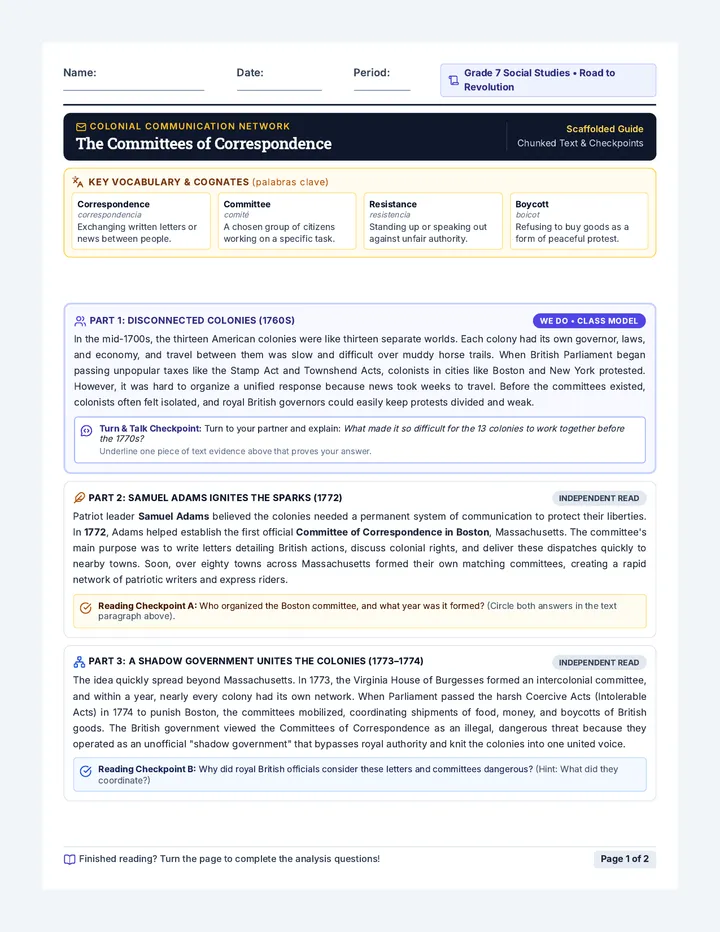
Name: Date: Period:
Grade 7 Social Studies • Road to Revolution
Colonial Communication Network
The Committees of Correspondence
Scaffolded Guide Chunked Text & Checkpoints
Key Vocabulary & Cognates (palabras clave)
Correspondence correspondencia
Exchanging written letters or news between people.
Committee comité
A chosen group of citizens working on a specific task.
Resistance resistencia
Standing up or speaking out against unfair authority.
Boycott boicot
Refusing to buy goods as a form of peaceful protest.
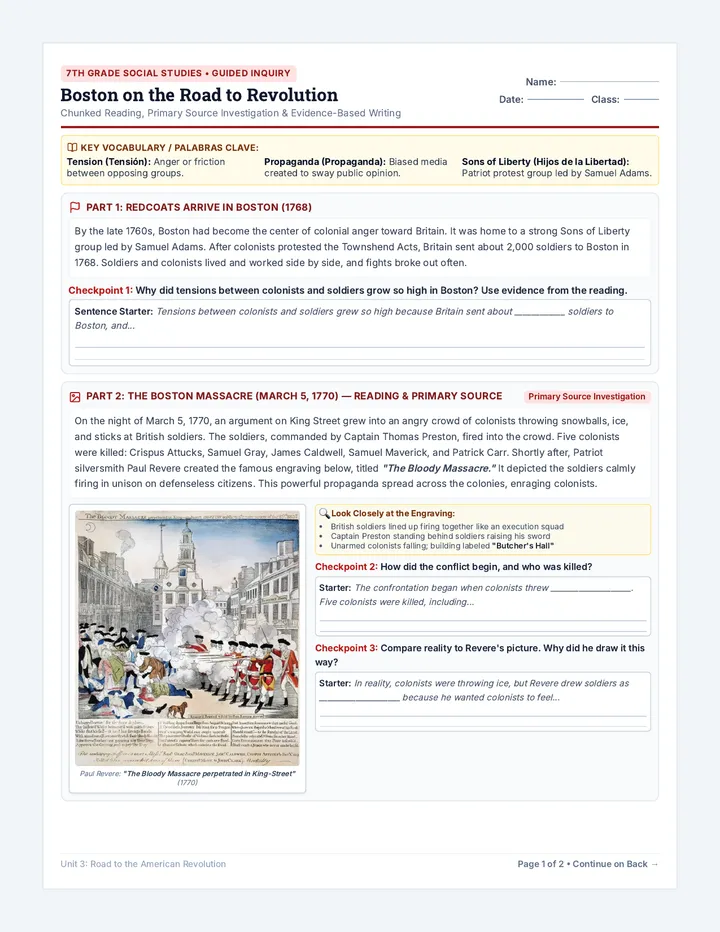
Part 1: Disconnected Colonies (1760s) WE DO • Class Model
In the mid-1700s, the thirteen American colonies were like thirteen separate worlds. Each colony had its own governor, laws, and economy, and travel between them was slow and difficult over muddy horse trails. When British Parliament began passing unpopular taxes like the Stamp Act and Townshend Acts, colonists in cities like Boston and New York protested. However, it was hard to organize a unified response because news took weeks to travel. Before the committees existed, colonists often felt isolated, and royal British governors could easily keep protests divided and weak.
Turn & Talk Checkpoint: Turn to your partner and explain: What made it so difficult for the 13 colonies to work together before the 1770s? Underline one piece of text evidence above that proves your answer.
Part 2: Samuel Adams Ignites the Sparks (1772) Independent Read
Patriot leader Samuel Adams believed the colonies needed a permanent system of communication to protect their liberties. In 1772, Adams helped establish the first official Committee of Correspondence in Boston, Massachusetts. The committee's main purpose was to write letters detailing British actions, discuss colonial rights, and deliver these dispatches quickly to nearby towns. Soon, over eighty towns across Massachusetts formed their own matching committees, creating a rapid network of patriotic writers and express riders.
Reading Checkpoint A: Who organized the Boston committee, and what year was it formed? (Circle both answers in the text paragraph above).
Part 3: A Shadow Government Unites the Colonies (1773–1774) Independent Read
The idea quickly spread beyond Massachusetts. In 1773, the Virginia House of Burgesses formed an intercolonial committee, and within a year, nearly every colony had its own network. When Parliament passed the harsh Coercive Acts (Intolerable Acts) in 1774 to punish Boston, the committees mobilized, coordinating shipments of food, money, and boycotts of British goods. The British government viewed the Committees of Correspondence as an illegal, dangerous threat because they operated as an unofficial "shadow government" that bypasses royal authority and knit the colonies into one united voice.
Reading Checkpoint B: Why did royal British officials consider these letters and committees dangerous? (Hint: What did they coordinate?)
Finished reading? Turn the page to complete the analysis questions! Page 1 of 2
PART 2
Evidence-Based Analysis & Critical Thinking
Use the sentence starters to guide your responses.
Directions: Answer the questions below using specific facts and quotes from the reading on Page 1.
1 Who started the first Committee of Correspondence in Boston, and in what year? WE DO • MODEL
Sentence Starter: The first Committee of Correspondence in Boston was founded by... in the year...
2 What was the main purpose of the Committees of Correspondence?
Sentence Starter: The primary purpose of the Committees of Correspondence was to...
3 Why was it difficult for the colonies to work together before the committees existed?
Sentence Starter: Before the committees were created, colonies struggled to cooperate because...
4 Critical Thinking: How did sharing information through letters help the colonies become more united?
Sentence Starter: Sharing letters helped unite the colonies because... According to the text,...
5 Critical Thinking: Why might the British government have seen the committees as a threat?
Sentence Starter: The British government viewed the committees as a threat because they functioned like...
6 Extension Challenge: Compare the Committees to a way people share information today. CHALLENGE
Sentence Starter: Today, people organize using... This is similar because... but different because...
Daily Formative Assessment • Exit Ticket
4 Minutes • Independent
Prompt: Do you think the American colonies could have successfully resisted Great Britain without the Committees of Correspondence? Explain your answer using at least one fact from today’s lesson.
Sentence Starter: I believe the colonies (could / could not) have successfully resisted Great Britain without the committees because...
Unit: Colonial Resistance & The Road to Revolution Page 2 of 2
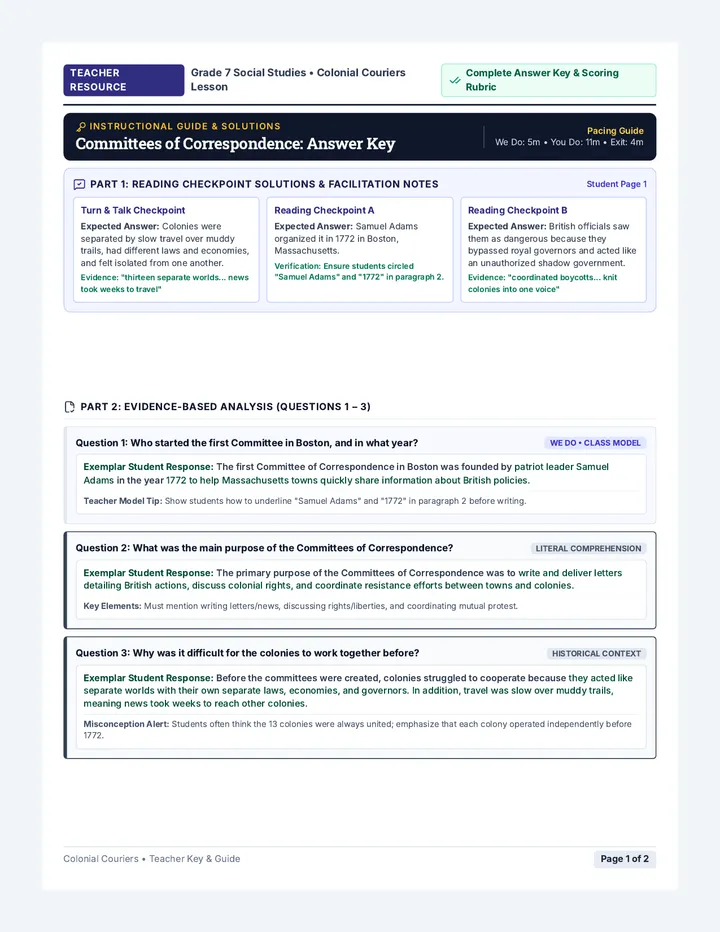
Colonial Courier Answer Key
Teacher Resource Grade 7 Social Studies • Colonial Couriers Lesson
Complete Answer Key & Scoring Rubric
Instructional Guide & Solutions
Committees of Correspondence: Answer Key
Pacing Guide We Do: 5m • You Do: 11m • Exit: 4m
Part 1: Reading Checkpoint Solutions & Facilitation Notes
Student Page 1
Turn & Talk Checkpoint
Expected Answer: Colonies were separated by slow travel over muddy trails, had different laws and economies, and felt isolated from one another.
Evidence: "thirteen separate worlds... news took weeks to travel"
Reading Checkpoint A
Expected Answer: Samuel Adams organized it in 1772 in Boston, Massachusetts.
Verification: Ensure students circled "Samuel Adams" and "1772" in paragraph 2.
Reading Checkpoint B
Expected Answer: British officials saw them as dangerous because they bypassed royal governors and acted like an unauthorized shadow government.
Evidence: "coordinated boycotts... knit colonies into one voice"
Part 2: Evidence-Based Analysis (Questions 1 – 3)
Question 1: Who started the first Committee in Boston, and in what year? WE DO • CLASS MODEL
Exemplar Student Response: The first Committee of Correspondence in Boston was founded by patriot leader Samuel Adams in the year 1772 to help Massachusetts towns quickly share information about British policies.
Teacher Model Tip: Show students how to underline "Samuel Adams" and "1772" in paragraph 2 before writing.
Question 2: What was the main purpose of the Committees of Correspondence? LITERAL COMPREHENSION
Exemplar Student Response: The primary purpose of the Committees of Correspondence was to write and deliver letters detailing British actions, discuss colonial rights, and coordinate resistance efforts between towns and colonies.
Key Elements: Must mention writing letters/news, discussing rights/liberties, and coordinating mutual protest.
Question 3: Why was it difficult for the colonies to work together before? HISTORICAL CONTEXT
Exemplar Student Response: Before the committees were created, colonies struggled to cooperate because they acted like separate worlds with their own separate laws, economies, and governors. In addition, travel was slow over muddy trails, meaning news took weeks to reach other colonies.
Misconception Alert: Students often think the 13 colonies were always united; emphasize that each colony operated independently before 1772.
Colonial Couriers • Teacher Key & Guide Page 1 of 2
PART 2 CONTINUED
Critical Thinking, Extension & Exit Ticket Assessment
Scoring Standards & Student Exemplars
Question 4: How did sharing letters help the colonies become more united? TEXT EVIDENCE REQUIRED
Exemplar Student Response: Sharing letters helped unite the colonies because it allowed distant colonists to realize they all faced the same British taxes and threats to their liberty. According to the text, the network enabled colonies to mobilize, send supplies, and organize joint boycotts of British goods, turning thirteen isolated colonies into "one united voice."
Scoring: Full credit requires an explanation of unity + a direct quote or paraphrase from paragraph 3.
Question 5: Why might the British government have seen the committees as a threat? PERSPECTIVE TAKING
Exemplar Student Response: The British government viewed the committees as a threat because they functioned like an illegal "shadow government." Instead of obeying royal governors and Parliament, colonists made decisions together and organized successful boycotts that undermined British authority and revenue.
Question 6 (Extension): Compare the Committees to how people organize today. HIGHER-ORDER EXTENSION
Exemplar Student Response: Today, people organize using social media platforms or group messaging apps. This is similar because both systems allow citizens to quickly share news, raise awareness about unfair policies, and coordinate peaceful protests or boycotts. However, it is different because modern news spreads instantly across the globe with a click, whereas colonial couriers relied on riders on horseback taking days or weeks.
Formative Assessment (Exit Ticket) Rubric & Exemplars
4 Points Max
Prompt: Could the colonies have successfully resisted Great Britain without the Committees of Correspondence?
Stance A: Could NOT Resist (Most Common)
"I believe the colonies could not have resisted without the committees because before they were created, the colonies were isolated and divided. Without express riders sharing news, royal governors could have kept each colony weak and separated."
Fact used: Isolated colonies / coordination of Intolerable Acts boycott.
Stance B: COULD Resist (Valid with Logic)
"I believe the colonies could have eventually resisted because British taxes like the Stamp Act and Intolerable Acts were already causing massive anger in individual cities, and colonists would have found another way to meet, like local town halls."
Fact used: Widespread colonial outrage over taxes / Boston resistance.
Full Credit (4/4): Clear claim + 1 specific historical lesson fact + logical cause/effect explanation. Partial Credit (2-3/4): Claim made but missing text fact or explanation is vague.
Verbal Closing Reminder: "Next, we’ll see how this unity led to the First Continental Congress." Page 2 of 2