Stamp Act Showdown Slides Grade 8 US History Road to Revolution Series
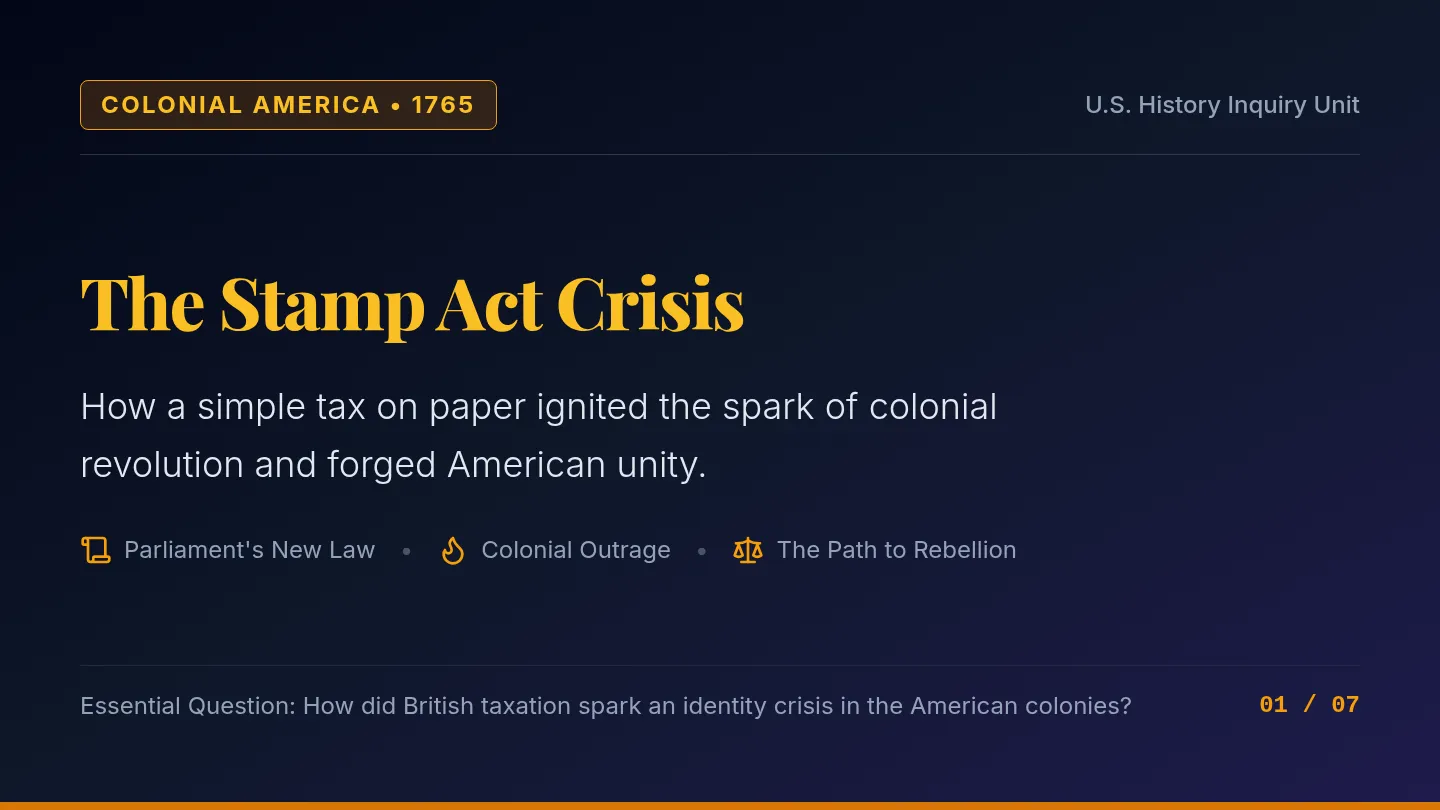
March 22, 1765
The Spark of Colonial Rebellion
Stamp Act Showdown
How a small piece of embossed paper triggered riots, united thirteen divided colonies, and coined America's most famous protest slogan.
The Problem
Massive War Debt
The Policy
Internal Direct Tax
The Outcry
No Taxation w/o Rep.
Historical Context: The Bill Comes Due
1754 – 1763
The French & Indian War
Great Britain defeated France to secure control of North America, but victory carried a staggering financial cost.
National Debt Doubled
British debt skyrocketed from £72 million to over £130 million. Plus, 10,000 soldiers remained on the frontier.
?
London's Perspective
"The British army protected the American colonists from French forces and frontier conflicts. Why shouldn't the colonies pay a fraction of their defense costs?"
PM George Grenville: Citizens in London paid up to 20 times more in taxes than American colonists.
Key Shift: Britain abandons decades of Salutary Neglect to enforce imperial control.
The Law: What Was the Stamp Act?
Passed by Parliament: March 1765
Legal Paper
Required an embossed tax stamp on wills, land deeds, court contracts, college diplomas, and marriage licenses.
Hit lawyers & merchants
Everyday Media
Every colonial newspaper, published pamphlet, political flyer, and annual almanac required a paid revenue stamp.
Infuriated printers & writers
Tavern Goods
Even decks of playing cards and pairs of dice were taxed! Playing games legally in public taverns required stamps.
Touched all social classes
Crucial Difference: Not an import duty at the harbor, but the first internal direct tax placed directly on daily colonial life!
The Great Debate: Principle vs. Pocketbook
Constitutional Crisis
Colonies
Actual Representation
No colonists sat in Parliament in London.
English rights held that citizens can only be taxed by their own elected representatives.
Danger: If Parliament taxes paper today, they can tax our homes and farms tomorrow.
"NO TAXATION WITHOUT REPRESENTATION!"
Britain
Virtual Representation
Parliament argued members represent all British subjects everywhere.
Many major English cities (like Manchester) also had no direct Members of Parliament.
The tax rate was very modest (pennies per document).
"Parliament holds supreme legislative authority over all."
It wasn't the amount of money; it was the authority to tax without consent.
Colonial Resistance: Three Fronts
Summer & Autumn 1765
01
Street Action
The Sons of Liberty formed in Boston and NY. They hanged tax agents in effigy, harassed officials, and tore down stamp offices.
Result: Nearly all tax distributors resigned!
02
Economic Boycott
Merchants signed Non-Importation Agreements , refusing British goods. Women spun homemade cloth to replace English fabrics.
Result: British colonial trade dropped by 40%.
03
Political Voice
Colonial assemblies passed fiery resolves. Newspapers printed warning skulls where the royal tax stamp was supposed to be placed.
Result: Divided colonies began uniting.
"If this be treason, make the most of it!" — Patrick Henry, Virginia House of Burgesses
Milestone: The Stamp Act Congress
New York City • October 1765
9 Colonies Unite
Twenty-seven delegates met in New York City. This was the first unified, multi-colony political assembly organized without royal permission.
Declaration of Rights
Penned by John Dickinson: affirmed colonial loyalty to King George III, but firmly stated that only colonial assemblies could tax colonial citizens.
Historical Significance
Divided Colonies Find a Shared Voice
Before 1765, colonies functioned as separate islands. The Stamp Act gave them a common grievance that created a shared American political identity.
"There ought to be no more New Englanders, no more New Yorkers, but all of us Americans." — Christopher Gadsden
Key Takeaway: Peaceful petitions to the King accompanied aggressive economic boycotts.
The Outcome: Repeal & The Trap
March 1766
Colonial Joy
The Act is Repealed!
Facing severe pressure from British merchants who were going bankrupt, Parliament repealed the Stamp Act in March 1766.
Bells rang and fireworks lit up Boston.
The trade boycott was immediately lifted.
Colonists celebrated thinking their principle was recognized.
The Trap
The Declaratory Act
On the very same day of repeal, Parliament quietly issued a new law:
"Parliament has authority to make laws binding the colonies... in all cases whatsoever ."
Britain retreated on the tax, but asserted unlimited imperial power!
Next Clashes Ahead: Townshend Duties (1767) • Boston Massacre (1770) • Boston Tea Party (1773)
Historical Investigation: Your Mission
Student Task
Examine the Evidence in Your Worksheet
Today you become historical detectives. You will analyze authentic 1765 documents and weigh the arguments on both sides of the Atlantic.
Part 1
Primary Source
Deconstruct the Pennsylvania Journal skull & crossbones stamp.
Part 2
Perspective Duel
Compare Parliament's defense with Patrick Henry's Resolves.
Part 3
Historical Verdict
Defend whether colonial resistance was justified or unlawful.
Essential Question: Was the conflict driven by money or constitutional rights? Grab your pencil & worksheet!
Stamp Act Investigation Worksheet Grade 8 U.S. History • Primary Source Lab
Stamp Act Investigation
Student Name
Date
Class Period
Essential Question: Was colonial anger over the Stamp Act driven by the financial cost of the tax, or the constitutional principle of self-government?
1765
Direct (Internal) Tax
A tax paid directly by consumers on daily items (like paper), not hidden in shipping import costs.
Non-Importation Boycott
An organized refusal by colonial merchants and shoppers to purchase any manufactured goods from Britain.
Sons of Liberty
A secret network of colonial activists who coordinated protests, intimidated tax collectors, and printed defiance.
1 Artifact Analysis: The Skull & Crossbones Protest Stamp
Pennsylvania Journal, October 31, 1765
This is the place to
Affix the STAMP
"O! the fatal Stamp"
Historical Context:
On the day before the Stamp Act took effect (November 1, 1765), newspaper publisher William Bradford printed a special black-bordered "tombstone" edition of the Pennsylvania Journal . Instead of attaching the mandatory red royal revenue stamp, he mocked British authorities by printing this satirical woodcut of a skull and crossbones.
"Expiring: In Hopes of a Resurrection to LIFE again."
1. OBSERVE & INFER: What visual symbol did publisher William Bradford substitute in place of the King's official revenue stamp, and what message was he sending about the future of a free press in America?
2. ANALYZE MOTIVE: Why were newspaper printers and colonial lawyers among the most dangerous groups for the British government to anger with a new tax?
Stamp Act Investigation • Page 1 of 2 Turn over for Part 2 & Part 3 →
2 Perspectives in Conflict: London vs. Williamsburg
Close-Reading Evidence
Source A: London George Grenville (1765)
"Great Britain has expended immense sums for the defense and security of her American colonies. Protection and obedience are reciprocal. Parliament represents the whole body of British subjects everywhere, and holds sovereign authority over all trade and taxation."
Core Claim: Virtual representation gives Parliament total power; colonies owe money for past military defense.
Source B: Virginia Patrick Henry (Resolves, 1765)
"Resolved, that the General Assembly of this Colony have the only and exclusive right and power to lay taxes and imposts upon the inhabitants of this Colony... Any attempt to vest such power in any persons whatsoever other than the Assembly has a manifest tendency to destroy British as well as American freedom."
Core Claim: Actual representation only; colonists can lawfully be taxed solely by legislators they voted for.
3. COMPARE ARGUMENTS: What is the fundamental difference between Parliament's concept of virtual representation (Source A) and the colonists' concept of actual representation (Source B)?
4. ECONOMIC RESISTANCE: Colonial boycotts cut British imports by nearly 40%. Why was economic boycott more effective at forcing Parliament to repeal the law in 1766 than peaceful written petitions?
3 Historical Verdict: Claim & Evidence
Constructed Response
Prompt: Write a structured historical argument (3–5 sentences) answering: Were American colonists justified in resisting the Stamp Act through civil disobedience and boycotts, or was Parliament acting lawfully to fund colonial defense? Use at least one specific piece of evidence from Source A or B.
Claim sentence:
Historical evidence:
Reasoning / Explanation:
Concluding thought:
Self-Check: Clear historical claim Direct quote or reference Explains representation principle Score: ___ / 20
Stamp Act Answer Key Teacher Resource • Grade 8 U.S. History
Stamp Act Investigation [Answer Key & Notes]
Teacher Edition
Suggested Pacing: 45–60 min
Instructional Goal:
Ensure students distinguish between the financial burden (which was low—often pennies) and the constitutional precedent of an unrepresented parliament passing internal taxes.
Teacher Notes on Key Concepts
Direct vs. Indirect: Indirect duties (Sugar Act) were paid by ship captains at docks. Direct taxes (Stamp Act) were visibly paid by everyday citizens on retail items.
Boycott Power: Colonies consumed 25% of all British manufactured exports. Boycotts targeted British merchants who then lobbied Parliament for repeal.
Sons of Liberty: Led by figures like Samuel Adams; used street protests, intimidation, and liberty poles to render the act unenforced.
1 Part 1: Primary Source Analysis Model Responses
Artifact: Pennsylvania Journal (1765)
Q1: Visual symbol substituted and message sent about free press
4 Points
Exemplary Student Response:
"Bradford replaced the royal British revenue stamp with a satirical woodcut of a skull and crossbones (a symbol of death/poison). He placed it in the exact corner where the official stamp was mandated to go. His message was that the Stamp Act was a 'fatal' blow that would kill freedom of the press and bankrupt colonial newspapers, while warning that colonial liberty was dying under parliamentary tyranny."
Grading Criteria: Identifies skull/crossbones (2 pts) + explains metaphorical death of press/liberty (2 pts). Misconception: Stating it was a pirate symbol.
Q2: Why printers and lawyers were dangerous groups to tax
4 Points
Exemplary Student Response:
"Printers and lawyers were the most literate, articulate, and politically influential colonists. Printers controlled information and public opinion through newspapers and pamphlets, allowing them to rally public anger. Lawyers understood legal precedent, royal charters, and English constitutional rights, making them equipped to formulate formal legal resistance."
Grading Criteria: Explains printers' communication influence (2 pts) + lawyers' legal and rhetorical expertise (2 pts).
Stamp Act Investigation • Answer Key • Page 1 of 2 Turn over for Part 2 & Part 3 Rubric →
2 Part 2: Perspectives Analysis Model Responses
Source A (Grenville) vs. Source B (Henry)
Q3: Virtual Representation (Grenville) vs. Actual Representation (Henry)
4 Points
Exemplary Student Response:
"Parliament's 'virtual representation' argued that every Member of Parliament represented the interests of all British subjects everywhere in the empire, even if those subjects never voted for them. In contrast, Patrick Henry's 'actual representation' insisted that citizens can only be taxed by legislators whom they personally elect to speak for their local community, such as the Virginia House of Burgesses."
Q4: Why economic boycotts were more effective than written petitions
4 Points
Exemplary Student Response:
"Written petitions were easy for King George III and Parliament to ignore or dismiss as colonial whining. However, the non-importation boycotts hurt the British economy directly. When English merchants and factory owners lost 40% of their trade, they flooded Parliament with urgent demands to repeal the tax to save British businesses from bankruptcy."
3 Part 3: Historical Verdict Scoring Guide & Rubric
4 Points (Total 20 pts)
Sample High-Scoring Student Paragraph (Colonial Justification):
"Colonial resistance to the Stamp Act was completely justified because it defended the core British constitutional right of self-taxation. As Patrick Henry declared in the Virginia Resolves, colonial assemblies held 'the only and exclusive right and power to lay taxes' upon their people. While Britain claimed 'virtual representation' and cited war debts, allowing an unelected Parliament 3,000 miles away to levy internal taxes would have surrendered the colonists' property and fundamental rights without consent."
4 - Advanced
3 - Proficient
2 - Developing
1 - Emerging
Clear historical claim, directly quotes Source A or B with seamless attribution, and provides sophisticated reasoning linking representation to civil disobedience.
Clear claim, references Source A or B accurately, and explains either actual representation or parliamentary authority adequately.
Presents an opinion without a clear historical claim, mentions the sources vaguely without quotation, or confuses internal vs. external taxes.
Incomplete response, factual inaccuracies regarding the Stamp Act, or lacks evidence from the provided sources.
Class Discussion Follow-Up: "If Parliament repealed the Stamp Act but immediately passed the Declaratory Act, who actually won the showdown?"
Total Score: 20 pts