Articles in Crisis Lesson Plan Educator Blueprint US History • Civics
Articles in Crisis: Fatal Flaws of 1781
Inquiry into the Structural Failures of America's First Constitution
Pacing
40 Minutes
Single-Period Inquiry
Core Focus
Taxation, interstate trade barriers, national defense paralysis, and zero executive enforcement authority.
Essential Question
How did post-Revolutionary fear of monarchical tyranny result in a national government unable to survive?
Student Output
Scenario-based crisis analysis, primary mechanism identification, and Constitutional reform thesis.
Learning Objectives
Diagnose Structural Weaknesses: Identify why the requisition system, lack of commerce regulation, and absence of an executive crippled the Confederation Congress.Evaluate Historical Crises: Apply Articles mechanisms to real-world dilemmas (Shays' Rebellion, tariff wars, British frontier occupation).Trace Constitutional Causation: Explain why leaders abandoned revision and engineered the 1787 Convention.
Key Academic Vocabulary
Sovereignty: Supreme political authority residing in individual states.
Requisition: Formal request for funds or soldiers without power to compel.
Tariff: Tax imposed on imports, levied by states against neighboring states.
Unicameral: One-house legislature with equal voting (one vote per state).
Supermajority: Requirement of 9/13 states for laws, 13/13 for amendments.
Executive Paralysis: No president or agency to enforce federal statutes.
40-Minute Lesson Timeline & Pacing
Time
Phase
Teacher Moves & Instructional Action
Grouping
00 – 05 min
Hook: The Pendulum
Display warm-up question: "After fighting a brutal war against an all-powerful King, what type of government would you intentionally design?" Elicit fear of central tyranny.
Whole Class
05 – 13 min
Direct Framing
Introduce the "League of Friendship." Highlight the 4 pillar vulnerabilities: No Tax Power, No Commerce Control, No Standing Army, No Executive .
Direct Instruction
13 – 28 min
Crisis Investigation
Distribute Confederation Breakdown Assignment . Students investigate four authentic historical crisis dossiers (War Debt, Trade Wars, Shays' Rebellion, Treaty Failure).
Pairs or Trios
28 – 36 min
Socratic Debrief
Lead fishbowl debrief: Which flaw proved most fatal? Connect student findings to the 1787 Annapolis and Philadelphia Conventions.
Whole Class Debrief
36 – 40 min
Exit Assessment
Students complete the Part C Synthesis prompt on their assignment sheet assessing whether the Articles were doomed from inception.
Independent
Unit: Foundations of American Governance Articles in Crisis • Page 1 of 2
Facilitation Guide & Pedagogical Strategies
Teacher Instructional Companion
Deep Dive: Guiding the 4 Historical Crisis Scenarios
Crisis 1: The Requisition Trap (Taxation) Treasury Empty
The Dilemma: Congress owed millions to Revolutionary War veterans and French lenders, but had to "beg" states for quotas. In 1781-1786, states paid less than 20% of requests.
Teacher Prompt: "What happens to a restaurant if payment is voluntary? How can a government defend its credit without compulsory taxation?"
Crisis 2: Interstate Tariff Wars (Trade) Commerce Paralyzed
The Dilemma: NY taxed NJ firewood and CT produce; NJ retaliated with tax on NY's Sandy Hook lighthouse. Each state printed depreciating paper currency.
Teacher Prompt: "If crossing a state border felt like traveling to a hostile foreign nation, how could American commerce ever compete with Great Britain?"
Crisis 3: Shays' Rebellion (Defense) Insurrection
The Dilemma: Indebted farmers shut down Massachusetts courthouses. When Congress attempted to raise troops, only Virginia contributed funds. Wealthy Boston merchants had to fund a private militia.
Teacher Prompt: "If a nation cannot enforce internal order or defend its arsenals, does it truly meet the definition of a sovereign nation?"
Crisis 4: British Forts & Pirates (Executive) Foreign Contempt
The Dilemma: Britain refused to evacuate frontier forts citing state violations of the 1783 Treaty of Paris. Barbary pirates enslaved sailors; without a federal executive or navy, Congress was helpless.
Teacher Prompt: "Why are laws and foreign treaties useless if no single official or department possesses the power to execute them?"
Critical Student Misconceptions to Address
1. "There was a President"
Students confuse the ceremonial "President of Congress" (presiding moderator) with an executive branch. Remind them: zero enforcement agency existed.
2. "Founders Were Incompetent"
Weaknesses were deliberate design choices, not accidental oversights. They consciously chose state liberty over potential central despotism.
3. "Amendment was Easy"
A 13/13 unanimous vote was required. Rhode Island single-handedly blocked national tariff proposals in 1781 and 1783, paralyzing reform.
Scaffolding (Striving Learners & ELL)
Jigsaw Strategy: Assign each student pair just 1 of the 4 Crisis Dossiers, then have pairs cross-share findings in quad-groups.Sentence Starters: Provide stems for Part C: "Under the Articles, Congress could not solve [crisis] because Article [X] prohibited..." Visual Concept Map: Sketch 13 separate arrows pulling in opposite directions versus 1 united arrow.
Extension (Advanced & Honors)
Federalist No. 15 Connection: Have students analyze Alexander Hamilton's essay declaring: "We have reached almost the last stage of national humiliation." Comparative Politics: Compare the Confederation Congress to modern intergovernmental bodies like the United Nations or European Union.Articles Defense: Challenge students to argue what the Articles actually achieved (e.g., Northwest Ordinance of 1787, Treaty of Paris).
Unit: Foundations of American Governance Articles in Crisis • Page 2 of 2
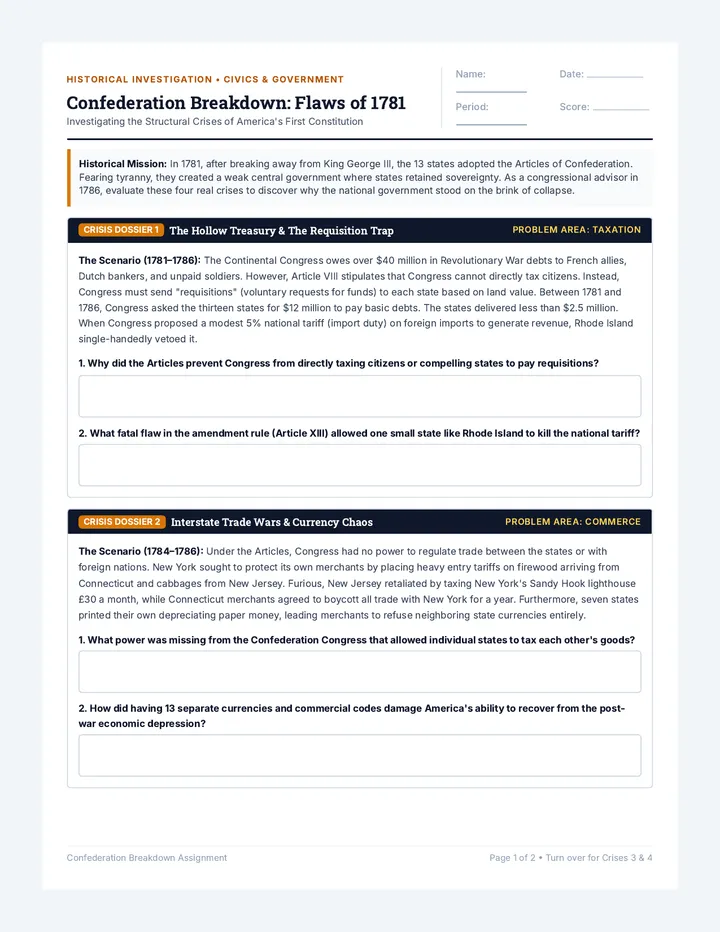
Confederation Breakdown Assignment Historical Investigation • Civics & Government
Confederation Breakdown: Flaws of 1781
Investigating the Structural Crises of America's First Constitution
Name:
Date:
Period:
Score:
Historical Mission: In 1781, after breaking away from King George III, the 13 states adopted the Articles of Confederation. Fearing tyranny, they created a weak central government where states retained sovereignty. As a congressional advisor in 1786, evaluate these four real crises to discover why the national government stood on the brink of collapse.
Crisis Dossier 1
The Hollow Treasury & The Requisition Trap
Problem Area: Taxation
The Scenario (1781–1786): The Continental Congress owes over $40 million in Revolutionary War debts to French allies, Dutch bankers, and unpaid soldiers. However, Article VIII stipulates that Congress cannot directly tax citizens. Instead, Congress must send "requisitions" (voluntary requests for funds) to each state based on land value. Between 1781 and 1786, Congress asked the thirteen states for $12 million to pay basic debts. The states delivered less than $2.5 million. When Congress proposed a modest 5% national tariff (import duty) on foreign imports to generate revenue, Rhode Island single-handedly vetoed it.
1. Why did the Articles prevent Congress from directly taxing citizens or compelling states to pay requisitions?
2. What fatal flaw in the amendment rule (Article XIII) allowed one small state like Rhode Island to kill the national tariff?
Crisis Dossier 2
Interstate Trade Wars & Currency Chaos
Problem Area: Commerce
The Scenario (1784–1786): Under the Articles, Congress had no power to regulate trade between the states or with foreign nations. New York sought to protect its own merchants by placing heavy entry tariffs on firewood arriving from Connecticut and cabbages from New Jersey. Furious, New Jersey retaliated by taxing New York's Sandy Hook lighthouse £30 a month, while Connecticut merchants agreed to boycott all trade with New York for a year. Furthermore, seven states printed their own depreciating paper money, leading merchants to refuse neighboring state currencies entirely.
1. What power was missing from the Confederation Congress that allowed individual states to tax each other's goods?
2. How did having 13 separate currencies and commercial codes damage America's ability to recover from the post-war economic depression?
Confederation Breakdown Assignment Page 1 of 2 • Turn over for Crises 3 & 4
Part B Continued National Defense, Foreign Contempt & Executive Paralysis
Student Response Dossiers
Crisis Dossier 3
Shays' Rebellion & Military Impotence
Problem Area: Defense
The Scenario (1786–1787): In western Massachusetts, Revolutionary War veteran Captain Daniel Shays led hundreds of armed, debt-crushed farmers to forcibly shut down county debt courts to prevent land foreclosures and debtors' prison. Shays then marched on the federal arsenal in Springfield to seize heavy artillery. Terrified state leaders asked Congress for federal military assistance. Congress voted to raise an army of 1,340 soldiers, but had no standing army and no funds to pay recruits. Only one state (Virginia) sent any money. Ultimately, wealthy Boston merchants had to privately finance a mercenary militia to suppress the revolt.
1. Why was the Confederation Congress unable to dispatch a national military force to defend federal property at Springfield?
2. Why did the sight of private citizens funding an army shock leaders like George Washington into demanding fundamental constitutional reform?
Crisis Dossier 4
Frontier Forts & Executive Paralysis
Problem Area: Executive Power
The Scenario (1783–1787): Under the 1783 Treaty of Paris, Great Britain promised to withdraw all troops from forts on American soil (such as Detroit and Oswego). Yet Britain defiantly occupied these forts, armed Native American tribes against settlers, and shut off British Caribbean ports to American ships. Britain pointed out that individual American states openly violated the peace treaty by refusing to compensate Loyalists or pay pre-war British debts. Under the Articles, there was no President, no cabinet department, and no federal court system to enforce national treaties on recalcitrant states.
1. What consequence did the complete absence of an executive branch (President or enforcement agency) have on enforcing national treaties?
2. Why did foreign empires view the Confederation Congress as a weak "committee" rather than a legitimate nation?
Part C: The Constitutional Verdict (Synthesis Assessment)
Crucial Judgment
Prompt: In May 1787, delegates gathered in Philadelphia originally to "revise" the Articles, but quickly decided to scrap them entirely. In your view, which of the four weaknesses (Taxation, Trade Regulation, National Defense, or Executive Power ) posed the single most immediate threat to America's survival? Defend your claim with evidence from the dossiers, and identify what new power the 1787 Constitution needed to fix it.
Confederation Breakdown Assignment Page 2 of 2 • Submit for Evaluation
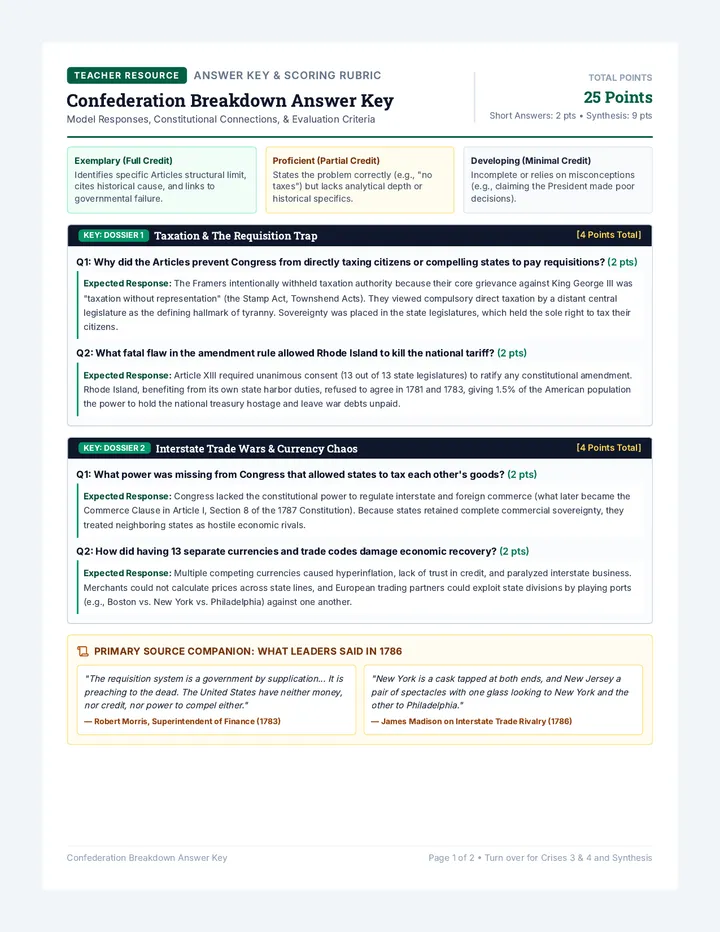
Confederation Breakdown Answer Key Teacher Resource Answer Key & Scoring Rubric
Confederation Breakdown Answer Key
Model Responses, Constitutional Connections, & Evaluation Criteria
Total Points
25 Points
Short Answers: 2 pts • Synthesis: 9 pts
Exemplary (Full Credit)
Identifies specific Articles structural limit, cites historical cause, and links to governmental failure.
Proficient (Partial Credit)
States the problem correctly (e.g., "no taxes") but lacks analytical depth or historical specifics.
Developing (Minimal Credit)
Incomplete or relies on misconceptions (e.g., claiming the President made poor decisions).
Key: Dossier 1
Taxation & The Requisition Trap
[4 Points Total]
Q1: Why did the Articles prevent Congress from directly taxing citizens or compelling states to pay requisitions? (2 pts)
Expected Response: The Framers intentionally withheld taxation authority because their core grievance against King George III was "taxation without representation" (the Stamp Act, Townshend Acts). They viewed compulsory direct taxation by a distant central legislature as the defining hallmark of tyranny. Sovereignty was placed in the state legislatures, which held the sole right to tax their citizens.
Q2: What fatal flaw in the amendment rule allowed Rhode Island to kill the national tariff? (2 pts)
Expected Response: Article XIII required unanimous consent (13 out of 13 state legislatures) to ratify any constitutional amendment. Rhode Island, benefiting from its own state harbor duties, refused to agree in 1781 and 1783, giving 1.5% of the American population the power to hold the national treasury hostage and leave war debts unpaid.
Key: Dossier 2
Interstate Trade Wars & Currency Chaos
[4 Points Total]
Q1: What power was missing from Congress that allowed states to tax each other's goods? (2 pts)
Expected Response: Congress lacked the constitutional power to regulate interstate and foreign commerce (what later became the Commerce Clause in Article I, Section 8 of the 1787 Constitution). Because states retained complete commercial sovereignty, they treated neighboring states as hostile economic rivals.
Q2: How did having 13 separate currencies and trade codes damage economic recovery? (2 pts)
Expected Response: Multiple competing currencies caused hyperinflation, lack of trust in credit, and paralyzed interstate business. Merchants could not calculate prices across state lines, and European trading partners could exploit state divisions by playing ports (e.g., Boston vs. New York vs. Philadelphia) against one another.
Primary Source Companion: What Leaders Said in 1786
"The requisition system is a government by supplication... It is preaching to the dead. The United States have neither money, nor credit, nor power to compel either."
— Robert Morris, Superintendent of Finance (1783)
"New York is a cask tapped at both ends, and New Jersey a pair of spectacles with one glass looking to New York and the other to Philadelphia."
— James Madison on Interstate Trade Rivalry (1786)
Confederation Breakdown Answer Key Page 1 of 2 • Turn over for Crises 3 & 4 and Synthesis
Key: Part B Continued Defense, Executive Power, & Synthesis Scoring
Evaluation Guide
Key: Dossier 3
Shays' Rebellion & Military Impotence
[4 Points Total]
Q1: Why couldn't Congress dispatch a national military force to defend Springfield? (2 pts)
Expected Response: Congress had no standing army and lacked the power to conscript troops or requisition funds to pay them. The military depended entirely on voluntary state militia contributions, and other states refused to send men or money to quell a civil disturbance in Massachusetts.
Q2: Why did private citizens funding an army shock national leaders? (2 pts)
Expected Response: It exposed complete anarchy: if a nation cannot protect its own arsenals and must rely on private mercenaries hired by wealthy merchants, the social contract has collapsed. George Washington warned that without a strong central government, the country was descending into "anarchy and confusion."
Key: Dossier 4
Frontier Forts & Executive Paralysis
[4 Points Total]
Q1: What consequence did the absence of an executive branch have on treaties? (2 pts)
Expected Response: Laws and treaties were purely symbolic because there was no executive to enforce compliance, command federal law enforcement, or punish defiant states. States regularly ignored federal treaties when convenient, proving that laws without enforcement are meaningless.
Q2: Why did foreign empires view Congress as a weak committee? (2 pts)
Expected Response: Foreign powers saw 13 separate sovereign states rather than a unified nation. Because Congress could not guarantee state compliance with trade agreements or back up its diplomacy with naval or military force, European powers treated American diplomats with contempt.
Part C: Synthesis Assessment Scoring Rubric & Exemplar [9 Points]
Rubric Matrix
Exemplar Argument (Taxation/Defense): "The inability to tax was the most fatal flaw because it undermined all other governmental duties. Without revenue, Congress could not pay Continental soldiers, could not pay foreign creditors to establish international credibility, and could not recruit troops to defend the Springfield arsenal during Shays' Rebellion. The 1787 Constitution solved this in Article I, Section 8 by granting Congress the explicit power to 'lay and collect Taxes, Duties, Imposts and Excises' directly on citizens."
Claim (3 pts): Clearly picks one weakness and articulates why it posed the greatest immediate threat.
Evidence (3 pts): Cites specific scenario details (e.g., $12M requested vs $2.5M paid, Shays' Rebellion).
Constitutional Fix (3 pts): Correctly identifies the 1787 Constitution's structural remedy.
Weakness (Articles of Confed.)
Historical Crisis Dilemma
1787 Constitutional Remedy
No Power to Tax
Hollow Treasury & $40M war debt unpaid
Art. I, Sec. 8: Direct power to lay & collect taxes
No Interstate Commerce Power
NY vs. NJ/CT tariff wars & currency chaos
Art. I, Sec. 8: Commerce Clause & single federal currency
No Standing Army
Shays' Rebellion & private merchant army
Art. I, Sec. 8: Power to raise & support armies/navy
No Executive Branch
British forts occupied & treaties ignored
Art. II: President as Chief Executive & Commander-in-Chief
Confederation Breakdown Answer Key Page 2 of 2 • Comprehensive Educator Guide