Stamp Act Showdown Slides
Colonial America • 1765
U.S. History Inquiry Unit
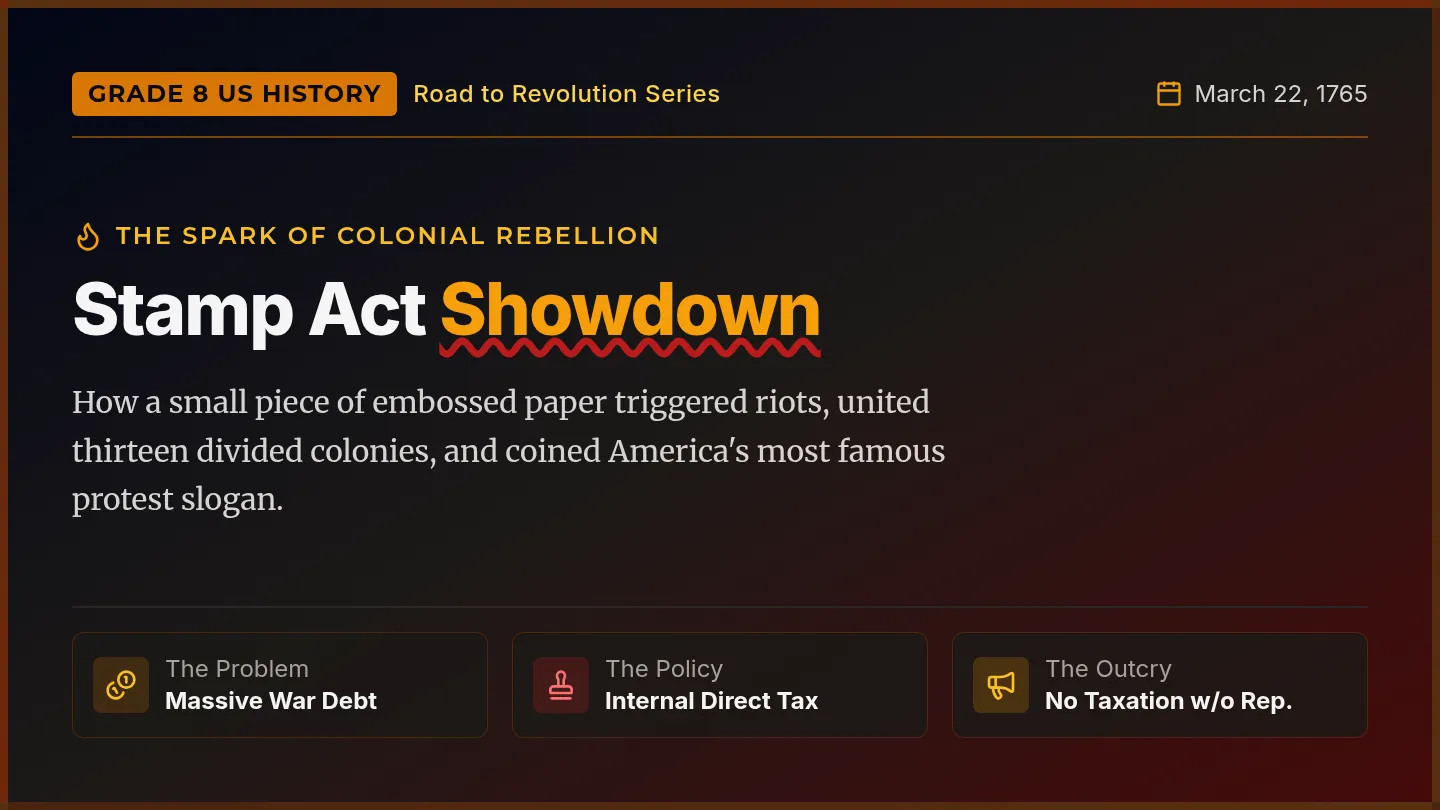
The Stamp Act Crisis
How a simple tax on paper ignited the spark of colonial revolution and forged American unity.
Parliament's New Law • Colonial Outrage • The Path to Rebellion
Essential Question: How did British taxation spark an identity crisis in the American colonies? 01 / 07
Historical Context 02 / 07
The Seeds of Conflict: Imperial War Debt
The French & Indian War
Britain defeated France in 1763, gaining vast North American territory but doubling its national debt to over £133 million.
London's View: British soldiers defended the colonies, so colonists should help pay the bill.
The End of "Salutary Neglect"
For over a century, Britain largely let colonies govern and tax themselves through their own local elected assemblies.
Colonial View: Colonists had paid with their own soldiers' blood and taxes; local assemblies held sovereign tax power.
Key Shift: Britain moved from loosely regulating trade to directly governing colonial pockets. 1754–1763 Debt Boom
The Legislation • March 1765 03 / 07
What Exactly Was the Stamp Act?
Unlike tariffs on imports, this was the first internal direct tax Parliament ever levied on colonists.
Printed Media
Newspapers, political pamphlets, calendars, and almanacs all required an embossed royal revenue stamp.
Legal Documents
Land deeds, court papers, contracts, wills, marriage licenses, and university diplomas were heavily taxed.
Daily Goods
Tavern licenses, liquor sales documents, even playing cards and sets of dice carried mandatory stamp duties.
Violators were tried in British Vice-Admiralty Courts without juries—violating the historic rights of Englishmen!
The Core Dispute 04 / 07
"No Taxation Without Representation!"
The protest was not simply about the money—it was about constitutional principle.
Parliament: "Virtual" Representation
British Prime Minister George Grenville claimed every Member of Parliament represented all British subjects everywhere in the empire, whether colonists voted for them or not.
London's Stance: Parliament is supreme.
Colonists: "Actual" Representation
Colonists pointed out they elected zero members to Parliament across 3,000 miles of ocean. By English law, free citizens could only be taxed by their own elected representatives.
Colonial Stance: Only local assemblies can tax us.
Patrick Henry in Virginia: "Caesar had his Brutus, Charles I his Cromwell... if this be treason, make the most of it!" May 1765
The Backlash 05 / 07
Three Fronts of Colonial Resistance
Political Unity
Stamp Act Congress
Delegates from 9 colonies gathered in New York (Oct 1765)—the first united intercolonial meeting to issue formal petitions of grievance.
Colonial cooperation begins
Economic Boycotts
Non-Importation
Merchants refused to buy British manufactured goods. British merchants suffered massive trade losses and panicked in London.
Hit London merchants' profits
Street Action
Sons of Liberty
Led by Samuel Adams and others, mobs hanged stamp collectors in effigy, sacked tax officials' homes, and forced all stamp distributors to resign.
Zero stamps were ever sold
Result: By November 1, 1765 (when the Act took effect), there was no one left willing to collect the tax! Fall 1765
The Outcome • March 1766 06 / 07
Victory with a Hidden Sting
The Repeal (March 1766)
Facing furious British merchant protests and total colonial refusal, Parliament voted to repeal the Stamp Act.
Colonists celebrated in the streets with bonfires and church bells, believing their rights were confirmed.
The Declaratory Act (1766)
On the very same day, Parliament passed a new law declaring it had the absolute authority to bind the colonies:
“...in all cases whatsoever.”
The fundamental constitutional disagreement was never resolved.
The stage was now set for the Townshend Acts, the Boston Tea Party, and armed revolution. 1766 Turning Point
Inquiry Challenge 07 / 07
Now It's Your Turn: Historical Investigation
Question 1: Legal Principles
Why did the colonists distinguish so fiercely between external trade duties and an internal tax like the Stamp Act?
Question 2: Methods of Protest
Which form of colonial resistance was most effective in forcing Parliament's hand: political petitions, economic boycotts, or street intimidation?
Transition to your Stamp Act Analysis Worksheet for primary source investigation.
Turn to Part 1: Primary Source Examination Investigation Time
Stamp Act Analysis Worksheet
Colonial America • Primary Source Investigation
The Stamp Act Crisis of 1765
Document Analysis, Constitutional Principles & Colonial Resistance
Name:
Date:
Period:
Score:
Historical Context: In March 1765, the British Parliament passed the Stamp Act to pay debts from the French and Indian War. It was the first direct internal tax levied on American colonists, requiring revenue stamps on all printed papers, legal contracts, newspapers, and pamphlets.
Part 1: Primary Source Investigation
Analyze the artifact and text below
Colonial Protest Artifact
☠
This is the fatal STAMP
"An Emblem of the Effects of the STAMP - O! the fatal Stamp"
Source: Pennsylvania Journal, October 31, 1765. The publisher announced the paper's suspension rather than pay for the required royal tax stamp.
Key Symbol: The skull and crossbones mockingly replaced the royal British coat-of-arms.
Declaration of Rights and Grievances Oct 19, 1765
“That it is inseparably essential to the freedom of a people, and the undoubted right of Englishmen, that no taxes be imposed on them, but with their own consent, given personally, or by their representatives... That the only representatives of the people of these colonies, are persons chosen therein by themselves; and that no taxes ever have been, or can be constitutionally imposed on them, but by their respective legislatures.”
Context: Passed unanimously by delegates from 9 colonies at the Stamp Act Congress in New York City.
1. [Visual Analysis] Why did colonial printers use a skull and crossbones to symbolize the British tax stamp? What message were they sending to their readers and British officials?
2. [Textual Evidence] According to the Stamp Act Congress, what ancient "right of Englishmen" did Parliament violate? Quote one specific phrase from the document to support your answer.
3. [Internal vs. External] Colonists had long paid tariffs on imported goods (external trade taxes). Why did they view an internal tax on paper items as a far more dangerous threat to liberty?
Stamp Act Revolt • Student Investigation Guide Turn to Page 2 for Resistance & Effects →
The Stamp Act Crisis | Part 2: Resistance, Repercussions & Historical Debate
Page 2 of 2
Part 2: Categorizing Colonial Resistance
Summarize how each method functioned
| Method of Protest |
Key Actions & Organizers |
Immediate Impact |
| 1. Economic Boycotts (Non-Importation) |
Colonial merchants pledged not to import British manufactured goods; homespun clothing replaced British cloth. |
British merchants faced severe financial collapse and begged Parliament to repeal the law. |
| 2. Street Action & Mobs (Sons of Liberty) |
Organized protests, burned stamp distributors in effigy, raided Lieutenant Governor Hutchinson's home in Boston. |
All stamp distributors resigned in terror; virtually zero stamps were ever purchased or distributed. |
| 3. Political Petitions (Stamp Act Congress) |
Delegates drafted formal, polite resolutions affirming loyalty to King George III while denying Parliament's right to tax them. |
Established first successful intercolonial cooperation and articulated core constitutional arguments. |
4. [The Representation Debate] British leaders argued colonists had "virtual representation" in Parliament, while colonists demanded "actual representation." Explain the fundamental difference between these two views.
5. [The Declaratory Act Trap] In March 1766, Parliament repealed the Stamp Act but immediately passed the Declaratory Act, claiming power to bind the colonies "in all cases whatsoever." Why did this set the stage for inevitable future conflict?
6. [Historical Evaluation] Looking back at the three resistance methods (boycotts, street violence, and political petitions), which one was most decisive in compelling Parliament to repeal the tax? Defend your claim with historical reasoning.
Self-Check: Did you refer to specific historical evidence (merchants, Parliament, Sons of Liberty) in Question 6?
Yes Needs Review
Stamp Act Revolt • Student Investigation Guide Teacher Check: ___________