Boston Revolution Scaffolded Worksheet
7th Grade Social Studies • Guided Inquiry
Boston on the Road to Revolution
Chunked Reading, Primary Source Investigation & Evidence-Based Writing
Name:
Date: Class:
Key Vocabulary / Palabras Clave:
Tension (Tensión): Anger or friction between opposing groups.
Propaganda (Propaganda): Biased media created to sway public opinion.
Sons of Liberty (Hijos de la Libertad): Patriot protest group led by Samuel Adams.
Part 1: Redcoats Arrive in Boston (1768)
By the late 1760s, Boston had become the center of colonial anger toward Britain. It was home to a strong Sons of Liberty group led by Samuel Adams. After colonists protested the Townshend Acts, Britain sent about 2,000 soldiers to Boston in 1768. Soldiers and colonists lived and worked side by side, and fights broke out often.
Checkpoint 1: Why did tensions between colonists and soldiers grow so high in Boston? Use evidence from the reading.
Sentence Starter: Tensions between colonists and soldiers grew so high because Britain sent about ____________ soldiers to Boston, and...
Part 2: The Boston Massacre (March 5, 1770) — Reading & Primary Source
Primary Source Investigation
On the night of March 5, 1770, an argument on King Street grew into an angry crowd of colonists throwing snowballs, ice, and sticks at British soldiers. The soldiers, commanded by Captain Thomas Preston, fired into the crowd. Five colonists were killed: Crispus Attucks, Samuel Gray, James Caldwell, Samuel Maverick, and Patrick Carr. Shortly after, Patriot silversmith Paul Revere created the famous engraving below, titled "The Bloody Massacre." It depicted the soldiers calmly firing in unison on defenseless citizens. This powerful propaganda spread across the colonies, enraging colonists.

Paul Revere: "The Bloody Massacre perpetrated in King-Street" (1770)
🔍 Look Closely at the Engraving:
- British soldiers lined up firing together like an execution squad
- Captain Preston standing behind soldiers raising his sword
- Unarmed colonists falling; building labeled "Butcher's Hall"
Checkpoint 2: How did the conflict begin, and who was killed?
Starter: The confrontation began when colonists threw ____________________. Five colonists were killed, including...
Checkpoint 3: Compare reality to Revere's picture. Why did he draw it this way?
Starter: In reality, colonists were throwing ice, but Revere drew soldiers as ____________________ because he wanted colonists to feel...
Unit 3: Road to the American Revolution Page 1 of 2 • Continue on Back →
Boston on the Road to Revolution — Part II
Student: ____________________
Part 3: The Soldiers' Trial & John Adams
Patriot lawyer John Adams took the controversial step to defend the British soldiers in court. Even though Adams strongly opposed British taxes, he believed that justice required a fair trial under the law. In the end, six of the soldiers were found not guilty and two were convicted of manslaughter.
Checkpoint 4: Why do you think John Adams, a dedicated Patriot, chose to defend the British soldiers in court?
Sentence Starter: John Adams chose to defend the soldiers in court because he believed that...
Part 4: The Tea Party & The Intolerable Acts (1773–1774)
On December 16, 1773, the Sons of Liberty protested the Tea Act. Disguised as Mohawk Indians, they boarded three ships and dumped 342 chests of tea into Boston Harbor. Britain responded in 1774 with the Intolerable Acts. These laws closed Boston Harbor, limited self-government in Massachusetts, and forced colonists to house soldiers. Instead of scaring the colonies, the Intolerable Acts united them. The colonies met at the First Continental Congress, and in April 1775, fighting began at Lexington and Concord.
Checkpoint 5 (Critical Thinking): Britain passed the Intolerable Acts to punish Boston and stop the protests. Did this plan work? Explain with evidence.
Sentence Starter: Britain's plan (did / did not) work because instead of scaring the colonies, the Intolerable Acts actually ________________________. For example, the text states...
Closing Synthesis: How Each Event Led to the Next
1768–1770
Troops arrive; tensions lead to Boston Massacre.
1773
Tea Act passed; Sons of Liberty dump 342 chests.
1774
Britain punishes Boston with Intolerable Acts.
1774–1775
Colonies unite at Congress; war begins!
Extension Challenge / Reto de Extensión:
Why did Paul Revere title his artwork "The Bloody Massacre" instead of "The King Street Riot"? How does specific word choice influence the emotions of readers?
Daily Formative Assessment
Exit Ticket
1–2 Minutes
Which event—the Boston Massacre, the Boston Tea Party, or the Intolerable Acts—do you think did the most to lead the colonies to war? Explain your choice using evidence from today's lesson.
Sentence Starter: In my opinion, the ________________________ did the most to lead the colonies to war because...
Boston on the Road to Revolution • Scaffolded Learning Task Page 2 of 2
Boston Revolution Answer Key
Teacher Resource • Complete Answer Key Grade 7 Social Studies
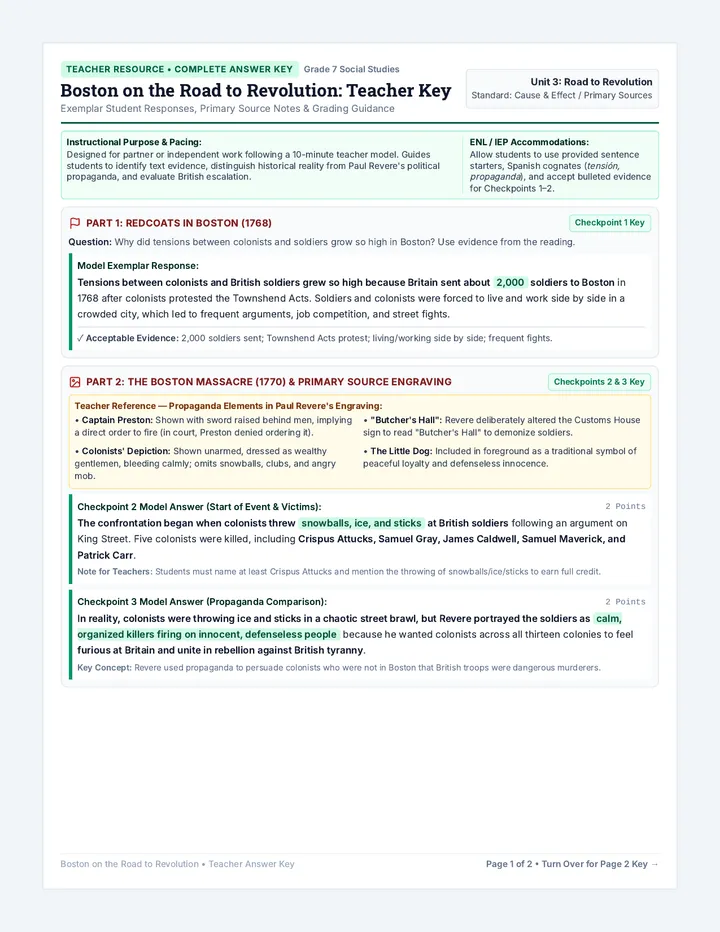
Boston on the Road to Revolution: Teacher Key
Exemplar Student Responses, Primary Source Notes & Grading Guidance
Unit 3: Road to Revolution
Standard: Cause & Effect / Primary Sources
Instructional Purpose & Pacing: Designed for partner or independent work following a 10-minute teacher model. Guides students to identify text evidence, distinguish historical reality from Paul Revere's political propaganda, and evaluate British escalation.
ENL / IEP Accommodations: Allow students to use provided sentence starters, Spanish cognates (tensión, propaganda), and accept bulleted evidence for Checkpoints 1–2.
Part 1: Redcoats in Boston (1768)
Checkpoint 1 Key
Question: Why did tensions between colonists and soldiers grow so high in Boston? Use evidence from the reading.
Model Exemplar Response:
Tensions between colonists and British soldiers grew so high because Britain sent about 2,000 soldiers to Boston in 1768 after colonists protested the Townshend Acts. Soldiers and colonists were forced to live and work side by side in a crowded city, which led to frequent arguments, job competition, and street fights.
✓ Acceptable Evidence: 2,000 soldiers sent; Townshend Acts protest; living/working side by side; frequent fights.
Part 2: The Boston Massacre (1770) & Primary Source Engraving
Checkpoints 2 & 3 Key
Teacher Reference — Propaganda Elements in Paul Revere's Engraving:
• Captain Preston: Shown with sword raised behind men, implying a direct order to fire (in court, Preston denied ordering it).
• "Butcher's Hall": Revere deliberately altered the Customs House sign to read "Butcher's Hall" to demonize soldiers.
• Colonists' Depiction: Shown unarmed, dressed as wealthy gentlemen, bleeding calmly; omits snowballs, clubs, and angry mob.
• The Little Dog: Included in foreground as a traditional symbol of peaceful loyalty and defenseless innocence.
Checkpoint 2 Model Answer (Start of Event & Victims): 2 Points
The confrontation began when colonists threw snowballs, ice, and sticks at British soldiers following an argument on King Street. Five colonists were killed, including Crispus Attucks, Samuel Gray, James Caldwell, Samuel Maverick, and Patrick Carr.
Note for Teachers: Students must name at least Crispus Attucks and mention the throwing of snowballs/ice/sticks to earn full credit.
Checkpoint 3 Model Answer (Propaganda Comparison): 2 Points
In reality, colonists were throwing ice and sticks in a chaotic street brawl, but Revere portrayed the soldiers as calm, organized killers firing on innocent, defenseless people because he wanted colonists across all thirteen colonies to feel furious at Britain and unite in rebellion against British tyranny.
Key Concept: Revere used propaganda to persuade colonists who were not in Boston that British troops were dangerous murderers.
Boston on the Road to Revolution • Teacher Answer Key Page 1 of 2 • Turn Over for Page 2 Key →
Teacher Answer Key — Page 2: Aftermath, Acts & Exit Ticket Rubric
Grading & Assessment Guide
Part 3: The Soldiers' Trial & John Adams
Checkpoint 4 Key
Model Exemplar Response:
John Adams chose to defend the soldiers in court because he believed that every person accused of a crime deserves a fair trial under the rule of law, regardless of their nationality or how unpopular they were. Adams wanted to show that American Patriots stood for real justice and constitutional principles rather than mob violence.
Trial Outcome: 6 soldiers acquitted; 2 convicted of manslaughter. Proved Boston courts could be fair.
Part 4: Boston Tea Party & Intolerable Acts (1773–1774)
Checkpoint 5 Key
Model Exemplar Response:
Britain's plan did not work because instead of scaring the colonies, the Intolerable Acts actually united the thirteen colonies together in resistance. Evidence from the text states that the colonies gathered at the First Continental Congress, stood together against British military rule, and by April 1775 began armed fighting at Lexington and Concord.
Verbal Closing Synthesis Check (1-Minute Question Solution):
How each event caused the next: 1. British troops arrive in 1768 → Sparks street tensions and Boston Massacre (1770). 2. Tea Act sparks the Boston Tea Party (1773). 3. King George III punishes Boston with Intolerable Acts (1774). 4. Colonies unite at Continental Congress, arm militias, and spark war at Lexington & Concord (1775).
Extension Challenge Model Answer:
Diction Analysis: Paul Revere chose "Massacre" because that word implies the cruel, unprovoked slaughter of helpless victims by monsters. Naming it "The King Street Riot" would have suggested colonists were violent instigators. Word choice directly shapes emotional response and public blame.
Exit Ticket Grading Rubric
Formative Assessment Scoring Guide (3 Points Total)
All 3 Choices Acceptable with Evidence
Claim (1 Pt): States clearly which of the three events led most directly to war.
Text Evidence (1 Pt): Cites at least one specific historical detail from the reading passage.
Reasoning (1 Pt): Explains why that event was the tipping point toward armed revolution.
If student chooses Boston Massacre (1770): "It was the first time British soldiers shed American blood, creating martyrs and spreading anti-British propaganda that made peace impossible."
If student chooses Boston Tea Party (1773): "It showed direct colonial defiance by destroying 342 chests of tea, forcing King George III to pass harsh punishments that triggered the war."
If student chooses Intolerable Acts (1774): "It took away Massachusetts self-government, closed the harbor, and directly united all thirteen colonies to meet at the Continental Congress and fight."
Boston on the Road to Revolution • Teacher Answer Key & Assessment Rubric Page 2 of 2