Lenny.com
Explore
Create
ActivitiesNewMathEnglish Language ArtsScience & EngineeringSocial StudiesGlobal LanguagesHealth & Physical EducationSpecial EducationCounseling & Life SkillsArts & CreativityESL
Lenny.com
Lenny.com
Explore
Create
ActivitiesNewMathEnglish Language ArtsScience & EngineeringSocial StudiesGlobal LanguagesHealth & Physical EducationSpecial EducationCounseling & Life SkillsArts & CreativityESL
Lenny.com
Lenny.com

Solutions

Lenny for EducatorsLenny for SchoolsLenny for Districts

Product

ExploreSign inCreateSupportAbout

Resources

Getting startedMTSS Acceleration Program

Newsletters

School Funding Newsletter

© 2026 Lenny Learning Inc.

TermsPrivacyAccessibility
LinkedInInstagramX
Lenny

Political Participation

Voting mechanisms, election cycles, and diverse forms of civic engagement like lobbying and grassroots activism. Analyzes the influence of political parties, interest groups, and public opinion on democratic decision-making.

Social StudiesSocial Studies PracticesLocation WordsMapsOrder EventsChronology and CausationEvaluating SourcesHistorical ThinkingGeography, Humans, & the EnvironmentAmerican Symbols and LandmarksCitiesStatesState CapitalsRegions of the United StatesGeographic SkillsPhysical GeographyHuman GeographyRegional GeographyGeography of AfricaGeography of AsiaGeography of EuropeGeography of OceaniaGeography of the AmericasSociety and Environment of EuropeSociety and Environment of AsiaSociety and Environment of The AmericasSociety and Environment of the Middle EastSociety and Environment of AfricaHistoryPrehistoryComparing Ancient River CivilizationsAncient MesopotamiaAncient Egypt and KushAncient South AsiaEarly ChinaGreeceRome and the Byzantine EmpireAncient World HistoryNative Peoples of North AmericaNative Peoples of Mesoamerica and South AmericaAfrican EmpiresMedieval AsiaMedieval EuropeThe Silk RoadMedieval HistoryIslamic EmpiresWorld ReligionsRenaissance PeriodAge of ExplorationThe Thirteen ColoniesThe American RevolutionUS History Early RepublicFounding of the United StatesUS History AntebellumUS Civil WarReconstruction PeriodThe Gilded AgeUS ImperialismWorld ImperialismWorld War IUS History 1920sGreat DepressionWorld War IIThe Cold WarUS History 1950-60sUS History 1960s-70sWorld History 20th CenturyContemporary US HistoryContemporary World HistoryHolidaysCivics and GovernmentCitizenshipGovernment FoundationsThe ConstitutionUS ConstitutionExecutive BranchLegislative BranchJudicial BranchState and LocalPolitical ParticipationPublic PolicyPolitical SystemsPower and AuthoritySocial MovementsDefining DevianceTheories of DevianceCrime and Criminal JusticeEconomicsBasic Economic PrinciplesSupply and DemandWhat is MoneyEconomic FundamentalsMicroeconomicsMacroeconomicsBanking and FinanceEconomic SystemsGlobal EconomicsCorporations and PowerThe Changing WorkplaceUnemployment and LaborClass and InequalitySocial MobilityGlobal InequalityPsychologyHistory of PsychologyPsychology as a ScienceBrain and Nervous SystemNeuroscience and BehaviorGenetics and BehaviorSleep and ConsciousnessSensory ProcessesPerceptual OrganizationClassical ConditioningOperant ConditioningObservational LearningCognitive LearningMemory ProcessesThinking and Problem SolvingLanguage and CognitionTheories of MotivationStress and CopingPrenatal and Infant DevelopmentChildhood DevelopmentAdolescent DevelopmentAdulthood and AgingSelf and IdentitySocial CognitionSocial InfluenceAttraction and RelationshipsGroup BehaviorPrejudice and DiscriminationAnxiety and Mood DisordersClinical PsychologyForensic PsychologyPhilosophy & EthicsIntroduction to PhilosophyMajor Philosophers & IdeasMind and Body ProblemFree Will vs DeterminismEthics & MoralityReligion & PhilosophyPolitical Philosophy

Videos

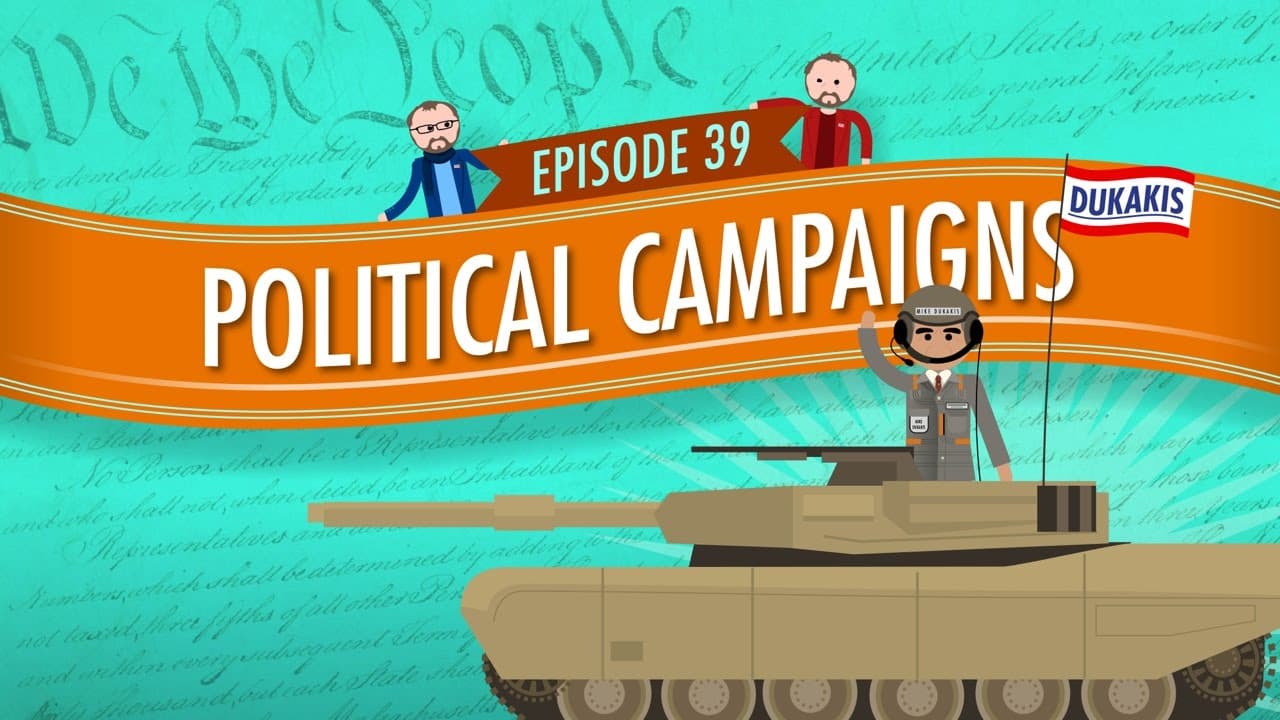
How US Political Campaigns Work and Finance Laws Explained

How US Political Campaigns Work and Finance Laws Explained

This episode of Crash Course Government and Politics dives deep into the complex machinery of American political campaigns. Host Craig Benzine breaks down exactly what a campaign is—an organized drive to get a candidate elected—and explores the intricate structures behind them, from local volunteers to national committees like the DNC and RNC. The video explains the primary function of campaigns: to provide voters with the information necessary to choose their representatives, while also examining the various methods used to disseminate that information, such as stump speeches, debates, and modern digital advertising. A significant portion of the video is dedicated to the controversial and confusing world of campaign finance. It traces the history of regulations from the Federal Election Campaign Act of 1971 to the McCain-Feingold Act of 2002, and finally to the landmark Citizens United Supreme Court decision. Viewers will learn about the critical legal distinction between limiting campaign *donations* versus limiting campaign *spending*, the rise of PACs, Super PACs, and 527 groups, and the constitutional arguments equating money with free speech. For educators, this video is an essential resource for high school Civics and Government units on elections. It moves beyond simple definitions to tackle the nuanced debate between preventing corruption and protecting free speech. The content provides a balanced look at why campaigns are so long and expensive, offering data-driven context—comparing election spending to national potato chip consumption—that helps students critically evaluate common media narratives about money in politics.

CrashCourseCrashCourse

9mins 36s

How Voters Decide: The Three Factors Influencing American Elections

How Voters Decide: The Three Factors Influencing American Elections

In this episode of Crash Course Government and Politics, host Craig Benzine explores the complex psychology and political science behind how American voters make decisions at the ballot box. While we might like to think every vote is a carefully weighed policy decision, the video reveals that voting behavior is largely driven by three distinct factors: party loyalty, candidate characteristics, and specific political issues. Craig explains that for most voters, the single strongest predictor of their vote is simply the political party they identify with, often influenced by their family upbringing.

CrashCourseCrashCourse

7mins 36s

How Students Led the Civil Rights Movement

How Students Led the Civil Rights Movement

This educational video from Crash Course Black American History explores the pivotal role that students and young people played in the Civil Rights Movement. While historical narratives often focus on singular charismatic leaders like Dr. Martin Luther King Jr., this episode highlights how the courage, organization, and persistence of ordinary high school and college students drove significant social change. The video specifically examines three major student-led initiatives: the integration of Central High School by the Little Rock Nine, the lunch counter sit-ins sparked by the Greensboro Four, and the Freedom Rides organized by groups like SNCC (Student Non-Violent Coordinating Committee). The video delves into the specific strategies of "non-violent direct action," explaining that it was not passive but an active, disciplined, and dangerous tactic that required immense self-control. It details the harrowing experiences of the Little Rock Nine facing mob violence and the National Guard, the rapid spread of the sit-in movement across 55 cities, and the violence faced by Freedom Riders in Alabama. The narrative connects these historical events to the organizational genius of figures like Ella Baker, who empowered students to form their own independent leadership structures. For educators, this video serves as a powerful tool to engage students by showing them historical figures their own age who shaped American history. It moves beyond the "Great Man" theory of history to show grassroots organizing in action. It provides clear definitions of key organizations (NAACP, SCLC, SNCC, CORE) and legal contexts (Brown v. Board of Education) while inviting students to reflect on their own agency and capacity to effect change in their communities today.
CrashCourseCrashCourse

13mins 27s

Reform and Revolution in Post-Napoleonic Europe

Reform and Revolution in Post-Napoleonic Europe

This educational video explores the turbulent period of European history between the fall of Napoleon in 1815 and the widespread revolutions of 1848. It examines the tension between the conservative order established by the Congress of Vienna and the rising tides of liberalism, nationalism, and socialism. The narrative covers significant geopolitical shifts, including Latin American independence movements, the Decembrist Revolt in Russia, the Greek War of Independence, and the 1830 Revolution in France. Key themes include the struggle for popular sovereignty against absolutist monarchies, the impact of industrialization on social structures, and the emergence of new political ideologies like Utopian Socialism. The video details specific historical events such as the Peterloo Massacre in Britain and the passing of the Great Reform Act of 1832, illustrating how public pressure and activism began to force incremental changes in governance and voting rights across the continent. For educators, this video serves as an excellent overview of the "Age of Isms" and the political unrest that defined early 19th-century Europe. It connects complex political theories to tangible historical events, making abstract concepts accessible. The content is particularly useful for analyzing the causes of social unrest, the evolution of modern democracy, and the role of art and literature (via Romanticism) in shaping political movements.

CrashCourseCrashCourse

14mins 6s

Regulating Online Speech in a Digital World

Regulating Online Speech in a Digital World

This educational video explores the complex relationship between free speech, democratic values, and content moderation in the digital age. It begins by distinguishing between government-protected civil liberties and the rights of private social media platforms to moderate content, introducing key legal frameworks like Section 230 of the Communications Decency Act. The narrator explains how social media companies have essentially created their own "platform law" to police content, acting as arbitrators of truth without the checks and balances of traditional government institutions. The video details the mechanisms of content moderation, including user flagging and artificial intelligence, while highlighting the limitations of AI in detecting nuance like sarcasm. It then categorizes potential solutions to the disinformation crisis into four approaches: Public-to-Private (like Germany's NetzDG law), Government interventions (such as internal referral units or content filters), Market-based solutions (adjusting algorithms for social value), and Consumer-focused strategies (teaching digital literacy and signaling authority). This resource is highly valuable for Civics, Government, and Media Literacy classrooms. It moves beyond simple definitions to analyze the structural challenges of regulating online speech. Teachers can use this video to spark high-level debates about censorship, corporate responsibility, and the trade-offs between safety and freedom. It provides concrete examples of global policies, making it an excellent tool for comparative government studies and discussions on digital citizenship.

Miacademy & MiaPrep Learning ChannelMiacademy & MiaPrep Learning Channel

13mins 18s

Understanding Government and Politics: The Engine and the Driver

Understanding Government and Politics: The Engine and the Driver

This engaging educational video introduces students to the fundamental concepts of government and politics, distinguishing clearly between the two often-confused terms. Using accessible analogies—specifically comparing government to a car's engine and politics to the driver—the narrator explains how these systems function to organize society. The video emphasizes that government is a tool for social control and management, while politics is the process by which decisions are made regarding society's direction and resource distribution. Key themes include the distinction between power and authority, the crucial role of individual rights in checking government power, and the concept of "mass politics" where ordinary citizens participate through voting, debating, and protesting. The lesson also explores the historical origins of governance, tracing it back to family units, clans, and early agricultural societies like the Natufians, showing how increased population density necessitated written laws and formal structures. This resource is highly valuable for Civics and Social Studies classrooms as it simplifies abstract political science concepts into tangible examples. It empowers students by highlighting their role as future active citizens who hold the ultimate political power. The video sets a strong foundation for units on the Constitution, types of government, or the evolution of human civilization.

Miacademy & MiaPrep Learning ChannelMiacademy & MiaPrep Learning Channel

8mins 39s

Materials

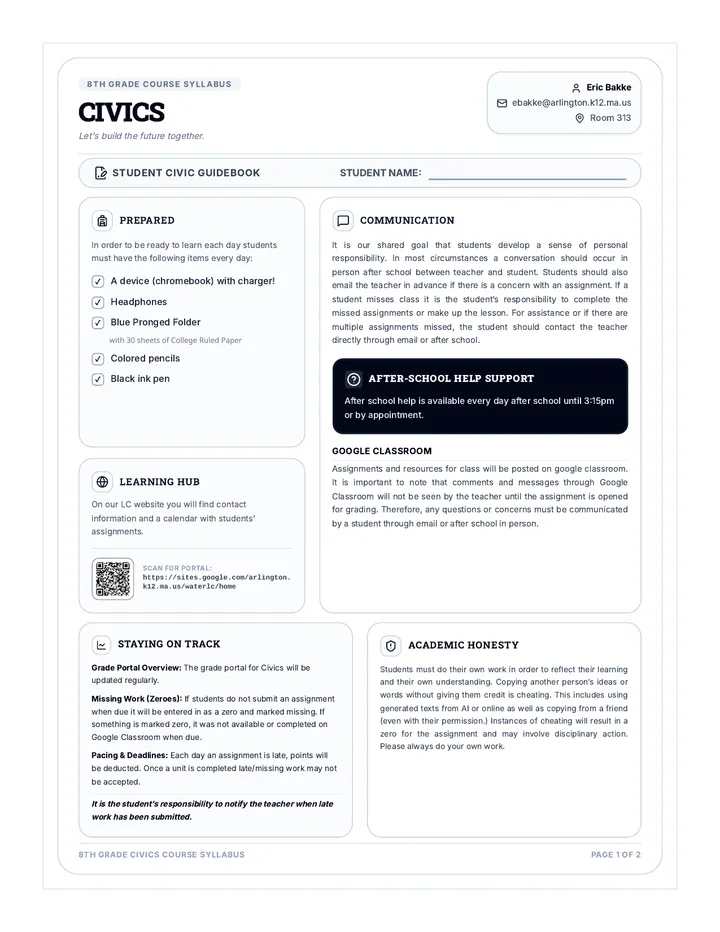
Civics Class Syllabus

Civics Class Syllabus

Civics Class Syllabus updated with an extra large QR code filling approximately half of the Digital Spaces container for maximum visibility and effortless scanning.

E

ebakke

Council Minutes Packet

Council Minutes Packet

An elementary-friendly, three-page Student Council Meeting Record Packet designed for 3rd-5th grade secretaries. Includes clear, spacious sections for meeting details, officer and grade-level class representative attendance, large lined discussion areas, simple vote tallies, an action to-do list, and dual sign-offs for both the secretary and faculty advisor.

KP

Katherine Perkins

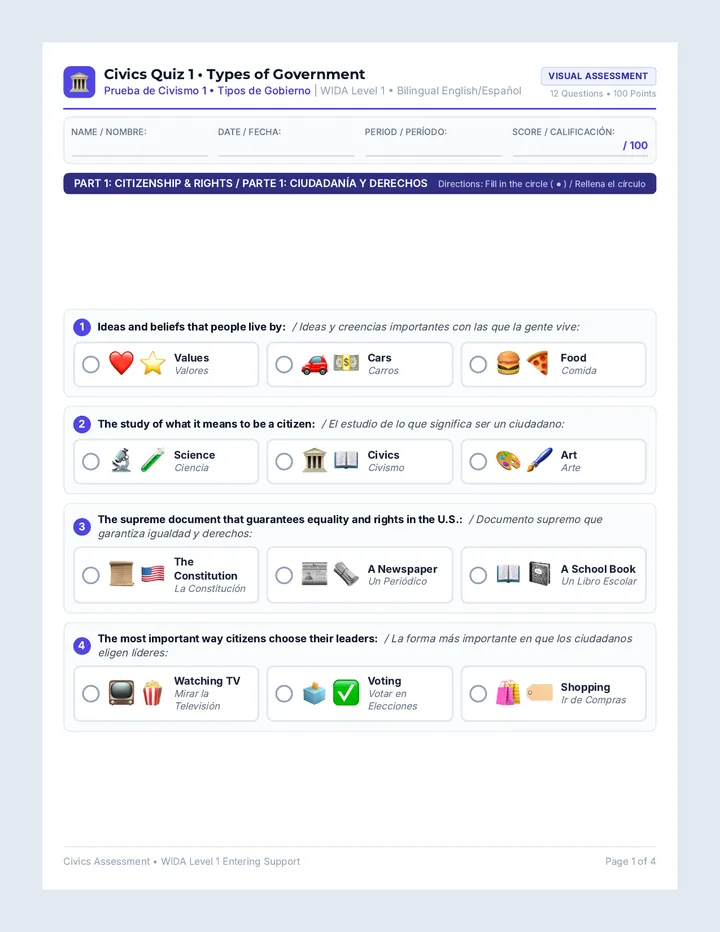
Bilingual Civics Picture Quiz

Bilingual Civics Picture Quiz

A 4-page print-ready bilingual (English and Spanish) Civics and Types of Government quiz specifically modified for WIDA Level 1 English Learners, featuring simplified sentence frames, pictorial icons for every prompt and choice, identical answer styling, and an educator scoring and accommodations guide.

N

nebouchard

Central American Freedom Reading Worksheet

Central American Freedom Reading Worksheet

A Grade 8-9 dual-language reading and multiple-choice worksheet covering Central American Independence Day (September 15, 1821). Features a 4-paragraph parallel English and Spanish text alongside 6 standards-aligned bilingual multiple choice questions assessing key historical concepts, leaders, and civic traditions.

GJ

Gerardo Jimenez Ramirez

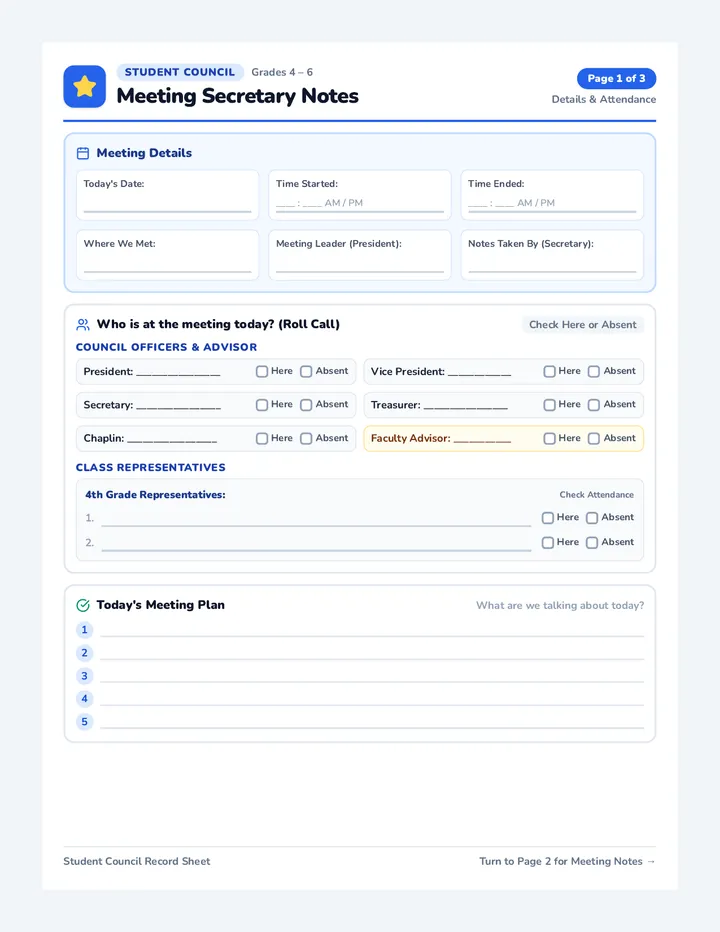
Council Minutes Packet

Council Minutes Packet

An elementary-friendly, three-page Student Council Meeting Record Packet designed for 4th-6th grade secretaries. Includes roll call with Chaplin, 2 dedicated lines for 4th grade class representatives, a 5-item meeting plan, 3 discussion topics, 3 vote tallies, an expanded 6-item to-do list, and dual sign-offs.

RJ

Rachel Johnston

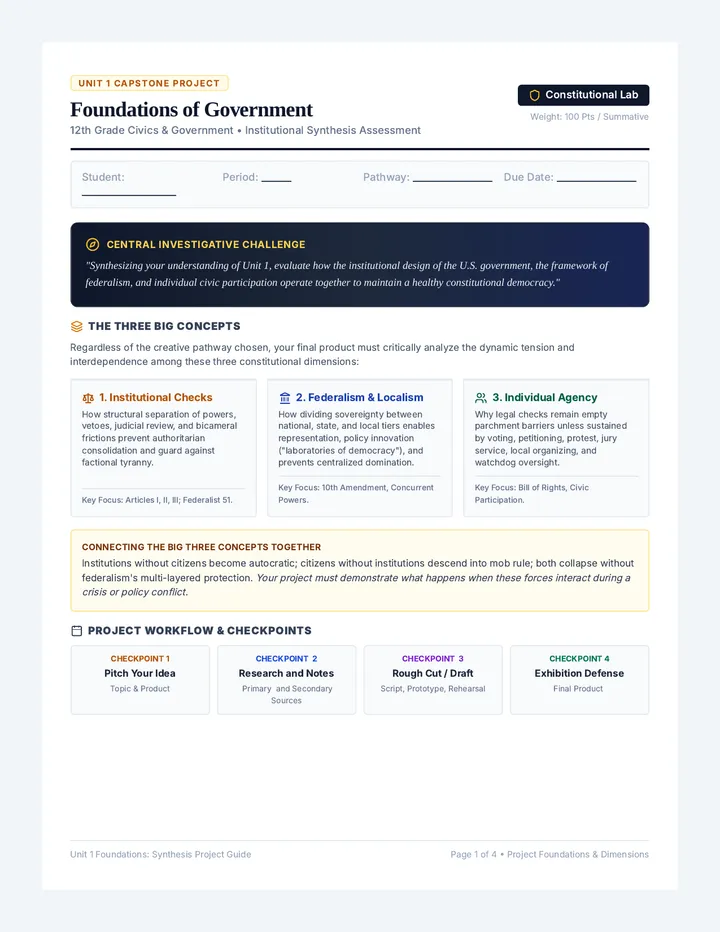
Democracy Design Project Guide

Democracy Design Project Guide

A comprehensive 4-page student project assignment guide for 12th-grade Civics and Government, detailing 5 creative project pathways (podcast, documentary, interview simulation, reader's theater drama, and board/card game), an analytical rubric across the three core constitutional dimensions, and a student planning blueprint.

JG

Joshua Griffith

Sequences

Invention Boom Slides

Modern Era Odyssey

A 13-day journey through modern American history, from the Industrial Revolution to the present day, focusing on key historical figures and major conflicts as outlined in the 5th Grade TEKS. Each lesson is designed for a quick 30-minute block, integrating multimedia and primary source analysis.

CH

Courtney Holdren

49
Cotton Kingdom Slides

Divided Nation

A 4-part exploration of the deep-seated tensions and pivotal events that led the United States to the brink of the Civil War, focusing on economic shifts, legislative compromises, and political flashpoints.

IA

Isabella Adkins

9
Teacher Facilitation Guide

Revolutionary Dilemmas

A comprehensive book club unit for the historical fiction novel 'My Brother Sam is Dead', focusing on the moral complexities of the Revolutionary War, character transformation, and historical context.

KL

Kim Leary

8
Thirteen Friends Worksheet

Democratic Foundations

A series of lessons exploring the foundational documents and processes of the United States government, from the birth of the nation to the creation of modern laws.

SB

Stephanie Bizeur

40
Unity Roadmap Teacher Guide

Unity and Growth

A modified Modern US History curriculum (Founding to Present) for Tier 2 and 3 special education students, based on Grade 11 Social Studies standards. Focuses on government, industrialization, world wars, and civil rights.

D

dfleisch

26
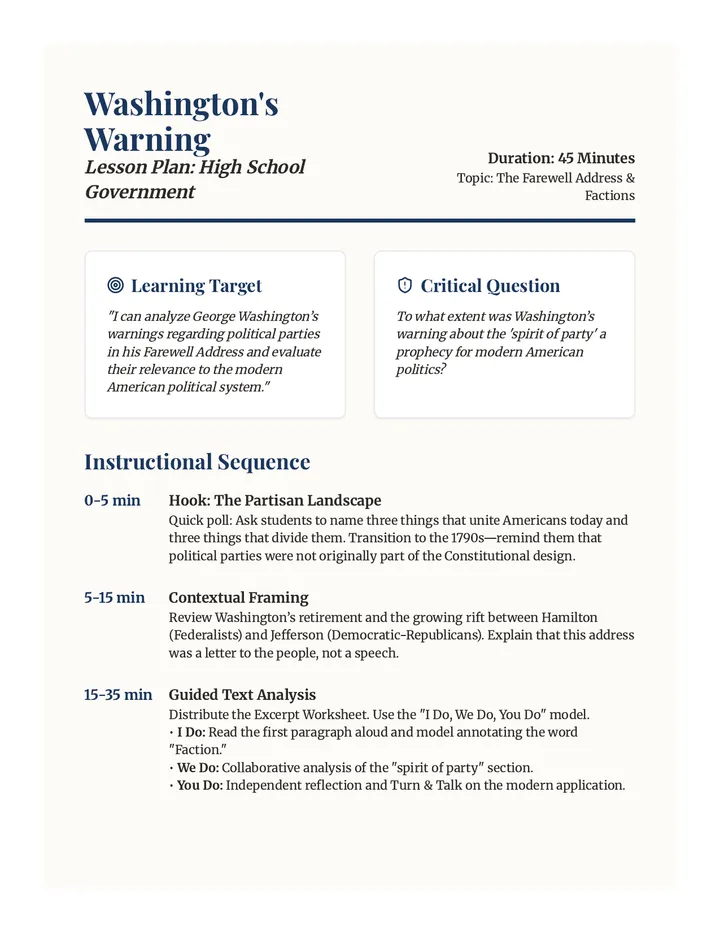
Washingtons Warning Lesson Plan

Washington's Farewell Legacy

A two-part sequence that takes students from a deep-dive analysis of George Washington's Farewell Address to a modern-day evaluation of his warnings regarding political parties, media bias, and national unity.

CE

Chelsea Elliott

24

Lessons

History Sprint Pacing Guide

STAAR History Sprint

A comprehensive pacing guide and activity resource designed to cover the remaining 11th Grade US History TEKS before the STAAR test on April 16th. This lesson provides a day-by-day calendar for A/B block schedules and high-engagement activities for each remaining historical era.

BB

Bridgette Burdick

51
Border Lines Activity

Harriet Tubman Escape

A lesson exploring Harriet Tubman's 1850 escape and the significance of the Mason-Dixon Line as a geographical and legal boundary in the pre-Civil War United States.

TL

Tanya Larson

46
Modern Era Reader Part 1

The Modern Ledger

A comprehensive exploration of the 1990s through the modern day, covering technological shifts, political milestones, military conflicts, and cultural evolution in the United States.

CE

Chelsea Elliott

20
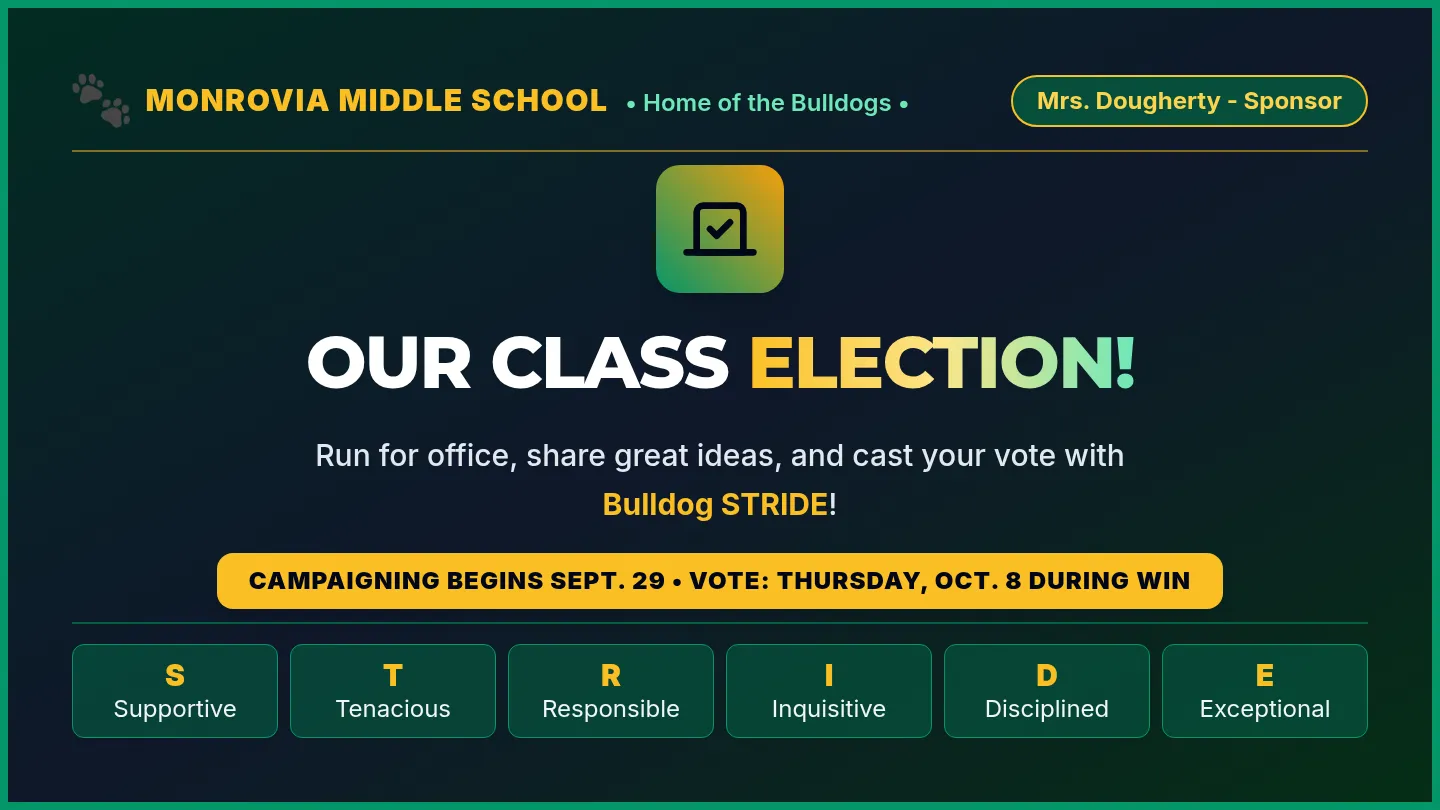
Ballot Blitz Slides

Ballot Blitz

A comprehensive classroom election simulation where students explore democratic principles, develop campaign platforms, and participate in a guided secret-ballot election.

AD

amee dougherty

6
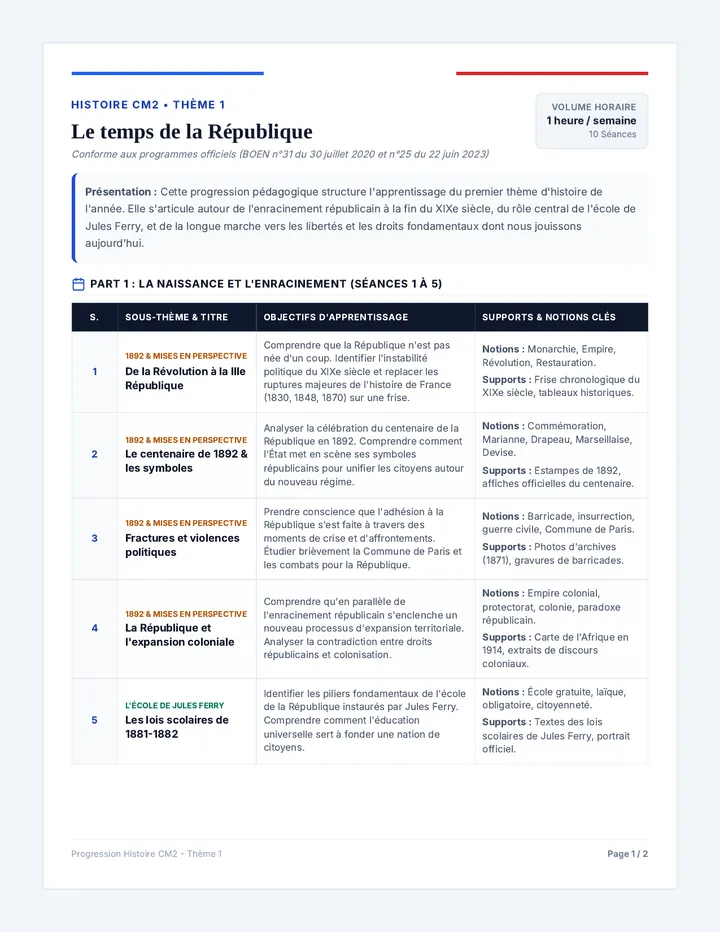
Progression Annuelle Histoire CM2

Le Temps de la République

Une progression pédagogique de 10 séances d'histoire pour le CM2, couvrant l'intégralité du premier thème 'Le temps de la République' selon les programmes officiels de 2020 et 2023. Elle structure la mise en perspective historique de 1892, l'école de Jules Ferry, ainsi que la conquête des libertés, droits et devoirs.

AC

anne chandelier

37
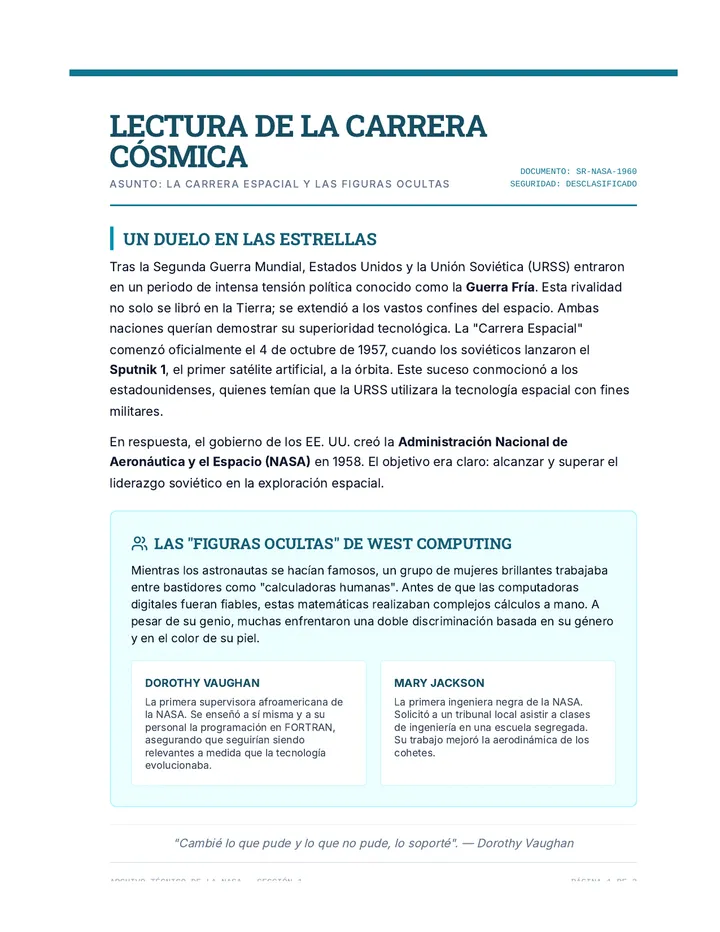
Cosmic Race Reading Text

Stellar Rivalry

A comprehensive exploration of the Space Race, highlighting the technological competition between the US and USSR, the essential contributions of African American women at NASA, and the international agreements that keep space a peaceful frontier.

RM

Robyn MacDonald

16