Geographical Space Lesson Plan Space and Place
Geographical Space Lesson Plan
11th Grade
90 Minutes • Tier 1 Instruction
Objective
Students will be able to identify the concept of geographical space and its components by analyzing images of different types of landscapes (urban, rural, and natural), collaboratively organizing their elements through a concept map, and valuing the diversity of ways in which human groups interact with their environment.
Why This Matters
"Understanding geographical space helps us comprehend the complex relationship between human societies and the natural world, fostering a deeper appreciation for diverse environments and cultures."
Approach
Image analysis, concept mapping, and discussion.
Materials Needed
Digital Projector & Computer
Space and Place Slides
Landscape Analysis Worksheet
Concept Map Activity Guide
Reflection Journal
Chart Paper & Markers
Teacher Preparation
Review all instructional materials and slide content.
Arrange classroom for small group collaboration (3-4 students).
Ensure projector/audio equipment is functional.
Print class sets of the worksheet, activity guide, and journal.
Estimated Prep Time: 15 Minutes
Lesson Instructions
10 min
Warm-Up
What is "Space"?
Begin by projecting the first slide of the Space and Place Slides .
Ask students: "When you hear the word 'space,' what comes to mind?" Allow for a brief class discussion, guiding them from general ideas of space (outer space, empty room) to geographical space.
Introduce the essential question: "How do we define and understand geographical space, and how do humans interact with it?"
15 min
Direct Instruction
Introducing Geographical Space
Present slides 2-4, defining geographical space and its key components: natural, social, economic, political, and cultural .
Provide real-world examples for each component, encouraging students to share their own local examples (e.g., a local landmark as a cultural component).
Distribute the Landscape Analysis Worksheet .
25 min
Guided Practice
Landscape Analysis Activity
Display slides 5-10, showing high-resolution images of urban, rural, and natural landscapes.
For each landscape type, guide students to analyze the images and complete the corresponding sections of their Landscape Analysis Worksheet .
Encourage discussion within small groups about the visible components of geographical space in each image before they write their responses.
25 min
Collaboration
Collaborative Concept Mapping
Divide students into small groups (3-4 students per group).
Introduce the Concept Map Activity Guide and provide each group with large paper or a digital tool.
Instruct groups to create a map that organizes the components of geographical space, using the landscapes analyzed as examples. They must illustrate the interconnections and interactions between human groups and their environment.
Circulate among groups, providing support and prompting deeper thinking about how political borders might impact natural waterways or how culture shapes economic production.
15 min
Closure
Share and Reflect
Have each group briefly present their concept map, highlighting their key insights.
Facilitate a whole-class discussion, comparing and contrasting the different concept maps and reinforcing the diversity of human-environment interactions.
Distribute the Reflection Journal and instruct students to complete it as a cool-down activity, reflecting on their learning and the value of understanding geographical space.
Geographical Space Slides Space and Place
Exploring Geographical Space
An 11th Grade Exploration
What is "Space"?
"When you hear the word space, what comes to mind?"
Outer Space
Empty Rooms
Geographical Space
Defining Geographical Space
More than just a location on a map!
Area on Earth shaped by both natural features and human actions .
Where societies and environments interact.
Dynamic, ever-changing, and unique.
"It's a continuous process of transformation."
Components of Geographical Space
Natural
Landforms, climate, water, plants.
Social
Population, community, structures.
Economic
Industries, jobs, consumption.
Political
Governance, laws, borders.
Cultural
Beliefs, traditions, arts, language.
All Connected!
Example: A River
Natural: Physical water body
Political: National border
Economic: Agricultural water
Cultural: Sacred site
Think of geographical space as a puzzle where all these components fit together and influence each other.
Activity: Landscape Analysis
We're going to examine different types of landscapes. Use your worksheet to record observations on natural features, human activities, and social clues.
Landscape Type 1: Urban
Cityscapes and Human Hubs
01
[Project High-Density City Image Here]
Look for: Skyscrapers, transit, density, commerce.
Analysis Prompts:
What original natural features remain?
What economic hubs are visible?
How is the population organized?
Landscape Type 2: Rural
Countryside and Agricultural Lands
02
[Project Farmland/Small Village Image Here]
Look for: Fields, pastures, small clusters, tractors.
Analysis Prompts:
How much land is natural vs. transformed?
What is the primary economic activity?
How are people connected?
Landscape Type 3: Natural
Wilderness and Pristine Environments
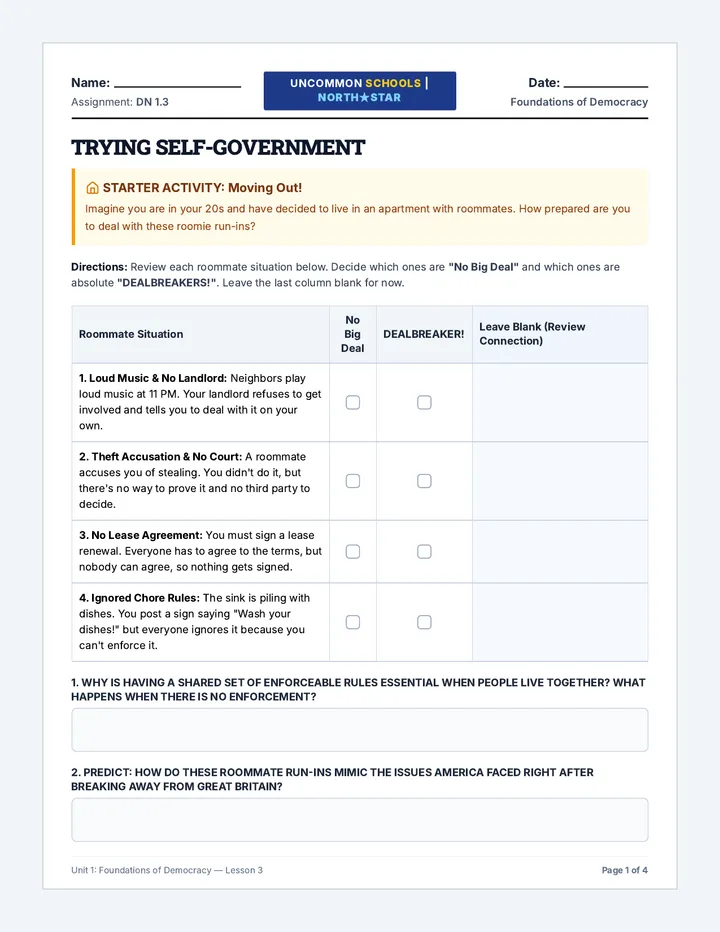
Landscape Analysis Worksheet Landscape Analysis Worksheet
Geographical Space Investigation
Name:
Date:
Instructions: As we view the images of different landscapes in the slide deck, analyze each one and identify the various components of geographical space you observe. Look beyond the surface to identify the invisible social, economic, and political forces at play.
1
Landscape Type 1: Urban
Natural Components Rivers, hills, original vegetation, climate
Social Components Population density, community areas, interactions
Economic Components Businesses, industries, infrastructure for trade
Political Components Government buildings, public spaces, regulations
Cultural Components History, religion, art, community style
2
Landscape Type 2: Rural
Natural Components Fields, forests, specific flora/fauna
Social Components Sparse population, community gatherings
Economic Components Agriculture, small industries, local markets
Political Components Local governance, land use policies
Cultural Components Traditions tied to land, local festivals
3
Landscape Type 3: Natural
Natural Components Mountains, oceans, ecosystems, wildlife
Social Components Presence of humans, protected areas
Economic Components Tourism, extraction, conservation efforts
Political Components National parks, ownership, regulations
Cultural Components Spiritual significance, indigenous heritage
Concept Map Activity Guide Collaborative Concept Map
Team Activity Guide
Mission Statement
"In your groups, create a concept map that visually represents your understanding of geographical space, its components, and how human groups interact with their environment. Your goal is to show how these parts breathe and work together."
Map Requirements
1. Central Idea
Start with "Geographical Space" as your central anchor.
2. Key Components
Branch out to include all 5 components: Natural, Social, Economic, Political, Cultural.
3. Landscape Examples
Include specific examples from the Urban, Rural, and Natural landscapes we analyzed.
4. Interactions
Draw lines and arrows showing how human groups influence or are influenced by the environment.
5. Illustrate Diversity
Show the diverse ways human groups interact with different environments. Think about positive/negative impacts, adaptations, and major transformations.
Group Discussion Prompts
A
How does a natural feature (like a river) influence the social life of an urban area versus a rural area?
B
What economic activities are unique to each landscape type, and how do they impact the environment?
C
How do political decisions (like declaring a National Park) shape the cultural landscape of a region?
D
Can you find examples where one component (like the Cultural belief in a sacred mountain) strongly influences all others?
Be prepared to share your concept map with the class!
Reflection Journal Prompt Reflection Journal
Space and Place: Lesson Cool-Down
Student Name:
Date:
01
New Definitions
How has your understanding of the word "space" changed after today's lesson? Define "geographical space" in your own words, incorporating at least two of the components we discussed.
02
Human-Environment Interaction
In your opinion, which of the three landscape types (urban, rural, natural) shows the most complex interaction between humans and their environment? Why? Support your answer with a specific observation from the slides or your concept map.
03
Value of Diversity
Why is it important for us to value and protect the diversity of ways human groups interact with their environment? How does understanding "geographical space" help us become better global citizens?
"Geography is the subject which holds the key to our future." — Michael Palin