Unit 1: Foundations of Democracy — Lesson 3 Teacher Key Page 1 of 4
TEACHER GUIDE & KEY
Assignment: CW 1.3 Key
Uncommon Schools | NORTH★STAR
Date: Exemplar Key
Foundations of Democracy
Instructional Strategy (15 Minutes): Have students read aloud (Control the Game reading) or partner read. Direct them to specifically underline definition clues for Natural Rights, Social Contract, Popular Sovereignty, and Limited Government.
The Declaration of Independence was America’s official breakup letter with the British government. King George III of Great Britain had grown to be a tyrant... He dissolved colonial legislatures, forced colonists to house British soldiers, and taxed colonial goods without their consent. [Teacher note: Connect these grievances directly to the violation of Lockean ideals.]
Teacher Key Notes
When King George III taxed colonists without their consent, which of the four democratic ideals was he directly violating?
Exemplar Answer: King George III was violating the ideal of Popular Sovereignty. Since popular sovereignty states that the power of a government comes only from the "consent of the governed," taxing the colonists without giving them representation in Parliament meant the government was exercising power without their consent. Additionally, this violated the Social Contract, as the government failed to protect their rights.
Unit 1: Foundations of Democracy — Lesson 3 Teacher Key Page 2 of 4
TEACHER GUIDE & KEY
Assignment: CW 1.3 Review
Uncommon Schools | NORTH★STAR
Date: Exemplar Key
Foundations of Democracy
UNDER REVIEW
Key Concept Blueprint: Exemplar Completed Notes
Ideal 1: Natural Rights [Key]
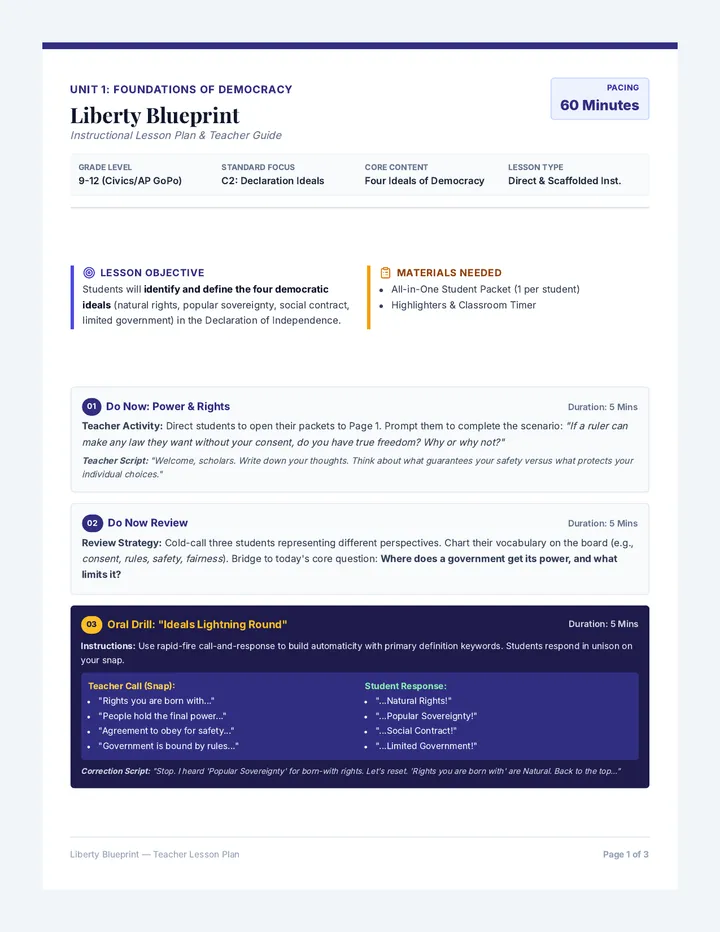
Core Concept: Rights given by nature/Creator that government is bound to respect. Focus standard check: Life, Liberty, and the pursuit of Happiness are fundamental elements of human dignity.
Ideal 2: Popular Sovereignty [Key]
Core Concept: Power to rule belongs to the citizens. Focus standard check: "Consent of the governed" means elections, public voting, and legislative representation.
Ideal 3: Social Contract [Key]
Core Concept: Citizens surrender absolute freedom for safety and security. Focus standard check: If a government acts destructively toward citizen rights, the contract is broken, justifying rebellion.
Ideal 4: Limited Government [Key]
Core Concept: Government authority is strictly bound by a written charter (Constitution) to avoid centralization of power. Focus standard check: Promotes local state power and structural checks & balances.
Explain which democratic ideal one roommate situation represents a failure of:
Exemplar Answer: Situation 4 (ignored chore rules) represents a failure of the Social Contract. Under a social contract, roomies agree to surrender their complete freedom to make a mess in exchange for a clean and cooperative living space. When they ignore the chore sign, they break the agreement because there is no governing authority to enforce the rules, showing why a functional government requires enforcement powers.
Unit 1: Foundations of Democracy — Lesson 3 Teacher Key Page 3 of 4
TEACHER GUIDE & KEY
Assignment: ET 1.3 Key
Uncommon Schools | NORTH★STAR
Date: Exemplar Key
Foundations of Democracy
EXIT TICKET KEY
Mastery Grading Standard & Exemplars
1. Natural Rights C
2. Popular Sov. D
3. Social Contract B
4. Limited Govt A
Grading Criteria:
Ideal Identifications:
1. Social Contract
2. Popular Sovereignty
Exemplar Response (Perfect Score 4):
The first ideal in this excerpt is the Social Contract. The text states, "to secure these rights, Governments are instituted among Men," which explicitly mirrors Locke's theory that government is a contract created solely to protect the natural rights of individuals.
The second ideal is Popular Sovereignty. The text states that governments derive "their just powers from the consent of the governed." This matches the definition of popular sovereignty because it emphasizes that political authority originates with the citizens rather than a monarch.
Additionally, the excerpt references the right of the people to "alter or to abolish it" if it becomes destructive, reinforcing the breach of contract clause in the Social Contract theory.
Unit 1: Foundations of Democracy — Lesson 3 Teacher Key Page 4 of 4