A
Ideal 4 Limited Government
C
A
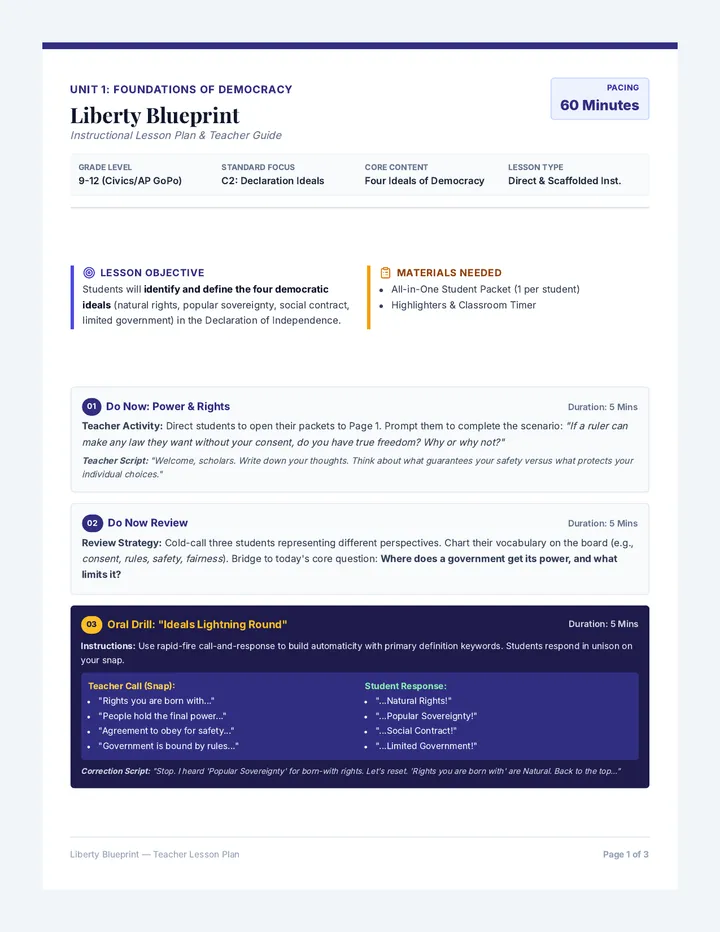
An agreement where individuals yield some freedom to a central authority in return for guaranteed protection of basic human rights.
B
Fundamental liberties that are inherent to birth, cannot be granted or revoked by any ruler, and must remain permanently protected.
C
The core constitutional principle that a state's political authority is strictly bound by written laws and structural constraints.
D
The democratic ideal that a government's rightful power is created by, and completely dependent on, the explicit consent of the people.
Teacher Key: Below is a simplified, middle-school level anchor chart layout.
[NR] Natural Rights
Born with them. Life & Liberty. • Symbol: Shield
[PS] Popular Sovereignty
People rule. We vote. • Symbol: Crowd
[SC] Social Contract
Obey laws for safety. • Symbol: Handshake
[LG] Limited Government
Rules limit leaders. • Symbol: Lock
1- Explain the core connection between popular sovereignty and the legitimacy of a nation's laws.
Popular sovereignty means power comes from the citizens. This means a government's rules and laws are only fair and real if the people get to vote or choose the leaders who make them.
Ideals of Democracy Unit (Middle School Key)
Page 2
Uncommon Schools • North Star
Name: TEACHER ANSWER KEY
Assignment: CW 1.3 ANSWER KEY
Uncommon Schools
NORTH KEY
Date: MODEL STUDY
We Hold These Truths - Four Democratic Ideals
Directions: Below is the annotated teacher version highlighting where the four core ideals of democracy are localized in the text.
Declaration of Independence Excerpt Drafted by Thomas Jefferson • July 1776
"We hold these truths to be self-evident, that [1] all men are created equal, that they are endowed by their Creator with certain unalienable Rights, that among these are [2] Life, Liberty and the pursuit of Happiness."
"— That to secure these rights, Governments are instituted among Men, deriving their [3] just powers from the consent of the governed,"
"— That whenever any Form of Government becomes destructive of these ends, it is the [4] Right of the People to alter or to abolish it, and to institute new Government, laying its foundation on such principles and organizing its powers in such form, as to them shall seem most likely to effect their Safety and Happiness."
"Prudence, indeed, will dictate that Governments long established should not be changed for light and transient causes... but when a long train of abuses and usurpations... evinces a design to reduce them under absolute Despotism, it is their right, [5] it is their duty, to throw off such Government, and to provide new Guards for their future security."
Teacher Key Annotation Indicators: [1] equality, [2] Natural Rights, [3] Popular Sovereignty, [4] Social Contract, [5] Limited Government.
Active Annotations
Line [1] & [2] NATURAL RIGHTS (NR): Jefferson says we get our basic rights just by being born. No government is allowed to take them away.
Line [3] POPULAR SOVEREIGNTY (PS): Power comes from 'consent of the governed.' This means the people are the real boss of the government.
Line [4] SOCIAL CONTRACT (SC): People agree to follow laws in exchange for protection. If the government fails to protect them, they can get rid of it.
Line [5] LIMITED GOVT (LG): "Despotism" means a leader with unchecked, absolute power. Jefferson says we must limit power to keep people free.
Ideals of Democracy Unit (Teacher Key)
Page 3
Uncommon Schools • North Star
Name: TEACHER ANSWER KEY
Assignment: CW 1.3 ANSWER KEY
Uncommon Schools
NORTH KEY
Date: MODEL STUDY
We Hold These Truths - Four Democratic Ideals
Directions: Analyze the specific quotes and language utilized by Thomas Jefferson on page 3. The questions increase in depth, analysis, and difficulty.
1
Jefferson explicitly names three fundamental, inherent elements of human liberty. Quote the phrase describing these Natural Rights, and explain who has the authority to take them away according to the text.
Middle School Exemplary Answer: Jefferson quotes: "unalienable Rights, that among these are Life, Liberty and the pursuit of Happiness." Because these rights are "unalienable" (cannot be taken away) and come from a "Creator" rather than a king, the text shows that no government has the right to steal them from us.
2
In paragraph 2, Jefferson claims governments derive "their just powers from the consent of the governed." Explain how this represents the ideal of Popular Sovereignty. What happens if a government rules without consent?
Middle School Exemplary Answer: This means power belongs to the people. Governments only have "just" (fair) power if the citizens agree to let them rule. If a government rules without asking the people or letting them vote, it is not a real democracy; it is a tyranny where rulers do whatever they want.
3
Jefferson outlines conditions under which the Social Contract is broken. Synthesize the text: what standard of "abuses and usurpations" must be met for citizens to legally and morally "alter or to abolish" their government?
Middle School Exemplary Answer: Jefferson says we should not change or overthrow a government for small or silly reasons. But if a ruler keeps abusing their power over and over again (a "long train of abuses") and acts like a bully, then the social contract is broken and the people have the right to throw them out.
Ideals of Democracy Unit (Teacher Key)
Page 4
Uncommon Schools • North Star
Name: TEACHER ANSWER KEY
Assignment: CW 1.3 ANSWER KEY
Uncommon Schools
NORTH KEY
Date: MODEL STUDY
We Hold These Truths - Four Democratic Ideals
Under Review
Teacher Reference Page: Core content standards for classroom review.
Fundamental human freedoms given inherently at birth by a higher power (or nature), which no government has the legitimate authority to restrict or strip away.
"Life, Liberty and the pursuit of Happiness."
The foundational political principle that all legitimate governmental power and sovereignty resides purely in the citizens, who must grant their consent to be ruled.
"Deriving their just powers from the consent..."
A mutual pact where citizens agree to obey the state's laws in exchange for security; if a government breaks this promise, the people retain the right to overthrow it.
"Right of the People to alter or to abolish it..."
A governing framework whose powers are strictly bounded by constitutional guidelines and the rule of law to protect individual liberty and prevent despotic overreach.
"...reduce them under absolute Despotism..."
The four ideals function as a single system. Without Natural Rights, we have no inherent value. Without Popular Sovereignty, leaders rule by raw force. Without the Social Contract, there is no agreement to keep the peace. Without Limited Government, tyranny is inevitable. Together, they form the intellectual bedrock of the American democratic experiment.
Ideals of Democracy Unit (Teacher Key)
Page 5
Uncommon Schools • North Star
Name: TEACHER ANSWER KEY
Assignment: CW/ET 1.3 ANSWER KEY
Uncommon Schools
NORTH KEY
Date: MODEL STUDY
We Hold These Truths - Four Democratic Ideals
Exit Ticket Answers
Directions: Complete the master exit questions below. Write in complete sentences and demonstrate rigorous historical vocabulary and critical thinking.
1
In your own words, what is the exact difference between Natural Rights and the Social Contract?
Middle School Exemplary Answer: Natural Rights are the basic freedoms you are born with (like life and liberty). The Social Contract is the team agreement where citizens follow the laws in exchange for the government keeping those basic rights safe.
2
How does the Declaration of Independence use the concept of Limited Government to justify breaking away from King George III?
Middle School Exemplary Answer: Limited government means leaders cannot just do whatever they want. King George III ignored this by making unfair taxes and laws without the colonists' consent, which showed he had unlimited power. This meant he broke the rules of a limited government, so the colonists decided to rebel.
3
Critical Thinking: If you completely removed the ideal of Popular Sovereignty from a democracy, what would happen? What would political power look like instead?
Middle School Exemplary Answer: If we got rid of popular sovereignty, citizens would have no say or vote in anything. Democracy would break because the government wouldn't care what the people wanted. Instead, power would belong to a king, dictator, or a small group of bullies who rule by forcing everyone to obey.
Ideals of Democracy Unit (Teacher Key)
Page 6
Uncommon Schools • North Star